The Feminist Critique of Pure Immanuel Kant

There is an ad in the latest New York Times Review of Books (November 20, 1997) that really shook me up. It is for a book called “The Feminist Interpretation of Immanuel Kant”. It is edited by Robin May Schott, in case you want to order it.

Now, hey, I’d be the first person to say that it’s about time someone over-hauled the old transcendental critique of pure reason, I mean, after all, it’s only been out of date since about fifteen minutes after it was printed, but even I would never have guessed that the feminists would be the ones to put the last nail in the coffin. I’m not sure Immanuel would be pleased. I think he said something like “feminism is destroying our society” or something like that at one point in his career, probably just after his wife left him.

But you know, the next time some dark-minded pundit goes on and on about how our society is just falling apart and things have never been so bad and our youth have really lousy manners, and Hollywood sucks, and so on, I’m going to think about those feminists out there reinterpreting Immanuel Kant and breathe a quiet little sigh of relief. If there is one thing more amazing than any other about our society, its our ability to chew up and regurgitate almost any idea, any image, any concept, and spit it out again as lively and ripe as if it were new.

Like Immanuel Kant. It would have been audacious enough if the feminists had taken on Wittgenstein or Popper, but Kant? So what do the feminists have to say? I don’t know. I haven’t read the book yet. But I’ll bet they accuse Kant of building his entire rigid, rational system of thought on some misdirected patriarchal impulse to rule reality with an iron fist. And I’ll bet the feminists believe that a view of reality more harmonious with natural, empathetic impulses would have worked better. If I remember my college philosophy correctly, Kant was trying to rescue Reason with a capital “R” from Descartes’ radical critique, which consisted of declaring that the only thing you could know for sure was that you existed. Both of them sound a little anal retentive to me. The women probably point out that doing the laundry, cooking, and cleaning, require some pretty fundamental ontological conclusions about cause and effect that can’t be justified by going for a walk every day trying to think up new categories of existence.

Then along comes Sartre who believed we don’t exist in a static sense at all. We are constantly in the state of becoming, and that’s why we are free, unless, of course, your wife expects you home for supper. I’ll bet Simone De Beauvoir had a few precious thoughts about this herself.

Wittgenstein thought we basically constructed a reality in our language, and so our society is really nothing more than a construct of the words we imagine to describe it with. I think the feminists might find a home there. You know how they love to get together and talk. Then there was Martin Heidegger. He believed that mankind had forgotten something very, very important about existence, but what it was we had forgotten he couldn’t seem to remember either, so he joined the Nazi party and continued to teach at a university in Germany throughout World War II. Nothing like a philosophy that stimulates you into positive action! I think the feminists wouldn’t like him. They would think that it’s not that hard to remember the important things, as long as you care about people.

Microsoft Philosophy 1.01

You can tell what philosophy Bill Gates believes in by running a spell check on little known recent philosophers in Microsoft Word and then analyzing the results. Watch:

Philosopher Result Meaning
(Martin) Heidegger headgear groovy
(Imre) Lakatos lactose milk for the mind
(Paul) Feyerabend no suggestions vacant
(Albert) Camus cameos we only see reality in hazy profile
(Dan) Quayle quarrel don’t go into politics
(Hannah) Arendt aren’t we don’t exist, unless we’re banal and evil

Hannah Arendt is the only woman on the list, and I don’t think most philosophers would place her next to Heidegger or even Imre Lakatos in terms of importance, but she did come up with one great idea. While in Jerusalem covering the Eichmann trial (Jewish agents had kidnapped Eichmann, a Nazi war criminal, from Argentina and spirited him away to Jerusalem for a show trial), she found herself at a loss for words to describe the utter mediocrity of this minor functionary who was partly responsible for the deaths of six million Jews, so she coined the phrase “banality of evil”*. Later on, she was sorry that she became so well known for that phrase alone. I have to admit, that’s about the only thing I know about Hannah Arendt myself, but I like the phrase, because it captures the idea that incredibly evil things can result from the actions or inactions of people who perceive themselves as being only minor cogs in a big machine. Raul Wallenberg was a minor functionary, but he saved hundreds of lives. Eichmann claimed that he was only following orders. The crew of the Enola Gay were only following orders when they dropped a nuclear bomb on Hiroshima (victors get to write history so we don’t seem to regard them as villains the way we regard the Germans, Italians, or Japanese). The crew of the Titanic sent lifeboats away half-filled because their orders were “women and children first” and the third-class women and children were still below decks, and the only other people present were men.

That’s the way most people behave– just following orders–and that may be the tragedy of the human race.

So if the feminists find a new way of thinking about reality that can convince most people that they should always do the right thing, even when it goes against orders or policy or whatever, then, hey, I’m all in favour of it.

* It appears that Hannah Arendt was wrong.  The discover of more information about Adolf Eichmann revealed that he was, in fact, virulently anti-Semitic, and fully on board with the plans to exterminate the Jews.
Pinochet Ricochet

Baltasar Garzon is my hero. If I get a picture, I’m going to put it up on my web page.

Baltasar Garzon is a Spanish judge. He found out that some Spanish citizens had been kidnapped, tortured, and murdered in Chile in the 1970’s. He found out that the murderers were never apprehended. He was outraged. Then he found out that the leader of this gang of criminals was in England getting some heart surgery. Like any conscientious magistrate, he immediately issued a warrant for this man’s arrest.

pinochet.jpg (9510 bytes)

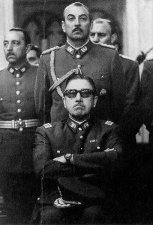
The man is Augusto Pinochet.

In 1973, Chile held a democratic election. The people chose a socialist, Salvador Allende, as their new President. The Americans didn’t like that. Mr. Kissinger was heard to remark something like, “Why should we stand back and let an irresponsible people elect the wrong party?” So first, with the aid of reactionary forces within Chile, a crisis was created. Then, fig leaf in place, with the help from the CIA, General Pinochet led a bloody coup d’etat, during which Salvador Allende was cold-bloodedly murdered (Pinochet’s cronies claim he committed suicide). (There is a good film, Missing, on this story). Pinochet’s army then rounded up as many dissidents and potential dissidents as it could find, held them in the Santiago soccer stadium, tortured as many as he could to get more names to arrest, then murdered thousands of them.

A few years ago, Pinochet did what all ugly, maggoty, disgusting despots do when faced with a powerful reform movement: he agreed to step down only in exchange for a full amnesty. I don’t understand how any government can even pretend to be part of this farce. A man walks into a bank . He shoots five people and locks another twenty in the vault. He takes all the money. He runs off with five hostages. He kills four of them. Then he says, “I didn’t do anything wrong, but I will turn over this last hostage to you unharmed if you agree to not prosecute me for anything I might or might not have done before this.” The people say, “if you didn’t do anything wrong, then what do you have to worry about?” Maybe the police are smart. Maybe they say yes. He turns over the hostage. Then he is arrested and tried and convicted and executed.

Except that here, no one arrested or tried or convicted Pinochet, because they were afraid of the army. The army supports Pinochet because, after all, they are the bloody arms and hands of this evil man. They are complicit.

But Garzon had the guts to say, this man is a murderer and a torturer plain and simple. And he had the audacity to serve the warrant. (The French and Swiss governments have since done likewise.) And Blair’s government seized Pinochet and are holding him pending the outcome of the legal wrangling.

Think what a bizarre, crazy, mixed up message this is going to send to the world. That we are all equal before the law? That torture and murder are criminal acts? That justice awaits even the most powerful? Idi Amin, the happy guest of the Saudi Arabian government for twenty-years, since, presumably, his last meal of fresh humans, must be quaking in his boots!

* * *

Someone says to me, in defense of Pinochet, how would you feel if Castro, on his way to the United Nations, was arrested by the FBI and held for murder and torture? You see? We must have separate rules for dictators.

Well, first of all, if seeing Castro arrested was the price to pay for having assholes like Pinochet and Amin and Hussein, and Karadzic arrested, I think I’d go along with it. Let’s arrest him and have a fair trial and see what we come up with. I doubt you’d find nearly as many serious offenses for Castro as you find for Pinochet, or the others, but if you do, then, yeah, he should be charged. The witnesses should be brought forward, and let’s try him. Yes, it would be worth it, even though I like Castro, and his beard.

There is one other complicating factor. Pinochet was not an invited guest of the British government. He came as a private citizen seeking medical treatment (using the money, undoubtedly, that he pilfered from the state treasury).

If he had been an invited guest of the British Government, they would not have had a legitimate right to arrest him. If they did, the whole system of international diplomacy and the conditions under which negotiations can take place would begin to break down. Fair enough.

When Castro speaks at the U.N., as an invited guest, he has the same protection.

But hey, if goes for a walk in Central Park: arrest him! He and Pinochet can share a cell.

That Darned Subversive Cat

Remember all the stuff you heard about democracy and freedom and so on when you were kid? And how the Russians were supposed to be so evil because their government spied on their own people and arrested and imprisoned them just for daring to criticize Communism? And how the United States and Canada were so great, because here we were free to vote for whoever we wanted and think whatever we wanted?

Well, let’s keep things in perspective. What follows is not meant to suggest that the West was as bad as Russia was then (and China is today). It’s just meant to balance out a fairly idiotic image of who and what we were during the cold war. The truth is, our own governments were spying on us, and arresting people who spoke out in dissent and attempting to control the free flow of information, just like the commies did.

Actually, none of this is news. We already know about McCarthyism and the excesses of J. Edgar Hoover. I merely want to add a little tidbit here to help put the extent of government control into perspective.

It seems that in 1965 Walt Disney wanted to make a movie based on a book by former FBI agent Gordon Gordon and his wife, Mildred, about a cat who belongs to a kidnap victim. When the cat turns up one night wearing the victim’s wrist watch, the FBI puts the cat under surveillance. Hayley Mills, Dean Jones, and Frank Gorshin starred. Hilarious concept!

Anyway, the FBI heard about this movie, and, when informed about it, J. Edgar Hoover immediately turned to his faithful sidekick, Pedro De Loach, and told him, “Hey, it’s a free country. People can make movies about whatever they please.”

No, he did not.  As a matter of fact,  Mr. De Loach dispatched an FBI agent to investigate this movie to ensure that the Bureau’s “interests” were protected.  I’m not making this up.

Think about this. The FBI, using your hard-earned tax dollars, dispatches a highly-paid agent to Hollywood to investigate the possibility that a Disney movie about a cat might be dangerous to civil order and the justice system.

Did they have time? Well, Groucho Marx might have been retired by then, so I guess that freed up a few agents. Maybe Lucille Ball had let her communist party membership lapse. Perhaps Ring Lardner hadn’t ordered any explosives recently. Maybe Dalton Trumbo had started hanging out with Ronald Reagan. Who knows?

It is tempting to laugh at this bizarre episode and just shrug it off. When you were a kid and you recited the pledge of allegiance to the flag of America and the liberty for which it stands, did you think for a moment that your own government had it’s own little department of thought control?

Did you watch the television drama called “The FBI” on TV in the 1960’s? Did you know that the FBI virtually controlled the program? They could veto any line of dialogue, any shot, if they didn’t like it. And do you even have to think for a minute to realize that their first priority was not “accuracy”, as they claimed, but depicting the agency in a favourable light?

Ever see that episode where the FBI tapped Martin Luther King’s phones? Yeah, me neither. Or where they collected information about President Kennedy’s mistresses?

Even today, with all the so-called sophistication we now have, TV is still inundated with police-approved TV shows that labour mightily to convince you that the police never make mistakes. I watched one episode of “REAL TV”, which showed tapes from a police helicopter chasing a “suspect”. What was the man suspected of? We never find out, for the only thing he is ever charged with is resisting arrest– a chilling echo of Soviet Russia’s “enemy of the state”. All during the chase, the voice-over narration laboured to assure us that these reckless and insane pursuits were necessary because the felon might very well have done something unspeakably evil, if the police had not damaged five cruisers chasing him at speeds of 100 mph through populated suburbs and snarled highways.

Is there a single TV police show that does not show police officers assaulting suspects and violating their civil rights with approval. The program is careful to let you “know” the one thing that, in real life, the police almost never know with any degree of certainty: that the suspect is guilty.

Back to the FBI: I’m sure if you asked the FBI today, their official spokesman would chuckle and say something like, “Oh, well, yes, J. Edgar did get a little carried away back in the 1960’s, but I can assure you that the FBI today is too busy tracking down militant survivalists and murderers to waste time on Hollywood movies.”

Like the Branch Davidians, in Waco, Texas?

To see a copy of the FBI report on “That Darn Cat”:
http://www.thesmokinggun.com/archive/darncat1.html

The Naked Truth About Police Chases

A 46-year-old woman in Indiana decided to go for a drive. Naked. A policeman spotted her.

Okay, let’s say you’re a cop. You see this woman drive by, and she appears to be naked. You immediately realize that this naked woman is a serious threat to public safety and security and MUST BE STOPPED. On go the lights. On goes the siren. Maybe you even make little “woo-woo” sounds with your mouth as you wheel your muscular Chevy Malibu 360 degrees and step on the gas. Maybe your trigger finger starts twitching: what if she’s got a concealed weapon? Well, all right. What if she has a gun on her lap? You think back to police school– what did they teach you about handling naked women drivers? Should you call out the SWAT team? You get on the radio, anyway, and call for assistance. From the looks of things, could be trouble. “Naked woman in a car. Am proceeding to apprehend.”

Five different police departments respond to your call.

This naked woman doesn’t want to stop for you. She steps on the gas. Soon, she is driving 160 kilometers per hour (110 mph).

Well, now you have a threat to public safety.

At least five other police cars get involved in the chase. Let’s say it takes them about 30 minutes to join the race, catch up with the woman, pull her over, sort out who gets to lay charges, and then get back to other duties. That’s probably about $1000.00 for the officers alone, benefits included. Then there’s the cars (fuel and maintenance) the paper work, the processing time for the charges, the court appearances, the District Attorney and his assistants, and so on. I’ll bet by the time you’re done, it’s going to cost the taxpayer over $5,000.00 to deal with this naked woman. What if one or more of the police cars had been damaged in the chase? What if a child had been hit by one of the speeding cars?

Sometimes I think privatization might be a good thing. Suppose I was an ambitious businessman and I owned my own police force and I contracted my services out to the State of Indiana. Suppose one of my employees radioed in that a naked woman just drove by and he wanted to pursue her.

Come on. Are you nuts? I’d tell him to go check to see if a bank is being robbed somewhere. I’d tell him to go to a pool hall and cover a few games for a bunch of teenagers. I’d tell him to park his car downtown and take a walk and chat with at least five merchants. I’d tell him to find a school basketball court, take off his tie and gun, and play three-on-three with whoever’s hanging out there. I’d tell him to go to a liquor store and get himself onto a first-name basis with the proprietor. I’d tell him to go find a milk carton and see if he can memorize the faces of the missing children.

If I was really conscientious, I’d have one of the receptionists from the office get into her Toyota and see if she can find the naked woman, follow her around, and see if she’s in some kind of trouble. I pay her $15.00 an hour and cover her mileage. Net cost: $25.00. No lives lost. No cars damaged. No big deal.

* * *

Just read today that the police in Mildmay, Ontario, found out that a local Radio Shack dealer had purchased some parts from a cruise missile at a flea market in Ohio. Oooo! SWAT team for sure. On May 13, 1997, they invaded his store with 15 flak-jacketed camouflaged armed commandos (I am not making this up), terrifying the law-abiding owner, an electronics hobbyist with plans to take over the world but who was not charged with anything for four months. I’ll bet this operation cost more than $5,000. I’ll bet the Ontario Provincial Police ask for–and receive–more money next year, to handle this epidemic of terrorism: naked ladies and Radio Shack managers.

I would have sent that same secretary in her Toyota. Let’s have a chat. I’ll give you a thousand bucks. (According to the owner, he would have accepted less than that, if they had only offered.) Maybe we can work this out.

But the, what would the police do with all those flak jackets and commando gear? Paintball?

The “Heroic” Captain Smith

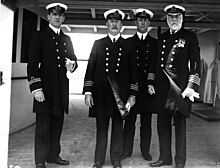
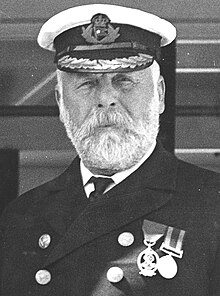
Almost every movie version of the Titanic renders Captain Smith the same way. Grey-bearded and reserved, dignified, and ineffably tragic. Pictures of the real guy, in uniform, seem to confirm the impression. He had a sparkling career until the Titanic disaster.  He ran his ship into an ice berg in the dead of night in calm seas. A small blemish, to be sure.

Edward J. Smith.jpg

We prefer J. Bruce Ismay, President of the White Star Line, as the villain of this story. Writers and movie-makers have moved heaven and earth to make it appear as though he was responsible for the disaster, by urging the Captain to go faster. The Cameron movie version blithely sidesteps one precious little detail: the Titanic was not capable of going faster than the “crack” Cunard ships. The Titanic was built for luxury, not speed. There was no chance of it setting any records. Cameron knows that, so he merely leaves Ismay to impress upon Captain Smith that it would be nice if they could arrive a day early. At least some movie-goers, however, are easily confused, and I’ve heard people say, after seeing the movie, that it was Ismay’s fault, for trying to break “the record”.

So, we can put that to rest. Ismay may have urged speed, but the Titanic had no dreams of breaking the record.

That leaves Captain Smith. On the high seas, the Captain has absolute authority. Ismay or no Ismay, it was Smith’s decision to proceed into an area known to be inhabited by large ice bergs at the Titanic’s top speed of about 22 knots. The Titanic had received numerous warnings during the preceding days, from other other ships in the area. Smith’s precautions consisted of posting two look-outs, usual practice on White Star ships. The look-outs did not have binoculars– they had been lost before the ship even reached Cherbourg– but then, binoculars were considered an accessory, not a necessity, at the time. A good look-out was simply supposed to have good eyes.

Nobody will ever know whether the look-outs should have seen the ice berg sooner. The ocean was extremely calm, the sky was very bright. Under those conditions, ironically, ice bergs are a greater hazard, because there is almost no wash at their edges, to make them more visible. Anyway, no one knows if Frederick Fleet was really paying attention or not. We do know that he eventually saw the ice berg, signaled the bridge, and the bridge immediately ordered the engines reversed and the helm brought about. Fleet’s testimony (he survived the disaster) about how far the berg was from the ship when he first spotted it is inconsistent.

He didn’t have a happy life, by the way, after the disaster, and he committed suicide in the 1960’s.

The Titanic was poorly designed. It was a long, cigar-shaped ship, with an undersized rudder. It didn’t respond very quickly to sharp turns. It responded enough to avoid a head-on crash, but then it grazed the ice berg under the water line. The first five compartments of the ship were breeched. Within minutes, Mr. Thomas Andrews, the ship’s designer, knew that it was doomed. The rest is history.

It is here, however, that we are able to take the true measure of Captain Smith. But before we assess Captain Smith’s performance, it is worth, for comparison’s sake, taking a quick look at the actions of Captain Arthur Rostron, of the Carpathia, the ship that picked up the survivors of the Titanic disaster.

Captain Rostron received word of the Titanic disaster around midnight, long before the Titanic sunk. He immediately issued numerous orders. First, to the engine room, to stoke up the boilers and get under way immediately in the direction of the Titanic. Secondly, to the stewards, to roust blankets and supplies. Thirdly, to his officers, to ensure space for the survivors, and calm aboard his own ship, and to prepare for receiving the lifeboats. Fourth, to the wireless operator, to signal Titanic that they were under way. He followed up on his orders to see that they were carried out efficiently. The Carpathia steamed towards the disaster site at full speed, well-prepared to deal with whatever awaited it.

Onboard the Titanic, it was a different story. Smith seemed bewildered, lost, inadequate. His officers came up to him one at a time and asked permission to send flares, prepare the life boats, roust the passengers. He seemed to have no particular views on what should be done. According to testimony at both the British and American inquiries, he generally seemed to nod his head and go, “yes, yes, good idea.”

What should he have done? He should have immediately summoned all of his officers and staff. He should have emphatically specified that each life-boat was to be filled to capacity. He should have dispatched stewards to the third class compartments to arrange for the women and children to reach the boat deck. He should have instructed the officers to ensure that at least four men with some ability or experience were dispatched to each life boat. He should have declared the bar open with free drinks for all the men. Well, just kidding. Maybe. You see, at least one drunk survived a few hours in the sea, probably because the alcohol had thinned his blood.

If he had taken decisive steps, at least 500 more people could have survived the disaster. As it was, only 705 survived out of 2200. The official capacity of the 16 lifeboats was 65 each, or 1040 total. In addition, there were four “collapsible” boats, with a capacity of 24 each, making 96, or 1136 total. With calm seas– and the seas were calm–  and a some ingenuity, they could easily have squeezed in an additional 100 above that.

So why do directors and writers continue to portray him as something of a hero? One reason and one reason alone: he went down with his ship, like all good captains do. Going down with the ship is the Captain’s way of saying “Ooops. I made a mistake. I’m really very sorry.” A captain who survives is basically saying, like Ismay, “What? I suppose you’re going to blame me for this?”

We are always willing to forgive those who say I’m sorry.  But we also have this blather, from passenger Roger Williams Daniel:

“I saw Captain Smith on the bridge. My eyes seemingly clung to him. The deck from which I had leapt was immersed. The water had risen slowly, and was now to the floor of the bridge. Then it was to Captain Smith’s waist. I saw him no more. He died a hero.”

He died a what?

I think what Daniel is actually saying is, “having contributed nothing in a moment of great crisis, he made up for it by at least not taking up space in a half-filled lifeboat that wasn’t lowered until it was almost too late.”

She’s a Femme Fatale: Raging Hypocrites

It was sort of inevitable, don’t you think?

hyde_lap.gif (17035 bytes)

Henry Hyde’s “indiscretion”.

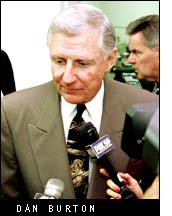
It has just been revealed that the Republican Chairman of the House Judiciary Committee, Henry Hyde, had an affair with a woman named Cherie Snodgrass, about thirty years ago. She was married, and so was he. We have also been informed that Dan Burton, one of Clinton’s harshest critics, fessed up that he has fathered a child in an extramarital affair. And Representative Helen Chenoweth of Idaho has also confessed to an illicit liaison. Well, let’s not be disingenuous here: they didn’t voluntarily fess up– they were caught. Newt Gingrich and Bob Dole, of course, are not with their first spouses anymore. Any details, Newt? Come one, Bob, let’s get this out into the open.

Ah, you say. But isn’t the issue perjury?

burton.jpg (8097 bytes)

The trouble is, for the Republicans, that they have had to justify Kenneth Starr’s report on the basis of the argument that Clinton’s personal sexual behaviour is relevant. And whenever these clowns appear on TV to argue for impeachment, they don’t talk much about legalities: they talk about trust and morality and values and leadership. Besides, Clinton’s perjury occurred during testimony which was eventually ruled “immaterial” by a judge in the Paula Jones case. That’s a pretty thin case for impeachment. But you understand the two-track strategy of the Republicans. They know that the public will not be outraged by the perjury which gives them the legal pretense to impeach, but they think the public might be outraged by the sexual relationship, which, however, cannot be the basis for an impeachment. So they are trying to blur the distinction. You are supposed to be so outraged at Clinton’s personal conduct, that you will consent to impeach him on a trivial legal issue Well, that’s how they got Al Capone. The well-known gang-meister was finally indicted for…. yes, tax evasion!

There is only one solution: Henry Hyde, Dan Burton, Helen Chenoweth, Newt Gingrich, Bob Dole, and whoever else comes out of hiding soon enough, should all be impeached.

burton.jpg (8097 bytes)

If I were Henry Hyde, who is in charge of the committee for impeaching adulterers, I’d do the honorable thing and impeach myself first, just to show the American Public that the judicial system doesn’t play politics, and that the Clinton thing is not just a partisan Republican pogrom against a Democratic President, but a reflection of the Republican Party’s earnest devotion to purity and decency in government. So long Henry. Nice knowing you Dan. May you find healing and fulfillment Helen. I hope something comes along for you Newt.

The Republicans, by the way, have demanded that the FBI investigate whether the White House had a hand in getting these stories to the public. Think about this. The Republicans, who have just insisted on publishing extremely intimate details about the President’s sexual liaison with a 21-year-old intern, are outraged, I say, outraged, that someone should expose, with no detail whatsoever, the adulteries of some of their own. Who do they think is buying this? It’s too much! It’s insane! It’s a crazy world!

One last piece of craziness: the Republicans are arguing that the public needs to know these details, and that the impeachment proceedings should hear the evidence in public, and that all the information Kenneth Starr has gathered should be released, because it is important that justice been seen to be done publicly.

All of these decisions were made in a closed session of the Judiciary Committee Meeting.

* * *

While the Republicans were busy rationalizing themselves, Lou Reed, former leader of the Velvet Underground, was putting on a performance of his own. Lou Reed’s Velvet Underground was quite possibly the most aesthetically progressive rock band of the 1960’s. Listen to their stuff: you can’t believe it was recorded thirty years ago. It has a visceral rawness to it, the kind of edgy authenticity so-called alternative bands would die for. Nico, the lead singer on some of their most haunting ballads, is now dead, destroyed by years of drug abuse… not. She died in a bicycle accident. Lou Reed has found a second career walking the border between revision and nostalgia.

So where do you think they performed? At some dark night-club in New York? No, in the White House. President Vaclav Havel of Czechoslovakia was Bill Clinton’s guest this weekend. I wonder if Reed performed one of his better tunes, “Femme Fatale”:

Cause everybody knows (she’s a femme fatale)
The things she does to please (she’s a femme fatale)
She’s just a little tease (she’s a femme fatale)

If you would have told me, thirty years ago, that some day the Velvet Underground would be playing the White House!

Well, … actually, that is kind of what I thought thirty years ago. After all, we knew that we were all going to be fifty some day, and none of us really believed we were going to start listening to Frank Sinatra or Perry Como after we turned 40.

Now if you would have told me that Congress, in solemn session, would be listening in rapt devotion to intimate details about the President’s affair with a young intern– I would have thought you were mad.

Anyway, it’s happened. The most anti-establishment rock artist of the 60’s has played the White House. This has cosmic significance. As soon as I can think of what that is, I’ll try to write about it.

Homeless in Ontario

Premier Mike Harris has long made it his own particular virtue to proclaim that the provincial government will no longer support deadbeats. Get out there and find a job, says Mike. Stop sponging off the hard-working taxpayer. Pull yourself up by your bootstraps!

Well, let’s say you’re one of the uneducated poor and you do find a job. Maybe not a great job, but a job nonetheless. Maybe not even a full-time job. But at least you have a reason to get up early most mornings. Mike is happy. You’re no longer a deadbeat. Let’s say this job is half-time at minimum wage with no benefits and pays you all of about $550 a month. That’s $6,600 a year. Could you live off of $6,600 a year? Would you get up early every morning, get dressed, scrape the snow off your car— more likely, wait in the cold for a bus– and get yourself off to a job for $6,600 a year?

Until now, the provincial government realized that someone making only a little money would probably not have much left over for “luxuries” like prescription drugs or dental work. So the government, sensibly enough, has allowed these people to be eligible for a special drug, dental, and vision plan normally available only to welfare recipients. Now tell me: in your heart of hearts, does this sound unreasonable? Wouldn’t this person be more likely to improve his chances at a full-time job if he could at least take care of his teeth and replace his glasses once every two years? And if that’s all we do for the working poor, isn’t this, in fact, embarrassingly pathetic?

Well, it wasn’t pathetic enough for the Harris government. They are removing that benefit. They are also removing certain exemptions and changing other rules so that a jobless man living at home with his parents gets all of $52.00 a month to take care of all his needs. The Harris government is now also going to require that welfare recipients provide receipts for any rent they have paid. If they don’t or can’t, their welfare check gets slashed by $180. They will then receive a grand total of $195 a month basic allowance. That is $2,400 a year. How much did it cost you get through the last year? Do you feel wealthy? Most people spend about this much on movies and eating out.

Now if you really believe that we should be the kind of society that is merciless and heartless, don’t read any further. We have built this society that runs like a machine. We’re spinning right now at maximum rpm. To survive in our society, you have to keep up with a million details. You need the right education, the right clothes, the right haircut, the right forms, the right location, the right skills, the right connections, the right state of mind. Not everyone can hack it. It doesn’t surprise me that there are 30,000 people living on the streets of Toronto because they can’t keep up. So if we want to be merciless, we can say to them, “Tough. Go drop off the edge of the earth.” Or we can say, it’s a fact of life that not everybody can fit in.

It’s not a question of blame. It is true that some people abuse the system. It is also true that a lot of people pass around third-hand stories about people living the high life on welfare and unemployment insurance, double-dipping, and squandering all their money on cigarettes, lottery tickets, and booze. But there really are a lot of people out there who fall through the cracks simply because they don’t have the mental or emotional make-up to succeed in this hyper-world. So we toss them a pittance, maybe enough to eat semi-regularly, and we provide some shelters so they can sleep inside on the coldest winter nights.

The only hard research on this subject indicates that the real rate of abuse is very small, but everyone’s got a story and a lot of people are credulous. Life on welfare shouldn’t be too easy– after all, it’s not good for people to live in dependency anyway. But it’s one thing to have reasonable restrictions; it’s quite another to kick someone in the teeth when they’re already down. By steadily diminishing their access to assistance, we are pushing them into a state of desperation.

Some social workers don’t believe that the government is actually going to save much money with this latest jab at the poor anyway. It’s just another mean-spirited expression of the Harris’ government’s contempt for losers.

Our society generates enormous wealth. There was a time, in the 19th century, when it was believed that there was a fixed limit to the amount of wealth any economy could generate. If wealth was diverted to the poor, that meant that someone had to give it up. Social conservatives argued that there wasn’t enough wealth to go around, and that redistribution would simply make us all poor. Socialists played this game, declaring that, whether there was enough or not, more of it ought to be taken from the rich and given to the poor.

The late 20th century has proven these arguments false. We are, in fact, generating more and more wealth, on a scale that was unimaginable in the 19th century. The problem is, as almost every significant study shows, that more and more of the wealth is ending up in the hands of fewer and fewer people. Nobody knows what someone with ten million dollars needs another ten million for. What can you buy with twenty million that you can’t buy with ten? Isn’t this called greed? Then why does our society heap admiration and honors on people like Conrad Black and Bill Gates and Michael Jordan? And why do we heap contempt upon young mothers with children who live in brutal conditions off a tiny, tiny, tiny piece of pie? Are we that heartless?

With budget surpluses looming, a surprisingly large percentage of the voting population favours increases in government spending on social programs, education, and health care. Perhaps this is the beginning of a reversal of a twenty year trend that has seen a growing disparity between the haves and the have-nots.

The Noble Charlton and His Festive Murder Weapons

Charlton Heston, who played Moses in Cecil B. DeMille’s pompous and boring “10 Commandments” has just been elected President of the National Rifle Association.

Charlton Heston claims he was a liberal back in the 1950’s and early 60’s. He was in favor of the civil rights movement. Then it all got out of hand he became an arch-conservative. The NRA hopes the luster of Moses will revive the somewhat sagging fortunes of the NRA, which has lost more than 500,000 members in the past two years.

The NRA only has about 2.5 million members, yet they virtually dictate U.S. policy in regard to gun regulation, because they have the big bucks.  The general population has no regard for the NRA but– here’s the key– Republican Primary voters do.  Once you win the primary, you tone down your virulent pro-death views and act as if you’re a moderate.

The NRA fought tooth and nail against Clinton’s efforts to ban the importation of assault rifles.

I’m not going to waste my time making a case against virtually unrestricted gun sales, which the NRA advocates. Only an idiot would believe we are safer if everyone has a gun than if no one has a gun. Shall I repeat it? Yes, it sounds harsh, but sometimes you have to call a spade a spade: only an idiot would believe that we are safer if everyone has a gun than if no one has a gun.

John Sayles recently produced a brilliant movie (“Men with Guns”) that dramatizes better than almost any other what the meaning of a gun is. If Jesus were here today, I think he would say something like “anyone who buys a gun has already committed murder in his heart”.

That said, I am not totally unsympathetic to those who buy a hand-gun out of fear and keep it next to the bed. The truth is, American’s have made their bed: they have made guns readily available to everyone. They have created a sick, ultra-competitive, violent society, and now they have to deal with it. American culture constantly hammers home the message that if you are poor or unemployed or on welfare, you are a valueless parasite and a worthless human being. I sometimes think they will never solve the gun problem– it’s too late.

But the politicization of gun control can be changed.

A few years ago, a man came home to his house, heard a noise in a closet, flung the door open and shot whoever was in there. It turned out to be his own daughter, who died in his arms.

Well, hey, anybody can make a mistake. What bothers me about this case, however, is the fact that the man was never even charged with careless use of a firearm. Similarly, a Japanese student was shot to death when he walked up someone’s driveway to ask for directions to a party. You could, maybe, argue that it wasn’t quite the same thing as first degree murder, but the killer was not even charged with negligence. What if he had run him over instead, while drunk or drugged? Do people actually believe that such negligence is more criminal than firing a handgun at a stranger walking up your driveway before you have the slightest idea of what he wants?

The most offensive irony of all this is the large number of fundamentalist Christians who support these insane gun laws and yet call themselves “pro-life”.

“Moses” should take a few tablets himself and start rereading his scriptures. Or did I miss the verses where Jesus tells his disciples to travel light, preach the good news to the poor, and pack a .45.

The satirical Arrogant Worms had it right:

“Wouldn’t it be great if everybody had a gun?.
Wouldn’t it be great if everybody had a gun?
No one would ever get shot,
’cause everybody would have a gun
Wouldn’t it be great if everybody had a gun…”

The sad part is that some people would take those lyrics seriously.

Evita the Movie: Rewriting History, Because I’m Worth It!

Most people going to see the movie version of EVITA or renting the video for a snuggly Friday night probably never listened to the original recording by Andrew Lloyd Webber and Tim Rice, and are even less likely to have seen one of the early stage productions. What percentage only saw the movie? It’s hard to say– the movie was not a great success. But let’s make a conservative guess: 70%?

That’s the percentage of people who will get a slightly different picture of EVITA than the ones who heard the original recording or saw an early stage production (the newer stage productions are likely to be modeled on the movie version). The original was based fairly closely on the known historical facts about the life of Eva Duarte Peron, who rocketed to fame and power in Argentina in the 1930’s and 40’s and then died very young, of cancer, at the height of her influence, on July 26, 1952. The picture of Evita, as drawn in the original, is somewhat ambivalent. If she is admirable in any sense, she is admirable only for her remarkable ability to rise from almost nothing to one of the most powerful women in the world. But the original EVITA also makes it clear that the way she accomplished this feat was by whoring herself up the rungs of a ladder of influential men. And once she was married to the top dog in the military, Colonel Juan Peron, she became co-responsible for one of the most brutal and repressive regimes ever to rule Argentina. Snubbed by the aristocracy, she extrapolated bundles of money from everyone–including the labour unions– for her celebrated “Foundation Eva Peron”, and distributed unknown amounts (no books were kept) to the poor. Without a doubt, most of the money went into her own pockets, and to pay for jewels and dresses and her extravagant lifestyle as unofficial queen. It was a little like the Ontario lotteries, except that the lotteries steal from the poor instead of the rich. Eva stocked government officialdom with her relatives and cronies and severely punished any newspapers (including La Prensa) that dared to print critical commentary about her or her husband.

Now, I don’t mean to brag, or maybe I do, but not many of the people sitting in the movie theatres watching the Madonna version of EVITA know every single word of every song in the original. I do. And I immediately noticed many significant changes to the lyrics. Furthermore, I noticed a distinct trend. All of the changes functioned to improve the image of Evita herself. One of many examples: when an aristocrat observes that “statesmanship is more than entertaining peasants”, in the original, Evita snarls, “We shall see, little man!” In other words, yes, statesmanship is merely a matter of entertaining peasants. In the movie version, this line is given to a minor character. The result leaves open the possibility that Eva was more far-sighted than that.

The most disgusting change–because it is so patently self-serving–is the assignment of the beautiful aria, Another Suitcase in Another Hall, to Evita herself, when it was originally performed by Peron’s young mistress after Evita gave her the boot. This aria (remember, this is not a musical, but an opera, in spite of what the movie promoters tell you), had an important function in the original. It followed Evita’s initial seduction of Peron, during which she portrayed herself as a humble, innocent girl, who was so overwhelmed with Peron’s goodness and charm that she couldn’t help but throw herself at his feet. Then she nastily tosses Peron’s 14-year-old mistress out into the streets. The mistress sings a very plaintiff, introspective song about her dismal prospects. Interestingly– and in sharp contrast to Evita– she claims to be hard on the outside but confesses that, in her heart, she is devastated.

Time and time again, I’ve said that I don’t care/
that I’m immune to gloom/
That I’m hard, through and through/
But every time it matters, all my words desert me/
so anyone can hurt me/
and they do

In the original, you feel a twinge of your heartstrings for this poor, vulnerable girl. And your perception of Eva’s heartlessness and ruthlessness is enlarged. The contrast with the scheming Eva makes it plain that her seduction of Juan Peron is nothing more than a ploy to whore herself up another rung of the ladder.

In the movie version, Evita herself sings this song! This is a little like rewriting THE SOUND OF MUSIC and taking “Do Re Me” away from Julie Andrews and giving it to one of the Nazis. What a fun-loving, charming guy!

The reason for the change is obvious, and no, it’s not quite as sinister as you might think. Though the Peronista’s are still a force to be reckoned with in Argentina, I don’t think their reach extends all the way to Hollywood. No, it’s more banal than that. It’s Madonna’s Evita-like ego.

Madonna didn’t just get asked to do this picture: her representatives played an active role in getting her part, and, indeed, in getting the movie made (the property has been around for years but no-one was able to put the package together until recently). Strings were pulled. Everybody knows that the most captivating song in the show is the little aria sung by Peron’s mistress. Well, Madonna wanted that song for herself, and if she had to revise history a little in order to get it: so be it. In fact, all the other little changes also seem calculated to present Eva as less of a conniving slut and more like a poor girl who was merely ambitious and clever. As a result, many people will leave the theatre thinking that Eva Peron may have been a little rough around the edges, but maybe she was genuinely in love with Juan Peron, and maybe she really cared about the poor and dispossessed, and maybe her death was a real tragedy because Argentina was deprived of her gossamer presence as a result of it.

And you know, when you think about it, there are a lot of parallels with Madonna’s life. After all, hasn’t she been accused of the same things that Eva was accused of? Didn’t Madonna exploit her sex for money and power? And wasn’t Madonna reviled by some critics who didn’t really appreciate how sweet and vulnerable she really was, inside? And thus that obnoxious song they added, to ensure airplay for a “new” release: “You Must Love Me”. That’s all the poor girl wanted: to be loved.

The truth is that Peron was a Hitlerite and a fascist (Argentina was Germany’s very last ally), and Eva was a little dominatrix who abused her husband’s office for pure personal gain. The tragic results of her ascendancy to power–violence and social and economic instability–were still felt up until the 1970’s. The idea that she really wasn’t so bad is not a harmless delusion. When Bill Clinton talks about teaching Saddam Hussein a lesson, and when Jesse Helms spouts off about Castro, and when Le Pen in France denounces foreigners, and when Bouchard talks about “humiliation”, we are hearing echoes of the same demagogic impulses. EVITA could have done us all a favour by showing us, unflinchingly, just how attractive an evil political philosophy can make itself.

By the way, as a movie, EVITA isn’t great either, though it’s not as bad as some reviewers have decreed. And Madonna’s performance is relatively faultless: the girl does have a set of pipes. But there are too many moments where the singers don’t really know what to do with themselves. See Jesus Christ Superstar for an example of what they could be doing.

One last note: when is someone going to do an opera based on the story of Eva’s corpse? It was embalmed remarkably well and apparently remained quite life-like for years afterwards. It was stolen by the government when it feared Juan Peron would use it to regain political power, after he was turfed in 1955. After years of chaos, Peron was invited to return and he did so, but only after her corpse, which had been hidden in a crypt in Italy, was returned to him. He kept it on a living room table and his third wife, Isabel, (Eva was wife #2) dusted it every day for him, when she wasn’t occupied with her duties as vice-president! Isabel, eventually achieved what even Eva had not been able to achieve: the Vice-Presidency. In July 1974, upon the death of her husband, she became President of Argentina.

Her administration was an unmitigated disaster, as Eva’s likely would have been.

So how about it, composers?

Update 2009

Updated January 16, 2009

The real “Evita” in action, leading a rally (left).

Not the first revision… when introduced in Europe, the musical was controversial — did it glorify a woman associated with Fascism? When brought to America by producer Hal Prince, the authors (Rice and Webber) apparently agreed to develop a character based on Che Guevara to “balance” the role of Eva. He tells the audience what to think… a bad development artistically, if not morally. You can hear it in his songs– let me frame it for you, so you understand just how bad she is. Or good. Or both.

Still, the best lines in the show are Che’s reaction to the monumental funeral of Evita: “Oh what a circus, oh what a show….”

On the other hand… keep in mind that in the process of extorting millions of dollars from workers, the rich, and corporations to give to the poor (in a manner that suggested to them that they were personal gifts from Eva’s own pockets), Eva was merely practicing a form of socialism that benefited families and individuals who managed to come into her orbit. The actual numbers helped probably pale in comparison to the numbers helped by, say, an increase in the minimum wage, which applies to everyone, regardless of whether they have the opportunity to personally thank Evita. It’s a bit like a socialist lottery. In this context, it’s hard to have any sympathy for the upper classes who thought that politics was more than “entertaining peasants”.

The Just War Theory

The Christian Reformed Church officially believes that there is such a thing as a “just” war. It’s there in our official church policy, right next to sensual abstinence and charitable materialism.

I liked the 1960’s. Sure there were a lot of crazy ideas in the air, and a lot of foolish ones. And sure, the hippies were naïve and idealistic. But you have to see it from the point of view of someone “coming of age”. You have to appreciate what it was like before t he 1960’s.

The 1950’s was Frank Sinatra, Leave it to Beaver, Senator Joseph McCarthy. It was Billy Graham and Richard Nixon and John Wayne. It was military bands and double-knit pants, pant-suits and Tupperware parties.  It was Bette Davis and Doris Day and Rock Hudson and, god help us, Barbara Stanwyck, who all, to me, had the sexual appeal of dried potatoes.

The 1960’s was the Beatles, Bob Dylan, Jesus Christ Superstar, and blue jeans. It was Woodstock, Janis Joplin, J.D. Salinger.  It was Natalie Wood and Ali McGraw and Faye Dunaway.  It was t-shirts and sandals and free love–whatever that was– and John Kennedy.

It was no contest.

One of the things a lot of people in my generation believed in–don’t puke now–was the PEACE movement. I remember arguing with my teachers and parents and minister about it. They all believed that war was a regrettable necessity, but a necessity nevertheless. They argued that the world was full of violent, evil people, who were just itching to conquer and destroy us, just like the Nazis, and the Communists, and, of course, Cuba. In order to preserve our God-ordained lives as suburban consumers, it was necessary to threaten to destroy all life on the entire planet. There could never be peace as long as there was sin in the world, and there would always be sin in the world.

The more sophisticated among us argued back: they are warlike because we are warlike. They hit back, because we hit first. They threaten to destroy us because we threaten to destroy them.

Hopelessly naïve, so we were told.

The Christian Reformed Church produced a thoughtful document that supported the pro-war faction. But a careful reading of it reveals that the peaceniks were gaining the high ground. This document laid out very stringent conditions under which a war could be considered “just”. The one that was most interesting: the benefits of a particular war should outweigh the cost.

Well, I suppose you wouldn’t have a hard time finding militarists who really believed that the benefits of almost any war outweighed the costs. Benefit: lots of medals. Cost: hundreds of thousands of lives. After reading this document, I came to conclusion that some members of the committee which wrote it were playing a joke on us.

It is of more than passing interest that the current generation of leadership in the West, especially Tony Blair in England and Bill Clinton in the U.S., are baby-boomers, members of the “Give Peace a Chance” generation. And guess what: they are proving us right.

The biggest difference between Clinton and Blair and their predecessors, Thatcher and Reagan, is that Clinton and Blair really do believe that peace is a good thing. (One of Ronald Reagan’s first acts as president, way back in 1980, was to restore the funding for military brass bands which President Carter had cut. Thatcher, of course, charged off to Argentina to save the Falklands for England, tally ho.)

And so we finally have peace in South Africa. Peace has a tenuous grasp in the Middle East. And so you have Blair in Ireland and Israel, and Bill Clinton lending the full support of the U.S. But it is not those two men alone. Baby boomers now hold the reigns of power in industry, commerce, education, and government, and whatever other compromises they have made in their lives, they seem to agree that peace is better than war.

Of course, there are still conflicts and civil wars and other disturbances, in places like Nigeria and Kosovo, and the Middle East could still explode if negotiations don’t make some progress soon. But over-all, has the world ever been in better shape? No, it hasn’t. Last year, there were two significant conflicts in the entire world. In any given year during the 1960’s, there were at least 20.

*

Perhaps the difference in generations is most aptly summed up in a controversy that broke out several years ago between the Canadian Legion and some “peaceniks” in Chatham, Ontario. The Legion was outraged– outraged, I say– that a group of nuns and activists had decided to hold a peace rally in front of the local cenotaph. How dare they! In their protests, the Legion made transparent all their pretty rhetoric about heroism and sacrifice: the truth was, they didn’t go over “there” to die for their country. They went over there to kill for their country. And the monument was not a tribute to the peace they won; it was a tribute to the camaraderie of men who enjoyed dressing up and shooting guns off at each other, and then spending the next forty years boozing it up away from their wives and retelling the same boring stories about “Jack” and “Bill” and how splendidly they gave it to the wicked kraut.

They realized that peace activists devalued their most cherished accomplishments.

I had been brought up to respect these men for the grim work they did of defending liberty and freedom. After hanging around a Legion hall a few times, and after all we’ve heard in the last few years– about the Queen and admitting Sikhs to the Legion halls, and the flag and so on– I was left with the impression that most of these men had some skewed imperialistic notion of “liberty” that didn’t have much latitude in it for diversity or democracy. I don’t think many of these men cared much about the horrible injustices of the Nazi regime, except insofar as particular incidents could be used to paint the enemies as monsters.

More recently, the veterans complained bitterly when the National War Museum revealed plans to include a section on the Holocaust. How dare they? What’s that go to do with World War II? In the U.S., veterans complained so loudly and bitterly that the Smithsonian Institute in Washington D.C. was forced to withdraw an exhibit that merely documented– did not damn or praise, merely documented– the bombing of Hiroshima. In one sense, their actions are a glorious admission of shame. They want to pretend that Hiroshima never happened.

I mean that, absolutely, their actions were a monumental admission of shame.  If they really believed there was nothing morally wrong with Hiroshima they would not have been bothered one whit about featuring it in an exhibit on the war.

I have gone from believing that these men fought out of a sincere belief in democracy and freedom and justice to believing that most of these men still hold the same attitudes and political views that gave rise to many of the 20th century’s military conflicts in the first place, namely, that honor and national pride are worth killing for, and that material wealth must be guarded against interlopers, and that killing in the name of a nation or a flag is honorable and right.