
Big Pink

The crucial difference between Bob Dylan and artists like him and Elvis Presley and Michael Jackson and Brian Wilson and artists like them can be distilled to a simple set of transactions that took place in 1967.

Bob Dylan had been riding high on the celebrity charts, some top ten singles, a massively successful set of albums, critical acclaim.  Like Elvis, to some extent, though he was a completely different kind of artist.  The point is, he had money.  Lots of money.  And he had the status.

When Elvis and Michael Jackson arrived at this point they built themselves massive ugly tasteless mansions, surrounded themselves with parasites and plastic men, and spent enormous personal capital on sustaining their celebrity status and wealth.

Well, so did Bob, a little later.  But I am interested in this brief transition about 1968-69.  There is a record.  Dylan was very ambivalent about the devotion of his fans.  This is an artist who understood that “don’t follow leaders/Watch the parking meters” was more than a quip.  Like Kurt Cobain, much later, he knew the dark side of celebrity worship and was repelled by it.

What did Dylan do?  He moved to Woodstock, New York, and started regularly dropping by to join The Band in their home, the Big Pink, and write songs and  jam with them in the basement.  You can see this building on Youtube.  It’s is a very pedestrian-looking house in a remote area in the woods.  There is not even a paved road leading to it (I’ve driven the dirt trail that takes you there).  The house is rather ugly, to be truthful, and the basement in which they jammed is remarkably plain.  Bare rafters.  Cinder block walls.  A carpet they put down to absorb sound.

While Elvis and Michael Jackson surrounded themselves with sycophants and status symbols (cars, limos, body guards, expensive toys, private jets, and so on), and Brian Wilson played in his sandbox and got therapy, Dylan spent hours and hours and hours in this house writing and testing new songs  that evoked Americana in it’s most vital and authentic forms.  He treated The Band as colleagues and absorbed their idiosyncratic musical tastes.

He also bought a mansion nearby on 175 acres in the woods, for seclusion.  Later, he acquired other properties in Malibu, New York, Minnesota, and Scotland.

For a time, he lived like folk and interacted in a healthy way with a group of talented musicians who shared his love of Americana and roots music.  Obviously, something about the prosaic surroundings and the real people (most of The Band were Canadian folks) appealed to him,  Surely it kept him grounded and honest and humble (when playing with The Band, he was often  one of many voices within the ensemble: not the “star”, the only one in the spotlight.

The Rolling Thunder Revue was another attempt to stay connected and authentic.

It’s a real dilemma for genuine artists who really can’t just walk down a city street without being immediately recognized and probably mobbed.  People, in general, are awful.  John Lennon saw the same problem and made an effort to stay connected.  It cost him his life.

A lot of literary writers choose to live in quiet little farm houses in rural areas in New England and are able to shop and pick up their mail in small local villages without a problem.  But they are not pop stars on the scale of Dylan or Lennon.

Lately Dylan seems to be on an endless tour.  At 85 years old.
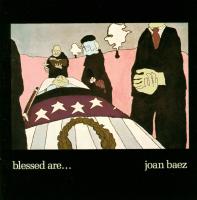
 

Joan Baez’s Weird Homage to Slavery

Way back in 1971, Joan Baez released a double album called “Blessed Are”, which, in retrospect, may be one of the weirdest album releases of all time.

Blessed Are... (Joan Baez album - cover art).jpg

Joan Baez, in case you don’t remember or weren’t born yet, was a famous folk singer who became a prominent anti-war, anti-racism protest leader during the 1960’s, and an interpreter of Bob Dylan’s songs.  As a result, unsurprisingly, she pissed off a lot of patriotic war-loving Americans who regarded her, along with Jane Fonda, as treasonous dupes of the radical left.  They may not have liked John Lennon; they may have regarded Dylan with hostile indifference; they may have ignored Pete Seeger; but they hated Baez and Fonda with a toxic rage.

“Blessed Are” appears to be a peace offering of some kind, to southerners, patriots, farmers, and, perhaps, country music fans.    It featured a hit for Baez, “The Night They Drove old Dixie Down”, by Robbie Robertson of The Band (and subject of a bitter dispute between him and The Band’s drummer Levon Helm).

Levon Helm says in his autobiography:

“I remember taking him [Robertson] to the library so he could research the history and geography of the era and make General Robert E. Lee come out with all due respect.”

Helm was so bitterly annoyed by Baez’s version of “The Night They Drove old Dixie Down” that he refused afterwards to sing it in concert.  I wonder if he was more annoyed by her politics than anything else.  What musician gets upset when another artist makes a signature song more popular?

Anyway, to make General Lee come out with “all due respect”– all the respect due to a slave-owning General who led the war effort to preserve the institution of slavery– may strike some as a dubious cause.

Look at the lyrics:

Like my father before me, I’m a working man
I’m like my brother before me, I took a rebel stand
Well, he was just eighteen, proud and brave
When a Yankee laid him in his grave
I swear by the blood below my feet,
You can’t raise a Cain back up with it’s in defeat

Some claim that the song is sympathetic to the Lost Cause ideology and defends slavery.  I think it does neither.  The fact that it was written by a Canadian should clue listeners in: this is an observational song, not propaganda for either side.  In fact, its observational qualities are acute and beautiful and tragic.

The album also has a song by Jagger and Richards, a paean to the “hard-working” average joe who always gets the short end of the stick.  And a tribute to a southern farmer friend with “the slowest drawl I’d ever heard” showing the narrator and friend around his beautiful farm.  There’s an intriguing song about apocalypse: Three Horses.

But let’s move on to “Lincoln Freed Me Today”.  If “The Night They Drove Old Dixie Down” seems ambiguous, “Lincoln Freed Me Today” is decidedly revisionist.

Been a slave most all my life
So’s my kids and so’s my wife
I been working on the Colonel’s farm
Aint been mistreated, aint done no harm…
The Colonel’s been right good to me
He’s taken care of my family

The Colonel rode his buggy in from town
Hitched his horse and called us all around
Said he couldn’t keep us here no more
I saw a tear as he walked toward the door

Wow!

I’m sure Baez did not have in mind the idea of rescuing slavery from the dustbin of history, or, giving us the positive side of antebellum culture.  I’m sure she thought, well, it’s a true picture of some slave-owners, and some slaves.  And one must be fair by presenting both sides of the issue.   But the “I saw a tear” is kind of repulsive.  That’s the image we’re supposed to take away from this kindly old slaveholder?

You see how convoluted we become.

The songwriter is variously credited as David Paton, David Patten, and David Paton.  It’s likely David Patton.  There’s very little information out there about him.


Ian and Sylvia do a just peachy version of this song.


Ringo is the GOAT

This Youtube Video informs us about the “genius” of Ringo.

Seriously?  Look, I don’t mind Ringo.  He’s a decent drummer.  He stays in time, can hold a rhythm, and looks good doing it.  Furthermore, he seems to be a really decent guy.  He is unpretentious.  Humble.  He is a photographer.

But “great”?  Ringo is not and never was a “great” drummer.  In fact, there have been occasions on which Paul banged out a few bars in Ringo’s absence, and no hue and cry was raised.  Was it even noticed?  Some acolytes of the Sacred Heart of the Ringo is Great Divinity School like to try to make a virtue of his deficiencies by praising his simple, straight-forward, unadorned style.   The truth is that Ringo was never capable of anything much more complex than that.

Ringo just happened to be the drummer for a band that became very, very famous, and nobody will believe that a band that famous could not have had an elite drummer, and since almost no listener has the slightest clue as to what a really, really good drummer sounds like (try Hal Blaine, or Kenneth A. Buttrey on Dylan’s “John Wesley Harding”, or The Band’s Levon Helm, or Neal Pert of Rush) they just assume he is one of them.

Want to hear the worst drummers of all time?  Check out most of Neil Young’s backing bands, but especially Crazy Horse.


Five Perfect Songs

There are five perfect songs. Here they are:

  • Sam Stone (John Prine)
  • All Along the Watchtower (Bob Dylan)
  • Anchorage (Michelle Shocked)
  • I Fought the Law (Bobby Fuller Four)
  • You Don’t Own Me (Leslie Gore)

That’s it.

About Sam Stone:
But life had lost its fun
And there was nothing to be done
But trade his house that he bought on the GI bill
For a flag-draped casket on a local heroe’s hill

“Suspicion” (Elvis Presley) comes close, but no cigar.

Other Honorable Mentions:

“Reelin’ in the Years” (Steely Dan) A truly awesome recording but I can’t overlook the pettiness of “the things that pass for knowledge I can’t understand…”

“Homeward Bound” (Simon and Garfunkel) a fine, fine song, but “all my words come back to me in shades of mediocrity” is a little precious.

“Four Strong Winds” (Ian & Sylvia) is a bit slight, so you have to repeat the chorus and that gives it a bit of a sense of aimlessness and repetition and violates the rule of economy.

The Beatles’ best song is “Girl”:

Was she told when she was young that pain would lead to pleasure?
Did she understand it when they said,
That a man must break his back to earn his day of leisure
Will she still believe it when he’s dead?

But “Eleanor Rigby” is also very nearly perfect.

“Go Your Own Way” (Fleetwood Mac) is too slight.

“Sultans of Swing” by Dire Straits is very, very good.

“Echo Beach” (Martha & the Muffins) Actually, this song is darn near perfect as well. Darn near.

“The Night They Drove Old Dixie Down” (The Band) Great, great song, but a bit murky, and the Band’s own recording of it is not as perfect as the song. As is “This Wheel’s on Fire” and “Tears of Rage”. I do actually like the cover version of “Dixie” by Joan Baez, featuring crack Nashville session musicians. It’s from an album that appeared to be an effort by Baez to reach out to the alienated silent majority of Americans who seemed to despise her.

Levon Helm (who wrote “The Night They Drove Old Dixie Down”) despised her version, but one suspects that that is because Levon Helm despised Joan Baez.

“Satisfaction” (Rolling Stones) Okay. So this one is perfect too. Six perfect songs. But it has to share with “Light My Fire” (Doors).

“Like a Rolling Stone” (Bob Dylan) Violates rule of economy, but also a great, great song. “Tangled up in Blue” might actually be a better song.

“Thunder Road” (Bruce Springsteen) Can’t sustain that great take-off, “you can hide ‘neath your covers and study your pain” though he tries, brilliantly. In the end, it’s just a trifle indulgent, a trifle too self-consciously monumental. A trifle. On some days I prefer “Jungleland”.

“Don’t Think Twice, It’s Alright” (Bob Dylan) is as good or better than any other song on the list. All right, seven.

“One of These Days” (Emmy Lou Harris) Lovely, enchanting piece, reminds me of “As I Went Out One Morning” (Bob Dylan): both are elegantly economical, tight, balanced.

“Someday Soon” (Judy Collins) Okay– another one. Eight.

All right: 9– “The Hammond Song”, by the Roches. Actually, this song is obviously flawed, but there are moments when it does sound just perfect to me. So 8. Wait — 9. I forgot about one of the most perfect, crystalline, renditions ever: “Wayfarin’ Stranger” by Emmy-Lou Harris with that absolutely wonderful lead by Tony Rice and mandolin by Albert Lee.