George Eliot’s Husband

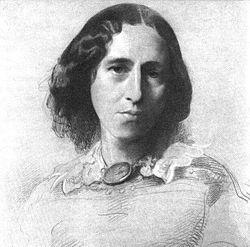
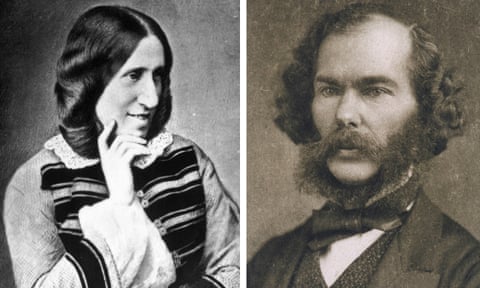
After a daring life of living in connubial bliss with a married man (married, that is, to someone else), Mary Ann Evans, (then Marian Evans, then Mary Ann Evans Lewes)– aka the author George Eliot– married John Walter Cross, who was 21 years younger than her.  He had been her companion and financial advisor and, we are told, was the one who wanted the marriage.

George Eliot was, by all accounts, a very homely woman– very homely– so it’s all a bit of a mystery.  What did George Henry Lewes see in her?  I presume a great personality.  That awesome talent.

What did John Walter Cross see in her?  We don’t know much about this relationship except that on their honeymoon in Venice he tried to drown himself in a canal.  Eliot herself died very soon after.  Cross lived and wrote her biography.

George Eliot was very rich at the time.

George Eliot

George Eliot and George Henry Lewes: their relationship caused Eliot’s brother not to speak to her for 23 years

George Eliot and first husband George Henry Lewes

final years JW Cross

John Walter Cross.

Authentic Nostalgia

The music industry has become aware of the potential gold mine in taking old live recordings of celebrated artists which were not released at the time they were made because of performance flaws and autotuning the vocals to hide mistakes and releasing them now as “remixes”.

So, now you can’t even trust, for example, “The Eagles Live in New York 1975” to be an accurate representation of their performance.

I would find a collection like that no less boring than all the factory-pop robotic autotuned filler coming out of the music industry now: confections that dissipate into thin air the minute the sound stops.

What made artists like Van Morrison, Dylan, Neil Young, Cohen, The Band, and others so vibrant was the uniqueness of their sounds, their authenticity, including the blemishes.

Speed Cameras

We are repeatedly told that more people speed if there are no cameras. But the data showing that safety is actually compromised is extremely thin. There are a lot of things we could do that would make life “safer” (like banning electric bikes, for instance, or skate-boarding, or skiing) but we don’t do them all because we don’t always believe the trade-off is worthwhile.  But there are people in our local government who don’t believe that anything that serves the interest of car drivers is a benefit.  And everyone wants to be seen to fall over themselves when it comes to the safety of children.

There is something about speed cameras that carries a tone of “gotcha!” for reasonable people who usually drive carefully. You feel you are being nitpicked for a brief moment of inattention.  You feel like you are being punished even when you are a conscientious driver.  And of course it absolutely feels like a money grab.

Paul Kalanithi – When Breath Becomes Something

I recently read the memoir by the late Paul Kalanithi called “When Breath Becomes Air” (a title which, even after finishing the book, doesn’t resonate with me).

Paul Kalanithi was a brilliant neurosurgeon who died in March 2015 shortly after graduating from residency and having not quite finished his memoir.  People recommended the book to me, though, as is often the case, they mostly did not give me much of an idea of the taste or texture of it.

I read it.  It can be compelling, as most medical dramas are, when he tells us about several patients and their afflictions, and some peculiar cases, like one in which brain damage created a condition in which a patient could only express himself with numbers, and tried very hard to tell something important to Kalanithi but could only blurt our a seemingly random group of digits.  Yes, medical dramas are compelling, but they are also a dime a dozen– though Kalanithi is a very good writer.  He draws on literature and philosophy and that enriches his narrative to a point.

Kalanithi spends considerable portions of the book describing his search for meaning, in philosophy and literature and neuroscience.  This part sounds a bit schematic, even sophomoric at times.  I don’t sense a real struggle.  I sense someone rationally processing possible theoretical frameworks for understanding life, comparing a few possible options, and then settling for the rather orthodox view that someone must have created reality so there must be a god and if you don’t believe in god your life will be empty.  He doesn’t consider the possibility that the incredible richness of life, of history, of nature, of beauty, or art and music, can itself be profoundly meaningful.  He expects something transcendent– I think– because he’s already settled on god and god is transcendent and a belief that there is no god would be missing that transcendent part that is required.

I found the book more disturbing on another level.  While rhapsodizing about the wonderful benefits of good medical care he gives almost no consideration to the horrible state of the American health care system.  Why would he?  He has great insurance coverage and a prosperous family and he is offered the services of Emma,   “Emma not only was one of the best– a world-renowned oncologist who served as the lung cancer expert on one of the major national cancer advisory boards– but she was also known to be compassionate…”.

Well, how nice for you.  Wouldn’t we all want to have the services of a person like that if we had cancer?  Or to be able to consider flying to Houston or New York or some University somewhere to try to get better treatment than that available locally?