Farting on Sacred Scripture

I don’t think politics can get much more stupid than this.

A Democratic politician has been taking bibles from tables in the lounge and hiding them under the seat cushions.  In one case, he put one in the fridge.  Some Republicans were horrified to discover that their asses actually rested on holy scripture.  Some of them may even have farted.  As we know, hell is full of miscreants who farted on holy scripture.

The Republicans apparently believe the Bible has some kind of weird voodoo power that can be transmitted up through the anus and into the larynx and cause otherwise rational politicians to defecate on Reason and Rationality and Intelligence and try to expel a Presbyterian Minister (Stahl Hamilton) who likes to play mild practical jokes.  The vote was 30-28, a majority, but not enough. A two-thirds majority is required to expel a member.

Hamilton was apparently trying to make the point that religion and politics should be kept separate.  The fact that the Republicans almost voted him out of office for tampering with their totemic texts tells you that he is absolutely right.

The Double Standard

The double-standard peaks out from behind it’s feminist camouflage.

I was thinking of Al Franken here, mostly.  There is no doubt at all that if a man had performed the same rude gesture as Ellen Degeneres did, he would have been roundly condemned.  If he had been a Senator, Kirsten Gillibrand and Kamala Harris would have led the charge to drive him from office.

Well, let’s hear it Senators Gillibrand and Harris!  Let’s hear your full-throated outrage once again: this kind of sexual ogling and intimidation will not be tolerated!  You will never, ever appear on her show.  Ever.

What was Franken accused of?  Posing for a picture with his hands in the air over a woman’s chest.  And the other accusations, as far as I can determine, include “trying to kiss me”.  Oh the horror!  A man tried to kiss me!  Off with his head!!  Yet some feminist jihadists insisted on lumping Franken in with Harvey Weinstein and Kevin Spacey as poster-ogres of the passing patriarchy.

Imagine a male guest on Ellen asking the hostess what she thinks of his penis?   What do you think?  Just a trivial thing that should be swept aside and ignored.  Let’s just get on to something real, here?  Or a horribly inappropriate and offensive gesture that should be sanctioned immediately with suitable consequences?

Well, here we have Gal Gadot asking Jimmy Kimmel what he thinks of her breasts.  My point is not that Gal should be fired from her job because she asked Jimmy Kimmel to comment on her breasts (which she pointed to with her hands) but that neither of these incidents, nor the ones Al Franken was accused of, nor the ones that Louis C.K. was accused of, rises to the level of hysteria with which Franken’s alleged offenses were greeted by the “outraged” harpies who demanded his resignation.

I am most disgusted with Kirsten Gillibrand.  It was widely discussed at the time that Gillibrand was looking for Franken’s scalp as an entree into the world of 2020 presidential candidates.

And so it was.  Guess whose running for president in 2020?

I didn’t hear as much speculation then about Kamala Harris’ motives.  But guess who else is running for president in 2020?

A pox on both their houses.


When asked what type of man she likes, Rihanna said: “I like men who are more aggressive, but mysterious. I like them to be sure of themselves and know that you’re the man, I’m the lady, and the only way for us to make this work is if we play our roles.

I’m not sure that a man who heeded the call here would not be worried that after being “aggressive” he would be accused of not obtaining enthusiastic consent.  Is it possible to have both?


“It’s no problem at all for a man to wear a dark blue suit a hundred days in a row,” she said, “but if I wear the same blazer four times within two weeks, the letters start pouring in.”  Angela Merkel

I have no doubt that most, if not all, of those letters (do they really still send letters in Germany?) come from women.  We have seen similar reactions to women newscasters who change their hairstyle.  So why do some feminists keep blaming men for the double-standard applied to women in politics?  Why are you outraged at us?  Why aren’t you working on your own constituency, who publicly ogle breasts, yearn for “aggressive” men, and complain about the way you dress and look?

When I was in college, years and years ago, I was asked by a couple of girls– good friends to each other–  to take their portrait together.  They tried various poses, and dressing in similar t-shirts, and sweaters, and tank-tops.  Then I half-jokingly suggested they pose nude, back to back.  I remembered a similar picture of the two women in the band Heart.  I thought it looked strikingly beautiful.  The two girls looked at me thoughtfully and considered it and I was quite sure they were ready to go when I quipped, “and without makeup”.  They immediately, decisively rejected that option.  They were horrified at the very thought.

I’ve thought about that lot, for years.  I– the male– was the one who thought they would look more beautiful with their flaws, with a more natural image of their faces, with their real pores and real eyes and real lips.

Would a good feminist argue that they only think that way because they have been brainwashed by men to think that?  I don’t believe it.

Figaro

I recently read an article (can’t remember where– the Atlantic?) that described, with adoration, the conclusion of the opera “The Marriage of Figaro” by Wolfgang Amadeus Mozart.  This article went to argue that “The Marriage of Figaro” is one of the greatest artistic achievements of Western Civilization.  I decided I must see it.  One must be cultured.

There is a wonderful version on Youtube by Glyndebourne Festival Opera– with subtitles!  Here’s another.  You want subtitles because “The Marriage of Figaro” is in Italian and songs don’t generally translate well from one language to another.  You want to know what’s happening.

I will summarize the plot because I want to try to remember the basic plot points and regurgitating it is a good way to do that.

Okay, so here we go.  Figaro is a servant to the Count.  The Count has just abolished le droit de seigneur to the delight of his citizens.  This, of course, is the mythical right of a lord to have the first sex with a subordinate woman on her wedding night.  Figaro is especially delighted because he wishes to marry a fellow servant, hand-maiden to the Countess, Susanna.   The Count, however, realizing he has missed an opportunity, attempts to rescind abolishment at least for one case: Susanna.  Meanwhile, a mischievous servant, Cherubino, has been roaming around the castle making out with lots of women, and even has his eye on Susanna as well.  The Count knows about him and wants to send him off to join the army, but the Countess and Susanna decide to dress him up as a woman so he can hide from the Count.

The Countess is upset about the Count chasing other women so she and Susanna plot together.  Susanna will send a note to the Count agreeing to meet secretly in the garden that night.  The Countess will dress up as Susanna on her wedding night, wearing her veil, and then wait there instead, trapping the Count.  Susanna will dress up as the Countess.  Figaro doesn’t know about the plan and thinks, at first, that Susanna is about to betray him.  Somehow, he finds out she is not (there are lot of overheard conversations in this opera), but Susanna doesn’t know that Figaro knows that it is her dressed as the Countess.  Figaro decides to have some fun and pretends to be hitting on the Countess.  An angry Susanna whacks him a few times until he admits he knew who she was right away.  The Count, meanwhile, does believe that Figaro was hitting on his wife, the Countess and calls in the guards to arrest them.  That’s when his wife shows up revealing the Count’s nefarious scheme.  The Count asks for forgiveness and everyone is happy.  They sing a lovely song together.

That’s the song the writer raved about:  Pian pianin le andrò più presso.

Or is it “Contessa Perdono”?  I am not sure how Opera segments are organized and I don’t feel like taking the time to find out.  There are lists and references to tracks and then to arias and recitatives and duets, and then subtitles referring to specific passages, I think.

In Amadeus, Salieri speaks about “Figaro” in the same vein as the piece in the Atlantic:

The restored third act is bold, brilliant. The fourth… was astounding. l saw a woman disguised in her maid’s clothes hear her husband speak the first tender words he’d offered her in years. Simply because he thinks she is someone else.

l heard the music of true forgiveness filling the theatre… conferring on all who sat there perfect absolution.

God was singing through this little man to all the world. Unstoppable. Making my defeat more bitter with every passing bar.

Anyway.  Here’s my take-aways from watching the entire 3 hours.

One of the greatest works of art in history?  Seriously?  The music is absolutely fabulous, of course, but the comedy is very broad, very obvious, and the characters are cardboard cut-outs, really.  One does get “into it” if you watch it patiently, and it is fairly enjoyable, but I would not rank it even against the movie about the composer, “Amadeus”, which, to me, was far more profound, far more insightful, and richer and deeper.

It is interesting to hear praise for the last act, the reconciliation scene, which kind of trivializes the philandering going on.  All is forgiven.  “Perfect absolution”.  Let’s get back to the party and enjoy the frivolous pleasures of flirtation and– well, fucking.  I don’t object to Mozart’s take on the issue– I mean, it is a comedy.  But I wonder if the admiring audience shares his Woody Alan-esque view of love and romance?

But if you were trying to sell the “perfect absolution” is this context, you could never beat the musical setting of that piece: it is exquisite.


The Slobbering Appreciation of Tina Turner

If you were ever trying to sell me on the importance or artistic genius of a particular singer, song-writer, painter, novelist, or film-maker, the first mistake is to talk about how may books, albums, singles he or she has sold, or how much his latest movie grossed, or how much a painting of his recently sold for at Christies, or even how many Oscars he won.

Leonardo Di Caprio has an Oscar for acting.

Case closed.

To me, that information is worse than irrelevant: it’s a marker of likely mediocrity.  Line up Beyonce, Neil Diamond, Steven Spielberg, Basquiat, Andy Warhol, whoever you like: I’m not buying.

So when Tina Turner died recently we were bombarded with the usual fawning appreciations from the media most of which, of course, exaggerated her good qualities and completely forgot about the bad ones.  That’s to be expected.  What I did not expect was a slobbering wet kiss from the New York Times in the “Headlines” podcast.  The Times, a very, very good paper, should be embarrassed by this one.  Don’t do it again.

For one thing, Tina Turner did not quite stand out as breathlessly alone as the Times made it sound.  There have been a lot of great female rock or pop singers over the years and each one of them claims to have been the first important one.  Diana Ross (another singer I never cared for), Dionne Warwick, Janis Joplin, Aretha Franklin — of course! Nina Simone– even more of course.  Come on folks– it’s not that hard.

The Fanny’s were more substantial and far more interesting than Tina Turner.  Ever heard of them?  I thought not.

It’s not that Turner is not entitled to an appreciation.  She’s not really the giant some make her out to be: she’s had a few good hits and she put on a lively show and a lot of feminists see her as an icon for self-empowerment for the way she dumped Ike Turner, struck out on her own, and found someone else’s great songs to cover.  I hope the feminists who complain about men oogling women find it in their hearts to forgive Turner for wearing costumes that conspicuously beg to be oogled.  Come on.

“What’s Love Got to Do With It” is not a bad song.  It’s a less incisive update of Bob Dylan’s stunning “Love is Just a Four-Letter Word”, a toxic take-down of romanticism and delusion.  You would not call “What’s Love Got to Do With It” a toxic take down of anything, really.  It’s a glorious hook, wonderful arrangement, and a couple of verses.  Not bad.  It resonates with her disillusionment with Ike Turner.   Okay?  Good song; now let’s not weigh it down with unentitled significance.

“Proud Mary” gets dreary after a while but I can see why someone hearing it for the first time might think of himself as thinking of himself being blown away.   I really dislike the intro on one of the most popular live performances on Youtube, the patter about “we never take things slow”, as if that is supposed to be incredibly sexy or funny or both.

The talk about her “sensational comeback” is a lot of hype: she never stopped touring really and continued to appear on television shows like “Donny and Marie” (yes she did), The Brady Bunch Hour, Sonny and Cher, and Hollywood Squares.  Just because “Private Dancer” was a monster hit doesn’t mean that Turner’s career didn’t exist prior to it, but it’s a story everyone loves and repeats no matter how many times they’ve heard it, or untrue it is.

The bottom line for me is, has she ever done a song that really mattered to me?   Like any of these:

  • Someday Soon (Ian & Sylvia, Judy Collins)
  • Anchorage (Michelle Shocked)
  • Diamonds and Rust (Joan Baez)
  • That’s the Way I’ve Always Heard it Should Be (Carly Simon)
  • You Don’t Own Me (Leslie Gore)

Doing this list I can’ help but notice how many of these songs performed by women were written by men.  Sigh.  All except “Diamonds and Rust”.

Wikipedia, incidentally, tirelessly lists Tina Turner’s sales records.  A long list of so many so much so popular.   Why?  Because there is not much to say about what she actually achieved artistically?  Loud and fast and legs.

Wikipedia also reports on her divorce and her allegations of physical abuse against Ike Turner while acknowledging that he did a hell of a lot for her career early on.  When they divorced, I had the impression, from all the blather, that he left her penniless.  Yes, penniless, along with two Jaguars, furs, and jewelry.   She demanded $4,000 a month in alimony.  Wiki doesn’t say if she got it or not, but the BS about running away from Ike with 23 cents in her pocket is just that: BS.  Oh, she may have had 23 cents in her pocket– and the keys to the Jaguar.

She refused to attend his funeral.  Phil Spector, the murderer, did.

There is a film.  I’d be absolutely pleasantly stunned if it was any more accurate than the usual Hollywood bullshit.


Exactingly Planned: Paul Simon’s Hallmark Card

What makes this music connect is Simon’s ability to make a spiritual setting feel down-to-earth, what you might expect from one of American pop music’s greatest conversational songwriters. “I heard two cows in a conversation/One called the other one a name/In my professional opinion/All cows in the country must bear the blame,” Simon sings, showing us that he hasn’t lost his sense of humor, however somber the setting.  Rolling Stone

There are red flags here.  Not stop signs– but red flags.

Back to the cows: this is witty?

Here is a review I find more trustworthy (not because it disagrees but because I suspect it is a less compromised source.)  The Guardian.

Here are some lyrics from Simon’s previous album (the song: “Love is Eternal Sacred Light”):

Love is eternal sacred light
Free from the shackles of time
Evil is darkness, sight without sight
A demon that feeds on the mind

Really?  Love is light, evil is darkness?  Fifty years of kicking around New York City, touring, writing and recording songs, partying with the glitterati, hobnobbing with the elite minds of our culture, and your opus starts to look like Hallmark cards?  “A demon that feeds on the mind”?

A college English professor would immediately ask the obvious question:  “how is it like a demon that feeds on the mind?”  And yes, Simon latest work is the very definition of sophomoric.

“Free from the shackles of time”?  What does that even mean?

This is not new for Simon: it’s the updated self-conscious posturing of “So Long Frank Lloyd Wright” and “El Conder Pasa” and “American Tune”.  It sadly reminds me of the faux profundity of Mumford and Sons.  It is Simon trying to sound like Leonard Cohen, or like himself writing “The Sound of Silence”, a song that barely escapes pretentiousness–but does– because of its vivid imagery (“the words of the prophets are written on the subway walls/and tenement halls” is pretty good even if familiar).

Or how about this (from Seven Psalms):

Dip your hand in Heaven’s waters
God’s imagination
Dip your hand in Heaven’s waters
All of life’s abundance in a drop of condensation
Dip your hand in Heaven’s waters

Oh come on!  It sounds like Leonard Cohen on an off day, like something you wouldn’t even see in his notebooks on display at the Leonard Cohen museum, wherever it is.  It’s banal.  It’s pathetic.  It is transparently calculated to sound like something that sounds profound.

All right Simon– you want to get “spiritual”?  You want to sound like this?

If it be your will, that I speak no more
And my voice be still, as it was before
I shall speak no more, I shall abide until
I am spoken for, if it be your will

Yes.  Leonard Cohen doing the real thing.

Or compare it to earlier Simon, perhaps his most telling song of all:

Takin’ time to treat your friendly neighbors honestly
I’ve just been fakin’ it
I’m not really makin’ it
This feeling of fakin’ it
I still haven’t shakin’ it

No, you haven’t.

Watch the video on the Guardian’s website above.  It’s brilliant, but not in the way most people think it is.  Everybody I know will come away from it impressed with what a musical genius Paul Simon is not because the video proves he is a musical genius but because a sophisticate like Paul Simon knows exactly how to push those buttons– scenes of him trying out various exotic instruments, apparently directing the strings, coaching a choir, giving the impression that he is way more of a musical genius than you thought, in full control of every aspect of his music.  It takes a cur like me to notice that it does not show that he is a musical genius– that takes actual music– but just that he knows how to look like one.  The corresponding musical tracks are all refinement and almost no invention.

Firstly, I don’t know of many reputable critics who would credit Simon as a one of pop music’s “greatest conversational songwriters”.  Well, pardon me, now I do.  But I have never forgotten what is perhaps the most pungent back-hand compliment I’ve ever read in reference to a singer-songwriter, in regard to “The Boxer”:  “one of Paul Simon’s few unpretentious songs”.  A remark that incisive and accurate doesn’t die– I’ve remembered it for 40 years, and always when I am listening to Simon.  It used to be a consistent gripe about Simon’s work.  Has he aged out of those critics?  As I hear snatches of Simon’s newest work, his “farewell” (we’ll see), it lives on.  “The Boxer” remains his best song.  Simon was a fine song-writer with regrettable tendencies and a thin skin.   His latest work is a drag on his oeuvre.

Simon sings “the lord is a meal for the poorest, a welcome door to the stranger…. The Covid virus is the Lord/The Lord is the ocean rising.”  Seriously? This passes for poetic lyrics nowadays?  Look folks: those are banal images.  They are over and done with in a flash.  How is the Lord a “meal” for the poorest?  And if he is– one might speculate, a “meal”– charity– or a “welcome door” — hospitality– how is he also global warming (“the ocean rising”)?  Is the listener supposed to fill in the gaps?  (One thinks of a far better aphorism: “the opiate of the masses”.)  They don’t evoke anything more than sophomoric ramblings skipping the detail work, the specifics, the real experiences and incidents that inspire real poetry, and sliding right into the aphorism.

There is mystery, oh yes.  The mystery is, why does the New York Times critic think this is deep stuff?  It is actually banal.  Simon adopts phrases from Cohen, I would suggest, but he doesn’t have the gravitas to fill it with meaning.  Cohen brilliantly anchors his spirituality in his carnal impulses: “She tied you to her kitchen chair/She broke your throne and she cut your hair/and from your lips she drew the Hallelujah”.  That’s how you get to Hallelujah.  Not through mumbling warmed-over vaguely spiritual platitudes or “the lord is the water rising”..  Simon gives the impression of having glossed over a Reader’s Digest “Today’s Spiritual Sayings” page.  How about something like “religion is a smile on a dog”, a far more rich, allusive image.  Ironically from Edie Brickell.  (Along with “philosophy is a walk on the slippery rocks” and “religion is a light in the fog”.  Both more striking than Simon’s “the Lord is a virgin forest/the Lord is the earth I ran on”.)

The New York Times observes:  “its informality is exactingly planned.”  That’s what some of us have never liked about Simon.  I am surprised that the Times followed that comment up with generous praise.  Yes, Simon emits more platitudes about forgiveness and acceptance without once identifying a single sin.

Simon is a very good songwriter, but he is never not conscious of himself as “a poet and a one-man band” and never just a “one-man band”.  He’s always had a grievance about not being regarded as just as great as Bob Dylan or The Beatles or Billy Joel (he is greater than Billy Joel, but leave that aside for now).

And it appears that the Guardian and Rolling Stone and New York Times bought it.   Yeah, you have to be pretty fucking arrogant to call them out, but I do: they have been far too credulous.  It is possible, considering that Simon is near the end of life, to be generous without being slavish.  Go back and try again.

Here’s more:

When he and Brickell finish this expansive work by harmonizing, “Children, get ready/It’s time to come home/Amen,” it has the kind of finality you expect from a great composer summoning many decades of accrued wisdom.

I hate it when musicians bring their wives or children into their recordings, even if, as in the case of Brickell, that person has had a career in her own right.  It reeks of privilege.  It is an insult to the usual talents that fill those spaces on recordings by notable artists.  It always feels to me like “honey, why can’t I be on your album?”  It draws to mind McCartney’s embarrassing attempts to put Linda in Wings.  I remember Neil Young performing with Emmy Lou Harris and Michele Shocked and his wife Pegi as backup singers, and felt sure that Harris and Shocked must have felt more than a little insulted at the idea that Young’s wife belonged in that chorus.

The lord is my engineer / The Lord is my record producer

And let’s identify the obvious: is Simon taking another note from Leonard Cohen here?  If he is, one immediately suspects he took note of the esteem Cohen has earned over the years for his overtly spiritual references (among a host of carnal allusions) and decided to weigh in with one of his own.  Rolling Stone acts if listeners should be delightfully surprised.  No, but here’s a list of things that could have been on a Paul Simon album that would have surprised me:

    • an appearance by Art Garfunkel
    • an unpretentious song
    • a cover of “Pretty Vacant” by the Sex Pistols
    • a reboot of “Fakin’ It”
    • a cover of “Cold, Cold Ground” by Tom Waits
    • an apology for “Cecelia”.
    • an abject apology for “Me and Julio Down by the School Yard”.
    • and even more abject apology for “Feelin’ Groovy”.

What even I would never expect: a cover of a Bob Dylan song.  My theory is that Simon would fear that it would draw a contrast and comparison to his own work– unfavorably.  I remember wandering through Germany somewhere and stumbling into a coffee shop and listening to some good singer-songwriter tunes on the radio when “Love Minus Zero/No Limit” by Dylan came on.  It’s not one of his greatest songs, but even minor Dylan in that context was strikingly superior to everything before and after that was not Dylan.  I suspect Simon would be worried about the same effect if he jammed a Dylan track into the middle of several of his own.

I am surprised at Rolling Stone rolling over on this one.  Who got to them?  What’s in it for “Rolling Stone”?

Paul Simon’s best album, as an album, remains Bookends.  Quintessentially hip, polished, sophisticated, expertly produced and recorded, the most distinctively Simon and Garfunkelish of all the Simon and Garfunkel albums, and relatively free of the cloying calculation of “Bridge Over Troubled Waters”.  Should be in the record box of every English major in America, at least in their sophomore year.   Parsley, Sage, Rosemary and Time is a fine album.  Just fine.   “A Poem on the Underground Wall” is under-rated.  Bridge Over Troubled Waters has too much junk on it, like “Cecilia” and “Baby Driver”– a vain attempt to rock.  There Goes Rhymon’ Simon can’t be forgiven for “Was a Sunny Day” and the fey title.  One Trick Pony was as horrible as the movie.  Graceland (1986) seemed like an attempt to transform Simon into a musician’s musician inspiring admiration and envy for the funky African textures that, weirdly, echoed Neil Diamond’s Tap Root Manuscript from 1970.  Both of them resonate uncomfortably today.

For the record, in my opinion, Paul Simon’s best songs:

    • The Boxer
    • The Sound of Silence
    • Mrs. Robinson
    • Hazy Shade of Winter
    • Fakin’ It
    • A Poem on the Underground Wall
    • Patterns
    • America
    • You Can Call Me Al
    • Hearts and Bones
    • The Only Living Boy in New York

Over-Rated

    • Bridge Over Troubled Waters
    • Mother and Child Reunion
    • Graceland

Worst (and over-rated)

    • Cecilia
    • 50 Ways to Leave Your Lover
    • Loves Me Like a Rock
    • Me and Julio Down by the School Yard

The Excretable

    • Feelin’ Groovy

If you thought “Graceland” was special, please consider “From Galway to Graceland” by Richard Thompson to see how musical allusions to Presley’s monument to self-indulgence should be done.  Here’s Simon’s take:

And my traveling companions
Are ghosts and empty sockets
I’m looking at ghosts and empties
But I’ve reason to believe
We all will be received
In Graceland

Simon writes about ghosts and empty sockets and ghosts and empties who will all be “received” at Graceland.  I suppose it suggests that Presley’s mansion provides America with almost a religious symbol of aspiration, to be “received”, perhaps blessed, redeemed, forgiven.  Okay– obviously, I’m filling in the blanks.  There are lot of blanks to be filled in.  Simon’s lyrics are unspecific and unattached, like those of “Mumford and Sons”.  They are tropes without gravity.

Try this instead (Richard Thompson, “From Galway to Graceland”:

She was humming ‘Suspicion’,
That’s the song she liked best
She had Elvis I Love You
Tattooed on her breast

The lyrics are too good to leave these out:

Ah, they came in their thousands
From the whole human race
To pay their respects
At his last resting place
But blindly she knelt there
And she told him her dreams
And she thought that he answered
Or that’s how it seems

I get chills just copying and pasting them.  Do not confuse her adoration for Elvis with a tribute; she is quietly but hopelessly deranged.  This is the damage, the danger, that Simon can’t be aware of because he’s too concerned with how his tribute looks and feels to his audience.

Simon is very good at creating the perception that he is a serious, thoughtful, imaginative, original talent.  He has written a few fine songs, but I think he is not capable of the kind of powerful, original evocative piece like Thompson’s “Galway to Graceland”.  It’s instructive how the two songs are different.  Simon evokes a sense of solidarity with the communal nostalgia for the fantasy represented by a crass monument to Elvis Presley’s popular success.   But he doesn’t regard it as crass.  He’s playing to a touchstone of Americana without probing it’s implications, the vanity, the superficiality of Presley’s later career.   Thompson, in contrast, probes deeply into the delusions at the heart of the worship of Presley’s corrupt later persona.  He observes, unlike Simon who genuflects.  He gets into the mind of a fan and explores: what is it she sees in Elvis?  How does it relate to the dreariness of her own real world?  How is Elvis’s public image a communal delusion of intimacy and familiarity?  What happens if it plays out, as it does in the song?  It’s a work of genius.  Simon’s “Graceland” is a work of terminal niftiness.

Another version of the good one.  Simon’s version is about Simon suggesting to us that he has deep thoughts about Elvis.  Thompson’s song really is deep, because it is about a fan, and Elvis’ tarnishing effect on fandom, and how the illusions this relationship creates can be damaging and disturbing.  The rock’n’roll rebel who congealed into the obese depressed shallow figure who died on the toilet, constipated to death by intoxicants and prescription drugs and surrounded by sycophants who can’t bear to tell him the truth about himself.

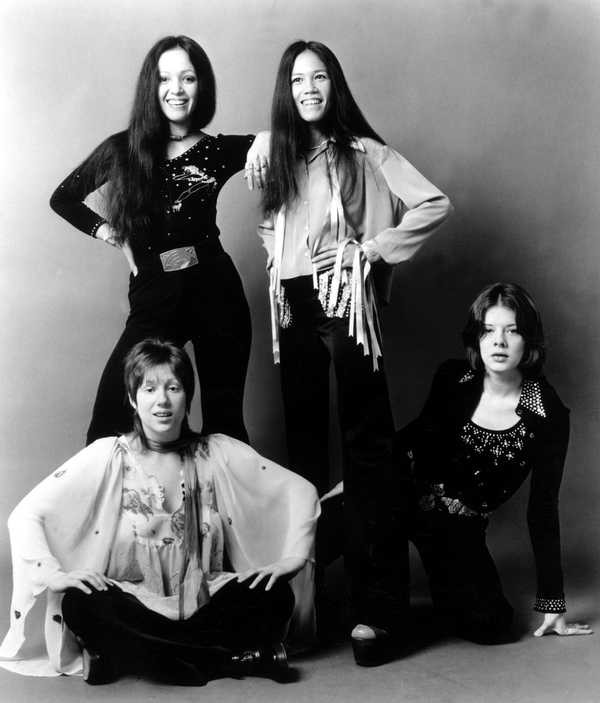
The Grievance Aesthetic: The Fannys

First of all, I had never before heard of Fanny.   Fanny was an all-female band that formed in 1970, consisting of June Millington (electric guitar), Jean Millington (bass), Alice De Buhr, and Nickey Barclay.  The women were remarkably talented– no doubt about it: they could play.

I have been following music closely since I started listening to Bob Dylan when I was ten years old.  I have followed it closely throughout the last 55 years.  I never heard of Fanny that I can remember.  After listening to their songs, I feel apologetic.  I feel dispossessed.

Come on– they are absolutely fabulous.

Let me be clear: hard rock is not my preferred style.  I find it abrasive, noisy, sometimes propulsive, sometimes dull.  I crave good lyrics, the use of musical space, nuance, and subtlety.  I don’t have a single hard rock song on my personal list of the top 25 songs of all time, though I suppose Springsteen’s “Thunder Road” or “Backstreets” or “Adam Raised a Cain” might qualify at least as “hard edged” rock.

I recently watched a documentary on PBS, “Fanny: The Right to Rock”.   To my utter disbelief, this variation of the film is clumsily censored, words beeped out, images of breasts blurred out.  Fuck you, whoever did that.  I found a good copy elsewhere.

If I had been in charge of this project there is one thing I would have asserted right from the start as absolutely essential to the objective of this film: at no point should the esteem or lack thereof of their music be attributed to sexist, patriarchal oppression, sexism, and discrimination.  The fact that Janis Joplin did succeed where Fanny did not tells you that there was more to it than sexism.  And to be fair, the members of the band on the record in the documentary don’t belabor the point.

[Incidentally: it’s a product of BBC IV and if you can find the original BBC version, you can avoid the contemptible censorship savaged on the PBS version, notably including scenes of the girls frolicking half-naked in Hedy Lamar’s former house in Los Angeles.]

But why?  Isn’t that the essential story of the band?  Well, if it is, the band is not worthy of this tribute.  If the band should be known to you because they broke barriers and because they were really better than anyone thinks they were because their singular lack of popular and critical success is due not to any deficiency of talent but to the obstacles placed in their path by sexist (and racist — they were Philippine) attitudes, then you have to prove it by providing me with the songs and musical achievements that deserved more recognition than they got.

What you should want more than anything– what you should positively crave– is for viewers to be convinced that Fanny produced some extraordinary music that stands on its own merits without qualification.  That, this documentary failed to do.   To declare that their work was important or significant because they were women is defeatist.  It is to admit that their work really wasn’t good enough to earn distinction on its own.

They should instead insist on their music being heard on its own terms: very, very good hard rock.  Four very good musicians creating respectable, admirable songs.  In particular, Jean Millington’s vocals are probably as good or better than Janis Joplins’– and she could play bass — really play– to boot.

Jean Millington later said that Fanny had to have a strong live presence in order to overcome audience’s perceptions that women could not play rock music well.  Wiki

Well, we don’t really know.  Do audiences really sit there and think, oh, I think they sound pretty good but they’re female so they can’t be as good as they sound?  Or do audiences simply sit there and think, “they don’t sound that great” and it’s the band and the feminists who think it’s because of their gender?  I am at a loss.  Listen to them: how could an audience not be impressed?

They didn’t “break through” into real success.  To do that, you absolutely have to have at least one song that really amazes people, that demonstrates originality and style and inventiveness and a compelling melody or vocal or all of the above.  A “More Than as Feeling” or “We Don’t Need no Education” or “Eighteen” or “Hit Me With Your Best Shot” or, crossing genres, “Have You Never Been Mellow” or “That’s the Way I’ve Always Heard it Should Be” or “Anchorage” or “First We Take Manhattan” or, even better, “The Hammond Song” by the Roches, a female group (in folk) that really did stand out for the quality of their music– not because they were female.  Fanny had many very good songs, but I can’t identify one that could have crossed-over into a pop hit.  But then, there were so many crappy pop hits.  And, of course, the promotional efforts of the record industry plays a big role.  They did have notable TV appearances, so you can’t say they didn’t get anything.  Just not enough.

What were they aspiring to?  Pop success?  They say they just wanted to be known for their talent, not their looks, but it was clear that they were not really good enough to be successful for their brilliant artistic achievements like, say, The Band or Steely Dan.  The bands that cite them as an inspiration, the Go-Gos, the Bangles, and the Runaways, were also pop bands with more success at creating the catchy pop single.  None of them were as good, from a purely musical perspective, as the Roches.

David Bowie’s appreciation of the band is frequently quoted:  “They were extraordinary: they wrote everything, they played like motherfuckers”.  Yeah, well, David Bowie was dating Jean Millington in 1973.  He was being asked to judge his girl.  But, okay, he was actually right.

Like almost all musicians, they were cruelly ripped off by their own management and the record companies.  But that is at least partly due to their own ignorance.  They allowed their producer and the record company to fire Brie Brandt because they wanted them to resemble the Beatles.  Seriously?  Because they had four members?  The rest of the band was very sad about cutting Brie out of the band, but it did not seem to occur to them that there is a universe in which young musicians can decide personnel matters for themselves.  It was as if God told them to fire her and they did.  They talk about it as if there really was no choice, because they don’t want to admit that the choice was between Brie and the commercial backing of the label.

There are bands that refused to compromise on issues like that and still found success.  There are probably even more bands that made the same compromise and, like Fanny, went nowhere.

The inevitable reunion is covered.  Nickey Barclay is mysteriously absent.  There is a clip of them performing live which is conspicuously deceitful: it’s the studio recording playing over the video of the band.  Not all viewers are dumb enough to not ask themselves immediately why they don’t play the live audio.

The broadcast version I saw beeped out “offensive” language.  Seriously?  It’s 2023.  You’re doing a documentary on this courageous, ground-breaking, revolutionary, ballsy female band, and you have to careful not to offend the delicate sensibilities of your projected audience?  [As I mentioned earlier, check out the BBC original if you can.]

The Candidates:

Aint That Peculiar

Fairly upbeat love song (the more you hurt me the more I love you).  Slide electric, pretty good bass.  Not bad, but not particularly distinguished.

Blind Alley

Typical Fanny: extremely busy, dense, vocals typical of thrash metal bands–  like, have you ever heard of space?  Vocals are “stretching”, a habit developed by metal bands from trying to be heard above their own noise.

Last Night I had a Dream

All the lousy little poets coming round trying to sound like Janis Joplin…

Place in the Country

Nicky Barclay sounds more than a little derivative of Janis Joplin (did Joplin cop a few strokes from Barclay?  They are active around the same time), but without the variety of tone and pace.


The Thought Police Strike Again

Once again the thought police have sprung into action.   The Canadian Broadcasts Standards Council has banned the original version of Dire Straits “Money for Nothing”.

The Canadian Broadcast Standards Council is a “self-governing regulatory body for Canada’s private broadcasters”.  What does that mean?  That means it can’t arrest you.  It is reminiscent of the Hays code, Hollywood’s attempt to clean itself up before Congress did it legislatively.  It is the CRTC, thank god, that has the real power, but I assume that the CBSC has some sway.

And how do you get the CBSC to ban a song you don’t like?  Hey, it’s a free-for-all!  Just contact them and announce that humble little you, just one out of 30 million citizens, has decided that you must step in and decide which songs should be played on the radio no matter how many people like it.

I am curious now: what if I filed a complaint.  What if I alleged that the censorship of “Money for Nothing” is deeply offensive to my delicate little sensibilities about truth and integrity and honesty and historical accuracy?  I am veritably traumatized by the idea that my precious memories of dramatic depictions of real personalities and social values are being erased by repressed puritanical little zealots with a political agenda.  Does my objection count?

Yes, I am enraged.  I feel threatened by a world that is sliding towards banality and antiseptic homogeneity.  Hey, can I file a complaint about vocalists using Autotune?  If ever there was a legitimate complaint to be made to a “broadcast standards” council that would be it.

Not only do they want to correct your current misshapen and erroneous ideas and feelings; they want to go back in time and correct your past iniquities.  Do you remember “Money for Nothing”?  It was a snippet of a certain attitude at a certain time and place.

Let’s get one thing absolutely clear and straight right off the bat:  “Money for Nothing” is not a dramatization of Mark Knopfler’s thoughts and feelings about MTV or gay people or microwave ovens.  It is a clever, insightful, reasonably accurate depiction of the attitudes of a working class schlub working at an appliance store watching MTV and thinking, geez, I could do that.   Are we clear?  Do you understand the difference between and artist and the subject?  Do you understand what drama is?  Do you get that when a writer tells you that a character committed a murder that the artist himself is not committing murder?

Here are the “offensive” lyrics:

See the little faggot with the earring and the makeup?
Yeah buddy, that’s his own hair
That little faggot got his own jet airplane
That little faggot, he’s a millionaire

I knew people who thought like that.  I don’t need any one to tell me to not remember him or his attitudes.   I don’t need anyone to try to erase the record of that person from public discourse.

Is the next step to go through Shakespeare and Dante and Dostoevsky and remove all the violence and murders and even the insults from their works?  Why not?  We no longer think people should be murdered.  It distresses people to see murder depicted in a play or movie.  Let’s remove it.  Let’s remove the rape scene from “Streetcar Named Desire”.  We don’t approve of rape any more.

And how does “Walk on the Wild Side” (Lou Reed) and “Hit Me With Your Best Shot” get away with it?   How about this, from the innocuous Elton John and Bernie Taupin (“All the Girls Love Alice”):

And who could you call your friends down in Soho?
One or two middle-aged dykes in a Go-Go
And what do you expect from a sixteen year old yo-yo
And hey, hey, hey (hey, hey, hey) oh don’t you know?

And please, please, please:  “All the Girls Love Alice” is not “by” Elton John.  The salient component here is the lyrics which are by Bernie Taupin.  Would the internet please grow up and get this straight?  Most of the songs it says are “by” an artist are actually merely recorded by that artist.  They do not deserve the holiest credit of all, the act of creation, which most of them don’t deserve even in respect of their vocals.

You think, well, we can’t gut one of America’s greatest works of drama, can we?  “Streetcar Named Desire” is a classic.  It is untouchable.  But how does that make a difference when public morals are at stake?  And what is the difference between the character saying “faggot” in “Money for Nothing” and the character raping Blanche in “A Streetcar Named Desire”?  They are both dramas of believable human behavior.  They both tell us, this is something someone would do (and has done, in real life), in the setting and circumstance depicted.  What is the problem?

There is no real problem.  What there is is a bunch of pious, self-righteous individuals trying to assert their own virtue by punishing a perceived miscreant.  Burn the witch.

If I was a gay man of any prominence I would have issued a statement– like the self-righteous guardians of public morality do– and insisted that Dire Straits keep the fucking lyrics exactly the way they are, just as “Huckleberry Finn” should retain the word “nigger” used in reference Jim, the escaped slave, just as Stanley should continue to rape Blanche in stage productions of “Streetcar Named Desire”, just as Ophelia should continue to commit suicide in any staging of “Hamlet” (spoiler alert).

And Leonard Cohen should never have excised “give me crack and anal sex” from his searing original version of “The Future”.    (Here, in a supreme act of gutlessness, Cohen jumps the shark and changes it to “careless sex”; am I harsh?  Yes, I admit it.  When you were influenced by an artist to embrace the authentic, the true, the audacious, and then he starts embracing compromise– yes, I’m harsh.  The odd thing is that as I am getting older, unlike Cohen, I feel less and less inclined to cater to the more delicate sensibilities around me.  Maybe it’s just a phase.  And here, expanding his audience for the sanitized version, he appears on– god help us– Letterman (!), changing  “crack” to “speed” and interjecting the awful “careless sex”.)  He didn’t have to castrate anything here:  he’s on the Ralph Benmurgui show.  And if you’re curious, here’s the original lyrics attached to inane video effects.  Finally, thank you, thank you, thank you Erlend Ropstad & the Salmon Smokers for this!

Finally, let me note the hypocrisy.  Here are the lines no one seems to object to:

It’s lonely here
There’s no one left to torture….

There’ll be fires there’ll be phantoms on the road
And the white man dancing…

Destroy another fetus now

Lie beside me baby, that’s an order

“Nigger” is what white people called black people at that time in history.    If I was teaching a college class on racism, I would discuss how the word “nigger” was used in America for years as a label of contempt and expression of white superiority.  “Faggot” is what straight working class white men called gay men at the time Mark Knopfler wrote that song.  “Dyke” is what they called women who were either gay or had turned down their advances.

We have reached a new pinnacle of stupid when a writer has to explain to the audience that this song or story is about someone who really existed and really thought that way.  Listen.  Consider it.  Be glad that we have made some progress (never enough, but some).  Tell your children that that’s the way working class white men used to talk about gay people.  Tell your children we now know better.

Tell your children is wrong to try to rewrite history into something false in order to avoid offending the delicate sensibilities of the weakest among us.

Senator Tim Scott

During the summer 2011 debate over raising the U.S. debt ceiling, Scott supported the inclusion of a balanced-budget Constitutional amendment in the debt ceiling bill, and opposed legislation that did not include the amendment. Before voting against the final bill to raise the debt ceiling, Scott and other first-term conservatives prayed for guidance in a congressional chapel. Afterward, he said he had received divine inspiration for his vote, and joined the rest of the South Carolina congressional delegation in voting No.   Wiki

The New York Times columnists seem to think highly of Mr. Scott, if not as president, then as VP.

I don’t think much of anyone who has the unmitigated arrogance to declare that he has the ear of God and the authority to relate unto us mere peons what the will of the almighty is.  In this case, the stupid idea of compelling the national U.S. government to balance its books every year.  There are very sound economic reasons why this is a preposterously unfeasible way to manage the national budget.  Even more preposterous is the idea that the Republicans would not immediately break their own rule in order to increase the military budget without having to actually raise taxes in order to do it.

This is a man who has laid the theoretical foundation for making all abortions illegal, terminating Social Security and Medicare, and abandoning the United Nations.  God told me to.  And if I tell you that that is what God thinks, I am right you are wrong.  There can be no debate with God.  There can be no compromise.

Tim Scott appears to be a decent man– by Republican standards.  He is civil.  No personal scandals that I know of.  And here’s an oddity, like Lindsay Graham, he is unmarried.   Born in 1965, which makes him about 60, and unmarried.   What does that mean?  Does it mean what I think it means in regard to Lindsay Graham?  I feel free to speculate because there is nothing wrong with being gay, but he is opposed to homosexual marriage, which would raise a host of fabulous intricacies in the perception of his social values.

His Justice Reform Bill, which got 55 votes in the Senate (not enough to bypass the filibuster) is not all bad.  It’s not enough, but it’s a step in the right direction.  He wants to rescind the Affordable Care Act and replace it with something more anodyne to Republicans, a nod to the fact that the act has actually become pretty popular.  How to reduce the phenomenal growth of health care costs?  Tort reform.  It’s the “Mental Health” red herring for health care: something that will have virtually no impact on the problem it is supposed to solve but makes it sound like the Republicans are doing something about it.

He rather pathetically dodges reporters’ questions on the abortion issue but says he is against it but would sign a national 20-week ban if he was president.  That is really a very odd position.   He knows he desperately needs the votes of the most hypocritical demographic in the nation– evangelical “christians”– so he can’t be in favor of abortion rights, which makes a national ban at 20 weeks problematic.  So he says he defers to state governments on the issues, which is the very epitome of passing the buck, equivocating, and, frankly, lying.

We know how Republicans handle deficits.  When we have all the reigns of government (as they were in the first two years of the Trump Administration) they cut taxes which balloons the deficit and refuse to cut program spending because they know how unpopular that would make them.  So the deficit is suddenly not a problem.  (Trump added more to the deficit than any previous president).

It is only when the Democrats have the White House that their crocodile tears appear.  I don’t expect Scott to be any exception.  If he won, by some ridiculous sequence of events, like every other republican president in the past fifty years, he will do nothing about it.


Rescue the Penguin

Saw a video today about animal rescues. A penguin being chased by orcas jumped into a zodiac boat, helped by the passengers. They patted him kindly and cheered. Heart-warming. An orca stranded on the rocks at low tide, were helped by other people who kept him wet until the tide returned and he could swim off. And eat the penguin.

The $1,200 Hockey Stick

“Total bill: $42,156.50, covering emergency surgery, scans, laboratory testing, and three hours in a recovery room. His insurer has said it will pay him about $8,184 (7,260.40 in Swiss francs), which is double the procedure’s price in Switzerland. This left him to cover the remaining roughly $34,000.” NPR

Presidential Candidate Tim Scott says America has the greatest healthcare system in the world. Yet this same procedure would cost about 1/7th the price in Switzerland, which is not exactly a backwater. Wait– no, it’s 1/10th (the insurance company voluntarily paid double). This is Switzerland- not Thailand or the Philippines (not that there’s anything deficient about health care in those countries).

If you took anything produced in some other country and gave an American company 10 times what it cost in that country and said see if you can produce one that’s better, well, heck, yeah, I think they probably could. They could certainly equal it. So if an American company could produce, say, a hockey stick for $1,200, I guess they could say it was the greatest hockey stick in the world and they might be right. If you want hockey sticks to cost $1,200.

Does that make the American company “the greatest”? I would argue that if it cost that much to make a hockey stick when everyone else knows how to make one for 1/10 the cost, they might be the worst.

And I’ll bet those sticks would break just as quickly as the $120 Canadian sticks. In terms of health care results, that is demonstrably true (life expectancy in the U.S. is lower than most other developed countries, including Canada).

The most depressing part of the story is the long list of itemized charges on this guy’s bill. It’s like this giant mechanical octopus with 100 arms wrapping itself around you and sucking as much blood out of you as it can. You’ll live, but those suction cup marks will be around for a long time.