Conrad Black

So it’s now Lord Black.

I personally find it completely offensive that there still exists, within the British Empire, an institution whose very foundation rests upon assumptions about class and lineage that should be utterly repellent to any democrat. The House of Lords is a bastion of exclusive White Rich Male Privilege (no matter how many token women and blacks are added) and British Upper Class Twittledom. And now, Mr. Twittledom himself, Conrad Black, who started a newspaper (and did a good job of it) just so he could show bad pictures of Jean Chretien and declare the Alliance winners before the election was held, is a Brit and a Lord and gets to wear hysterically funny costumes that remind me of the arch stereo-type of British Lords as, well, er, gay. Shall we say, fops. Precious. Delicate and righteous.

It’s Barbara Amiel who really annoys me, though. She once wrote an interesting article on Leonard Cohen, and I believe admitted that she agreed to strip for him in exchange for the interview. Correct me if my memory fails me, Barbara. She also wrote an article for Chatelaine once– my memory is clearer about this– in which she provided a vigorous defense of the art of gold-digging, which is, of course, the art of offering sex in exchange for position, power, and vast amounts of capital. Other than the prostitution angle, I suppose, not much to quibble with there, but it should suggest to us that perhaps Lord Black wasn’t himself so passionate about the cause of privilege as his wife, who now gets to be known as Lady Golddigger. Perhaps Mr. Cohen, recently descended from Mount Baldy (I kid you not) would consent to strip for the aristocracy.

The only thing that disturbs me is that she was a fan of Leonard Cohen. She should have been a fan of Frank Sinatra instead. Maybe she was. That would have been perfect. Frank was exactly the type of man who could see the value in an expensive Lordship. Perhaps she admired both. That’s possible nowadays. There was a time when any person acquainted with the work of Leonard Cohen could be counted on to be a dissident in some way, and remarkable for independence of thought, and, perhaps, a passionate spirit. Nowadays, it is obligatory to honor Mr. Cohen, which is precisely what is beginning to make Mr. Cohen boring. I say it makes Mr. Cohen boring not because his earlier work has become boring, but because Mr. Cohen has begun to believe in it himself.

Which leads me to the question of how one becomes a Lord. Well, it’s quite simple, really. If you have any doubts about my insinuations above just ask yourself a really easy question: is there any way that you or anyone you know could become a Lord? Yes, there is, of course. You simply have to have enough money.

Yankee Aura: $$$

Please spare me all the rhapsodic prose about the Yankee Mystique, and the “aura”, and “knowing how to win” and coming up big for the games that count, and so on and so and so on.

There is nothing mysterious about it. The Yankees win because they have the biggest payroll in baseball.

Now you may look at their line-up and say, well, who the heck is getting all that money? Paul O’Neil? Scott Brosius? Chuck Knoblach?

Not exactly. Big money looks like Mo Vaughn. It looks like Alex Rodriguez. It looks like Juan Gonzalez. It looks like Cal Everitt. It looks like all those “star players” that you hear about all the time, who set records for largest salaries, and biggest egos. The Yankees used to be the prime offender.

But that’s from the old days when George Steinbrenner called the shots and micromanaged the team into mediocrity, before he got smart and left baseball to the baseball men, and before Pat Gillick, the smartest manager in baseball, left the Blue Jays to try his luck in Baltimore, and then Seattle, and before Oakland decided to concentrate on young, talented pitchers.

The new big money talks more eloquently. Steinbrenner now lets his baseball people call the shots. The money is still big, but instead of being squandered on a couple of big, bloated Cadillac’s, it is wisely distributed among a dozen or so Accords. Fine cars. Reliable. Solid. Durable. Instead of Mo Vaughn or Carlos Delgado, and a cast of nobodies, the Yankees feature Bernie Williams, Derek Jeter, Roger Clemens, Mike Mussina, Mariano Rivera, Jorge Posada. None of these with the exception of Rivera are the very best, or the very biggest. But no other team can afford such an all-round stellar cast.

Baseball loves to believe that he money doesn’t make a difference. In the case of teams like Boston and Baltimore, it’s true. But Baseball acts as if any team can come along and assemble a durable winner, and take on any other team for the championship. The truth is, that the Yankees, spending their huge cable dollars wisely, are almost invincible. They have won four of the last five World Series, and show every sign of winning four of the next five. It may not be with O’Neill, Clemens, and Martinez, but they have some talented rookies coming up, young players like Soriano, and the money to bring in superb free-agents like Mussina to round out the line-up.

So what we have is that the richest team is going to be favored to win almost every year. And what needs to happen is for the Yankees to recognize that their huge payroll is financed by the game of baseball– not by the Yankees playing themselves– and that some kind of revenue-sharing is necessary to preserve a competitive league.

This year, Oakland and Seattle made credible runs at the World Series. Neither team could really match up to the Yankees. It’s deceptive because you think the teams are similar, but the extra money that the Yankees spent wisely– on a Mike Mussina instead of an Alex Rodriguez– made all the difference. Oakland will probably have to give up Giambi as a free agent this year. Seattle will probably never have so many players having career years all at once again.


If you made a list of the best players by position in baseball, surprise, surprise, there aren’t many Yankees on the list. Forget the hype about Jeter’s allegedly brilliant defense in the playoffs– Rodriguez is better. Giambi is a better first baseman, and Roberto Alomar is the best 2nd baseman. Ivan Rodriguez is the best catcher, and there is no best 3rd base. Shannon Stewart is a better lead-off hitter than Knoblach.

Where the Yankees do have the best is obvious: Mariano Rivera has no peer as a closer.

The trouble is, no other team has as many second or third best players.

Bush – WTC II

So what exactly is George Bush Jr. going to do?

He’s already made a couple of major mistakes here. He declared that an act of criminal terrorism was actually an act of war. He has vowed to eradicate terrorism from the face of the earth. He has promised the American people that he will destroy evil in the world.

We’re all getting carried away here. It sounds ridiculous, considering the scale of the disaster, the World Trade Centre attack, but we are getting carried away.

First of all, it was not an act of war. You have to have two parties for an act of war and both parties have to be nations in some form or another. So far, what we have, is a tightly bound group of conspirators. We have about 20 men against the entire military and industrial might of the United States of America. If this was a war, it would have been over before it started.

Bush has yet to show the world any evidence of complicity of any sovereign nation.

By calling it an “act of war”, Bush actually diminishes the horror of what the fanatics did. If it’s an act of war, it falls into the category of Dresden and London during World War II, or Hiroshima, or My Lai, or any of dozens of other wartime atrocities that history tends to excuse because it regards them as examples of excess, not criminality.

On this issue, I consider myself harsher than Bush: it was an act of criminal terror. It was mass murder.

By calling it an “act of war”, Bush probably hoped to justify a vigorous and powerful U.S. response. The next question, of course, is what is that response going to be?

It seems to me that there are three major options.

  1. He can blame a particular nation and launch a full-scale attack and invasion of that nation.
  2. He can blame a particular person or group and launch a limited attack with the aim of killing or apprehending that person or group. Or…
  3. He can blame a network of organizations and political entities and launch numerous limited attacks on their bases and hideouts.

Is there some other viable option I missed? I can’t think of it. I tried to think of it because these three options aren’t really very good.

With his grandiose rhetoric, Bush has created high expectations. Americans are waiting to see a big development. Can he deliver?

Option 1 is hopeless. There are good reasons why the U.S. would not want to invade or occupy Afghanistan or Iraq or Yemen or whoever. It would take a long time, and there would be an enormous cost in lives. It would likely introduce instability into a potentially volatile region. It would create a large pool of new, future terrorists. It would create alarm and concern in China and Russia and Pakistan. If the U.S. occupied the nation, it would have to constantly contend with terrorists and insurrectionists.

It would result in disaster.  [2022-04-27: Looks like I was right about that.]

The Soviets couldn’t take Afghanistan. It is a nation of mountains and deserts, with no infrastructure left, after the Soviet Occupation, to destroy. An invasion would unite the fractious forces that are currently at each other’s throats, as well as recruit tens of thousands of Islamic volunteers from other nations, some of whom will try to bring the war home to America. Most importantly, it would destabilize Pakistan.

Pakistan has a bomb.

I can’t believe the U.S. will adopt this insane strategy.  [They did.]

Option 2 is a more attractive, viable option, but won’t be effective. It’s too easy for the targets to move and hide and avoid interdiction. If it is the option Bush chooses, expect a ton of spin on the results. We got them. We got most of them. We got a lot of them. But nobody is going to be able to pretend we got all of them, and the ones we miss will strike back with a vengeance. Two, three years down the road, someone is going to ask an embarrassing question: do you feel safer today than you did in 2000?

Option 3 will look the most impressive with a new CNN logo and theme music. Lots of maps and diagrams, showing a combination of missiles, bombs, and paratroops, taking out numerous targets, and making a mighty impression on the global reach of the all-powerful U.S. military.

Once again, I doubt it will be particularly effective, but it will look effective, and when terrorists continue to strike back, it can be made to look more like the results of having intractable enemies than foolish foreign policy. American allies in the region– Pakistan, Saudi Arabia, Egypt– can breathe a big sigh of relief as the Americans pack up their carriers and rush home.

What should they do?

They should launch a new era of activism abroad with a concerted effort to broker peace in Israel, and to promote economic development in democratic third world nations. The U.S. should sign the Kyoto accord and law of the sea treaties, and ease up on it’s demands in the areas of trade and intellectual property rights.

It should forgive huge amounts of global debt.

That last item would cost it a lot less than most of the military options.

JFK WTC I

I keep thinking about the Kennedy assassination. It’s the only other event I can remember that parallels, in my mind, the impact of this catastrophe. At the time, people compared Kennedy’s violent death to Pearl Harbor, and the death of Roosevelt, so I guess that makes the lineage clear: Pearl Harbor, Roosevelt’s death, Kennedy’s Assassination, the World Trade Centre. In a league of their own.

Only four men died, initially, in the Kennedy Assassination– if you don’t count all those “mysterious” deaths of witnesses– but one was the youngest, brightest, and most forward-looking President in the history of the U.S. The others included one of the most baffling figures in American history: Lee Harvey Oswald. Oswald allegedly also killed Officer J.D. Tippit (one of the most puzzling peripheral characters in this drama) and was killed, in turn, by Jack Ruby, who, in turn, died of cancer in prison.

It is to the eternal shame of the Warren Commission that it did not create a sensation with a detailed biography of Lee Harvey Oswald, who joined the Marines, helped service U-2 spy planes in Japan, spoke fluent Russian, defected to the Soviet Union, married a Russian, defected back to the U.S., wandered around Dallas and Irving, Texas, and New Orleans, in the company of CIA agents and provocateurs, anti-Castro Cubans, and gay gun-runners and erstwhile assassins, and whose best friend in Dallas was a strange ex-Nazi CIA informant George De Mohrenschildt. Lone nut? Are you kidding? He had the craziest social life in Texas.

I just played back a speech Kennedy made in Houston on November 22, 1963. Someone converted it to an MP3 and put it up for file-sharing. (I love the internet.) He talks about 1990– I’m not kidding. In 1990, we will need three times as many spaces at our colleges and universities. In 1990, we will have long since landed on the moon and will have embarked on a new phase of the space program (the shuttle?). He talked about big government programs that would benefit all citizens. He talked about human progress and development.

Shameless, wasn’t it? One of the hallmarks of this age is that most of us would heap scorn and ridicule on big government programs even though those programs included civil rights, our highways, the internet, our defense systems, NASA, and the near destruction of organized crime.

There was a lot of innocence and optimism. The government of the United States can set it’s mind to a seemingly impossible task– landing a man on the moon — Johnson followed with a war on poverty– and accomplish miracles. It is amazing to me that Kennedy succeeded is his most grandiose project– though he never lived to see a man on the moon. He even succeeded within his schedule, before the end of the decade.

Kennedy’s charisma and wit were extraordinary. He describes a new booster rocket used in the space program and mispronounces “payload” into “payroll”. He pauses a second and then says, “it will be the largest payroll too… who should know that better than Houston?” and the audience roars with laughter. It’s not just the wittiness of the remark, but his timing, his utter confidence and charm, and total command of the facts and detailed information– correct names, numbers, statistics, (which, like it or not, was also a remarkable ability of Bill Clinton.) You had the extraordinary sense that he was probably smarter than his advisers.

This was a man so confident in his own abilities that he allowed film-makers to follow him around the White House recording every moment of the day. Nothing was staged or phony– these were real meetings and phone-calls. There was an extremely circumspect, tense phone call to a segregationist governor. There were discussions about how to deal with the crowds of segregationists blocking school entrances. It was extraordinary. I have not seen footage like this of any president since.

Kennedy wasn’t remotely perfect, of course, and it’s hard to tell where he was going since his administration was cut short. But he made a number of “helluva” good decisions and judgments under enormous pressure (the Cuban missile crisis, dispatching the National Guard to Mississippi), and he was arguably moving towards withdrawal from Viet Nam because he believed that the government of South Viet Nam did not have the support of it’s own people (it didn’t). And while Hoover’s FBI, terrified or indifferent, had made no progress against organized crime in 20 years, Bobby Kennedy turned the crime families upside down. By the way– the wonders of the Internet age– you can download a lot of Kennedy’s speeches through Morpheus or other file-sharing programs (along with the Zapruder film)– quite amazing. Listen for yourself. Has anyone sounded that articulate, and that visionary, in a million years?

By 1972, Nixon was talking about how best to withdraw, and that was probably the greatest difference between Kennedy and those who followed him: he thought ahead. He didn’t want to allow himself to be put into the position of having to “withdraw”. He wanted the nation to be somewhere farther along in science and education and culture 20 years down the road. He knew that new technologies would remake industrial America if the education system provided the talent and skills needed.

He was talking about 1990. He was thinking about quagmire. He reluctantly accepted the Bay of Pigs invasion, planned during the Eisenhower Administration, but when it failed he fired the people who planned it and had assured him it would succeed (one of these was the brother of Earle Cabell, the mayor of Dallas in 1963). He initially did not think America was ready to step ahead on civil rights but when Martin Luther King forced the issue, he realized there was only one path to follow, because there was a future and you had to think about that.

I think most people intuitively understood that the Warren Commission was a sham. The Zapruder film was withheld from the public for ten years because it was bought by Time-Life which was managed by C.D. Jackson who was a friend to the CIA and who kept it away from the public, possibly because it didn’t show what the Warren Commission claimed it showed. Dan Rather, the fatuous old ass, did see the film and publicly claimed that it showed Kennedy’s head jerking “forward” with the last shattering bullet. Then he assured America that all was well and that the constitution had worked and the peaceful transition of power had occurred. I have a feeling that a Chilean Dan Rather spoke similar words in 1973 in Santiago, with kind words for Pinochet.

In spite of this tacit complicity with the coup, media coverage of the assassination was genuine and stunningly compelling, probably because they didn’t know how to do it yet. There was no “The JFK Assassination” logo, no theme music, no pimped-up collagen-faced newsreaders with their best-rehearsed tragic faces, as there was in September 2001. Reporters didn’t habitually encourage people to cry on camera. News organizations routinely waited for confirmation before releasing new details.

There was Cronkite with a catch in his voice as he announced the death, sitting at a makeshift studio, reading the news on paper as it was handed to him, removing his glasses. The difference was that Cronkite was a newsman, a real reporter, who understood the significance of the story. And those men behind him at the teletype: real people, not props. And there was the incredible KBOX radio broadcast, live from the route ” something has gone terribly wrong with the motorcade…”. It was a reporter who was not yet trained on how to “package” a tragedy.

Anyone who is old enough probably remembers that the impact of the Kennedy assassination on the world was as great, if not greater, than this WTC attack. People stood on street corners in stunned disbelief. They crowded around stores watching television. Complete strangers began talking intimately. Men bit their lips and wept and young girls wailed in grief.

And it was a similar loss of innocence. This young, vibrant, popular president who was almost certainly headed for a second term, was suddenly replaced with the master of the back-room deal (not that Kennedy wasn’t), the sly old Lyndon Johnson. Nothing against Johnson– I think he was a better president than people give him credit for though his decision to escalate the American commitment in Viet Nam was was his undoing– but he didn’t have nearly the vision of Kennedy, or acute sense of what could or could not be accomplished, and at what cost. Johnson was old-style party politics, with cigar-chomping brokers, party favors, and big campaign contributions from vested interests.

[2022-04-27: I amend this: Johnson actually passed several visionary, milestone pieces of legislation.  But he was absolutely underestimated on domestic policy, and disastrously wrong about Viet Nam.]

Most people probably felt they didn’t fully understand what had happened or who was responsible. But the idea that they would choose a man to be their leader and that their sacred right to do this was unabridged and incorruptible was skewered.

Johnson was defeated by Viet Nam, and Nixon by Watergate, and Carter by the “debacle in the desert” (anyone remember Ken Taylor). What is it with the U.S. and the Middle East?

I don’t know if it was Oswald alone or if Oswald even fired a shot. The paraffin test failed to pick up gunpowder on his fingers, and it seems a stretch to believe he was able to fire three shots, hide the rifle and remove his fingerprints, descend to the second floor and buy a coke before building manager Roy Truly and police officer Marion Baker ran into him in the lunch room.

I know the Warren Commission was totally concerned with convincing America that all was well and didn’t have the slightest interest in actually analyzing the crime. I know the autopsy was performed by a forensic pathologist named Humes who had no experience with gunshot wounds and couldn’t draw the correct conclusion until he was told what it was. But there are so many crack-pot conspiracy theorists out there that it’s hard to sort out the truth anymore. Most Americans seem to have come to the conclusion that there probably was a conspiracy. Someone changed the direction of history. Someone led us to Johnson and Nixon and Ford (who was on the Warren Commission) and Carter.

It wasn’t until Reagan came along that I think America realized it had finally emerged from it’s own quagmire, the nightmare of assassinations and wars and hijackings and oil crises, that seemed to have enveloped the 60’s and 70’s. They turned to Reagan after four smart presidents (Kennedy, Johnson, Nixon, Carter) and the world, by coincidence, changed dramatically at the same time. The cold war was over. The internet age had begun. A new era of unparalleled peace and prosperity emerged.

The Kennedy assassination followed a decade of relative peace and prosperity, as did the WTC. Kennedy won the narrowest of victories over Nixon. We all know about George Bush Jr.’s margin. Kennedy seemed to be entrusted with a new decade of progress and technological marvels. Bush inherited the first surplus since… Kennedy.

Kennedy’s assassination, like the WTC, was captured on video (film) and live on radio. The world watched in stunned disbelief. America was relatively isolationist under Eisenhower, but Kennedy launched the Peace Corps and a new era of activism abroad (Ich bin Ein Berliner). Bush seems to have started his administration with a return to isolationism, rejecting international treaties and choosing to “go it alone” on several international issues.

And now, the U.S. embarks on a declared war on terrorism, which, for me, bears an awful echo of Viet Nam. I don’t know if the results will be the same or not. There is an impressive tone of optimism out there about America’s ability to defeat terrorism, and just because America was equally optimistic, in 1965, about it’s ability to save Viet Nam doesn’t mean the results will be the same this time. But I think any thoughtful person would consider the question.

CTV Mutilates Another Film

For about 5,000 little reasons, I have always disliked CTV. It has always seemed to me to be the most “American” of the big three Canadian Networks, and the most commercial. By “American” I mean that it seems populated by editors and programmers who never forget for even one second that the bottom line is profitability.

Even the investigative journalism on CTV smacks of ABC’s “20/20”, one of the worst journalistic television programs in existence. What’s it called? W5? Sensationalistic and specious.

The CBC, of course, is a prize. Non-commercial radio and semi-non-commercial television. The truth is, in the last few years, CBC television is starting to show too many commercials. But it is still the last hope in Canada for television that is not controlled by corporations and the imperatives of advertising.

Tonight I watched a movie called “Something About Mary” on CTV. “Something About Mary” is a vulgar but sometimes hysterically funny movie about a guy who decides to look up the girl of his dreams 12 years after an incredibly disastrous first and only date with her.

I’ve seen the movie before. It’s not really very good, but a couple of scenes are actually pretty funny and sometimes I just want to veg out and go along for the ride.

There was no ride. First of all, there were more commercial interruptions than scenes in the movie, and the commercials went on and on and on. I guess I’m not as used to them as I used to be– we do a lot of video in this house– but it is also a fact that tv networks, desperate for new revenue as the internet begins to suck away their advertising dollars, are showing more commercials than ever before.

Did you know that “The Dick Van Dyke Show” presented 28 minutes of actual program for the half-hour slot. Two minutes of advertising! Today, your so-called 1/2 hour comedy presents about 22 minutes, if you’re lucky.

Anyway, we have seen “Something About Mary” and were familiar enough with it to notice that, in addition to interrupting the movie about every six minutes to show another batch of ads, CTV had edited or removed scenes and language that, one supposes, it deemed to be offensive to viewers.

And it went one amazing step further. The one scene that “saved” the movie from mediocrity in my view was the ending, where the entire cast exuberantly sings “Build Me Up Buttercup”. All right– it’s kind of hokey, but it’s a pleasant, good-natured hokey and keeps the film in perspective: it’s just fun.

I guess the CTV thought this sort of fun was dangerous or unprofitable– it was deleted. The film ended on CTV with Stiller kissing Diaz in their final embrace, after she turns down the hunky football quarterback. Then– the credits roll.

The obvious reason was so CTV could squeeze in some more commercials. The judgment of where the cuts should occur was obviously left up to a stock boy or janitor.

The decision to cut a portion of the film out is so unspeakably barbaric, stupid, and offensive, that I am almost speechless.

His Holy and Munificent Magnificence, The Inestimable Juan Antonio Samaranch

Ha ha ha ha ha….

I am not making this up:

Juan Antonio Samaranch, the stool pigeon president of the International Olympic Committee, recently retired. He gratified the world’s fondest wishes in Moscow. How? Here’s how.

The Russian Interior Ministry Chorus– I’m not making that up either– the Interior Ministry of Russia has a chorus– sang “My Way” as Samaranch beamed in front of a huge photo of himself.

You think, at last we’re rid of this nauseating parasite!

Then he had his son appointed to an IOC position and retired.

His replacement, Jacques Rogge of Belgium, announced that people will not have to refer to him as “his Excellency” even though he, like Samaranch, is not entitled to be referred to as “His Excellency” anyway.

I solemnly wish that every politician and public official who ever has to greet or introduce Rogge to a meeting or convocation or sporting event would do with the preface, “And now, His Parasitical Vacuous Imbecile, Jacques Rogge”.

As if there were such a thing as a person who is an “Excellency”.

Meet the new boss.

Same as the old boss.

The Stature of Rene Leveque’s Statue

I have always liked Rene Levesque, and I think I like him even more in death than I did in life.

In life, of course, Levesque was a Quebec Nationalist, a separatist who dreamed of creating a Francophone state from the remains of Canadian Confederation. I didn’t agree with his politics– I’ve always believed that Nationalism is just a tarted up version of tribalism– but he was an honest man, and a straight-shooting politician. He wasn’t a hypocrite either. That’s quite an achievement for a Canadian politician.

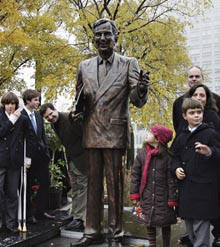
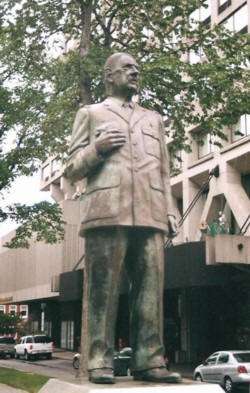
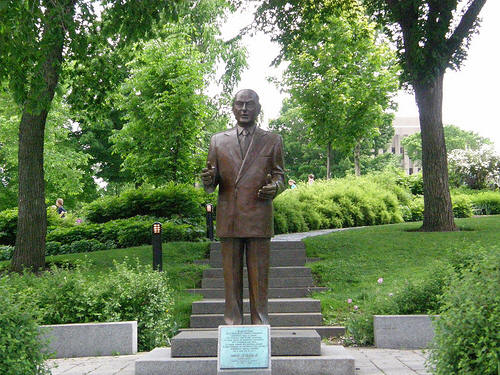
Levesque was 5′ 3″ tall. When the Quebec legislature decided to erect a statue of the former premiere, his family made it clear that they wanted none of that bombastic iconography that living hypocrites employ in honor of the dead. The statue would be 5′ 3″ tall.

Now you may think that it is only natural that a statue would be the same height as its subject. This is what the guy looked like. You can stand beside the statue and feel like this is a guy you could tell your problems to.

But most statues are not life-sized. Most statues, you see, are about 40% bigger than lifelike. Premiere Lesage stands about eight foot tall. When people walk by, they look up at this awesome man and think, what a hero!

Bourassa’s Statue.

Why is he a hero? Because his statue is so big.

Rene Levesque was also a heavy smoker. The statue makes it look like he should be holding a cigarette in his left hand, but the party leaders had to draw the line somewhere. The good citizens of Quebec generously stick real cigarettes into the bronze fingers: here, Rene, have one on me.

What goes through the minds of the functionaries, bureaucrats, and politicians when they decide on the size of a statue? Why would they make the statue eight feet tall? It seems to me that human nature is rather impure in this area. Monuments are rarely truly meant to honor the subject of the monument. They are made to honor the people who made the monument. France, for example, has innumerable monuments to wars and generals and battles. France, of course, has never won a single decisive battle in it’s history. These monuments are testaments to the spirit of denial and hypocrisy. These monuments say, “we are heroic, because we have monuments to heroes! Disregard the evidence of history: our leaders are giants!”

The monument to Levesque is unusual because it says, this was a guy who didn’t pretend to be any bigger or better than you or me. He was honest and real. He’d rather show you the unpleasant truth than a varnished lie. He knew what it was like to stand in a crowd of powerful, well-dressed men, and not be noticed. Quebec made him their first and best separatist leader.

But the leaders of the Party Quebecois want to put his monument on a pedestal so it will tower over the citizens of Quebec. They want the monument to reflect how they see themselves: Look at us and tremble! We are mighty giants!

I think they go to sleep in fear and trembling every night because they are afraid that after they die, someone will put up a monument to them, and it will be exactly the size it should be.

And Why Would the Police Lie

Why would the police lie about a thing like that?

Anyone who still believes in fairy tales might have a hard time explaining away the behavior of the Fort Lauderdale, Florida police and District Attorney’s office.

Chiquita Lowe claimed that she saw a man leaving the home of Shandra Whitehead in Fort Lauderdale on the night of April 14, 1985. Shandra had been raped and murdered. She was eight years old. Chiquita Lowe saw the man, she said in court.

The police had a suspect: he was Frank Lee Smith, a man with a criminal record. But they had no evidence linking Smith to the crime.

But they had Chiquita Lowe.

Chiquita saw Smith leave the house. The entire case– a capital case– sat on her testimony. Smith was convicted and sentenced to death. He remained on death row for eleven years, until he died, of cancer, in prison. He remained on death row for eleven years, even though Chiquita Lowe recanted her testimony. He remained on death row for eleven years while the prosecutors refused to do a DNA test to confirm or exclude his guilt.

Eventually, of course, the DNA test was done. Smith was categorically excluded. Not only was Smith exonerated, but another man, Eddie Lee Mosley, was matched to the DNA. Mosley is being held in psychiatric prisons after being found insane when he was brought up on two other murder charges.

Do the police go, “oops”?

Do they apologize?

And admit that the police can make mistakes?

Never!

Chiquita Lowe now says that the police pressured her to identify Smith. We now know enough about how the police work to imagine what they said to her.   We know the guy did it but we don’t exactly have the evidence. Do you want to be responsible for his next victim if he walks? It’s your duty to testify as to what we think you saw that night….

She also says the police never showed her a picture of Mosley though the police claim they did, and the police claim that she did not recognize him.

The police claim she did recognize Smith.

Who are you going to believe?

Lowe testified about all this at hearings to reopen the case in 1991 and 1998. The police and prosecutors said she was a liar and completely unreliable. The judge agreed. The judge didn’t seem to realize that he had just rejected as “unreliable” the only witness in support of the prosecution’s original case, a case so thin and insubstantial that it makes you wonder if there is any system at all to justice in America.

How can a judge, with a straight face, declare that a man’s life should be taken based almost entirely on the word of a single “unreliable” witness?

Well, now that the DNA evidence is in, what do the police have to say for themselves? You know what they say? You won’t believe it. They say that Smith must have been burglarizing the home at the same time that Mosley was raping and murdering little Shandra Whitehead. That’s why, they say, Lowe did see Smith fleeing the house. That’s why, they say, detectives really did overhear Smith say something incriminating as they were escorting him to jail. That’s why, they say, the police are really never wrong, though sometimes strange things happen… who knows?

The problem is not that the police occasionally make a mistake. The problem is that the police, encouraged by conservative law and order politicians and incompetent judges, have developed the habit of picking a likely suspect– preferably someone poor and uneducated and with a history of convictions– and then hanging a case on him.

It’s so much easier than investigating the crime and making a case against a real suspect.

A Victory in the War of Drugs

Russell Eugene Weston Jr., 44 years old, walked into the Capitol Building in Washington DC on July 24th, 1998, in order to save the world from cannibals, and to retrieve top secret information from a satellite system that was capable of time-travel. I’m not sure why he thought the government would be of any use to him, but he did, and when the government didn’t listen he shot and killed two guards.

He is imprisoned in Butner, North Carolina, in solitary, because, after all, he is mad. In what used to be the civilized world, he would be in some kind of treatment program where smart people with degrees in psychology would be trying to help him recover his senses. But this is America of the 21st century and bloodlust over-rules compassion so the government wants very badly to put him on trial for murder and sentence him to death.

The trouble is, of course, that Mr. Weston appears to be insane. It is a well-established facet of the modern justice system that a person who is not responsible for his actions cannot be convicted of crimes committed while he was not responsible for his actions, ie., in possession of his faculties, his reason, his ability to discern right from wrong.

A small obstacle to be sure. In a new, significant skirmish in the real drug war– the war waged by pharmaceuticals to get everybody onto drugs– a three judge panel of the U.S. Court of Appeals for the D.C. circuit ordered him to be medicated!

Mr. Weston’s lawyer– a public defender (and we all know how awesome public defenders are)– is considering an appeal. Of course, appeals ultimately end up in the hands of those robed dildos of Partisan Politics, the Supremes.

Well, what is wrong with medicating this guy so he can be ruled sane so he can be tried for murders committed while he was insane?  And then executed?   We need to provide a nice deterrent to all those crazy UFO-believers out there with guns.

Apart from the obvious– that just because medications can make him appear to be sane doesn’t mean he was sane at the time of the murders– there is the absurd circumstance of the government drugging people into certain specified conditions (guided by the high priests of mental sanitation, psychiatrists and psychologists) in order to obtain particular results from the justice system.

I know– it’s hard to wrap your mind around this issue, especially if it’s medicated. But break it down. The drugs in question are those very powerful psychotropic drugs the mission of which is to alter a person’s personality or emotions.

Is this allowed by the constitution? The very question is insane– of course not. The idea that a constitution that protects the right of privacy and freedom of speech and presumes innocence until proof of guilt is established and  validated by a duly constituted jury or judge, would permit any government body to forcibly alter a person’s mind with powerful psychotropic drugs— it’s absolutely outrageous.

But that’s not even the most objectionable part of it all. Of what use is this procedure to the prosecution? The man was probably insane when he shot the two guards. The prosecution wishes to argue that he was not insane. They are allowed to specify how his mind should be altered in order to present him as evidence in support of their view????

The precedent is shattering. With the pharmaceutical companies already revving up the corporate cheer-leaders, every prosecutor in the country will now consider the option of obtaining a court order to force prescribed personality alterations of defendants in criminal actions.

You think I’m getting carried away? What if I had told you 50 years ago that we were headed towards the kind of society in which people who are unhappy or dissatisfied with their lives in any form would go to their doctors and readily obtain prescriptions for powerful mood-altering substances that would help them cope with their terrible little lives?

You would have thought I was insane.

Artificial Stupidity: Software That Weeps

I have never liked Stephen Spielberg even when he thinks he’s being oh so serious and profound, as in “The Color Purple” and “Schindler’s List” and “Saving Private Ryan”.  I think he is a brilliant technical director, but he always feels that he has to slug you in the face with the emotional crux of his drama so you don’t miss it.   Spielberg, as is less well known, is also a shameless plagiarist.  He steals from other films, ones that are usually not well known (see the tank scene in “Saving Private Ryan” compared to Bernard Wicki’s “The Bridge”).

And he often employs the worst film music composer in history in John Williams.

I don’t think I have ever heard a piece by John Williams that I found moving in the slightest respect.  Yes, he is universally acclaimed.  He wins Oscars.   I don’t care.  On my side: he did “Star Wars”.  If you really think he’s that great— he did “Star Wars”.

I have always liked Stanley Kubrick who, in my opinion, created the greatest movie ever made in “Dr. Strangelove or How I Learned to Stop Worrying and Love the Bomb”.

So it was with stunned disbelief that I learned that Spielberg was the designated heir of Kubrick’s last film project, “AI”, about a boy created with artificial intelligence who wants to become a real boy. Pinocchio with silicon.

I am baffled by some of the early reviews of the film. The New York Times and Salon both made it sound like this was a really interesting film that might have failed on one or two points but, ultimately, represented an advance on Spielberg’s career. Well, Salon was a bit ambivalent and thought Spielberg was a true genius– when he stuck to entertainments like “Jaws” and “ET”.

Anyway, I found “AI” a big disappointment. The last hour– which seemed interminable– is Spielberg at his worst, wringing mawkish, overwrought tears from the virtual viewer with “heartrending” scenes of loss and grief.

But the real problem with this movie is the same problem countless sci-fi films have faced in the past: how to make a robot interesting. If a robot is nothing more than the sum of it’s programming and hardware, then how can it display the big emotions Hollywood regards as essential to the blockbuster film? How can software weep?

This is Spock, remember. Spock, in the original Star Trek, was supposed to something of a logic machine. He represented Reason, the ability of man to analyze and judge without the corrupting influence of emotions. But Star Trek couldn’t bear to leave Spock alone. When the captain was imperiled, the emotionless Spock would take absurd chances with the lives of the entire crew in order to save the one man he… loved?

It’s like claiming that the girl who seduced you in high school was the only virgin in your class.

If the original Star Trek had had any guts, Spock would have said, “tough luck” and instructed Scotty to plot a course to a sector of space not inhabited by gigantic amoeba’s or deadly Klingons. “It would not be rational to endanger the lives of 500 crew members in order to embark upon the marginal prospect of saving the captain’s life when I have calculated the odds against his survival to be 58,347 to 1. Furthermore, the odds of finding a replacement captain of equal or superior merit among current members of the crew are approximately 2 to 1…”

So we’re back to a robot, in AI, a little boy who replaces a seriously ill little boy in the lives of a young couple. When the real boy gets better and returns home, the mother drops the robot off in a woods somewhere and then drives off. Heart-wringing tear-jerking scene number one, and it’s milked for all it’s worth in classic Spielberg style.

We, the viewer, are supposed to feel something that the flesh-and-blood mother in the film–who cared so much about a child that she adopted an artificial one–does not.  But this is bizarre– the primary signal here, of what we should feel about this abandoned child– would normally come from the parents or siblings or friends of the child.  If they feel nothing, why should we?  Why would the mother demand a replacement for her seriously ill boy if she was going to care so little for it that she would drop it off in the woods?

The twist here is that the mother is right to feel nothing for the little robot.  He is a robot!   The deceit foisted on the viewer is that anyone would think she would feel anything for the robot in the first place.

The robot boy sets out to find the good fairy– I’m not kidding– who will turn him into a real boy. He has some adventures during which Spielberg, as is his habit, shamelessly pillages the archives for great shots, including the famous Statue of Liberty shot from “Planet of the Apes” (the first one), and various scenes from “Blade Runner”, “Mad Max”, and, well, you name it. Originality has never been Spielberg’s strong suit.

The truth is that no robot will ever have a genuine aspiration to be anything. What you are talking to, my friends, is a piece of machinery. And it is logically impossible for a machine to behave in any way other than the way it is programmed to respond, no matter how complex or advanced the programming is.

The only way around this conundrum is to imagine the possibility of incorporating organic elements into the robotic brain, something I’m sure Spielberg believes is possible. But then it’s not a robot. It’s an organism, and it may well be heartwarming to some of us, in the same way that “My Friend Flicka” and “Lassie Come Home” are heartwarming. [2011-04]

So when a robot says it wants to be human, what you really have is a human telling a machine to say it wants to be me. Is there any concept in Science Fiction so wrought with Narcissism?  So shallow and pointless?

The problem with that idea is that you would have to believe that humans would someday create sophisticated, powerful machinery that would behave in unpredictable– and uncontrollable– ways. You would also have to believe that humans would feel emotional attachments to these devices the way they attach to pets and social workers in real life.

Anyway, it’s hard to care about what happens to the boy when the premise of the film is fundamentally absurd, and Spielberg is entirely concerned with dazzling visual effects and contrived set pieces. The film opens, for example, with one of the lamest q & a sessions ever imagined, between a brilliant scientist (William Hurt) and a group of docile graduate students who lob softballs at Hurt (and the audience) in order to convey information that isn’t required by the audience anyway.

It is impossible to imagine Kubrick working with this kind of slop and incoherence. “AI” is 100% Spielberg.