Harold Shipman

In Great Britain, if you took a sampling of 1000 women between the ages of 65 and 74 who see a doctor regularly, you would normally find a death rate of 4.5 per year.

Of 1000 patients of Dr. Harold Frederick Shipman, the death rate was 45 per year. He began his own practice in Hyde in 1992. He was caught this year.

Uh yes… the numbers are not the result of chance or coincidence. Dr. Shipman has been injecting some of his patients with a fatal dose of diamorphine. He seems to have murdered 300 this way. Yes, does seem like it took a little while for anyone to notice.

Sometimes he would go into a patient’s file and alter significant facts, in order to establish the “illness” of which the patient died at his hands. No one noticed because the families of deceased patients do not get access to the deceased’s medical records.

A few people over the years became suspicious. The police were even called. But when the police went to the General Medical Council, which oversees doctors in Great Britain, they told them that unless an official complaint was received they could do nothing.

Since Dr. Shipman never summoned an ambulance or called for a coroner after any of the suspicious deaths, there were no records except his own, and therefore, no details about the exact circumstances of death, except those which he provided.

The local health authority investigated and found nothing suspicious. Again, it appears that they relied on Dr. Shipman’s records to verify Dr. Shipman’s performance. There is no system in place to monitor the performance of doctors. Think about that. There is no system in place to monitor the performance of doctors. In other words, a doctor could kill 300 patients and no one would be the wiser. Well, yes. That’s what happened.

The first public reports of the investigation of Dr. Shipman were met with outrage by the citizens of Hyde who felt that a good doctor was being tarred with a broad brushstroke. Obviously, the good citizens of Hyde hadn’t noticed anything odd either. Here was a doctor who murdered patients with great frequency. The patient’s families were notified of the death. The bodies were cremated or buried. Nobody kept score.

The police finally seized Dr. Shipman’s medical records. Ah, but they didn’t obtain the proper paperwork beforehand and had to return them. Imagine the police seizing a knife or a gun from a suspected murderer, and then being ordered to return it to the suspect because they hadn’t said “may I”? To get around this little technicality, the police charged him with homicide. Then they were permitted to investigate.

Altogether, as I said, Dr. Shipman may have killed more than 300 women.

Sometimes he did the killing in his office and saw several more patients before reporting the death.

Now this may sound like a bit of stretch, but ask yourself this, in connection with Dr. Shipman’s offenses: how do you know that your doctor is doing a good job? I’m serious. I mean, you know that your doctor is not likely to inject fatal quantities of diamorphine into your veins, but if a doctor in a developed country can get away with doing this to hundreds of women over a period of ten years, how much less likely is it that your own doctor can get away with being completely incompetent?

In other words, who is keeping score?

You can read the sports pages every day to find out if Delgado is earning his millions for the Blue Jays. How many home runs did he hit? What’s his batting average? Is he making a lot of errors over there at first base?

Why don’t we have the same thing for doctors? It doesn’t have to be ridiculously detailed. Just a simple table of visits, total number of operations, drugs prescribed, x-rays, cures, improvements, and… deaths.

There were signs of trouble with Dr. Shipman back in 1976 when he was convicted of stealing drugs and issuing fake prescriptions. But he was able to pay a modest little fine and move on. This was his minor league record. Mediocre. Not expected to make the big leagues.

But he worked at it and re-established himself and went on to establish a new record: 300 murders. That’s about 287 more than Klebold and Harris at Columbine. How many Nightlines do you think they’ll devote to this story? How many Newsweek Covers?

How many people are going to throw up their hands and scream, “What’s happening to our society! We should have zero-tolerance for deaths at the hands of doctors!”

The Mythical Open Road

As you sit in your car in the middle of yet another traffic jam in almost any major city and stare at your white knuckles, think about those beautiful car advertisements.

Obviously, Ford and Toyota and General Motors are never going to show you where you will really spend all your time in their glorious automobiles. But just because it’s obvious doesn’t mean it doesn’t deserve a round of good old fashioned outrage.

The ads show the beautiful cars– almost always perfectly, minty clean– cruising all by their lonesome selves down endless stretches of awe-inspiring roads that channel through hills and valleys, mountains and rivers, prairies and open plains. What is most astonishing about these scenarios is that there are never any other cars on the road. Nobody. Nowhere. No trucks. No cars. No ugly, fat, disgusting, gas-guzzling Winnebago’s. Nada. What a wonderful driving experience. You bet.

It’s like when they show anorexic models eating diet yogurt. Right. You’ll look like that someday. Some day if you manage to kidnap Kate Moss and transplant your brain into her body.

Nobody is surprised if car companies want to show their products in the best light. We probably generally laugh to ourselves and continue to wait for the normally scheduled program to resume. But why should we put up with this crap? Why are we so damn passive? Why can’t we muster a little righteous indignation for the outright fraud perpetuated on the consumer by these ads?

Let’s not mince words: these ads are indeed a fraud. They are filled with lies and distortion. You will never ever get to take the drive that is being offered to you. It doesn’t exist anywhere in the civilized world anymore. Why not? Because every idiot on the planet wants that driving experience so they are all stacked up behind each other on the freeways grinding their teeth and wondering why everyone else doesn’t just get off the road.

Selling the New Drug

How do the drug companies persuade doctors to prescribe their drugs? Well one company, Purdue, held over 7,000 seminars last year to “inform” doctors about “pain management”, which, of course, consists of prescribing its particularly powerful drug called “Oxycontin”. Why do the doctors go to these seminars? How about free weekend travel and hotel accommodations, to Florida and other lovely locales? (In December, United States attorneys in Maine, persuaded Purdue to stop paying for the doctor’s travel expenses to these seminars and it agreed do so.)

A spokesperson for Eli Lilly said that the company asked women and physicians about a treatment for PMDD and they told Eli Lilly that they wanted a drug with it’s own identity for this special problem. I’ll bet the same focus group told them they wanted to squander $100 a month on medicines that treat imaginary illnesses.

David Rubinow, Clinical Director of the National Institute of Mental Health, says “there is a very high degree of false positive self-assessments– women assume they are suffering from PMS or PMDD when, in fact, they are not.” If you were an investor, would you bet on that dynamic? I would.

Interesting side-effect: if Eli Lilly prevails– you can bet they are using all their influence to get “studies” that show that PMDD really exists– we will soon see court cases in which a woman claims that she shop-lifted or drove too fast or neglected a child, because of PMDD. The court will then hear that Americans spend more than $1 billion a year on treatment for this “disease”, even if it isn’t listed as one in the DSM, and will be duly impressed and find the woman not-guilty, or award somebody a hundred million dollars in damages or whatever. Then Eli Lilly will point to the court cases and say, “see– even our courts recognize that PMDD exists!” Thus you have self-fulfilling prophecy.

Saraphim, Sarafem

Lying, scheming, scoundrels!

Eli Lilly is the drug company that makes “Prozac”. Prozac, used to treat depression, is patented, which means Eli Lilly can charge a fortune for each prescription because nobody else can make or sell it. Unfortunately– hold the tears– the patent on Prozac expires in August of 2001.

Hold the tears.

Prozac is one of those wonder drugs that doctors love to prescribe to people who come in and say they are tired and depressed and sad and unhappy and tired and don’t enjoy their lives and are miserable and unhappy and tired and so on and so on and since the doctor doesn’t have the time, ability, or inclination to make the person’s life any better– to find them better jobs or spouses or children or neighborhoods or families– he prescribes a happy pill, which alters the basic chemical balance in the brain– well, it makes you happy. Like pot, except legal. And about $100 a month, which, frankly, makes pot look like value for the dollar.

But– hold the tears– soon anybody will be able to make a drug called “Prozac” and will be able to sell it for less than Eli Lilly. Lilly, one of the most profitable corporations on the face of the earth, will have to actually begin charging something close to what it actually costs to make the drug, plus a little profit.

Prozac earns Lilly about $2 billion a year. I’m not kidding. I’m not exaggerating. The Washington Post said it: $2 billion! A year! What’s a greedy corporation to do, especially after all it’s contributions to election campaigns have failed to save it’s patent!

Well, by golly, never underestimate the imagination and creativity of the drug dealers. The “legit” drug dealers, I mean. Eli Lilly has just introduced a new drug– Sarafem– and a massive advertising campaign to designed to convince you that you’re sick even if you aint. And low and behold– holy pharmaceuticals, Batman!– Sarafem, in cute little pastel colours, is nothing other than– hold those tears!– Prozac, relabeled and packaged!

Sarafem is for women suffering from PMDD. You don’t know what PMDD is? You don’t?! Shocking. How could you not be aware of an illness that is so absolutely scientifically proven that is has an official acronym? Read the magazines! Watch television! See your doctor! Ask her if you might be suffering from PMDD.

PMDD is “PreMenstrual Dysphoric Disorder”. That’s right. Phew. First of all, breathe a sigh of relief if you are a man. Since you aren’t as likely to stuff yourself full of chemicals in the first place, you can relish another opportunity to save yourself some money, because “Sarafem” costs as much as the old patented Prozac– about $100 a month. It is reported that women take Sarafem every day.

Every day! I find that stunning. Prozac is not a little pep pill or aspirin. It is a powerful psychotropic drug. And doctors and the pharmaceutical industry just blithely go about trying to persuade as many normal young women as possible to tamper with their brains.

Well, by golly, why does it cost so much? I’m glad you asked. If Prozac is no longer a patent medicine after August 2001 and anybody can make it….!

Ah– the loopholes! You see if an existing drug can find a new application, the patent on the new application of the existing drug can continue, in this case, until 2007! So while anybody can now make and market “Prozac”, only Eli Lilly can make and market Sarafem.

Yahoo! Now all we need to do is find an illness!

Now how do you find an illness? Well, in the United States, the APA (American Psychiatric Association) sort of officially defines mental illnesses. It puts out this huge book called the “DSM” which is like the Bible of mental health. You might remember a few years ago that the DSM has decided that most every energetic two-year-old is afflicted with a mental illness. Most parents have the good sense to know that their child is merely a two-year-old. But, hey, where’s the profit in that? And do “most” parents really know this? The statistics on the use of Ritalin do not encourage this assumption.

The importance of the DSM is that insurance companies use it to determine whether or not they will pay for treatments. If it aint listed, it aint covered. Of course, it is then in the interests of the health industry to ensure that almost everything is listed, so that therapists, doctors, and pharmacists can be paid.

In other words, what the DSM has actually become is a shopping catalogue of real and imagined complexes.

Anyway, we have women with periods. Periods, by all accounts, are uncomfortable and annoying. In short, they sometimes make women feel bad. Now, most people accept that PMS exists– a kind of moody irritable stage of the monthly cycle just before the period– and that drugs that alleviate the feelings of bloatedness and… whatever.. make some sense. Some.

But even the DSM doesn’t believe that PMDD really exists. It is listed in the appendix as a condition that is “under evaluation”. That doesn’t stop Eli Lilly from running advertisements that suggest that that lousy feeling you have while pushing a heavy shopping cart in an ugly grocery store with three kids screaming at you for candy can actually be blamed on an official, registered, scientifically validated “disorder”. See your doctor. Women do. They see the ad, they see their doctors, their doctors prescribe, Eli Lilly gets rich.

How can they get away with this? Well, the good old Food and Drug Administration in the U.S. has decided that Lilly’s opinion matters more than the DSM’s. It has approved Lilly marketing the drug for a non-existent disorder.

What we have here is something that, like Hyper Attention Deficit Disorder or Hyper Disorder Attention Deficit or whatever it’s called, defines normal but unpleasant conditions as a “disorder”. That is the dream disease for the drug companies because everyone has it. We have a limitless number of potential customers. All we need to do is convince them that they’re sick. And Sarafem advertises itself as the only official remedy for PMDD.

What we need are ads that show the same external conditions that the Eli Lilly ads show– tired women, ugly stores, muzak, incoherent labels, over-priced candy, noise, dust, rude clerks– with a text that runs: “Does your life stink? Try changing your life.” One thing you could do is join an organization that fights companies like Eli Lilly.

And hold the tears.

The Irvings Sink a Ship

There is a myth out there that a lot of your tax money goes to welfare cheats. True. Here’s one of them:

About 30 years ago, the Irving Corporation (a big Maritime oil company owned by the Irving family) accidentally sunk a barge loaded with PCBs in the St. Laurence River. When government scientists discovered that it was leaking deadly PCBs, the Irvings said, “surely you don’t expect us to pay for it?”.

The government raised the vessel for $45 million, cleaned up the PCB’s, then gave it back to the Irvings for a pittance, $5 million.

Why has no one been arrested? Why aren’t the Irvings sitting in jail? Why haven’t the RCMP seized the Irvings’ assets in order to sell them to pay the bill?

Because the Irvings are not like you or me, my friend. They are rich. They know politicians on a first-name basis.

Now that’s the way to do business! Thank you Mr. Chretien, now we’ll just resume our profiteering, if you don’t mind…

Bob Kerrey’s Burden

If you haven’t already read Bob Kerrey’s “confessions” to the New York Times and CBS’ 60 Minutes by now, you owe it to yourself. It is a stirring, compelling story.

It seems unfair to summarize this riveting account, but the basic facts are important. In February 1969, Bob Kerrey, a Lieutenant, the commander of a Navy Seals Squad, led his men into the village of Thanh Phong in the Mekong Delta. Shots were fired. “Thirteen to twenty” unarmed women and children were dead.

That’s really all there is. Well, you know, there is of course a long story with it. No one can live with himself having murdered twenty women and children without have a long story about it. And I don’t necessarily mean that Kerrey excuses his actions. But I do mean that when you add a long story and you admit that you are confessing a terrible secret and the secret is that you murdered twenty women and children, the truth is that you believe that what you did was different in some way from what a cold-blooded murderer does but very, very awful, but different, but awful… well, how far back can you step, from the basic facts? On my first reading of the account published in the New York Times, it certainly struck me that Bob Kerrey was confessing to a very serious crime. Just above his confession is a link to a story about attempts to prosecute the men who set a bomb off at a church in 1963 in Alabama which killed four children. You understand: we are trying to prosecute these men. And I had to wonder, of course, if anyone is going to try to prosecute Bob Kerrey.

Kerrey tells us that the women and children were killed because someone fired upon them and his men returned fire, and when they examined the bodies, they found only women and children. But he admits that before they returned fire, and before someone allegedly fired upon them, they had already murdered an old man and an old woman and three children in a hut on the outskirts of the village. If there is ambiguity about what happened to the people in the village proper, there is no ambiguity about the actions of the men earlier. They were afraid that these villagers would reveal their presence to the others.  They were not soldiers: they were civilians.  They had to be silenced. They were murdered.

Gerhard Klann, who was with Kerrey that night, doesn’t agree with Kerrey’s version. Neither does Mike Ambrose, who was also there, nor a Viet Namese woman who claimed to have witnessed the incident. Pham Tri Lahn.

Klann says they were never fired upon. Instead, they rounded up the women and children and when they realized that the man they were looking for, a Viet Cong officer, was not present, they decided to kill the villagers. They did not want to leave witnesses to the earlier murder of the grandparents and three children, and they did not want any enemy in the area to know they were there. Of course, as the Times points out, firing your weapons would certainly give away some information about yourself.

Now, there are a lot of people out there who will immediately object to my use of the word “murder”. I would expect they would argue all or any of the following:

1. “civilians”– women and children included– were known to operate as part of the Viet Cong and sometimes killed unsuspecting U.S. soldiers, therefore, Kerrey was justified in treating them as a threat to their lives.

2. This was war, after all, so you have to accept civilian casualties. The normal rules don’t apply.

3. It was all a regrettable mistake, but not something you could compare to a deliberate act under entirely different circumstances. The men were justifiably frightened.

The trouble is that all Western nations agree that, even in hostile territory, the deliberate murder of unarmed civilians is not permitted. This is the military speaking– not some pie-in-the-sky liberal pacifist. This is the standard that German officers were held to at Nuremberg. This is the standard that the U.S. has publicly agreed to in treaties and protocols signed and ratified by the government. This is the standard we are holding above the thugs and murderers of Kosovo and Serbia.

The trouble is, the civilians were unarmed. They did not attack the soldiers. They did not call out for help from hiding Viet Cong commandos. They did as they were told. They waited for the men to complete their search. Then they were shot in cold blood.

The trouble is that even if Kerrey’s account is to be believed– that they were fired upon first and that they returned fire in self-defense– they still murdered the old couple and three children in the first “hooch” in cold blood. That is a war crime. That is cold-blooded murder.

And Kerrey’s account is troubling. If they were fired upon first and returned fire in a random, panicked spree of self-defense… why were all of the civilians killed? Were none wounded?

In the movie, “The Great Escape”, a German officer informs an American commander that a group of the escapees were killed while fleeing their pursuers. “How many,” asks the American, “were wounded”. The German officer, whom we are given to understand is a honorable man fighting for the wrong side (a typical myth of militarists everywhere: that honorable men can fight for evil causes and still be “honorable”) painfully admits, “none”.

We know exactly what he means. And we know why it is so troubling that Kerrey tells us that none of the unarmed villagers were “wounded”. This is the part of the evening that Kerrey, while claiming to have made a damning confession, refuses to discuss.

There are strange ambiguities in the world. We still prosecute Nazi war criminals when we find them. We’re trying to prosecute the murderers of those four black girls in Alabama in 1963. An international tribunal in Holland is trying to bring Milosevic and his cronies to justice for similar crimes.

We throw children and young adults into brutal prisons for long terms for smoking a harmless weed. We try to impeach presidents for having sex with women they are not married to. We ruin the lives of athletes and politicians and business executives who lie or cheat or harass.

In Viet Nam, on a dark night thirty years ago, a group of American men entered a village and murdered 20 civilians. I think Kerrey is genuinely sorry it happened. But so is everybody.


Why did Kerrey do it? Why is he talking about this now?

His given reason is the usual rationale for salacious talk-shows: to advance healing. To bring closure, of course. Peace of mind. You know. And prevent if from ever happening again. But one has to consider that Kerrey ran for the Democratic nomination for President once upon a time and, with Bush not doing anything to dispel the notion that he is the country’s luckiest bozo, might run again. Suppose he was considering running in 2004. Suppose he was worried about the scrutiny his war record would have received had he become the Democratic nominee. Suppose he thought it might be smarter to get it all out now. It’s never a scandal if it’s already public knowledge (Clinton’s stupid mistake was, of course, lying about Lewinski– not the sex itself). Heck, it might even help him. He would have his war record credentials (he served, didn’t defer, didn’t dodge) front and centre, and the confessional aspect of it all might have endeared him to the public I don’t know if that’s what Kerrey is thinking, but you’d be a fool to not tuck this possibility into the back of your mind somewhere and save it for 2004..

In an eerie echo of Viet Nam era propaganda battles, Kerrey now accuses CBS and the New York Times with “collaboration” with the enemy. Uh, Bob, this is 2001…. And Bob, it doesn’t dignify you to sling mud no matter how much you disagree with the information posted in the New York Times or on “60 Minutes”


Has the story taken an even uglier turn? Kerrey met with six of the seven members of his commando team on April 27th for a long, evening meeting. The ostensible purpose of the meeting was to get their stories straight. The six emerged from the meeting all agreeing that they had been fired upon first by the enemy before returning fire. They all denied that villagers had been rounded up and shot.

What is kind of strange here is this: Kerrey has admitted to an act that certainly should raise questions about criminal prosecution. Then he held a meeting with all the American witnesses– except for Gerhard Klann, who denies that shots were fired at the commandos– to coordinate their stories. If Kerrey had been charged, it would be illegal, of course, for witnesses to gather together to “get their story straight”.

Kerrey and the six commandos then issued a press release insisting that they had been fired upon first. Why should we believe this account? To contradict this story would be to admit to cold-blooded murder, and the six ex-commandos would not likely embrace any other alternative. I’m not saying that we know their statement is false. But no court of law in America would accept or even allow the testimony of six witnesses who met together prior to giving testimony in order to coordinate their stories.

It should be noted that there are problems with this story in any case. First of all, none of Kerrey’s men were wounded. Secondly, all of the villagers died in the first hail of bullets, according to Kerrey. They all died? Not a single survivor? Not a single wounded? This strains credulity.

Kerrey also initially denied that he had anything to do with the murder of an old man at a “hooch” (hut) at the outskirts of the village. Now he admits, “we used lethal methods to keep our presence from being detected”. Oh the euphemisms! This one smells. Try “we killed several villagers at the outskirts of Thanh Phong so they wouldn’t give us away.”

“The unanimous view of the six was that we were young men and we did what was right and what was necessary”. The defendants have spoken: they’re not guilty. Think about it. He can’t have it both ways. Either the civilians were killed in cold blood or you were shot at and there is no need for the “we were young” and the “right and necessary”. No need at all.

What has being “young” to do with it? What is he trying to excuse, for which we would be less forgiving if they had been “old”? 2008-05

One last note: Kerrey received a medal for this action. Think about that. No Viet Cong were killed. No military objectives were achieved. The raid was not even successful in any sense at all. But, by golly, you get medals for failure in the army.

The “High-Quality” TV Show

The networks argue that there have been fewer and fewer local programs and that viewers much prefer to watch what the networks have to offer anyway. The networks, also noting the continued loss of their audience to cable TV, say they need to accrue more control to be able to afford the high-quality shows the viewing public expects of them. NY Times, April 23, 2001

I love that last line: “The high-quality shows”… like the Bette Midler Show? Two Guys and Girl? The Geena Davis Show? Donny and Marie? “Veronica’s Closet”? Mr. Ed? “Family Law”? “Survivor”? “Who Wants to Marry a Millionaire”? Reminds me of Eli Lilly’s claims that women and physicians simply demanded that they repackage Prozac as pastel-coloured “Sarafem”, as a treatment for a mythical disorder called PMDD (PreMenstrual Dyphoric Dysfunction).

What people want? Or what insiders demand? What friends and cronies can arrange?

“What About Raymond” is produced by a company owned by David Letterman. “Veronica’s Closet” is owned by the makers of “Friends”. Disney, which owns ABC, also owns Touchstone Television, which produced “Once and Again”. All of these shows might well have been cancelled had it not been for the connections to the right people. What about all the children’s shows with tie-ins to toy manufacturers and fast-food outlets and record companies? What about idiotic “reality” shows that are simply extremely cheap to produce?

It’s one thing to be a greedy corporation. It’s one thing to be greedy and dishonest. But when corporations try to tell us that we really want the tackiest, most exploitive, and stupid products– nay, that we demand these idiocies… It reminds me of when I complained to the post office about the crap they stick in my mail box every day. They actually tried, with a straight face, to tell me that most people actually want the information in those fliers.

My response is always this: if you really believe that, would you agree to abide by the results of a poll of what people really want?

The question is, should people have a choice about the crap that gets stuffed into their mailboxes, or on their tv screen, or their computer desktops?

Satirical Misappropriation: Gone With the Wind

Randall said she did not know about any of that. “It was just my simple understanding that I thought you were allowed to write parodies in America,” she said, “I have read parodies, and I wanted to write one.” NY Times, April 26, 2001

Alice Randall, a black country and western song-writer, has written a novel called “The Wind Done Gone” which sounds like it might be a wonderful parody of “Gone With the Wind”. But the soul-less Scarlet police who guard the “legacy” (ha ha ha) of Margaret Mitchell’s ridiculous novel have taken Randall to court to prevent her novel from being published by Houghton-Mifflin (preview copies now fetch $250 each on eBay). They have argued that the novel is an infringement of copyright because she uses characters and settings from the original Mitchell novel.

Well, duh.

Exactly how would you do a parody without referencing the subject of the parody?

A Federal District Court in Atlanta decided that Randall would just have to do her parody without the subject. It ruled that Houghton-Mifflin could not publish and sell her book. The ruling is being appealed.

And it should be. It’s a dumb ruling.


Update – May 25, 2001: A higher court has just ruled that publication of the book can proceed, because the lower court’s ruling makes too great an infringement on the right of free speech, because it is “prior restraint”.

Interesting note: Microsoft, Dow Jones & Company, and AOL Time Warner have filed briefs in support of Ms. Randall. I’m not sure why, but it’s curious.

Three Bad Stories

The four officers were found to be defending themselves when they fired 41 shots at the West African immigrant, striking him 19 times, two police sources, speaking on condition of anonymity, told The Associated Press.

The four officers — Kenneth Boss, Sean Carroll, Edward McMellon and Richard Murphy — encountered Diallo in the vestibule of his Bronx apartment building on Feb. 4, 1999, while searching for a rape suspect. They opened fire when they saw what they thought was a gun; it turned out to be his wallet. All four were acquitted of criminal charges last year. New York Times, Thursday, April 26, 2001

Sometimes a story hardly needs comment. The seeds of it’s own outrageous absurdity are already planted, in all their imminent glory, in the very words that tell the tale. In this case– “41 shots”. The only thing left to comment on is the bizarre distortion applied to an issue like the Diallo case because the bar of absurdity has been raised so high. Those who defend the police argue that because Diallo was reaching for his wallet– which some reasonable people might regard as a rather foolish thing to do with a number of New York’s finest closing in aggressively– the police are justified in applying lethal force. The argument appears to be that the police, given their dangerous occupation, can’t afford to wait to see if it really is a wallet. Thus if they win the point that the officers thought it might have been a gun, which is the only point they have a chance of winning, they would seem to prevail and the officers would get off scot free.

But the real issue is the 41 shots. There were four officers. If they had each fired once or twice, you could argue that they were jittery and too quick and maybe even incompetent. If that had been the case, they should simply have been fired. In a dream world, good heavens, they might even have been charged with criminal negligence. But the fact that each officer fired and fired and continued to fire can only be explained by one thing, and that is that they wanted to make sure that nobody was going to survive to go to court and testify that four big, mighty, manly New York police officers went ballistic and fired their guns at him for no good reason at all.

In reality, even if Diallo had been reaching for a gun, the officers, by any reasonable standard, should still have been charged with murder, because there were four of them, and because they obviously had no intention of arresting or disabling or wounding Diallo: they fully intended to kill him.

As it turns out, they may have correctly surmised that a dead Diallo would be easier to deal with than a living witness to their actions, since Diallo, of course, is not available to deny that he even reached for his wallet.


Cabaret (Pantages Theatre Toronto, 2001; Theatre Kent 1992)

Pantages Theatre, Toronto, April 23, 2001

“Cabaret”, after all, is still a musical.

You know– those dippy concoctions in which impossibly handsome lumberjacks sing schmaltzy love songs to dainty girls with kerchiefs in their hair while throwing them over hay stacks and pitch-forking in unison. Absurdities, in other words. Something which, in the right context, could be mistaken for a parody of something that is stupid it couldn’t possible exist in an original form.
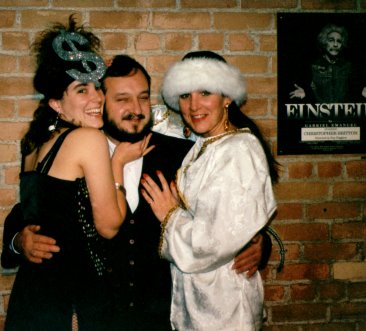
cabaret129.jpg (31150 bytes)

The author with two members of the “Cabaret” cast, Theatre Kent, Chatham, Ontario (1992).
(Photos from 1992 Theatre Kent production of Cabaret, Chatham, On.)

Yes, you heard it here first: the musical is no more of an “art form” than ceramics or collectible dolls or the can-can.

So Cabaret is still a musical, and so, at some point, Sally Bowles sings a dippy love song about this man (Cliff) just maybe being the one who will turn out to be “different” from all the other one-night stands, and might be that one special person with whom she can build an enduring relationship and it’s obviously a showpiece number, and the audience is expected to applaud at the end of the song even though it occurs in the middle of what is supposed to be a play, a story, a narrative, and even though the guy is gay.

By the way– I have to rant about this for a moment– the theatrical tradition of applauding at the end of a musical number within a theatrical performance is absolutely disgusting, contemptible, idiotic, annoying, and stupid. I hate it. If the drama is worth watching, the last thing in the world you want is for the audience to suddenly break out into applause. The drama is supposed to flow from scene to scene. Contrasts and ironies are developed and intensified. Emotions are pitched. Characters are illuminated. But, suddenly: hey, great singing there Alphonso! Bravo! What a show-stopper! Now, what was the girl doing with the rope around her neck?

Most musicals– however– deserve the interruptions.  They are mostly pabulum, bland confections of trite melodic ditties.

“Cabaret” is not trite.  It’s a very acute, perceptive dissection of the critical period in German history.

But the audience was trained:  they applauded after every song.

Now, in all fairness, most of the singing in Cabaret takes place in the Kit-Kat club, so the applause is not as disruptive as it is for, say, “The Sound of Music”, wherein we all applaud the children going to their bedrooms, or a nun dancing on what is supposed to be a hillside.

As I said, for most musicals– a phony art form if ever there was one– the applause at the end of each song is not really a problem because I never hear it because I rarely go to musicals. Do I really want to see “Oklahoma”? No. Do I think “The Sound of Music” really illuminates the nature of the Nazi terror? Not a chance. Does “Oliver” move me to some kind of state of contemplative bliss? Oh, please…

For the record, I have seen some musicals, live, on-stage, as well as a few on film. Here’s a list that I can remember off-hand:

  • Oklahoma (so very weird)
  • The Producers (delicious and funny, because it mocks the musical)
  • The Sound of Music (compared to “Cabaret”)
  • Fiddler on the Roof (least bad of this lot)
  • Cabaret (a twisted work of dark genius)
  • Hair (a musical with pseudo-rock songs in it.  The Milos Forman movie version is interesting.)
  • Oliver (can’t remember)
  • Showboat (boring, sorry.)
  • Camelot (awful)
  • West Side Story (Natalie Wood’s vocals were recorded by Marni Nixon– need I say anything more about phoniness?)
  • South Pacific (dumb, dumb, dumb)
  • My Fair Lady (who cares)

I have also seen and enjoyed “Jesus Christ Superstar” live and on film, and “Evita” on film, but neither of these are really musicals. They are operas. The word “opera” is death at the box office, so they are advertised as “musicals”. Get it straight: “Jesus Christ Superstar” is an opera, in form and style and design. It has arias and recitatives and the entire narrative is contained in the songs. It is an OPERA. And so is “Evita”.

(Backstage)

Anyway, back to “Cabaret”. “Cabaret” is loosely based on a book by Christopher Isherwood that is a fictionalization of his life in Berlin during the rise of the Nazis. It’s really not a very good book. It’s interesting, and it’s not awful, but it’s not great literature. But he did create some memorable characters and we don’t really have very much good English writing on Berlin in the 1920’s or 30’s so it stands out. In 1951, a guy named John Van Druten thought so too and wrote a drama (not a musical) based on the stories and it was produced on Broadway with Julie Harris and it was deemed a success. In the 1960’s, Hal Prince decided to develop it into a musical and recruited a couple of guys named John Kander and Fred Ebb to create the songs. Joel Grey created an absolutely unforgettable “Emcee”, and in 1966 the Broadway production won 8 Tony awards including “Best Musical”. In 1972, Bob Fosse made it into an exceptionally good film– except for the awful casting of Peter York as “Cliff” and Liza Minnelli as Sally Bowles– which won numerous Oscars including “Best Director”. Joel Grey indispensably reprised his role as the Emcee.

The production I saw live at the Pantages was “directed” by Sam Mendes, who directed the film “American Beauty”. Did Sam Mendes actually direct this version? I doubt it. More likely, this staging of Cabaret was based on his original staging, but directed by Rob Marshall.

Now, odd things happen to brilliant talents in our culture. We live in a democratic, free society. The powers that be do not censor our literature or movies or theatre. That means, in theory, that you can say anything you want in a play or movie or book, and no one will arrest you and prevent people from seeing or reading what you have to say.

No. But we go one better: when someone presents a disagreeable message to us, a message that might imply that there are faults or sins or crimes in the way we– the collective “we”, the audience– act, we simply appropriate the message, repackage it, and make it into a cultural artifact.

Consider, if you will, the title song of “Cabaret”.

What good is sitting alone in your room?
Come hear the music play,
Life is a cabaret, old chum,
Come to the cabaret

A line from this song– “What good is sitting alone in your room”– has been appropriated by SFX productions for the advertising of the touring version of “Cabaret”. Obviously it means, in this context, don’t stay home watching television or playing cards or staring discontentedly at your spouse! Get up off your fat duff, whip out your credit card, and fork over $80 for a crummy seat at a large theatre and watch our packaged presentation of a musical that collected amazing critical reviews and therefore must be artistic and telling your friends you saw it will confirm your good taste. Get out! Have a great time! Make it dinner and a show, and stay overnight at the Ramada with the pool and sauna and calypso bar! Enjoy yourself! Live!

The trouble is, that’s not what the song means at all. In the context of the play, Sally is announcing her refusal to accept reality, or any kind of responsibility for the monumental evil that is closing in around her. When Cliff announces his disgust with the Nazis, Sally says, “but what has politics to do with us?” Cliff tells her that she is blind. And the play tells us that this diseased society– Berlin of the 1930’s– has opened itself to the infusion of Nazi ideals. And Sally blithely sings on, “life is a cabaret, old chum…” Is this the sentiment the audience wishes to identify with?

I grant you– the advertising itself might be playing with irony. But I doubt it.

In the original production by Hal Prince, another line did cause consternation. The Emcee does a little dance with a gorilla, while singing to the audience that, if they could only see her through his eyes, they would realize how beautiful and desirable she was. At the end of the song, he sings,

if you could see her through my eyes/
she wouldn’t look Jewish at all.

It’s a terrific line. It’s a fabulous line. It’s the entire heart and soul of the play’s anti-nazi sentiment. And it was rejected by the original producers and deleted from the production! Why? Because they thought it would imply that the play’s producers thought that Jews resembled gorillas? Yes. They thought Jewish Theatre-goers would be offended by it!

I am sometimes filled with wonder at this crazy world of ours.

Cabaret is a “concept musical”. That is, instead of lumberjacks singing to virginal maidens while dancing through the fields, the trees themselves sing. Just kidding. I mean that there is never any pretense that the music pops out of real-life situations into a tiny set-piece before the drama resumes. In “Cabaret”, the music is organically and symbolically linked to the drama, and becomes a metaphorical part of the narrative. The Emcee, for example, often intrudes on the action, singing a line, or, through facial expression, passing ironic judgment on the characters.

Ah… but in this new production, the Emcee has also changed.

In the original, Joel Grey was a magnetic, ambiguous personality. He invites you in to the Kit-Kat Klub, to leave your troubles outside and live for the moment. He urges you to enjoy life to it’s fullest without inhibition or hesitation. The ambiguity in this part is critical: he is simultaneously attractive and repulsive. He glowers and caresses, cajoles and demands. He is sexually ambiguous too– androgynous, asexual, an object of fantasy or domination. One minute he is rhapsodizing about the pleasures of a ménage a trois, the next he is a menacing storm trooper, winking to the audience– this is a game we all can play. The swastikas, the leather, the boots mean nothing. It is just another fetish. Grey’s performance is the richest, most entrancing element of the movie version, precisely because he doesn’t offer the viewer any shortcuts or simplified perspectives. While the owners of the club are beaten to a pulp by Nazi thugs, the camera cuts back to Grey, leering, laughing, chasing the cabaret girls in their lacey underwear. We’re all part of it…

In the current touring stage version of Cabaret, the Emcee looks more like Edward Scissorshands. He is pale, intoxicated, and diminished. He is, in the words of Joe Masteroff (author of the book of the original version), a “figure of doom”. During the first performance of “Tomorrow Belongs to Me”, the sinister anthem to the rising power of the disciplined Nazis, the Emcee bares his ass: it has a swastika painted on it.

The audience can relax: evil has been conspicuously labeled and we are inoculated against the seductiveness of it all.

Which brings to me a certain ambiguity at the heart of “Cabaret”. You have a number of likeable characters at the center of the story who indulge in various degrees of licentious behavior and then you have the big bad Nazis trampling through the scenery hauling everyone off, presumably, to concentration camps. I’m not sure we want to draw a moral from the story, but if we did, what would it be? Isherwood was gay, so surely he wouldn’t want to have suggested that sexual immorality– defined in the broad strokes of the KitKat Klub– leads, as a consequence, to repressive, authoritarian governments? Cliff (or Brian, in the movie) leaves Berlin because he sees the Nazis as a genuine threat while Sally is blind to them. So he has “come to his senses”. So he goes back to America where he could be arrested for having sex with another man, and where plays like “Cabaret” have to conceal the homosexuality of one of it’s lead characters in order to find an audience on Broadway.

It’s a neat ambiguity. But then, Isherwood always insisted that his perspective was that of a camera– recording, but not judging.

Conversely, the orchestra is now comprised of beautiful women. In the original, the orchestra consisted of lumpy middle-aged men garishly dressed as women. Why the change? I don’t know. The first view of the orchestra in the film version is quite shocking, disturbing. How far will people go in this place? What is this Emcee leading us into? Is there any sanity in this place?

The Toronto production is smooth and efficient and even somewhat elegant. The orchestra is extremely tight and well-mannered, though the New York Times reported that the original revival production tried to sound more “authentic” and raw, as a real orchestra in the real original clubs would have sounded.


Christopher Isherwood lived in Berlin between 1930 and 1933. He wrote, of course, but paid the bills with English lessons. It was here that he met Jean Ross and the other persons who inspired the character sketches of “I am a Camera”. Isherwood later moved to the United States and taught English and wrote screenplays in California. “I am a Camera” was not a great success until the dramatization by John Van Druten made it’s mark in the 1950’s. In this version, as in the later movie, Cliff Bradshaw’s homosexuality was downplayed.

A book inscribed to “Jean Ross”, from Christopher Isherwood himself, was recently offered for auction at $12,500 by James S. Jaffe Rare Books.

Hal Prince on the movie version of Evita:

I must say I think that’s where the movie failed for me. They didn’t take that into account. They didn’t bother to figure out what was behind its underpinnings in the first place – and JUST told the story.

Did you like “The Money Song”? I did too. One of the highlights of the show. But it wasn’t written for the original “Cabaret”. It was created for the film version. But wait– you saw it in a live production?! Dang right. The movies rule! After the success of the Bob Fosse film, the stage version incorporated “The Money Song” too. Cross fertilization? Or homogenization?

Movies rule? Bill, check yourself. According to Hal Prince, the returns on “Phantom” are far greater than the total returns on the movie “Titanic”. Why? Because “Phantom” has played to sold-out houses for 11 years at, like, $45 a pop, whereas “Titanic” played to sold-out houses for three months at about $8 a pop. Hal Prince reports meeting people who have seen “Phantom” 75 times. He thinks that’s great. I’m not sure I don’t think it’s sick. What kind of person, do you think, sees “Phantom” 75 times? Think about it.

In it’s first incarnation, the German officers in “The Sound of Music” did not wear swastikas.

We now believe, in fact, that it is one of the great terrible illusions that we create an automatic redemption in such events as the Nazi era. Dr. James Young, Professor of English and Judaic Studies, University of Mass.
