McCaine Mutiny

There is a lot to be learned about the Republican Party from the failed candidacy of John McCain.

First of all, there is the bizarre logic of the primary process. The object of the primaries is to nominate a candidate who can represent the values of the Republican Party and win an election against the nominee from the Democrats. But you wouldn’t know it from this primary.

There is a certain percentage of the electorate who will vote upon party lines regardless of who the nominee is. But in order to win the election, you must appeal to more of the undecided, moderate voters than your opponent does. It was rather hysterical, in this context, to hear George Bush Jr. complain bitterly about John McCain appealing to Democrats and independents in order to win the Michigan primary. In other words, the outrageous John McCain actually positioned himself well to win the general election. Is that the kind of candidate you want??? Well… it is, sort of.

But the larger lesson is that the Republican Party really is, baldly and absolutely, the party of Big Money. Bush and McCain did not disagree on any major policy issue except what to do with the budget surplus (Bush wants to give it to the rich in the form of a tax break, while McCain wants to use it to pay down the debt and fortify Medicare) and campaign finance reform. McCain wants to eliminate the notorious “soft money” from election campaigns; Bush doesn’t.

The fundamental difference between the two men is that George Bush Jr. understands and likes the symbiotic relationship between the wealthy and Republican politics, and McCain does not. Bush understands that, in exchange for the millions of dollars in campaign financing he has received, he will enact certain policies and agendas that will generously benefit his rich sponsors, including, especially, his mammoth proposed tax break for the rich. McCain sees that relationship as something that essentially corrupts the political process. Instead of making decisions based on what is best for all Americans, Bush Jr. will be making decisions based on the best interests of his generous buddies.

The Republicans would have you believe that the Democrats do the same thing. But even the Republicans admit that the special interests that the Democrats are generally beholden to are groups, like the labor unions and the NAACP and teachers’ associations and so on. So at least the Democrats are beholden to large numbers of people, instead of a small minority of wealthy capitalists.

Gore has smartly positioned himself right behind McCain. He has offered to forego the use of all “soft” money if Bush Jr. also agrees.

Fat chance, and Gore knows it, and Bush knows it.

Cherry Pie in the Face

Hockey Night in Canada should fire Don Cherry.  The man is a complete fraud.

Don Cherry is a former NHL coach.  I emphasize the word “former”.  After short tours with the Boston Bruins and Colorado Flames, nobody wanted him anymore.  He was offered a post on Hockey Night in Canada.  He’s been there ever since, telling everyone else how to run their hockey teams.

His one virtue is he speaks his mind without thinking– if you can call that a virtue.  It is entertainment, but I wouldn’t call it a virtue.  For some reason (well, the reason is obvious– it wins viewers), Don Cherry is allowed to speak his mind on HNIC when nobody else is.  Remember Dave Hodge was fired for flipping a pencil when HNIC declined to switch to the last few minutes of an important game in Montreal instead of going to advertising.

Cherry lambastes coaches, referees, and players– especially European or Russian players–during the intermissions of hockey games.  You get the impression that if only Don Cherry were in charge of the Leafs or the Flyers or the Canadiens, the Stanley Cup would be a sure thing.

But wait a minute!  Don Cherry is in charge.  Don Cherry owns an Ontario Junior “A” hockey team called the Mississauga Ice Dogs.  Wow.  This team must be doing really great, right?

The Mississauga Ice Dogs are currently on pace to set a record all right.  It has about 8 wins.  It is about to set a record for the fewest points ever for a Junior “A” franchise.   The Ice Dogs have one of the top positions in next year’s OHL Junior “A” draft sown up.  But the most talented eligible players don’t want to play for Don Cherry’s team.

One of the biggest problems with the team is that many of the employees are members of Don Cherry’s family.  Another problem is that Don Cherry hires a coach, puts him in charge of the team’s performance, and then second-guesses all of his decisions.

And, of course, Cherry doesn’t want any Russian or European players on his team.

The result of these policies is that the Ice Dogs are the worst team in junior hockey.  Cherry should admit he doesn’t know anything about hockey.  He just mouths off at every opportunity.

It’s time for Hockey Night in Canada to bring in an expert analyst instead.

Time Magazine’s Big Lie

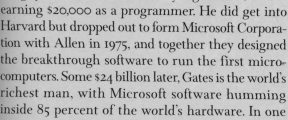
Time Magazine recently released an issue devoted to movers and shakers of the 20th century. I found an interesting little item on Bill Gates:

gates_txt.jpg (29609 bytes)

This is a lie.  It’s not a difference of opinion held by the editors of a popular news magazine: it is a lie, plain and simple.

Interesting, isn’t it? “..together they designed the breakthrough software to run the first microcomputers…”

A few points:

1. Gates was kicked out of Harvard for stealing computer time– he didn’t “drop out”.

2. Gary Kildall designed “DOS”, or CP/M as it was then known. Bill Gates and Paul Allen did NOT. When Kildall and IBM were unable to reach an agreement on the use of CP/M for the new IBM PC, IBM went to Bill Gates. Gates realized that a version of Kildall’s CP/M– called “QDOS” from Seattle Computer Products could do the trick, so Paul Allen licensed it and he and Gates turned around and licensed it to IBM. Kildall later discovered that QDOS was a virtual copy of CP/M, sued, and then settled out of court with IBM.

IBM does not settle out of court if they are right.  They settle out of court to mitigate their losses against the likelihood of losing in court.

History is so enamored of material success that it begins to re-write itself. Suddenly, not only is Gates greedily, madly, insanely rich– he must deserve it in some way!

2. The software they didn’t create– DOS– was as much of a “breakthrough” as the Edsel, especially as the years went by and it was solely in Microsoft’s hands.  It was a piece of dated, inadequate code that couldn’t even address memory above 640K for more than 10 years. The “breakthrough” was the Macintosh OS from Apple, which Gates shamelessly pillaged for Windows, and which itself stole from the Xerox lab at Palo Alto. Breakthrough? Geosworks was a breakthrough, and unlike Windows, it worked. Breakthrough? The 80386 chip was a breakthrough. But Windows still runs as if it’s on a 8088– it can’t multi-task or multi-thread. Breakthrough? On the same machine, Linux hums and 0S/2 throbs.

3. Microsoft software “humming”??? “Humming”???? “Humming”????? The person who wrote this little blurb was insane. Was Time soliciting new advertising from Microsoft at the time this little piece of shit was written?

Let us pray that “history” has more regard for the truth than Time Magazine or Bill Gates.

The Diagnosis

It is so important to give it a label.

You feel tired. You are bored. You are frustrated. Maybe you’re also not very bright or ambitious. You don’t want to tell people you are tired and bored and frustrated and not very ambitious, because that would make it sound like it’s your own fault. So, instead, you have chronic fatigue syndrome.

Maybe your two-year-old is really active. He climbs up everything. He’s loud and noisy and eager and excitable. You find this annoying. But you can’t tell anyone that you find your own kid annoying or that you are too impatient to be a good parent, so, instead, you say that he has attention deficit disorder and pop some drugs into him to slow him down.  Sure, it takes away some of his energy and curiosity, but, hey, you have to get your sleep.

The diagnosis, in our society, is essential. We need that label. We need an identifier. We have to generate public belief in and enthusiasm for conditions that might be nebulous, vague, or invisible.

Why?

Well, almost every time you hear the diagnostic label being propounded, it’s by someone who makes his or her living treating it. This is why the bible of psychotherapy, the DSM III or IV or V or whatever it’s at now, always gets bigger and bigger. It never shrinks. They almost never remove “syndromes” from it. (It caused a bit of nudging and winking when they did finally remove homosexuality from their list of morbidities not all that long ago.)

And that’s why pharmaceutical companies are determined to get your kid into their slimy clutches. They are promoting the idea that a four-year-old who wont go to bed nicely when asked has some kind of mental disorder and needs to be drugged. Once your kid is used to those colorful little pills twelve times a day, they know he’ll never, ever again feel that he can handle life without some kind of narcotic assistance.  His “baseline” is obliterated.  Whatever he feels from now on will be partly due to the drugs and partly due to withdrawal from the drugs.  The perfecta of pharmaceutical self-sufficiency.

The magic of the diagnosis is clear. Some people will deny that feeling tired or frustrated or depressed is an illness. Some people might think its just part of life. You put up with it. You endure it, and get on with the things you have to do.

But it’s easy to convince people otherwise. If you have the proper label for something, people will assume that adequate research and scientific analysis has determined that this condition really exists. We trust doctors. They’ll assume that a doctor made the diagnosis, and everyone knows how smart doctors are. They’ll assume that everyone thinks it is a real condition because it has become part of the language. It becomes shorthand, to a lot of people, for complexities that are too hard to explain quickly.

When I was a lot younger, if I heard someone say something like, “he has attention deficit disorder”, I would just assume that there was such a thing as “attention deficit disorder”, and therefore we better do something about it. Now I’m a lot more skeptical, but I can remember how easy it was to accept sophisticated-sounding terms like that as if they referred to clear, objective realities.

When you look at the “symptoms” of chronic fatigue syndrome, you realize how utterly subjective and arbitrary labels can be. Tiredness. Depression. Loss of appetite. Headaches. Difficult to get up in the morning. And so on. Sounds like just about anyone’s rotten little life. Label it, and we can blame someone or something else. Label it, and we can talk multi-million dollar lawsuits. Label it and we can make a drug that fixes it. Then we are not “doing drugs”. We are doing “therapy”. We are taking the “wonder drugs”, Lithium and Prozac and Paxil, and whatever. It’s okay– we have to take these drugs: we have a condition.

The drugs, of course, don’t really fix anything. They give you a sustained high. It is one of the great myths of our society that drugs like Lithium and Prozac actually treat real conditions. That is utter nonsense. They simply make you feel good. But we have to believe in the myth, or else we would have to admit that we’re really not much better than your average drug addict or alcoholic.

Well, we’re not.

I heard some parents on the radio recently (the CBC) talking about their “hyper-active” child. The parents of this child were at their wits end. They didn’t know what to do. They went to the doctor. He prescribed Ritalin. They tried it. It worked! Hallelujah. However, their child just didn’t seem to be herself anymore. She lost her sense of insatiable curiosity. She lost her spark, her zest for life. They took her off Ritalin and tried different parenting techniques instead. From the details the father gave on the air, it was clear that he and his wife simply got better at parenting. They learned to anticipate when problems might occur. They planned ahead for family outings. They became more flexible and adaptable. Amazingly, the problems seemed to go away.

Was their child ever really “hyper-active”? If you read the definition of hyper-activity from the DSM, it is an amazingly accurate description of just about any two-year-old.

Beware of labels.

Update 2022-04-26

And I will concede that this will not a popular post.  I am regularly astounded at how many people I know are taking psychotropic drugs, and obviously I am very skeptical of their use.  I am wary of hurting people’s feelings.  But there is good reason to voice my dissent no matter how small a minority I represent.  We in danger, as a society, of building a world in which we continually anesthetize ourselves against our deepest anxieties.  We have good reason to be anxious: we are melting the ice caps.  We are promoting intolerance and bigotry.  We are more divided than ever before.  We should be anxious and the worst solution is to address our anxiety with palliatives.

Robin Sharpe and the Supreme Court of Canada

The Supreme Court Handles a Tough One

Is it possible to consider this issue, soberly, and intelligently?

You are probably familiar now with the Robin Sharpe case that is now before the Supreme Court of Canada.

Nobody is saying that Robin Sharpe is a nice man. Sharpe was arrested by the police in Vancouver for possession of child pornography, an offense punishable under the Criminal Code of Canada– Federal Law. Newspaper accounts are rather sketchy about the details of the arrest, but we know what it is that the law said was illegal: he had, in his possession, images and texts describing sexual acts involving children.

Sharpe did not argue that people should be allowed to create child pornography and sell and distribute it. Most people don’t care about the distinction, but I do. He did argue, in court, that the law as worded was too broad. He argued that the law appeared to make it a criminal offense to even think about having sex with children. The law certainly made it a criminal offense to record such thoughts on paper, even if nobody else ever reads them, or sees them. Robin Sharpe, and his lawyers, and the British Columbia Civil Liberties Union, believe that this part of the law restricts his freedom to think and imagine. It infringes on an individual’s right to have an unfettered imagination. It opens a Pandora’s box of interpretation and analysis that cannot possibly result in just actions by the police. It is not the business of the government, or anyone, to make thoughts illegal.

You have to think carefully about what the law is trying to prohibit here. It prohibits the expression, in any form, of specific imaginary experiences (as well as real experiences). In this case, we are talking about a man who likes to fantasize about having sex with very young boys. But the law is never specific. It doesn’t tell you in advance what kind of person to arrest. Conceivably, a girl having dreams about being molested by a teacher could be arrested for writing them down. Well, we know that we would never arrest such a person, would we? For one thing, in practice, we always assume that the girl, in this instance, is the victim, even if they are her fantasies.

The law, however, should never make assumptions. And the law doesn’t help us make the kind of distinctions that might be required: what is imagination? Who is the victim? What is a dream? What is poetry? What is documentation? What is fiction? What if the girl imagined herself as the teacher that was molesting her? There is a raft of issues that could complicate the process of deciding if possession of this particular document or image is a crime. Is there a way to ensure that all of these issues are addressed in a consistent, convincing manner, to ensure that the right person is always punished? In a society that can’t even agree on what the rules are for political secession?

Two lower British Columbia courts have ruled in favor of Sharpe. They have ruled that the law goes too far. They have argued that if the principle is allowed to stand, then it will also be legal to arrest people for thinking and writing other things. It is a bedrock principle of our legal system that all of our citizens have the right to hold personal opinions no matter how unpopular they are. You cannot disobey most laws, but you can criticize them all you want, and advocate for changes to them.

The problem with discussing the issue with anyone is that people find the very idea of child pornography so repugnant that they react very emotionally to the issue and quickly pronounce themselves in favor of any law, no matter how ill-considered, that makes child pornography illegal. The courts, of course, cannot afford to be so cavalier.

Ironically, some of the groups most enthusiastic about keeping the law are the ones who also constantly rant about getting the government off our backs. They claim the government plays an excessive role in our society, when they advocate for the poor, or homosexuals, or other minorities. In this instance, however, they want to give the government extraordinary latitude in dealing with a particular type of activity.

You may recall the hysteria surrounding allegations of Satanic Ritual Abuse in the 1980’s. Similar emotions were at play. The result was a massive “witch-hunt” of mind-boggling proportions, in which dozens of innocent men and women were imprisoned, and hundreds of innocent lives were destroyed. After a few years of sober, second thoughts, and a re-analysis of the way the investigations were conducted, almost all of these cases were tossed out of court. Just a few months ago, charges against Bob Kelly, who was at the centre of one of the most infamous of these cases (the Edenton “Little Rascals” case) were finally dropped. (In spite of the fact that superior courts consistently ruled that these investigations were almost criminally sloppy and ill-conceived, no one, to my knowledge, has apologized for destroying the lives of the innocent men and women caught up in these events.)

Why did these cases go forward in the first place? For the same reason many people wish to see the Supreme Court uphold the child pornography laws: because they hate child pornography and they are willing to make compromises in order to believe that we are actually doing something about it. These people, including the Reform Party, believe that if the Supreme Court upholds the lower court appeal decisions, then Parliament should invoke the “notwithstanding” clause of the Bill of Rights and enforce the law anyway.

But if the Supreme Court rules that it can be made illegal to possess images and texts that describe illegal acts, it will have established that, in principle, the government can arrest people for what they think and say, instead of only for what they do.

In fact, that principle is already at play in Canada in our hate laws. A person can be arrested for publishing documents that promote hatred or contempt for people based on their race, nationality, religious beliefs, or ethnic origin. Many people think that these are good laws too. I don’t. I despise racism, but I believe that freedom of expression is the very foundation of freedom and democracy and should never be compromised for any other principle. Without freedom of expression, we cannot even guarantee that discussions about the law, including the pornography laws, will be allowed to take place.

For the same reason, I abhor the language laws in Quebec. Yes, it would be a tragedy to see the French language in North America die. But it is a greater tragedy that people can be arrested for saying something in the wrong words. It is absurd. If French deserves to survive, it will survive for the right reasons. If not, we should mourn it’s passing.

Right now, most of us think we have a reasonably fair and just government. But if we didn’t, the government could use this case as a precedent to justify arresting people who disagree with them on other things.

It is always a challenge to persuade people that it is important to fight for the rights of people we don’t like. We’d rather, often, just bash them in the teeth. We are short-sighted and stupid sometimes. We forget that every time we chisel away at these rights even a little, we establish the conditions under which our own freedoms can eventually be suppressed.

The Supreme Court should uphold the appeals courts and invalidate the child pornography laws. Then Parliament should enact a new law that omits the offending portions. It’s really no big deal. The law can continue to make it illegal to create or sell or distribute child pornography. The police can still arrest molesters and abusers. No stores will be allowed to display, for sale, the forbidden items. We will still be able to read the Bible (which, under certain circumstances, could fit the definition of “pornography” that some would like to see enacted into law).

I don’t know if people imagine that this one particular part of the child pornography law goes very far in terms of prevention anyway. It doesn’t.

It merely allows the police to arrest people for thought crimes.

Microsoft Word Still Sucks

Normally I sit down and collect details for this kind of rant, but I’m too enraged to do it right now.

The subject is Microsoft Office and Front Page 2000.

Microsoft has had a monopoly on office “suites” since they intentionally destroyed Word Perfect for Windows by finagling the settings on the links to the operating system so that Word Perfect crashed frequently. Word Perfect never recovered. (Does anyone still remember when Word Perfect had a huge margin on MS Word, in the DOS world?)

Office has a lot of nice functions, a fairly nice interface, and some intriguing capabilities. You can’t avoid using it because almost every office has standardized on it. Employees request it. And it does have some slick features.

But it has a number of very, very large annoyances, all of which serve to profit Microsoft at the users’ expense.

1. What kind of idiot wants to store all his documents in a directory called “my documents”? Well, an idiot. You get a computer. You don’t understand anything about directories or files. You create something in “Word”. Where is it? Where is my document? Oh! Eureka! It’s in “my documents”. How convenient. Convenient, of course, until you have about 200 documents and you need to sort them into logical directories.

And guess what– Microsoft is carrying this absurdity even further! I just noticed there are two new directories on my computer called “my photos” and “my web pages” and “my music”.

And, after reading Bill Gates’ personal web page, I now understand what the meaning is of “my” in those directory names: your files belong to Bill Gates.

2. I have a lot of documents. I store them in many directories. In order to find what I want quickly, I have a list of “favorites”, which narrows down the search considerably, and quickly. Then I installed Front Page 2000 and Internet Explorer. You know what these incomprehensibly stupid programs did? They added my internet bookmarks to my “favorites” list. Does Microsoft honestly think that I now want to keep all my files on web servers all over the globe? And just try to get rid of the extra “favorites” that refer to web sites like “Amazon” (just where I want to store my personal letters, of course). Does anyone know how to get rid of them?

3. I used to create a certain file in Excel and then save it and then import it into Front Page to convert it to a web page so I could adjust the décor, install some images, and fine tune it for my web page. Well, after installing Front Page 2000, whenever I open the file, it opens Excel! Look, you morons, I want to open it in Front Page, not Excel! You can’t even “import” it into Front Page. Are you people incredibly stupid or what?

4. We have an application in the office where I work that runs on Access 95. When we installed Access 97 (as part of Office 97) on our computers, the application could no longer run. So we tried to install Access 95, while leaving the rest of the Office suite alone. Access 95 killed off Access 97. For what reason, pray tell, can you not run both Access 95 and Access 97 on the same computer? Well, the obvious reason is Microsoft’s desire to bully you into upgrading everyone in your office to Office 97.

5. For that same application, we needed some kind of module from the Developer’s Tool Kit for Office 95, which cost about $1000. We bought it. We installed it. Then we found out the application will not work with Office 97. So we went looking for the Developer’s Toolkit for Office 97. Microsoft didn’t offer it anymore. Tell you what though– if you upgrade everyone in the office to Office 2000, you can buy some other combination of stupid modules for $2000 that might give you the same functionality. But then again, it might not. Nobody knows for sure. And just think: right at this very moment, Microsoft is probably hatching their next evil plan to make your life miserable until you buy some new, expensive Microsoft application, which only make your life even more miserable.

6. I invest a lot of work in templates. They save a lot of time, if you create web pages that essentially require similar formats and images. So where are the templates for Front Page? Where are they hiding? In a directory called “templates”? Damned if I know. Where are the Office 2000 templates now? Here’s a history of where templates used to go:


  • Word 6.0 c:\msoffice\msword\templates
  • Office 95 c:\msoffice\templates
  • Office 97a c:\program files\msoffice\templates
  • Office 97b c:\program files\Microsoft\office\templates
  • Office 2000 c:\program files\Microsoft\office\templates\??????

When I tried to find my Front Page templates, I ended up in a directory called:

..\..\..\windows\application data\Microsoft\chromehorse\images\rotw.jpg

Now the “chromehorse” and “rotw.jpg” are mine. They belong in c:\chromehorse. What is this file doing here? Why is Microsoft continually hiding stuff all over the place on my humungous hard drive, so it is almost impossible to figure out what files belong where and what they do? Well, it’s not some weird sort of complex system of preserving your data. In fact, this ‘system’ is designed to embed defaults into Windows that make you wholly and utterly dependent on the operating system (Microsoft) to manage your data. And the aim of all of this is to make it less and less conceivable or possible for you to use any product that doesn’t understand these secrets intimately. In other words, any product other than those made by Microsoft.

7. Do you use the power save functions of Windows? Then your system has probably crashed. It probably went into power save mode and wouldn’t “wake up”. It went into a coma. And guess what? If you shut off the power switch on the back of your computer so you can reboot, you might very well lock the system into a permanent coma. You might have to pull the battery off the motherboard to get it to wake up again. If they can’t make the power save functions work properly, why do they even bother to put them in?

8. Wow. Even as I was writing this, I discovered a new incredibly irritating “feature”. In order to get around the other idiotic defaults of Office 2000, I decided to import my favorite Front Page template into Word and save it as a Word template. Then I can use it to write my rants in Word and save them in HTML for transfer to my web page. But guess what? When I try to import the template, Office opens Front Page instead of Word, even when I try to open the document in Word!

Whoa nelly! I just found out where Microsoft is really storing my Office templates! It’s in:

c:\windows\application data\Microsoft\templates

So we can add this to the list.

And you can think about how efficient it is to keep moving your files around like that. It’s as if every six months, your company moved their head office to a different building in a different town, and hid all the office supplies in various new locations, and changed all your user names and passwords, and won’t tell you where the parking garage is.

Wow.

As for my templates….

I’m not sure where my templates are actually. There are some bizarre file names at the tail end of that directory, none of which tell me where my laboriously designed and crafted templates are.

So, never forget that Microsoft’s goal is to put a computer into every trailer in every trailer park in America. Never forget that customers can be broken down into three categories.

10% all smart people

44% all educated people and smart people

90% people who live in trailer parks and smart people and educated people

And Microsoft probably understands that 90% very well.

“Honey, where the hell are my documents?”

“You don’t have any documents, dear. You are illiterate.”

“Oh yeah. I forgot.”

By the way, Microsoft isn’t the only evil empire out there. Netscape stores your precious e-mails and bookmarks in a directory called:

c:\program files\communicator\users\mail

And your e-mail files are huge. Why? I don’t know. What are they storing in there? One of my email files is about 80 megabytes and contains about 500 messages. What on earth are they storing in there? Every address of every web page on the face of the earth in every message? Details of the merger with Warner Brothers?

Folks, it’s like TV. When TV started, in the 1950’s, we had some first-rate plays and dramas sponsored by Hallmark and other corporations looking for prestige.

Within ten years, we had “The Beverly Hillbillies”, “Green Acres”, “Mr. Ed”, “Petticoat Junction”, and “Gomer Pyle”.


Banks and Lawyers and Pimps and Pushers

I am the chairperson of a committee organizing a public, non-profit event in Montreal in May, 2000. People are registering for this event from all over the world. One of the problems we have encountered is how to transfer money from one country to another, swiftly, efficiently, and painlessly.

You would think that with the world gone hog-wild with the internet and digital wireless communications and fiber-optic cables and mergers and the new world economy, that this would be a simple thing to do. Franz, in Germany, wants to send me $75 Canadian to pay for his registration. He logs onto the internet, right, and transfers the money from his account to our Event account. Done, right? Simple. Easy.

Well, if you’re not already rolling on the floor laughing your head off, you’ve probably never tried to accomplish a simple transaction like that before.

Franz did indeed send us his $75 dollars. He got some kind of money order (it’s in German so I’m not sure what you call it) and sent it to me. I took it to my local Bank of Montreal. They accepted it and told me it would take three weeks to clear. They also warned me that there would be surcharges. Well, I knew the Canadian bank vampires would get their fangs into it right after the German bank vampires, and I knew it would be outrageous and excessive, but, hey, you can’t fight every battle, so I merely smiled and nodded and went on my way.

A few weeks later, I got a call from the bank. A nice woman named Cindy said, “You don’t want to cash this money order.” I said, “Why not?” She said, “Because it will cost you $15.” I said, “well, I know that’s pretty bad, and it’s a rip-off, but we really don’t have much choice. At least, we still get $60.00 out of the deal.” She said, “No– you won’t get any money out of the deal. It cost $90.00 in bank fees to process the check.”

!!

Now, if you’ve read through some of my earlier rants, you already know how I feel generally about the banks. But this is a new low. For Franz to get his $75 from Germany to Canada is going to cost $90.00. This is something he could also have done with an envelope and a $1 stamp, and some cash. At least then, I would only have been hit with the exchange rate.

Vampires. They’re all vampires out there. It’s getting depressing. VISA handles some of our registrations. They take a cut of 2 or 3%. The Bank of Montreal kindly provides us with a free “Community Account” but they still take their share of the exchanges from U.S. to Canadian dollars. The American banks and European banks each take their cut. Every time money moves in our economy, the vampires at the banks get their fangs out.

Why? The banks know that you can’t sit there and watch them and add up the total amount of time it takes for them to actually handle your check. But I do know that bank employees are not paid a lot of money (only the managers are, but they don’t handle checks) and that a trained employee doesn’t take more than a minute or so to stamp a check and put it into a pile to be sent on to the next clearing house. And with all this globalization going on, of course, we’re supposed to see all the advantages of increased efficiencies and productivity.

And, of course, we all know that the banks are making record profits these days.

Of course the “efficiency” stuff, the rationale for mergers and the new global economy, is pure nonsense. The increased efficiency is really only in the way they squeeze the customers for more and more money by applying vague and arbitrary surcharges to every conceivable transaction.

Efficiency? I’ve been to the bank three times to deposit checks. The first teller took about 45 minutes– I am not exaggerating– to process about 20 checks in U.S., Canadian, and European coinage. The second teller was indeed efficient: about five minutes to do the same amount of work. The third teller was in the middle: about 30 minutes. She was completely confused. She had to get help. She did not know how to deposit a check from Texas. Two of the three tellers had insufficient training.

Efficiency? I went at 2:00 in the afternoon and there were about ten people in line, and only one or two tellers working. It was slow and inefficient.

Efficiency? Remember when the banks promised that they wouldn’t start hitting us up for surcharges when they started driving us all out of the lobbies and into the vestibules to use the banking machines? Surprise, surprise– a few months ago, the Bank of Montreal sent me a notice that they were now going to charge me .50 for every transaction on the ATM. Everyone else on the face of the earth uses computers to increase productivity and efficiency. But the banks– it must be costing them a fortune to be so efficient– that’s why they keep hitting us up with service charges!

The banks have a cooperative monopoly in this country. No single bank has a monopoly, of course, but neither do they really compete with each other. All of them hit you with the same basic service charges and other aggravations.

The solution is simple: the government should now require every employer to give employees the option of receiving their pay in cash. This is not as silly as it sounds. Why don’t they offer to pay you in cash now? Because it would cost them more to do it. But it seems pretty likely to me that if you took all the service charges and bank fees paid by any group of 50 or more employees, you could easily do it more cheaply than the banks.

The banks have the most incredible office towers in every major city. I wish God would grind them all into the dust.

Self-Regulation and Snitch Lines

I just heard that Mike Harris is going to get rid of all those snitch-lines and allow people on welfare to determine for themselves just how much they need and how long they need it for.

You think he’s crazy? You think that people would actually lie about how much money they need from the province to take care of their children and put food on the table, and to pay for those rapidly escalating rents on those de-controlled apartments? Do you really think someone might just quit his job out of sheer, perverse laziness, and collect welfare instead? How can you think that about people?

Just kidding, of course. Everyone knows that most people are fundamentally dishonest and, given half a chance, will cheat, lie, and steal at every opportunity.

Except…

Well, you see, Mikey Harris wants to do precisely the above…. except, he doesn’t want to rely on the honesty and integrity of the poor. He wants to rely on the honesty and integrity of the rich, the owners and managers of big industrial concerns that might– just might– cut corners by dumping toxic wastes into the environment or polluting the air.

I’m not making this up. He wants to rely more on “self-regulation” and get rid of those unpleasant, annoying pollution inspectors and officials.

Was there ever a more toxic illustration of the real philosophy of the conservatives: two sets of laws and principles– one for the rich, and one for the poor.

Attica

I just read that about 400 of the 800 victims of the ultra-violent repression of inmates at Attica State Prison in New York in 1971 will receive an $8 million settlement.

Well…. maybe $4 million.

I am not kidding: lawyers will take the other $4 million.

Bastards.

This is the American way of justice, circa 1970. A disproportionate number of blacks are sent to jail. They are allowed one shower a week and one roll of toilet paper a month. The prison is vastly over-crowded because the governor, Nelson Rockefeller, believes it would be unpopular, politically, to raise taxes to pay for more prisons (sound familiar?). The prisoners, driven to frustration, seize hostages and start a riot. The police, fortified with state troopers, attempt to regain control, killing 45 of the prisoners and seriously wounding 89.

Republican Governor Nelson Rockefeller gave the orders. Mr. Rockefeller, who ignored all the demands that the deep corruption among the prison guards and administration of Attica be addressed. For years, he did nothing. He sat on his hands. Then the prison exploded and he approved aggressive counter-measures.

After the tear gas had cleared, the police reported to the complicit media that the prisoners had killed 10 hostages by slitting their throats, and that they had even castrated a man. The public was outraged. Of course the police are right to use the most brutal methods available. Of course the police were right to kill 30 prisoners.

Then the autopsies and the coroner’s reports came back. None of the victims had their throats slit. No one was castrated. All of the victims, including the hostages, died from bullets fired by State Troopers.

Yes, every single one of them.

Did you read this at the time it happened, if you can remember that long ago? I remember that long ago. I don’t remember reading about the coroner’s report back then. It was not something the media thought the public wanted to read.

The inmates were forced to strip and crawl, naked, through fields filled with broken glass. They were assaulted, beaten, abused, and terrorized by the angry police and guards. Why were the police angry? Possibly because they knew that their assault had been badly managed and messy and brutal. Because they had been shown to be incompetent and stupid.

It took 30 years— 30 years!– for the real victims of this outrage, the prisoners, to get compensation. And then what happens? Their lawyers walk off with half of the settlement.

I know a few lawyers. They get upset when they hear lawyer jokes. They say it’s not fair to tar everyone with the same brush. I suppose you could argue that not all professional athletes are greedy and not all television evangelists are liars and not all Amway distributors are suckers. In each case, though, it seems like the exception proves the rule.

On the other hand, you could simply argue that there are serious structural flaws in a legal system that essentially provides two version of “justice”: one for those with money, and quite another for those without. Why do lawyers always seem to walk away with the money in lawsuits like the Attica case? Because the only way the poor can afford a good lawyer is to sign an outrageous “contingency” agreement that gives most of the settlement money to the lawyers. Why? Because lawyers cost too much. The system needs to be drastically changed.

The police brutally violate the civil rights of 800 prisoners in Attica State Prison– who were protesting the inhumane living conditions in the prison– and the slug-like legal system takes 30 years to make a judgment, and then the lawyers jump in and grab all the money. The victims get almost nothing. The police pay no penalty. Nobody is fired. Nobody goes to jail. Just hand the money over to the lawyers.

Janet DeVries: Where are you Now?

I wonder sometimes what happened to Janet DeVries.

The last time I saw her was in 1970, at grade 8 graduation. Then she went to one high school and I went to another.

That’s her picture below. I didn’t take many pictures before high school, so that’s about it– my only picture of Janet DeVries.

janet_sm.jpg (2912 bytes)

Janet, circa 1970. .

billg8_sm.jpg (2984 bytes)

And Me.
When I look at my graduation picture, and all the young, fresh little faces, I have a place in the cosmic geography for each of my friends. John Ellens was the farmer’s son, straight up, diligent. John Suk was impish, and compensated for his size with wit. Ria Brouwer was a bit straight-laced, but a go-getter, an organizer—always on a committee of some kind. . Diane was quiet and smart, and a bit sophisticated. Coreen was sweet and kind. And so on and so on. I knew them all in a way, though I didn’t really know them at all. I know where they are though, in the mythic land of my cosmological imagination. They have a place. They have a source, a destination, a style.

janet_sig.jpg (3069 bytes)

Janet’s signature.

But I didn’t really know Janet DeVries. She was different. She had a kind of cheerful self-sufficiency that I didn’t see in any other girl in that class. That’s not to say that the other girls couldn’t be cheerfully self-sufficient– just that I didn’t notice it.

I felt like I was smart and funny when I hung around with Janet, and a couple of other friends, and that good things were going to happen to me. We didn’t hang around all the time– that was part of what made it cool. And it didn’t seem like it was an “occasion” when we did hang around. We just seemed to “get along”. If you were a teacher and you were assembling groups for a class project and you were mixing boys and girls up, you could safely put Janet together with Bill, and probably add John Vandermaarl and Grace Prinzen, and you would have a group that would “get along”, would do the work, and could have a bit of fun at the same time.

It was not that usual, at that age, to have friends of the opposite sex. There was too much pressure to be one of the guys. It created suspicion to say that you liked girls. Besides, if you showed the slightest interest in a girl, it always invited humiliation, if she didn’t like you back. I always remembered that I felt “safe”, in that sense, around Janet and Grace, and I recently realized that she probably felt “safe” around me, and if she did, I’m glad.

We actually played spin the bottle a few times. We were on a walkathon once to raise money for the school gym. We stopped at an abandoned house on a country road. If I remember correctly, the group included Janet and myself, and Grace and John Ellens and John Vandermaarl. I feel sure there were others there, but I can’t remember. We were adventurous, but when you’re12 or 13, your worst nightmare is to be ridiculed in front of your peers. When the bottle spun around to Janet, she chose me, and when it spun to me, I chose her. I think we also both chose others, on different turns. It was okay.

I don’t really remember it all too clearly. It is possible that the entire event struck Janet completely differently. Maybe I didn’t even kiss her– maybe I only wished it later. I’m pretty sure she kissed me though. I’m pretty sure because I can still feel the tension in my gut– is somebody going to want to kiss me? I’m pretty sure because I don’t think there was ever a time in my life when the memory of being chosen at that particular moment, even for a casual kiss, didn’t matter to me.

grade8.jpg (9827 bytes)

Most of us were 13 in that class photo. Thirteen is an extremely interesting age. Boys and girls start to get interested in each other. You’re not sure what to do. You are experimenting and exploring. You don’t assume the worst about everybody else.

I look at the picture and think, geez, I was a baby then. But how far was I away from that most adult of enmeshments, marriage, and children, and full-time work, and that dull membrane of fiscal encumbrances—a mortgage?

Here’s the chart:

1970 Grade 8, the picture above
1971 Grade 9, high school.
1972 Grade 10
1973 Grade 11- got my driver’s license
1974 Grade 12
1975 Freshman year at college.
1976 Sophomore year.
1977 Trip to Europe, worked.
1978 Junior year.
1979 Graduated, married.

And that’s it. In less than 10 years, I was married.

From what to what? I don’t know. One minute, it seemed, I was a child, with no definite ideas about the world, but lots of dreams about traveling and having all kinds of exotic experiences. I wanted to be a writer when I was 13. I don’t make my living at it now, but I still write.

People don’t change as much as I thought most people think they do.

But I make my living managing personal computer systems and networks. They didn’t even exist when I was 13.

The trajectory of my life felt quite chaotic, until 1979. Until marriage. When you get married, everything becomes kind of fixed. It goes like this:

  • flirtation
  • hanging around together
  • going to things together
  • showing up at parties together
  • getting serious.
  • getting more serious
  • marriage
  • apartment, used and borrowed furnishings
  • rented house: buying your first couch
  • baby.
  • purchased house: mortgage, furnishings, debt
  • bigger car
  • bigger house, more furniture, more toys

You might not like the word “trapped”. It has negative connotations, doesn’t it? But I don’t like it when people redefine words to suit their prejudices. The truth is, once you have children, it is almost impossible for a sane, reasonable person to change his life. You are “trapped”. You have to work to keep paying for the house and the car and the toys and the furniture. You can’t move to some other place unless you have a job there first, and a house. You can’t quit for a year to see if you’d like to take up mountain climbing or writing or belly dancing or something instead. You keep working. You work. You work. You get up every day and go to your job. You must have that check. Your friends would think you were despicable if you did anything else.

As someone pointed out, you seem to lose the ability to make new friends about the time you buy your first expensive piece of furniture.

You also realize that to get very, very good at something, you have to work at it for years and years. And you realize that you will never have the possibility of doing just that– dedicating yourself completely to the development of a particular set of skills. You just don’t have the time. You can’t stop your life and get off and do something else for a while and then get back on.

Your kids would like to believe that they are now the center of your lives. They are. It doesn’t mean that the rest of your life no longer exists.

You see all these other people doing stuff– working at something for years and years until they get really, really good at it– they are single.

I can see why some people panic when they hit their mid-forties. That’s when you really confront the fact that you have pretty well had all of the opportunities you are ever going to have in your life. It was all no big deal after all.

Janet, where are you now? If you’re out there somewhere and you ever stumble upon your picture on my page, forgive me for invading your privacy but, please drop me a line. I’d like to know what happened to you. I’d like to know if you’re married and have kids. I’d like to know if you’re happy.


March 2020:

You see what happens? I found another girl I liked a lot in high school 40 years ago on Facebook recently. I was glad to reconnect. We friended each other. Then she started posting despicable right-wing blather about how the “mainstream” media goes crazy when a white nationalist kills a lot of Muslims but plays down stories of Christians being killed by Muslims.

Well, you know where that is going.  I, sadly, dropped her from my “friends”.

March 2005:

When I wrote the original piece a few years ago, I was pretty glib about my memories of Janet, and our friendship, and how cool she was. When I read it over recently, I realized I was probably guilty of romanticizing, or projecting, or whatever it is we do when were are safely removed from our old narratives. We lie. We tell ourselves what we want to hear instead of what we really remember.

Which is not to say that the reality wasn’t as charming as my memory of it. It’s just that since I never saw or met Janet again after Grade 8, it is quite possible that she grew up to be something else. What I do remember clearly is that Janet was funny– she had a wit and a sense of humour. She was cute. She had dark hair and a great smile. She hung around with Grace Prinzen, whom I also liked. And I enjoy thinking about her because we will always think fondly of those who liked us, and whom we liked back.