
The Feminist Critique of Pure Immanuel Kant

There is an ad in the latest New York Times Review of Books (November 20, 1997) that really shook me up. It is for a book called “The Feminist Interpretation of Immanuel Kant”. It is edited by Robin May Schott, in case you want to order it.

Now, hey, I’d be the first person to say that it’s about time someone over-hauled the old transcendental critique of pure reason, I mean, after all, it’s only been out of date since about fifteen minutes after it was printed, but even I would never have guessed that the feminists would be the ones to put the last nail in the coffin. I’m not sure Immanuel would be pleased. I think he said something like “feminism is destroying our society” or something like that at one point in his career, probably just after his wife left him.

But you know, the next time some dark-minded pundit goes on and on about how our society is just falling apart and things have never been so bad and our youth have really lousy manners, and Hollywood sucks, and so on, I’m going to think about those feminists out there reinterpreting Immanuel Kant and breathe a quiet little sigh of relief. If there is one thing more amazing than any other about our society, its our ability to chew up and regurgitate almost any idea, any image, any concept, and spit it out again as lively and ripe as if it were new.

Like Immanuel Kant. It would have been audacious enough if the feminists had taken on Wittgenstein or Popper, but Kant? So what do the feminists have to say? I don’t know. I haven’t read the book yet. But I’ll bet they accuse Kant of building his entire rigid, rational system of thought on some misdirected patriarchal impulse to rule reality with an iron fist. And I’ll bet the feminists believe that a view of reality more harmonious with natural, empathetic impulses would have worked better. If I remember my college philosophy correctly, Kant was trying to rescue Reason with a capital “R” from Descartes’ radical critique, which consisted of declaring that the only thing you could know for sure was that you existed. Both of them sound a little anal retentive to me. The women probably point out that doing the laundry, cooking, and cleaning, require some pretty fundamental ontological conclusions about cause and effect that can’t be justified by going for a walk every day trying to think up new categories of existence.

Then along comes Sartre who believed we don’t exist in a static sense at all. We are constantly in the state of becoming, and that’s why we are free, unless, of course, your wife expects you home for supper. I’ll bet Simone De Beauvoir had a few precious thoughts about this herself.

Wittgenstein thought we basically constructed a reality in our language, and so our society is really nothing more than a construct of the words we imagine to describe it with. I think the feminists might find a home there. You know how they love to get together and talk. Then there was Martin Heidegger. He believed that mankind had forgotten something very, very important about existence, but what it was we had forgotten he couldn’t seem to remember either, so he joined the Nazi party and continued to teach at a university in Germany throughout World War II. Nothing like a philosophy that stimulates you into positive action! I think the feminists wouldn’t like him. They would think that it’s not that hard to remember the important things, as long as you care about people.

Microsoft Philosophy 1.01

You can tell what philosophy Bill Gates believes in by running a spell check on little known recent philosophers in Microsoft Word and then analyzing the results. Watch:

Philosopher Result Meaning
(Martin) Heidegger headgear groovy
(Imre) Lakatos lactose milk for the mind
(Paul) Feyerabend no suggestions vacant
(Albert) Camus cameos we only see reality in hazy profile
(Dan) Quayle quarrel don’t go into politics
(Hannah) Arendt aren’t we don’t exist, unless we’re banal and evil

Hannah Arendt is the only woman on the list, and I don’t think most philosophers would place her next to Heidegger or even Imre Lakatos in terms of importance, but she did come up with one great idea. While in Jerusalem covering the Eichmann trial (Jewish agents had kidnapped Eichmann, a Nazi war criminal, from Argentina and spirited him away to Jerusalem for a show trial), she found herself at a loss for words to describe the utter mediocrity of this minor functionary who was partly responsible for the deaths of six million Jews, so she coined the phrase “banality of evil”*. Later on, she was sorry that she became so well known for that phrase alone. I have to admit, that’s about the only thing I know about Hannah Arendt myself, but I like the phrase, because it captures the idea that incredibly evil things can result from the actions or inactions of people who perceive themselves as being only minor cogs in a big machine. Raul Wallenberg was a minor functionary, but he saved hundreds of lives. Eichmann claimed that he was only following orders. The crew of the Enola Gay were only following orders when they dropped a nuclear bomb on Hiroshima (victors get to write history so we don’t seem to regard them as villains the way we regard the Germans, Italians, or Japanese). The crew of the Titanic sent lifeboats away half-filled because their orders were “women and children first” and the third-class women and children were still below decks, and the only other people present were men.

That’s the way most people behave– just following orders–and that may be the tragedy of the human race.

So if the feminists find a new way of thinking about reality that can convince most people that they should always do the right thing, even when it goes against orders or policy or whatever, then, hey, I’m all in favour of it.

* It appears that Hannah Arendt was wrong.  The discover of more information about Adolf Eichmann revealed that he was, in fact, virulently anti-Semitic, and fully on board with the plans to exterminate the Jews.
There is an ad in the latest New York Times Review of Books (November 20, 1997) that really shook me up. It is for a book called “The Feminist Interpretation of Immanuel Kant”. It is edited by Robin May Schott, in case you want to order it.

Now, hey, I’d be the first person to say that it’s about time someone over-hauled the old transcendental critique of pure reason, I mean, after all, it’s only been out of date since about fifteen minutes after it was printed, but even I would never have guessed that the feminists would be the ones to put the last nail in the coffin. I’m not sure Immanuel would be pleased. I think he said something like “feminism is destroying our society” or something like that at one point in his career, probably just after his wife left him.

But you know, the next time some dark-minded pundit goes on and on about how our society is just falling apart and things have never been so bad and our youth have really lousy manners, and Hollywood sucks, and so on, I’m going to think about those feminists out there reinterpreting Immanuel Kant and breathe a quiet little sigh of relief. If there is one thing more amazing than any other about our society, its our ability to chew up and regurgitate almost any idea, any image, any concept, and spit it out again as lively and ripe as if it were new.

Like Immanuel Kant. It would have been audacious enough if the feminists had taken on Wittgenstein or Popper, but Kant? So what do the feminists have to say? I don’t know. I haven’t read the book yet. But I’ll bet they accuse Kant of building his entire rigid, rational system of thought on some misdirected patriarchal impulse to rule reality with an iron fist. And I’ll bet the feminists believe that a view of reality more harmonious with natural, empathetic impulses would have worked better. If I remember my college philosophy correctly, Kant was trying to rescue Reason with a capital “R” from Descartes’ radical critique, which consisted of declaring that the only thing you could know for sure was that you existed. Both of them sound a little anal retentive to me. The women probably point out that doing the laundry, cooking, and cleaning, require some pretty fundamental ontological conclusions about cause and effect that can’t be justified by going for a walk every day trying to think up new categories of existence.

Then along comes Sartre who believed we don’t exist in a static sense at all. We are constantly in the state of becoming, and that’s why we are free, unless, of course, your wife expects you home for supper. I’ll bet Simone De Beauvoir had a few precious thoughts about this herself.

Wittgenstein thought we basically constructed a reality in our language, and so our society is really nothing more than a construct of the words we imagine to describe it with. I think the feminists might find a home there. You know how they love to get together and talk. Then there was Martin Heidegger. He believed that mankind had forgotten something very, very important about existence, but what it was we had forgotten he couldn’t seem to remember either, so he joined the Nazi party and continued to teach at a university in Germany throughout World War II. Nothing like a philosophy that stimulates you into positive action! I think the feminists wouldn’t like him. They would think that it’s not that hard to remember the important things, as long as you care about people.

Microsoft Philosophy 1.01

You can tell what philosophy Bill Gates believes in by running a spell check on little known recent philosophers in Microsoft Word and then analyzing the results. Watch:

Philosopher Result Meaning
(Martin) Heidegger headgear groovy
(Imre) Lakatos lactose milk for the mind
(Paul) Feyerabend no suggestions vacant
(Albert) Camus cameos we only see reality in hazy profile
(Dan) Quayle quarrel don’t go into politics
(Hannah) Arendt aren’t we don’t exist, unless we’re banal and evil

Hannah Arendt is the only woman on the list, and I don’t think most philosophers would place her next to Heidegger or even Imre Lakatos in terms of importance, but she did come up with one great idea. While in Jerusalem covering the Eichmann trial (Jewish agents had kidnapped Eichmann, a Nazi war criminal, from Argentina and spirited him away to Jerusalem for a show trial), she found herself at a loss for words to describe the utter mediocrity of this minor functionary who was partly responsible for the deaths of six million Jews, so she coined the phrase “banality of evil”. Later on, she was sorry that she became so well known for that phrase alone. I have to admit, that’s about the only thing I know about Hannah Arendt myself, but I like the phrase, because it captures the idea that incredibly evil things can result from the actions or inactions of people who perceive themselves as being only minor cogs in a big machine. Raul Wallenberg was a minor functionary, but he saved hundreds of lives. Eichmann claimed that he was only following orders. The crew of the Enola Gay were only following orders when they dropped a nuclear bomb on Hiroshima (victors get to write history so we don’t seem to regard them as villains the way we regard the Germans, Italians, or Japanese). The crew of the Titanic sent lifeboats away half-filled because their orders were “women and children first” and the third-class women and children were still below decks, and the only other people present were men.

That’s the way most people behave– just following orders–and that may be the tragedy of the human race.

So if the feminists find a new way of thinking about reality that can convince most people that they should always do the right thing, even when it goes against orders or policy or whatever, then, hey, I’m all in favour of it.

The Guayaki Indians of Paraguay

In a remote corner of Paraguay, in the 1960’s, lived a tribe of Indians known as the Guayaki. They lived among jaguars, coatis, vultures, peccaries, tree snakes, howler monkeys. The Guayaki abandoned their elderly. They beat menstruating girls with tapir penises in order to make them insanely ardent.   Seriously.  They practice polyandry (the female has more than one male sexual partner).

A French anthropologist named Pierre Clastres wrote a book about them, “Chronicle of the Guayaki Indians”. Clastres died at the age of 43 in a car crash.

The Guayaki are almost gone now. They numbered a hundred when the Paraguayan government moved them to a remote, uninhabited part of the country. Then 75. Then 40.

When an unusually dark child is born– the grandmother strangles it.

February 2007: thanks to international pressure, including a plea from Elie Wiesel, the Paraguayan government has amended some of its policies and the Guayaki have recovered to a population of about 1500.

Just part of that wonderful panoply of our wonderful species.

Newt Gangrene and the Pacs

Newt Gangrene and PACS

This reminds me– during the height of the cold war, the evil Soviet Union, of course, had a TOTALITARIAN government. The United States, on the other hand, was a DEMOCRACY.

In a DEMOCRACY, the people are free to elect the leaders they choose. In a TOTALITARIAN country, the people have no choice: you have to elect whoever the party tells you to elect.

Of course, in a DEMOCRACY, special interests are free to give as much money to politicians as they want to in exchange for special favours, like laws extending copyright protection…. oops! Forget that. That wouldn’t be right! That would mean that we really don’t have a DEMOCRACY at all, that America is actually ruled by wealthy, special interests! Not true. They are free to give as much money to the politicians PAC as they want to. There. That’s better. Then the PAC gives the money to the politician.

Senator John McCain wanted to change that. He wanted new rules to enforce what the old rules were supposed to enforce: limitations on how much “soft” money a politician can receive.

John McCain doesn’t have many friends these days.

I watched Newt Gangrene speak to his PAC tonight, thanking them for helping preserve freedom and DEMOCRACY.

But, hey, this is a DEMOCRACY. So we go to the polls and exercise our choice. Those poor Russians! In our country, we regularly elect the people we choose.

Of course… it is a little strange… during all the years of the cold war, which country, do you think, most often re-elected the same guy who’s been in there for ten, twenty, thirty years already, who is fat and corrupt and tired and bloated and isolated from the the people he represents?

That’s right: the good old U.S. of A.

Karacter and Politics

Karacter

What is character? The Republican’s keep trotting out the word “character” because they think it’s something they have and Clinton doesn’t. Someone with “character” doesn’t cheat on his wife. Oops. Bob Dole left his first wife to shack up with Elizabeth at the Watergate hotel. Where’s your first wife, Newt? The one that had cancer?

How about that fling of yours, Henry Hyde? Well, a “character” has principles. Oops. Gingrich has been charged with more than 60 violations of various ethics rules for House members. George Bush refused to intervene to prevent slaughter in Bosnia because he was afraid he would lose the next election.

Well, a “character” doesn’t give in to cheap temptations. Oops. The Republicans, eager for campaign money, keep granting all the wishes of corporate America so the money keeps pouring into those PACS. Oops, oops, oops.

Well, a “character” doesn’t sneak around recording conversations illegally, doesn’t cheat in order to get his way, doesn’t blow things out of proportion or sensationalize, and knows the value of discretion and honor. Kenneth Starr, anyone? Linda Tripp? A “character” doesn’t preach one thing and practice another. Henry Hyde, are you there?

It’s weird how this group of self-serving, conniving, dishonest hypocrites seems to have succeeded in hi-jacking the term “character”. Most people know pretty well what is meant by “character”. Honesty and integrity. Above all else, a willingness to put principles ahead of expediency. Clinton failed in regard to Monica Lewinsky, but he hasn’t done all that badly in almost every other area of government. Henry Hyde and his fellow leaders of the holy jihad, currently conducting show-trials in Congress, have demonstrated over and over again a willingness to sell their votes to whichever corporate lobbyist carries the fattest check.

This isn’t mere hypocrisy. You have to understand that while this show trial continues, Congress has been writing laws that take money away from middle-class and poor voters and hands it over to the rich as quickly as possible. Disney and Citibank are only two of the beneficiaries. Archer Daniels Midland. Microsoft. RCA. Boeing. Line up boys: the pork barrel’s full and nobody’s looking!

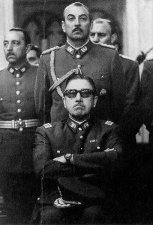
Pinochet Ricochet

Baltasar Garzon is my hero. If I get a picture, I’m going to put it up on my web page.

Baltasar Garzon is a Spanish judge. He found out that some Spanish citizens had been kidnapped, tortured, and murdered in Chile in the 1970’s. He found out that the murderers were never apprehended. He was outraged. Then he found out that the leader of this gang of criminals was in England getting some heart surgery. Like any conscientious magistrate, he immediately issued a warrant for this man’s arrest.

pinochet.jpg (9510 bytes)

The man is Augusto Pinochet.

In 1973, Chile held a democratic election. The people chose a socialist, Salvador Allende, as their new President. The Americans didn’t like that. Mr. Kissinger was heard to remark something like, “Why should we stand back and let an irresponsible people elect the wrong party?” So first, with the aid of reactionary forces within Chile, a crisis was created. Then, fig leaf in place, with the help from the CIA, General Pinochet led a bloody coup d’etat, during which Salvador Allende was cold-bloodedly murdered (Pinochet’s cronies claim he committed suicide). (There is a good film, Missing, on this story). Pinochet’s army then rounded up as many dissidents and potential dissidents as it could find, held them in the Santiago soccer stadium, tortured as many as he could to get more names to arrest, then murdered thousands of them.

A few years ago, Pinochet did what all ugly, maggoty, disgusting despots do when faced with a powerful reform movement: he agreed to step down only in exchange for a full amnesty. I don’t understand how any government can even pretend to be part of this farce. A man walks into a bank . He shoots five people and locks another twenty in the vault. He takes all the money. He runs off with five hostages. He kills four of them. Then he says, “I didn’t do anything wrong, but I will turn over this last hostage to you unharmed if you agree to not prosecute me for anything I might or might not have done before this.” The people say, “if you didn’t do anything wrong, then what do you have to worry about?” Maybe the police are smart. Maybe they say yes. He turns over the hostage. Then he is arrested and tried and convicted and executed.

Except that here, no one arrested or tried or convicted Pinochet, because they were afraid of the army. The army supports Pinochet because, after all, they are the bloody arms and hands of this evil man. They are complicit.

But Garzon had the guts to say, this man is a murderer and a torturer plain and simple. And he had the audacity to serve the warrant. (The French and Swiss governments have since done likewise.) And Blair’s government seized Pinochet and are holding him pending the outcome of the legal wrangling.

Think what a bizarre, crazy, mixed up message this is going to send to the world. That we are all equal before the law? That torture and murder are criminal acts? That justice awaits even the most powerful? Idi Amin, the happy guest of the Saudi Arabian government for twenty-years, since, presumably, his last meal of fresh humans, must be quaking in his boots!

* * *

Someone says to me, in defense of Pinochet, how would you feel if Castro, on his way to the United Nations, was arrested by the FBI and held for murder and torture? You see? We must have separate rules for dictators.

Well, first of all, if seeing Castro arrested was the price to pay for having assholes like Pinochet and Amin and Hussein, and Karadzic arrested, I think I’d go along with it. Let’s arrest him and have a fair trial and see what we come up with. I doubt you’d find nearly as many serious offenses for Castro as you find for Pinochet, or the others, but if you do, then, yeah, he should be charged. The witnesses should be brought forward, and let’s try him. Yes, it would be worth it, even though I like Castro, and his beard.

There is one other complicating factor. Pinochet was not an invited guest of the British government. He came as a private citizen seeking medical treatment (using the money, undoubtedly, that he pilfered from the state treasury).

If he had been an invited guest of the British Government, they would not have had a legitimate right to arrest him. If they did, the whole system of international diplomacy and the conditions under which negotiations can take place would begin to break down. Fair enough.

When Castro speaks at the U.N., as an invited guest, he has the same protection.

But hey, if goes for a walk in Central Park: arrest him! He and Pinochet can share a cell.

The Immorality of Komodo Dragons

I just watched a television documentary on Komodo Dragons. These creatures are real slime balls. I think we should have nothing to do with them. In the first place, they are very ugly. They’re up to five feet long, covered with scales, and they have kind of a baggy, flabby look. They look like a log covered with wet burlap. And it’s no wonder: they’re only active for about three hours a day. Why are they only active for three hours a day? Why don’t they get out there and put in a regular eight-hour day like the rest of the hard-working animal kingdom? Because they will eat anything, no matter how old or disgusting. Komodo dragons will kill large animals, like goats and deer, and eat part of them, and put the rest away for later, and not in a fridge. I guess when you’re as ugly as a Komodo dragon, you don’t care what goes into you. You see this fresh elk go leaping by and he looks real tasty and all, and then you look over at a two-week old rotting goat carcass and think, “hey, that looks good…”

Komodo dragons drool when they’re hungry. But not like you and me. Oh no. Komodo dragon drool is toxic. You see, Komodo dragons don’t go chasing after deer, knock their legs out from under them, and then break their spines, like the hard-working jaguar or cheetah. No, the Komodo dragon sort of wanders around as if he wasn’t up to anything, and then, if a deer gets kind of careless and doesn’t move out of the way quickly enough, they leap– “leap” being a relative term here–into the air and bite them. The deer often gets away, or thinks it gets away. It moves off into the distance and looks behind itself and sees this ugly, baggy old lizard coming after it… slowly. But the Komodo dragon will follow the deer for a week, from way behind, because the Komodo dragon knows that, thanks to that toxic sludge drool, that little bite is going to get very badly infected. That deer is doomed. Eventually.

You have to respect the Komodo dragon’s patience, don’t you? Would you go into MacDonald’s, order a hamburger, take a bite, and then wait a whole week until it quieted down ten blocks away so you could finish it off?

Komodo dragons will eat other Komodo dragons if they can. This is a non-issue for Komodo dragons. I don’t think they give it much thought at all. You certainly don’t see other Komodo dragons gathering around a corpse and demanding an investigation. They are more likely to demand a share. And this is why young Komodo dragons live in trees until they are three years old and at least five feet long.

Komodo Dragons mate for life, but the male doesn’t have a good memory. He can’t tell just by looking at a female whether it’s his wife or not. He kind of follows her for a while until she notices him. “Huh? What do you want? Oh—again? I should have known. Is that all you think about?” Yup. That’s her.

Seriously, if he is strolling along and he happens to see a female and he gets the urge, he has to get real close first and then taste her sweat glands. Then he knows. It is very important for him to be very, very sure that this beauty is his wife, because, if it isn’t, the minute he gets close, she might kill him and eat him. This makes it very difficult for Komodos to have orgies. I’m not saying it’s impossible or that it’s never happened: just that it’s difficult. And for the same reason that a dead goat lasts a Komodo a month, they aren’t too worried about “protection”. A Komodo thinks, “Listen, I just had a mouthful of month-old maggoty goat meat, I’m been crawling through leech infested muck for three hours, I live in a dark cave with thousands of fruit bats, and I just sniffed your sweat glands— and you’re worried about exchanging bodily fluids? What are you? A prude?”

In order to mate, the male Komodo has to bring his body temperature up about ten degrees. So he goes and lays in the sun for an hour before sex. This takes a lot of spontaneity out of the Komodo dragon’s life, but hey, how spontaneous can you be if you only move three miles per hour? So, say a couple of Komodo dragons meet in a singles swamp. He says, “hey, you look like my type.” She says, “Oooo. You’re getting me hot. Let’s make it.” He says, “Okay. I’ll go find a sunny rock and we’ll see you in an hour.”

And what if the nearest sunshine is waiting for him on the other side of a shady mango grove? He waddles over there at 3 miles per hour, lays in the sun for an hour, brushes his teeth and slaps a little after-shave under the old burlap, waddles half-way across hell’s half acre, through swamps, under trees, through gnarled roots, finds the female, sniffs her sweat glands to make sure it’s her, rears up… “Oh damn. I’m too cold.” And you thought Viagra was inconvenient?

As if life isn’t hard enough for the male Komodo dragon, if he stays in the sun too long, he will die of heat stroke. So he can’t let himself go way over the ten degrees up, and then hope he cools off just the right amount by the time he gets to the female. For Komodo dragons as for humans, timing is important.

Komodo dragons live in only one place in the entire world: you guessed it: Komodo. People have to be careful on Komodo because Komodo dragons will sometimes eat people. Now, you’ve got this 150 pound lizard roaming around this island drooling this toxic sludge and attacking your children… and what do you? You protect the lizard! You put him on the endangered species list!

Well, I think we’re just getting carried away with this endangered species business. If it was up to me, we’d be having Komodo soup every night until they were all gone.

Mike Piazza Pie: Sports Economics

Mike Piazza now makes $91 million for playing baseball, for seven years. How on earth can they do it? Only 30 years ago, the entire New York Yankees baseball club was valued at only $12,000,000.

Well, it’s a free country. If a baseball owner wants to pay an athlete $17 million a year to play a game, why shouldn’t he?

They can pay Mike Piazza $91 million because fans continue to flock to the stadiums and plop themselves in front of their television sets to watch Mike Piazza play baseball. From that money, the New York Mets pays its players. And like every other business, they pay all their other expenses, like administrative staff, office space, scouts, managers, and rent or mortgage for the stadium… and taxes.

Well, wait a minute.

Yes, yes, the Blue Jays pay $11 million dollars a year in taxes on the Skydome. But who built the Skydome? You did. With your tax money. We paid $321 million to build the Skydome and then we rented it to the Jays for considerably less than it costs to operate it.

That is why the Skydome Corporation is now bankrupt.

This year, Hartford, Conn. is donating $350 million to the New England Patriots. And Maryland is donating $220 million to the Baltimore Ravens NFL team, and kicked in an extra $80 just to make owner Art Modell happy.

At least the Blue Jays paid their taxes last year. And so did the Expos. But the Cardinals and the White Sox, and the Red Sox, and the Reds, and the Dodgers, and the Rockies, and the Mets, and all the other teams? Not a penny.

How can that be? This is a multi-million dollar business! These owners are filthy rich. They pay their players absurdly extravagant sums of money to do what most of us would gladly do for nothing. And they don’t pay taxes?!

No, they don’t. They don’t pay taxes, because foolish citizens and even more foolish politicians have decided to use tax payer money to subsidize professional sports teams.

You see, Mike Piazza doesn’t care who he plays for. You do. You are a fan. You want your team to win. You are loyal to your team even if they lose. Loyalty is a good quality.  But baseball players have the loyalty of rats. If the New York Mets didn’t offer to pay Mike Piazza more money, he was going to go play for someone else!

But the New York Mets didn’t have enough money for Mike Piazza. How would the owners of the Mets make a profit if they had to pay Mike Piazza more money?

Well, they can cut other expenses, like those horrific stadium costs. But if the team cuts those costs from its budget, who is going to pay for it? Why the city, of course! But where does the city get its money? From property taxes. And where do property taxes come from?

Right– you. You with your $45,000 a year. You are going to give tax money to the New York Mets (if you are citizen of New York) so that they can give Mike Piazza an additional $4 million per year.

But the tax payer would think that is a dumb idea. So instead of the city giving a check to the Mets, it gives them a deduction on their taxes. And then it chips in for a stadium. And then it provides police and traffic services for free.

This is all no secret, by the way, though you would think it would be almost unimaginable that voters would be so stupid as to approve these arrangements. Sports Illustrated has been ranting about this devious little scam for years. A few smart politicians and journalists have caught on as well. And the voters in Minnesota caught on, and recently turned down a proposal to make a gift of a $100 million stadium to the billionaire owner of the Twins, who then threatened to move the Twins to some town with more idiots in it.

It is one of the biggest scandals in modern history: taxpayers subsidizing multi-million dollar contracts for spoiled athletes! And you just know that some of these same owners and athletes and sports journalists and politicians who approve of these arrangements would be among the first to complain bitterly about their hard-earned tax dollars going to a single mother on welfare. Freeloader! Parasite! Give us back your $500 a month and go find a job! Maybe you can park Mike Piazza’s spare Rolls Royce for him, if you’re good.

The problem is that too many cities give in to owner blackmail: build me a stadium or I move to a different city. And the city fathers weep and wail– “Alas, we cannot be without our sports team!” and issue a bond or debenture and build a stadium and forgive them their annual property taxes. Cities without sports teams plead with the Expos or the Twins: move here and we will give you millions of dollars. Millions of YOUR dollars.

And you voters stand for this??? You re-elect these guys? Are you insane?

The Baltimore Orioles, thank you, paid for their own stadium. Hurray for Baltimore! But they still don’t pay any taxes. [According to the Toronto Star of Nov. 29, 1998, the taxpayers paid $254 million for Baltimore’s stadium. When I find out who’s telling the truth, I’ll update this.]

Now, you will hear many supporters of these professional sport teams argue that the teams generate a great deal of revenue, including tax revenue, and attract jobs, and therefore, more than “pay for themselves”. Right. You can apply this argument to absolutely any business you like: banks, car makers, theatre companies, insurance companies, computer makers, anybody. They all generate revenue and taxes. Big deal. Pay your taxes and shut up.

And the issue has been studied: the economic benefits are grossly exaggerated, especially, as I say, compared to other possible investments.

The only solution is for all the cities to get together and agree that none of them will subsidize major league professional sports in any shape or form whatsoever. No subsidized stadiums. No tax concessions. No free police guards. Not even a parade (a long civic advertisement for the team). Tell the major leagues to conduct their businesses like everyone else: you balance out your income vs. your expenditures, and if you can’t afford to pay Mike Piazza $91 million, you offer him less.

Even better, the federal governments in both Canada and the U.S. should outlaw civic funding of sports stadiums.


Dr. Laura’s Indescretion

You’ve probably heard the news, right? Self-righteous, simplistic-minded Dr. Laura, who tells her listeners what God says they should do, once posed naked for pictures by a former boyfriend, and now those pictures are all over the internet. They are even being posted in the Dr. Laura newsgroup.

Well, you can see worse things on the Internet, I suppose.

Dr. Laura first denied that the pictures existed. They were composites! Just like Bill Clinton! Then she admitted they existed, but they were stolen. Then she said she had the copyright on those pictures, so, they can’t be shown without her permission and she doesn’t give you her permission.

Copyright? Well, what do you know? If you take a picture of a bum on the street–except in Quebec–you don’t need any permission to publish this picture. By being in the street, you see, where everybody could see him, he was making himself “public”. So, he has no right to prevent you from taking his picture or showing what you saw to somebody else.

It’s a little different for a model. Models have to sign a release, to give you permission to use the pictures you take of them. That’s because they are not posing in the middle of the street– they are posing in a studio. You are paying them to pose. You have to get their permission.

Was Dr. Laura once a model? I don’t think so. Looks like she was just being nice to her former boyfriend. He wanted some dirty pictures he could keep as souvenirs.

The point is, I guess, that it doesn’t matter. Dr. Laura could get a hundred lawyers working on this full-time and they wouldn’t be able to stop the pictures. They are all over the world, on servers, in news groups, in web sites… everywhere. One little mistake, and kablooie! The whole world knows. People who have never heard Dr. Laura’s radio show can now see her naked by simply dialing into DejaNews.

Tell me– at this moment– are you trying to remember if you ever posed naked for anyone? Hmmm. You might be smart to post the pictures yourself. That way, at least you don’t look like you’re hiding anything from anybody.

Lawyers

I used to be in charge of benefits administration at a small social service agency. It was my job to evaluate and understand all the provisions of our benefit package, in order to explain them to new employees and file claims.

I must have been more stupid than most: I got out the policies and actually tried to read them. Every word. Well, not exactly every word. I figured it would take two months or more to read every word, and another ten years to fully understand it. But I did read a lot of inscrutable text about all the subtle little conditions and notwithstandings and wherewithals and provisions. I discovered that our liability coverage had so many exceptions to it that I doubted that it actually covered anything. Sometimes I couldn’t believe what I was reading. It sounded so contrary to good sense that I thought I must have misunderstood it.

I phoned our agent and asked him to explain. In the back of my mind, I think I expected him to say that the small print didn’t mean anything because, of course, no reasonable person could ever find enough time to read it and, therefore, no one could ever really agree to it. That’s not what he said. He said that of course the small print applied. It’s all part of the agreement. He tried to convince me that all insurance companies had the same basic agreements. I called some of those other agencies and found out that that was not true. When I told him we intended to cancel the policy, he offered to cut our rates in half. Just like that! So much for the assumption that they were making a “reasonable” profit.

We cancelled anyway and switched to another company with more agreeable small print.

Did you ever think about the fact that the biggest agreements of all, God’s covenant with us, is phrased in the plainest, most straightforward language you can imagine? I will be your God. You will be my people. I will send a Redeemer. I will never again destroy the earth with a flood. He who believes in me shall never die.

The small print exists because lawyers write most of these agreements and, like many other professionals, they, consciously or not, want to ensure that they will always have plenty of work. It is there because insurance companies want to be able to protect themselves against having too many claims filed. It is there because banks don’t want you to know how obscene the interest rates on charge cards really is, or how much power they have to destroy your life if you forget to make a single payment on a loan.

Did you know, for example, that a lot of home-owner’s policies have a provision that during any extended absence by the homeowner, the insured house must be entered and inspected by someone every day? And there you were in Florida in your lawn chair feeling so comfy and reassured.

A lot of people won’t believe this, but there is no need in the universe for small print. It should be abolished, banned, exiled, censored, shredded. The law will not collapse. The courts will not be inundated with frivolous claims. Injustice will not prevail. In fact, I am quite sure the opposite will happen.

A holding company in Toronto which rented 30,000 apartment units tried to eliminate all the small print in their leases. The new lease agreements basically said “You agree to pay so much money every month so you can live in this apartment at this address. You agree not to damage the apartment. We agree to maintain the apartment. If you don’t pay the rent, you have to leave. If we don’t maintain the apartment, you don’t have to pay the rent.” Done. In plain English. What happened? The company saved thousands of dollars in legal fees every year because everybody understood the agreements and, as a result, were far less inclined to challenge or break them. The tenants loved the agreements. They understood them. They had the wonderful feeling that they weren’t about to be tricked or cheated because they didn’t have the time to read twenty pages of incomprehensible legalese.

The only drawback… ahem… is that most lawyers would be put out of business.