Paying the Artist

“The chart linked to the left gives you a rather dramatic picture of the state of the art in terms of artist’s earnings from recorded music. As you can see, the picture is rather dismal. It appears that an artist’s best chance of making any kind of living at all from his own recorded songs is to sell the CD directly to the public, at gigs or online.

Music Industry – the Chart!

You can’t ignore an omission (forgivable– that’s not what the page is about): the chart doesn’t account for the role of publicity and promotion in CD sales. But it does make it clear that the trade-off, for the artist, is absurd. In exchange for access to the “star-making-machinery” of Sony or BMG, you sell a gazillion units, and then get to turn over pretty well all of your earnings to the record company. No– you don’t even “turn over” the profits– you will never even see them, for the music industry skims off almost everything– and I mean that literally– almost everything– before turning over a pittance to the artist. But then, you get to be on TV. You get promoted. You get fame. You get the girls. You get broke.

I have said this before and I’ll say it again: I believe the government should step in and set standards for contracts between musicians and record companies which guarantee that the artist receives a “reasonable” portion of royalties for every unit sold. It also needs to regulate how much the recording industry can deduct from an artists royalties for the cost of “promotion”. To me, those charges have always seemed like General Motors deducting money from the wages of assembly line workers to cover “advertising”. Why the hell should the assembly line workers pay for the cost of doing business? Especially when you find that a lot of these expenses are fees paid to shadow entities that are actually owned by the record company itself– like “image consultants”, market researchers, arrangers, and so on.

The most compelling paradox of the music industry remains this: would any artist be happy to know that his music is not being pirated? Yes, nobody’s stealing your music. You are so lucky.

So what’s a young recording artist/singer/songwriter to do? Would they really want to go back to the pre-internet lottery system: if you get chosen (by a record company) and you’re lucky and you get a contract, you get rich? And everyone else has absolutely no way to reach a potential audience.

I suspect that the current reality is what is going to work as well as anything can work in this world. New artists practice and play when they can, record their own CD’s cheaply with newly accessible technology, and sell them online and at their performances.

The music industry has never, probably, been so democratic: anybody can reach a large potential audience via the internet, post a video on Youtube, post their music at iTunes, and keep their fan base informed via Facebook.

But without the machinery of the music industry establishment, their prospects are dismal.

President Mrs. Wilson

For the last 14 months of his second term as President of the United States, Woodrow Wilson was virtually incapacitated. His condition was kept secret from the American public and most of the government. His wife, Mrs. Wilson– Edith Bolling Wilson– effectively ruled for him, appointing and dismissing officials and advisors, and shielding him from the scrutiny of members of Congress and even the vice-president.

How does a person know if one is not competent? Woodrow Wilson, apparently, did not know he was incapacitated. Mrs. Wilson did not know that she was not qualified to run the United States of America.

The sky did not fall.

On the other hand…. The New York Times article (sidebar) by Morris makes the argument that history might have been radically altered had Mrs. Wilson properly notified the authorities that her husband was no longer capable of executing the office of President of the United States. Instead, in what is surely one of the most outrageous cases of hubris in history, she decided that she would just do it herself. These men! These cabinet secretaries and advisors and senators and staff… what do they know that I don’t know?

That’s what Morris’ article is about– how do you know what you don’t know? The answer, of course, is that you can’t know what you don’t know. In other words, if you are incompetent, you are not likely to have the faculties of good judgment that would allow you to accurately assess your own performance– by definition.

Think about this the next time you see Timothy Geithner or Lawrence Summers or Bernard Bernanke on TV. Think about this as Senators fall over themselves to eulogize Robert Byrd, Senator for over 50 years, who seems have been much beloved. Who loved him? The citizens of West Virginia who rhapsodize about all the goodies he brought them from the federal government, all the buildings and freeways and public squares now named for him.

Edith Bolling Wilson was careful, in her auto-biography, to insist that Wilson was mentally competent at the time, and that it was Wilson’s own doctor (who was dead when she published), among others, who insisted that humble little Edith Bolling undertake the task of relaying Wilson’s authentic wishes to the world. But Wilson’s doctor and chief steward, in their own accounts, were clear: Wilson had no capacity whatsoever to convey any wishes, authentic or not, to anyone, or to govern; his reason was impaired. Though he later improved somewhat, he was never the same person after the stroke as he was before it. Edith Bolling Wilson, however, issued numerous communiqués from her husband which were invariably written in her own tiny little script. No one else was permitted anywhere near him.

There was no way for any reasonable person to get past Mrs. Wilson to determine if it ever actually was Woodrow who was doing to governing.

It was a critical moment. The international treaty creating the League of Nations was up for ratification in the U.S. Senate. Senate Republicans, led by Henry Cabot Lodge, were against certain provisions of the treaty. But Wilson seemed to take a hard line: no compromise. He’d rather see the bill fail than make a few adjustments, or give the Republican’s a face-saving concession. Wilson– or Mrs. Wilson, concerned that anyone should perceive a vacuum of leadership, brooked no dissent, no argument.

The treaty went down in flames.

Vice-President Thomas Marshall would surely have agreed to some of the amendments proposed by the Republican opposition– as might have a healthy, rational, Wilson– and the treaty would have been ratified, and the might and influence of the United States might have saved the League of Nations from it’s cruel fate of impotence, ineffectiveness, and its ultimate collapse in the face of German aggression and French and British intransigence.

It is possible– perhaps even likely– that no stroke: no Hitler.

This is not the same as saying that Woodrow Wilson was indispensable. The tragedy of Edith Bolling Wilson’s deceit was precisely the result of her delusion that Wilson was indispensable, that no one else should be allowed to lead the country at a critical moment in world history –the same delusion held by Robert Byrd who should have retired years ago.

It should also be said that a responsible Cabinet minister or Secretary of State or General should have insisted that Mrs. Wilson step aside and allow accountable political leaders to determine if the President was capable of carrying out his duties.  If Mrs. Wilson had insisted on blocking access to her husband, they should have followed the law and removed him from office.

But you can see the difficulty.  Do you have the Secret Service arrest Mrs. Wilson?  What if Mr. Wilson was partly coherent?

Tonight, I watched a documentary on the Berlin Wall. There it was again– Eric Honecker, Chairman of the Council of State for East Germany during the collapse of communism in Eastern Europe. Honecker also did not know what he did not know. As Hungary opened it’s borders and Lech Walesa overturned the Polish government and Gorbachaev transformed Russia with perestroika, Honecker clung to what he knew: the totalitarian communist state.

As tens of thousands of East Germans marched in the streets, he ordered the police to crack down, like the Chinese in Tiananmen Square. His deputy, Egor Krenz, simply refused to transmit the order, and a lower echelon functionary inadvertently– I’m not making this up– announced that the borders were open, immediately. The guards, confused, confronted with streaming crowds of refugees, opened the gates, and the genie was out of the bottle.


The Unknown Unknowns

  • Marshal Petain did not know that he did not know how to fight a war in 1939.
  • He still had all the knowledge he needed, however, to fight another war in 1914.
  • The White Star Line did not imagine that a situation would occur in which the number of life-boats on board the Titanic would matter.
  • Richard Nixon did not know that his actual culpability for the burglary of the Watergate offices of the National Democratic Party Headquarters would not matter, but his discussion of the incident in the Oval Office would eventually lead to his impeachment.
  • Nicholas II did not know even the Russian peasants no longer regarded his position as the result of the direct intervention of God in the affairs of men.

Errol Morris in the New York Times

Eric Honecker

G20 Opium Wars

The biggest Security Theatre show in the world takes place in Toronto this week. The people who are supposed to represent us, the voters, will do everything they can to keep as much distance as possible between their lavish affair, their snack bars and drinks, their banquets and soirees, and us, the smelly, worried, unprivileged mob.

In fact, they clear the expressways so the cavalcade of bulletproof limos and security mobs can proceed from airport to conference center without having to meet the gaze of frustrated travelers. You wait so Obama can glide. You have to wonder if any of these leaders have the slightest clue anymore of what real life is like for their own citizens.

It’s not surprising that some terrorists out there might think it’s a good target: the display of monumental privilege must surely excite them. The fences and guns and helicopters — it’s all like a wonderful, violent opera.

It also creates a perception among the easily persuaded that these leaders are so important, so indispensable– such marvels of brilliant leadership and vision– that no expense can be spared in keeping them safe. In fact, every one of them is very dispensable— the graveyards are full of them, as De Gaulle observed. The security services don’t mind colluding with the politicians because, if politicians are important, the jackboots protecting them are necessary.

If you think, well, it’s a lot to put up with, but, after all, these meetings are important. No, they aren’t. The idea of public disagreement is so horrifying to the organizers that they have their cronies work out all of the language of all the announcements weeks before hand. If there is real disagreement, the announcements only cover the areas where they agree: we will improve the environment, encourage economic growth, seek justice and purity and the preservation of our bodily fluids. Amen. So, surrounded by security theatre, we have political theatre.

Have you considered… how come they don’t shut down the nation’s capital every time parliament is in session?


History is full of oddities.

In the 19th Century, Britain and other European nations were trying to develop a healthy trade relationship with China. Chinese ceramics, silk, and tea were in huge demand in Europe. Britain sent a delegation to the Qing dynasty to show them some of Europe’s most exciting new technologies to be offered in exchange. The Chinese were not impressed, and demanded silver instead. As supplies of precious metals began to dwindle, the European nations settled on a different product they wished to offer the Chinese. Wait for it: opium. Yes, the British East Indian Company was your local drug pusher.

Those crazy Chinese– they didn’t see the wonderful upside to this innovative trade relationship, and decided to ban opium. This led to the First Opium War, in which the European powers humiliated the Qing dynasty and forced it to sign a humiliating armistice, the Nanking Treaty, granting the European powers the right to brutally exploit Chinese markets and labour. The treaty also ceded Hong Kong to the British, if you’ve ever wondered why the British eventually ceded it back.

I’m always impressed by the righteous outrage expressed by oppressors when their victims summon the courage to fight back. The Boxer Rebellion was portrayed in the West as an attack on missionaries and Christian Chinese. The missionaries themselves only seemed dimly aware of their function as cultural emissaries of British and American imperialism. They didn’t see any problem with associating Christianity with gunboat diplomacy.


Another historical oddity:

In 1945 when Japan surrendered, Chiang’s Chongqing government was ill-equipped and ill-prepared to reassert its authority in formerly Japanese-occupied China, and asked the Japanese to postpone their surrender until Kuomintang (KMT) authority could arrive to take over. [From Wikipedia entry on Chiang Kai-shek]

This is not the only time an ally– a freedom-loving, democratic, liberal, enlightened, western power– actually asked the Japanese– spawn of Satan just moments before– to hold a population down so a new oppressor could take over for the old oppressor without the local people being given a chance to form a representative government.

Well, let’s all not get patriotic here. This is what governments do. They do it with far more sophistication and polish in the west, but they do it nonetheless: pin you down long enough to have your pockets picked clean. You can spot the patriots easily: they have flag pins in their lapels. They get teary-eyed when you play the anthem. They invite the press to view them touring the graveyards for the men they sent to die for your sub-prime mortgage, your derivative, your Enron stock, your gasoline.

You almost never find them in uniforms themselves.

Sophie’s Choice

“Almost no one knows — including Sophie and Stingo — that Nathan is schizophrenic.” From the Wikipedia entry on “Sophie’s Choice”.

The question is, if no one knows that Nathan is a schizophrenic, how does anyone know he is a schizophrenic?

First, I do want to make it clear that I think “Sophie’s Choice” is a fine book by a fine author. But I find this little episode silly. We’re supposed to give knowing nods to each other, aren’t we? Ahhhh! He’s a schizophrenic! No wonder. We were fooled because he was self-medicating.

In fact, Nathan has just been labeled. Nobody has to prove that he is anything now: he has a label. That is sufficient. A label is what you use when you can’t be troubled to find any specific facts or evidence for your belief. [In an unusually contrived episode of West Wing, that could only have been written by a writer with an unnatural dependence on his therapist, “Noel”, Josh Lyman is similarly glibly labeled as “PTSD”.]

So how would you know if it’s true– if you were a character in this fiction. How would you know if Nathan is a schizophrenic? Author William Styron needs the label for dramatic tension so he glosses over the question.

Is there some tattoo somewhere on his body that tells the discerning acquaintance: schizophrenic? No– some person with a degree on his wall, who may be a genius or an idiot– we’ll never know, for both of them have an equal chance of getting the degree (the Nazi party was full of degrees)– this person, by virtue of society’s capitulation to the pseudo-sciences, has decreed: Nathan is a schizophrenic.

You can lock him up now. Anything he says in his own defense is to be regarded as further proof of his insanity. The more justly he becomes angry at your attempts to pigeon-hole him, the crazier he is. But no one may question the sanity of the man with the diploma on his wall. He has science on his side. He had the audacity to give the first label, thereby shifting the burden of proof on the labeled. Nathan is deprived of the presumption of sanity.

If only it was science, or something, anything more credible. In my view, most of what passes for “psychology” is a religion in drag; it’s a religion that tries to hide it’s assumptions behind a veil of mangled statistics and manipulative language that always manages to give a plausible answer to the wrong question.

There is no greater arrogance in the entire world than to sit in judgment of another person’s sanity. Anyone who would do this should get his head examined.

And if only Nathan had had the foresight to get his diploma first– he, also, was a genius– he could have decreed his brother as delusional instead of the other way around. Just imagine the scene in which the brother informs Stingo that Nathan is insane. Imagine, if you will, that Stingo has been told in advance by Nathan that the brother is delusional: the scene would work perfectly, and the brother would come off as no less creepy, least of all for inviting a perfect stranger to secretly report to him on the private activities of his brother.

So the lesson is this: be the first to get your diploma, so that you can deem all those who offend your prurient sense of good order and propriety insane.

The power of labels. Stingo is too naive to actually question whether a label means anything. He assumes that psychiatrists have some magical powers that allow them to reduce the sum of a person’s behaviors to a syndrome which, like all good labels– including the star of David– shall subsequently determine the context in which all other behaviors are regarded. Nathan’s rage at an unjust world– a world with lynch mobs, or HUAC, or the inquisition, or Salem’s magistrates, or a KGB — around every corner– is the result, say the doctors, of his schizophrenia.

Or maybe it’s the only sane reaction to a world gone mad. To a world that shows no signs of learning from it’s mistakes. From a world that still embraces the passions of the mob.

[Upon re-reading this, it has occurred to me that someone might say, well, would you rather Nathan be allowed to do whatever he wants, including harm himself or others? That’s always the rejoinder, isn’t it? If you dare to challenge social orthodoxy, then you’re responsible for bad things that happen, even though these people never take responsibility for the failures of their own ministrations. So, just to clarify for the easily confused: no, I’m not advocating that people do nothing. I’m just saying that we often use labels to avoid grappling with complexity, and, in many cases, to justify drastic actions that end up doing more harm than good.]

Education Pimps

It is very hard to imagine anything nice or interesting about the University of Phoenix, a private, for profit university which has over 500,000 students. I imagine myself as a student at this corporate meat-grinder and feel depressed.

The problem is this: why would a for-profit corporation care about history, or philosophy, or literature, or music, or art? They would only care about it as something that can be packaged and marketed to impressionable young people as a component of a certificate which will entitle them to a good-paying job which entitles them to a home and a car and nice clothes and vacation trips to Europe where they can examine ancient artifacts and artworks and take digital pictures and post them to Facebook and make wise investments and retire and die alone. They would be as interested in history as Microsoft is interested in literature, or IBM is interested in music, or General Motors is interested in nature: only insofar as it can be used to sell a product.

The online versions of schools like the University of Phoenix are even more depressing. You take courses over the internet on your computer. You punch in and punch out. You fill in the blanks, check off the boxes, get your scores. Does this even remotely begin to teach you the process of thinking on your feet, or responding to situations and expressions, or learning to connect to other people?

The rats who run the University of Phoenix understand few things:

  • many potential students don’t have $100,000 to pay for a degree
  • the government has lots of money
  • students can apply for loans
  • students at the age of 20 or so have no real understanding of 2 things: a) what the real odds are of them getting that “high-paying” job the University of Phoenix claims will be theirs when they graduate, and, b), how hard it will be to pay off that student load
  • all of that money is just sitting there waiting for them to skim off most of it to line their own pockets


Property

Is the right to own property the “most basic right” of any democracy, as some Tea Party leaders insist? Could something like that be any more true than, say, that the right to be paid a just wage is “the most basic right” of any democracy?

Maybe. Maybe not. But the first question that comes to mind is, what is property?

Original sin? Marxism as an economic philosophy may be dead, but a lot of Marx’s observations about the nature of work and property still seem acute. In a nutshell, the real value of “property” comes primarily from the labour invested in it. So the thing of real value is not a thing, but the work of our hands.

So if someone has a lot of property and they want to protect their right to that property, the first question is, what right does the person have to that property in the first place.

Most likely — this sounds glib, but it’s probably true– it was stolen in the first place. From neighbors. From neighboring tribes. From the people living above the oil deposit. From the native peoples who hadn’t developed a culture of putting “no trespassing” signs and fences around their property. Property comes from the exploitation of natural resources, forests, fish, water– how does anyone obtain the sacred right to take exclusive possession of a tree?

Since property has no value in and of itself, when someone says they want to guard the right to private property, they are really talking about monopoly. It’s nobody’s “private” property– it’s always public. What I want to be sacred is my fence around it.

This is not to say I am against the general arrangement of things we have worked out in modern capitalism. Our system works pretty well as a way of distributing real wealth (the product of labour). It’s the perversion of this system — the tax breaks, monopolies, lax regulation– that make the system unfair.

All corporations claim to love competition but no corporation really wants it, and only the government has the power to ensure that there is competition, and the idiots who think the government should stay out of the marketplace actually seem to believe we would be treated better by McDonald’s, BP, Exxon, Monsanto, Archer-Daniels-Midland, and General Foods than we would be by Nancy Pelosi.


“What I don’t like from the president’s administration is this sort of, ‘I’ll put my boot heel on the throat of BP,’ ” Paul said. “I think that sounds really un-American in his criticism of business.”

Rand Paul, criticizing the Obama Administration for being “too tough” on BP, Washington Post.


Republicans at Work: “A ‘teacher’ told my child in class that dolphins were mammals and not fish!” a third complains. “And the same thing about whales! We need TRADITIONAL VALUES in all areas of education. If it swims in the water, it is a FISH. Period! End of Story.

National Republican Party Website voter feedback, quoted by the Washington Post.

Dien Bien Phu

The Japanese took Viet Nam away from France during World War II. At the end of the war, France– it’s manhood seriously in doubt, I suppose– tried to take it back. To do this– believe it or not– they accepted the assistance of some Japanese forces that had yet to be repatriated. You can’t make this stuff up.

Let’s go back a little further: history is incredibly rich in instructive detail about empires and irony.

The French chose sides in a long-standing civil war in Viet Nam, which had it’s roots in the 1850’s. Eventually, the French and their proxies simply elbowed aside the natives and took over. Why? History books simply tell you that the French “took control” as if there was something logical and reasonable about a European Nation walking into a foreign country on the other side of globe and taking control. It’s ours now. Your wealth will now flow into our pockets. You are now working for us.

With the defeat by Nazi Germany, France lost control of their colonies, to the Japanese. During the Japanese occupation, Ho Chi Minh agitated for a end to any foreign domination, and formed a guerrilla movement. When the Japanese were defeated, Ho proclaimed an independent Viet Nam. That seemed an insanely rational thing to do.

The French, deeply moved by the sad experience of being occupied by an evil foreign power, congratulated them and moved on.

Hoo hah! Did you believe that even for a second? No, France said, not so fast. They offered a puppet state to Ho; he declined.

It was the French and the Americans who defied rationality. The French decided to try to take Viet Nam back, as if they had some sacred title deed to the nation. After the negotiations failed, the French moved their armies in. A little cheesy, you might think. Having been soundly defeated by the Germans and restored to power by the Americans and British, they go marching into Viet Nam all bluster and courage and medals and parades. In fact, General Gracie, the British commander, allowed the Japanese to be re-armed in order to help the French retake Viet Nam from the Viet Minh!

It reminds me of those parties in New York where people you thought were political or literary enemies all gather together and toast themselves.  Kissinger and Truman Capote and Barbara Walters and Jackie Kennedy and Prince Andrew– all together, schmoozing.

Here is the fork of history– how many lives would have been saved if the French had simply admitted that they didn’t belong there in the first place, and if they had simply congratulated Viet Nam on their independence and moved on? Where would we be today? How many French, Americans, and Vietnamese, and Cambodians, and Laotians, would be alive and well and perhaps even prosperous today, if some asshole Frenchmen had not decided that it would do France’s honor some good if it could bully some Asians into submission and take their rubber?

Yes, what they wanted, I believe, was the rubber.

Let’s not be overly simplistic– the communist government in the North were no saints; they destroyed the economy and caused famine into the 1950’s. Russia and China interfered, using them for their own purposes. But the decisive matter is this: Viet Nam resisted both the French and the Americans because they wanted independence, and once the French and then the Americans were gone, they turned on the Chinese and the Russians and did just what they said they would do originally: take control of their own nation. Had the French departed in 1950 as they should have, they would have learned their lessons about management of the economy much sooner. The moderates would also not have been driven from all levels of government the way they were when civil war broke out.

The Americans, we are told in one documentary, confronted Chinese troops in Korea, which led them to believe that communist China must be “contained”. The glib voice doesn’t tell us how the Chinese came to be involved in Korea, of the arrogance of McArthur, and the diplomatic bungling, or the hubris of the allies. (China wanted to stay out, but the Americans blundered into the border areas in order to crush the North Koreans. China warned the U.S. that they had an interest in who occupied the towns near or on their borders– the U.S. ignored the warnings and were completely taken by surprise by the Chinese attack.)

So the French, in order to cut off a possible Viet Minh initiative into Laos, moved about 10,000 troops into a valley in North Western Viet Nam called Dien Bien Phu. Comments on Youtube in response to a documentary on Dien Bien Phu rhapsodize about the honor and courage of those 10,000 French.  These commentators want you, the reader, to be willing to do the same thing, because it’s so honorable and courageous, for your government, if they ask you do.

Are you mad?

What is “courage”, when placed in the service of idiocy and patriotism?  The French built an airstrip and fortifications and promptly found themselves surrounded by 50,000 Viet Minh. Even the possibility of retreat had been excised.

In early stages of the battle, the Viet Minh lost 10,000 casualties to 1,700 French. At that rate, you might think the French might eventually win.

But all the lessons the U.S. later took 13 years to learn were in full expression at Dien Bien Phu already in 1954.

  • technological superiority may not prevail
  • the determination of the enemy should not be underestimated
  • an enemy with a deep and abiding knowledge of the terrain and culture will drive you crazy
  • a war should never be about settling scores or proving your manhood or making points: what, really, was the French interest in Indochina?
  • the full support of the nation is required for a long, drawn-out conflict
  • God knows that you are sacrificing the lives of others. God knows that you asked others to risk what you yourself would never risk for anyone: your life.
  • God knows that you were blinded by self-interest when you assessed the relative risks and benefits of the military actions you commanded.

How many of these lessons apply to Iraq?

They almost certainly apply to Afghanistan which, after 10 years of occupation, shows no sign of pacification.
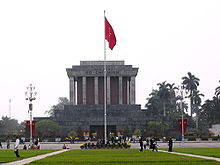

Above, the monument to Ho Chi Minh.

It’s always been the oil. It’s never been about anything other than the oil. And the fact that naive Americans still fervently believe that it is about anything other than oil tells you a lot about how astoundingly successful the massive public con of “patriotism” has been. My goodness- it’s there, right in your face. It’s not even camouflaged. It’s Dick Cheney in the White House actually admitting that it’s about the oil. And the open question about whether George Bush ever, deep in his heart, did not believe it.


Invariably, the terms offered during negotiations after fighting has broken out and the costs have become clear are worse than those offered initially.

And so it was in Viet Nam: in 1953, the terms offered to the French were far less attractive than those offered at the start of the civil war in 1950. If you were the parents or wife or lover of a young soldier who died in the civil conflict before 1953— would a monument ease your sense of lost?

There is a magnificent monument to Ho Chi Minh in Hanoi. Isn’t it beautiful? You should read about Viet Nam in the 1940’s and 50’s and 60’s, and the wars, and the betrayals, and the genocides, and the Vietnamese intervention in Cambodia to put a stop the Khmer Rouge, and then the Chinese putting a stop to the Vietnamese… you should look at the monument and contemplate it’s stolid quiet complacency, the almost zen-like beauty of it’s ghostly visage against the horizon, and you will see history. You will see the millions of shattered and destroyed lives, the starvations, the tortures, the explosions and fires, the bombs and bayonets, the rivers of blood– there they all are, asleep, anesthetized, dreaming of the lives they might have lived, were it not for the grand mission of history embalmed in the monument by the name of a general or king or president for life… in this case, a dried up old corpse named Ho Chi Minh.


Clarence Thomas, Wake Up

Thomas criticized the majority for imposing ”its own sense of morality and retributive justice” on state lawmakers and voters who chose to give state judges the option of life-without-parole sentences. ”I am unwilling to assume that we, as members of this court, are any more capable of making such moral judgments than our fellow citizens,” Thomas said. NYTimes, May 17, 2010

That is a stunning declaration.  What I do, says Thomas, as a Justice on the Supreme Court, is rubber-stamp any cockamamie decision you want.  But we know: as long as it is a conservative decision.

Wow! Even for a long-time follower of the diminutive career of Justice Clarence Thomas, this one is particularly mind-boggling. He appears to have forgotten what the Supreme Court is for. He calls it a “moral judgment” but what he is talking about is the job of the court to ensure that government legislation and policy does not infringe on the rights guaranteed by the Constitution of the United States. Thomas, having accepted the job of navigator on this airplane, suddenly exclaims, “why are we on an airplane? We should be on a boat instead” and jumps out the window.

What is a “moral judgment”? The majority (6-3) simply agreed that the Constitution of the United States prohibits “cruel and unusual punishment”. Is it a moral judgment to force voters and legislators to obey the constitution? Could it be that the framers of the constitution didn’t mean cruel and unusual? Maybe they meant to ban “reasonable and humane” punishments instead.

One has to ask the obvious question: does Clarence Thomas know he is on the Supreme Court? Does he understand what a Supreme Court does? If the Supreme Court is not capable of “making such moral judgments” about what was meant by “cruel and unusual”, then what exactly, one wonders with astonishment, is the function of the Supreme Court?

But then we know what Clarence Thomas’ answer would be: to prevent suspects from defending themselves against criminal charges. To prevent citizens from suing corporations. To prevent corporations from being unprofitable. To prevent minorities from oppressing the majorities with their extravagant demands for equal opportunity, fair wages and a safe workplace. To prevent women from stealing jobs from white men. To prevent black men from stealing jobs from white women. To prevent parents of minority school children from demanding trained teachers and science labs. To prevent reporters from demanding information. To prevent police from having to seek medical attention for injured prisoners. To prevent privatized prisons from having to provide adequate space and staff for prisoners. To prevent witches from witching and sorcerers from corrupting the minds of young children with their liberal theories and scientific text books and pagan culture. To prevent feminists from being feminine and masculine men from using mescaline. To prevent guns from falling into the hands of pacifists and pacifists from falling into the hands of lesbians. To prevent lesbians from being lesbians or living in sin or enticing gay-bashing preachers to have children they could adopt.

Let us all now and forever and again deliriously sing the praises of the unlawful, the unconstitutional, the transcendent Clarence Thomas. May he go down in history as the only Supreme Court Justice to ascend directly into heaven.


Thomas might answer that the Constitution is not a moral document. But that’s not the issue and he knows it, for he asserts that Congress and the voters have the right to make “such moral judgments”. I think Thomas would concede that what he is saying is that the “moral” content of the judgment that a life sentence is too harsh for a mere property crime is not subject to constitutional constraints.

If the public wants to torture and hang a witch– so be it. Who are we to say they shall not torture or hang a witch? Who are we to say there are no such things as witches?

My other ecstatic tribute to Justice Clarence Thomas.

The Lofti Raissi Case

The Lofti Raissi Case

It’s been a few years since Lotfi Raissi was finally released but people who actually believe in the competence, wisdom, and good judgment of the authorities in Britain, Canada, and the U.S., should reread this account every day. I mean every day–first thing in the morning, like a prayer: this is your tax dollar at work. You are paying for the keystone cops. But this is not a harmless comedy– these people are doing real damage to all of us.

The important thing about the Lotfi Raissi case is what it reveals about the practices, policies, and — most importantly– competence of American and British police authorities. What it reveals, actually, is that the idiots are in control. What it also reveals is that law enforcement officers have been consistently willing to lie to obtain convictions.

It is the tragedy of our age that the public largely supports violent, inhumane measures against anyone the police think might have ever been thinking of becoming a terrorist. We’re not safer– we’re generating 10 new terrorists for every new outrage. If you were an Algerian, just how would you feel about the treatment of Lotfi Raissi?

Streep’s Choice

Sophie is not a Jew, of course: she is a Pole. In fact, it is at times suggested that she is an anti-Semite, and Nathan certainly accuses her of it.

Hollywood simplifies. Reality is complex. Read this document about the remarkable experiences of Eleonore Hodys. I respect “Sophie’s Choice” for leaving intact the complexities, and thus giving us a taste of the astonishing ability of real events to confound our expectations.

As I said, I basically like “Sophie’s Choice”, but if you are a bright young author out there and you’re writing your first great book, please resist the temptation to have your characters fall over themselves praising your talent, as Styron does in “Sophie’s Choice” (Stingo is obviously a stand-in for Styron as a young man in New York); Sophie and Nathan, of course, think he is brilliant.

* * *

The mystery of Meryl Streep: it’s a great performance… that constantly calls attention to itself. It’s hard to describe what is meant exactly by that phrase– “calls attention to itself” — but I know it when I see it. (Dustin Hoffman — in “Rain Man” for example– is another great practitioner of the art of calling attention to himself being a character.) She’s so good in other respects, it’s almost possible to completely ignore it. But there are scenes when Streep is so much the actor being a brilliant actor that you almost forget the character: all you see is technique. Brilliant technique, but still technique. It’s so obvious in her performance that I could never believe in the relationship with Nathan– there doesn’t seem to be room in her technique for him, let alone a real passion.

The greatest flaw in actors like Streep (Ryan Gosling is another) is that they intuitively demand that every scene be absorbed into their performance. I always felt that any actor could have played Nathan– all you had to do was stand there an let Streep paint the colours of her day on your canvas. It’s the kind of technique that wins awards.

Streep is a very, very good actress at times, but one of the least generous actors I’ve ever seen. By generous, I mean giving the other actors and the film-maker space within which to do their own work. I mean studying the other actors to see what they’re doing and how you can contribute to the overall effect, rather than just call attention to yourself.

Kate Winslet is the opposite of Streep– look at her in “Heavenly Creatures” or even “Titanic”–: not as accomplished as Streep, but far more generous, and often more convincing. In “Heavenly Creatures”, she makes Melanie Lynskey, her co-star, look brilliant.

Michael Caine, Robert Duvall, Amy Adams– all generous.  Rachel McAdams is usually generous.  Meg Ryan is generous in “When Harry met Sally”: she gave Crystal room to ham it up.

Barbra Streisand and Robin Williams and especially Jim Carrey: utterly selfish. Every scene they are in is always only about them.

Next time you’re at a movie, ask yourself if the actor you are watching intently on the screen is contributing to the impact of the other actors.

And one more note: according to Wiki, Streep obtained an unauthorized copy of the script before it went into production and went to Alan Pakula’s house and threw herself onto the ground and begged for the role.

Smart girl: she knew it would win her an award because,

a) it has Nazis,
b) it has an accent.
c) it’s a period piece

[added 2019-11-20]