Hard Boyled

Over 30 million people have now been duped into watching the video of the frumpy middle-aged woman who can sing. Everyone is astonished. Who would have thought a frumpy middle-aged woman could sing?!

Who would have thought anyone would be surprised that a frumpy middle-aged woman can sing?

Either the average person is far more dull-witted than ever previously imagined, or we are all fooling ourselves. You’re at a talent show. You watch various attractive young people march across the stage, with varying levels of talent. Then you see a frumpy middle-aged woman. You think– obviously she has no talent.  Right.

In fact, any reasonably astute person would have likely thought, she’s certainly not here for her looks. Obviously, she must be able to sing.

Now, this is a program which introduces emerging talents and then processes them like hamburgers through the obscene rituals of fashion makeovers, stylists, image consultants, deportment experts, etc., with the goal of rendering them into mental frumps– celebrities. Why the real frumpy woman? To convince the viewers that they are not like those shallow, crass people who only appreciate art if it is packaged in sexy, youthful flesh. No no no– I don’t judge people by their appearance– only by their abilities.

And after Susan Boyle has had her meaningless moment on the stage, these same people will go back to choosing the singer with the biggest bosom, and only watching movies that star sexy young Hollywood starlets. Except for Meryl Streep movies– because she is the Susan Boyle of Hollywood films: the exception that proves we are decent, intelligent people after all. We like serious actors. My enjoyment of their films is a badge of culture and good taste. I’m glad you know that. Besides, Meryl Streep may be flat-chested but she is sort of pretty. She’s prettier than Mrs. Doubtfire.

Now, it has occurred to me that my enjoyment of obscure films by Japanese directors like Ozu might be taken for the same thing. I’ve had that reaction before: you can’t seriously like “Late Spring”– it’s excruciatingly slow moving and, it’s black and white. Or, more likely, “I watched that film you were so hot about– I couldn’t believe how boring it was!”

It’s probably true. Though I must admit, it’s not that much fun at work to casually mention, at lunch, that I watched an obscure Japanese film last night.

You just do that to make us think you’re smarter than we are.

Yeah, that’s what you get.

What I liked about my college experience is that it was one of the few times in my life when most of the people I hung out with respected elite artistry, drama, and music.

Nowadays, the elite is there to be mocked, even by the elite.


The Inevitable “Make-Over”

The latest: Susan Boyle has undergone a modest “make-over”, using a local hair stylist instead of a fancy one from the big city. The idea is to make it more digestible for the average viewer to maintain the illusion that they appreciate her for her voice and don’t care at all about the fact that she looks like a real person.


The Un-Boyle

Diana Krall seems like a perfectly fine lady. She looks very nice. She gets a lot of airplay on the CBC.

She is the opposite of Susan Boyle. Diana Krall looks absolutely ravishing– if your taste runs to big-boned blonde Visigoths– but, truthfully, is a rather average singer.

Norah Jones is in the same category: really, a mediocre singer with a pleasant voice, and, most importantly, a pretty body.

Just think– if you could combine Susan Boyle’s voice with Diana Krall’s looks, you would have the perfect entertainer. Right? Wrong. Nobody really cares about the voice part. Diana Krall has the only advantage that matters already in hand.

And actually, Susan Boyle’s singing talents really are quite over-rated as well.

The New Yankee Stadium

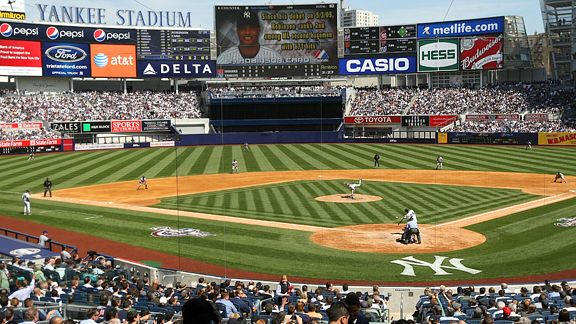
Here is a picture of the New Yankee Stadium, from behind home plate.

I know the Yankees used to think of themselves as being the “class” of professional sports franchises. They refused to allow advertising along the board behind home plate because that would be tacky, like hockey.

Well, here we are:

Now you might think this is the triumph of commercial considerations over artistic considerations. I say it isn’t. I say it’s the triumph of stupidity over wisdom– the commercial advantages will be short-lived because the damage to the Yankee brand will be long-term. Think of the impression children — future baseball fans– will have of this stadium. Think of the impression they would have had if there had been no advertising visible in the above shot. Think of how that plays on the imagination year after year after year– until a franchise has a clearly defined luster.

Not any more. What is the new Yankee Stadium? A bunch of billboards with people in front of them and grass in front of the people. That’s all. You’re uglier than Susan Boyle.  You’re tackier than roller derby.  You’re cheaper looking than professional wrestling.

Thank you and good bye.

The Courteous Gun

Mr. Wong told the man that he had probably shot 10,000 rounds in about a year’s time. “He was pleasant,” the man recalled. “He was courteous. You would never suspect that he would pose a threat to anyone.” NY Times, April 11, 2009

You mean, aside from shooting 10,000 rounds?

What more information do you need? The man who didn’t want his name used happened to be using the shooting range next to Jiverly A. Wong one day. He noticed that Wong was practicing the art of firing his hand gun rapidly and accurately. This is America, where “you would never suspect” that someone practicing using a handgun would pose a threat to somebody. After all, Mr. Wong had a permit.

If that statement– “would pose a threat to anybody”– doesn’t alarm you, you must a red-blooded red-state rural American.

The NRA would probably respond, as they have in the past, that if only someone else in the room had had a gun, Mr. Wong would have been stopped.

Okay– let’s say someone else in the room had a pistol strapped to his leg. Mr. Wong fired 98 shots and killed most of his victims in the first 60 seconds. So this potential hero is sitting in the classroom working on his forms and a stranger walks in. The stranger pulls out his pistols and starts firing, quickly, randomly. Let’s say we’re really lucky and our hero isn’t one of the first ones hit. Let’s say we’re even luckier and he doesn’t happen to be directly in front of the shooter. The potential hero, quick as he can, gets to his feet and pulls out his own heroic tool. Is he going to stop Mr. Wong with an accurate shot, under terrifying circumstances, before the damage is done?

Maybe the hero gets lucky and gets his gun out before he is himself hit, and maybe he draws it without drawing Mr. Wong’s attention, and maybe he isn’t too nervous and excited and is able to aim and keep his hand steady and get off an accurate shot or two. Even under the best of circumstances, several people will already be dead. And anyone who has seen real footage of people engaged in a gun battle know that it is very difficult to shoot calmly, accurately, under those circumstances.

I wonder if the families of Mr. Wong’s victims consider themselves martyrs to the second amendment. They died so Americans can be free to own guns without the slightest impediment.


On this website a writer argues, remarkably, that if we allow the government to abridge the rights guaranteed under the second amendment, they will feel free to take away the rights guaranteed under any of the other amendments.

Okay. Would this person be amenable to the argument that if we allow the police to tap our phones, they will then feel free to plant hidden cameras and microphones in our bedrooms? If we allow the government to ban pornography, will they soon come after our editorials? If you let your child have a sip of beer, will he then feel free to do drugs?


From the same hilarious pro-gun website:

To deny a human the right to defend him- or herself from any threat is the most grievous crime against humanity that I can think of. Human enslavement, you say? Genocide? Well, that kind of thing can’t happen to an armed populace. Hitler’s holocaust, together with a world war, began by disarming the German people. So to own a gun for the purpose of defense is one of the most universal and basic human rights – period.

That’s pretty amazing.  Aside from the historical inaccuracy (the Nazis never “disarmed” anybody) the writer essentially asserts that the only way to preserve freedom is through violent resistance.  Virtually every developed nation in the Western world is a vigorous example of the contrary.

And when, pray tell, have Americans ever used their guns to defend liberty?  And you really think you will stop tanks and aircraft with your pistol and your AK-47?

What’s even more amazing is that after years and years of solid majorities favoring some form of gun control, the NRA has been able to stymie every effort to do it.

The Value of a Human Life

How many times have you heard someone say that– “you can’t put a value on human life”. Yes, you can. Yes, we do. All the time.

We love to say it but we don’t mean it ourselves. If the government proposed raising our taxes by 50% to pay for a ream of new hospitals, clinics, emergency ward staff, helicopters, and defibrillators, they would be tossed out of office at the very next election. We don’t mean it.

We know that millions of people are starving to death at this moment in Darfur and Somalia. I don’t think a single person in Canada has proposed increasing our aid to those people since the economy went into the tank. How can you possibly put value on a life?

What we mean is, “you can’t put a limit on how much we want other people to pay for a human life that matters to us.”

The irony is that we often, in fact, end up putting less value on a human life when we have these knee-jerk responses to a crisis.

It is this kind of thinking that leads governments and individuals to spend huge sums of money on services and products that seem to protect life, when the same amount of money spent more wisely, on prevention, for example, would save far more human lives. It’s that same old human impulse. When a section of road is unsafe because it is too “expensive” to build a proper bridge or change the angle of the curve or widen the pavement, we panic and buy more ambulances and end up spending more money than it would have cost to fix the problem in the first place.

Case in point: a few years ago a child strangled to death playing on a jungle gym in a school play-ground in Toronto.  “You can’t put a price on a- human life” said the Toronto school board.  They removed all of the play ground equipment at all the schools in Toronto, eventually replacing them with better playground equipment that was deemed more safe.  But the children who normally played in these school years went elsewhere to play while the equipment was on order, and more of them were killed in accidents than could possibly have died from strangulation on the old equipment.

Besides, the whole notion that you “can’t put a value on human life” cuts two ways. In the case of a lawsuit against a corporation whose negligence caused a wrongful death– might not a judge decide that it would be crass to aware a specific amount of money to a plaintiff, because, you can’t put a value on human life.


“I heard about it and I was like, ‘Are you kidding me?’ How can they possibly put a value on a life?’ ” said Debra Moran of Preston, who credits Life Star helicopter with helping to save her 16-year-old son last summer. He was critically injured in an ATV crash in Ledyard, 55 miles from Hartford and the nearest trauma center. “Would they say a respirator is too expensive and they are not going to have an I.C.U. anymore?” she said.

Information Highway Robbery

Apparently there a lot of orphaned books out there. These poor little documents have no mothers or fathers or other living relatives. They reside in research facilities and libraries. But fear not little books– Google wants you.

Google has cut a deal with an association of publishers and an association of authors: we will take all those books. Thanks. Goodbye.

Google wants to scan in all these books. I don’t think they plan to sell access to them directly– they will profit by having you end up at their websites whenever you do an online search for any text in any of these books.

This is not all bad. In fact, this could be wonderfully useful. What has some people upset is that Google, in order to protect their investment, is demanding exclusive rights to this material. And they must have paid some money to the people in charge at the publishers and authors associations– people in charge– for these rights. Will any individual publishers and authors ever benefit? Almost certainly not as much as the people who negotiated the deal will benefit. This is the same principle behind the government giving away oil and gas and water: we citizens get nothing. They get lavish campaign contributions and parties.

Google would probably argue that if they don’t get exclusive rights, it won’t be in their interests to scan all these books in, so they won’t do it, and nobody else will either.

You also have to understand that this agreement is not the same as legislation. Google has simply paid off the only groups likely to be able to muster a legal battle against them. If you were to start scanning in all these books yourself and then offer them online on your own web page, Google would likely resort to the standard corporate practice of threatening you with their lawyers with no intention of ever actually allowing the case to go to court.

The article in the New York Times.

Need some therapy? Apparently those librarians do. They are angry about this deal. They think it stinks. And they are “mad”, “angry”, “upset”.

A good therapist could provide an effective solution to this problem: they just need to get some therapy. They aren’t “angry”– they have “anger issues” that need to be addressed.

Best TV Shows of All Time

All right, I just kind of whipped this up for fun.

Time Magazine calls “Lost” one of the 100 Best TV series of all time. It may not be as big a compliment as you think: the list includes “Leave it to Beaver” and “Friends”, “Oprah” and– ready for it? — “The Price is Right”. What is #1? There is no #1– it’s just a list of 100.

But, this leads me to question, what are the best TV series of all time? Off hand… [Additions 2011-03]

1. The Wire (without a doubt)

2.1 West Wing
2. Hill Street Blues
3. Mad Men (years 1 & 2)
4. Larry Saunders Show
5. All in the Family
6. Smothers Brothers Comedy Hour
6.1 Orange is the New Black
7. St. Elsewhere
8.1 I Claudius
8. 30 Something
9. 60 Minutes
10. Dick Van Dyke Show
11. Saturday Night Live
12. Seinfeld
13. Sex in the City
14. This Hour has Seven Days (Canadian)
15. Ed Sullivan
16. Twilight Zone
17. Alfred Hitchcock Presents
18. Odd Couple
19. Barney Miller
20. Star Trek (Year 1 only!)
20.1 The Bold Ones
20.2 WKRP in Cincinnati
20.3 The Tudors

Television: Lost

I’ve been watching the first season of “Lost” for the past few weeks. What a concept: a plane crash-lands on a tropical island and the survivors struggle to survive. Supernatural events intrude. The hunky stars sport perpetual five o’clock shadows. An attractive woman falls for a guy who’s no good for her. The castaways gang up on an unpopular dissident and torture him. He doesn’t mind being tortured.

It’s a combination of “Gilligan’s Island” (without the humour) and “Survivor” (without the circus master) and the computer game, “Myst” (without the tedium). It debuted in 2005– after 9/11. The makers of the show claim that everything will make sense when the series ends in 2011. Including the torture? I don’t believe them.

It’s hard to buy into a drama when the characters act inexplicably for inexplicable reasons. This is not a comedy though it has moments when you have to laugh out loud– Jack carrying firewood around, for example, for the obvious purpose of looking like he has a reason for existing at that particular moment other than to hold a conversation with Hugo. Sawyer enjoying a few moments of torture for no logical reason at all. Sayed marching around trying to organize a fascist police state. All the key male leaders with the only guns marching off into the jungle to look for Ethan the day after he surprised them by coming up from the beach instead. An anonymous extra is attacked and killed.

And everyone assuming, for no really logical reason, that Ethan was up to something nefarious with Claire just because his name wasn’t on the manifest. Don’t airlines officials make mistakes? Don’t people have middle names? And then everyone carrying on at the beach strangely unconcerned about the fact that a pregnant woman has been kidnapped by the same man, after he even tried to hang Charlie.

Did you think Charlie was dead? As from time immemorial, none of the regulars die. At least not yet. Sort of diffuses some of the tension, doesn’t it?

And let’s not forget about Mike’s girlfriend’s husband who leaves Mike’s son in Sydney to fly all the way to Los Angeles to tell Mike– in person– that he can have custody of his son. This is a strange, context-less world of spontaneous dramatic lurches and unmotivated passions. It’s a world in which no one, in the author’s mind, has any existence outside of their scenes. They find a mysterious door. They obsessively chip away at it for days while the rest of the islanders complain about not having any meat. Then the door disappears from consciousness, as does the pork, while amnesiac Claire falls in love with the most annoying castaway of all– Charlie. Everyone on the island only seems to be conscious of events in the script for that week’s episode.

So how on earth are the creators of the show going to explain anything when it comes to a conclusion in 2011? They seemly only dimly aware of what happened before the commercial break.

It is, by the way, a curiosity of Soap Opera that, for obvious and not so obvious dramatic purposes, women regularly fall in love with jerks. So Charlie and Sawyer attract the interests of the two most attractive women on the island. I guarantee you that if either of them ever consummate their desires for each other, neither will express the slightest concern about getting pregnant or catching a disease. Those things only happen many, many scripts from now.

If there is a consistent tone to the drama, it’s in the way sequences are sprung at the viewer like your annoying older brother sneaking up behind you and going “boo”. The polar bear would be far more sinister if it behaved more like a real polar bear, instead of announcing itself to it’s prey with a deafening roar. When a character is terrified by a sound, instead of seeing the source of the terrifying sound, we hear more sound effects and get the jerky, blurry camera movement . It’s as if they tried to dramatize the sinking of the titanic by by hosing a bunch of people sitting on a deck and spinning the camera around.

The castaways seem to be thriving in terms of food and health– unlike the first crew of “Survivor” who would have starved to death if the show’s producers hadn’t air dropped rice and other foods to the desperate “tribes”. Locke, in two days, acquired the hunting skills and acumen most people require years to learn. To hunt dangerous boar, no less! Even more remarkably, no one on the island seems to regard his rapidly acquired skills as amazing. Nor does anyone seem particularly grateful. Jin-Soo also seems capable of catching enough fish to feed 48 people. Think about that– how many fish would you need to feed 48 people? In fact, the utter lack of interest in explaining how the survivors are feeding themselves is breathtaking.

But where the series is most disappointing is in it’s utter lack of curiosity about how a group of 48 survivors would begin to organize themselves and relate to each other on the island– other than the incipient authoritarianism expressed by Locke and Jack and Sayed, who seem to believe that the others are all children who need to be herded to the caves or back to the beach or where-ever and told what to do.

Charlie murders Ethan in cold blood– there are no consequences for that kind of behavior in this society. In fact, the event seems to be regarded with the same seriousness as the missing pregnant Claire.

I would find it believable that there would be a few rebels and a few outcasts and a few natural leaders– but I find it unbelievable that everyone would just kind of hang around, eat, drink water, make fires, relieve themselves, and chat about that missing pregnant girl– what was her name again? Anyone see her lately?


What was the character doing before he entered the scene and began talking or inter-acting with another character, and then after the scene? Waiting to deliver his lines? In “Lost”, yes. And characters quite obviously undertake certain token tasks precisely so they can be paired with someone for some dialogue necessary to advance the story. Nobody has given much thought to who these characters are, what they think, how they live.

In a Mike Leigh film, for example, you immediately believe that character was up to something “real”– something his character would really be doing if this were a real world. Jack carrying firewood to the beach was so transparently contrived, I laughed out loud. What if the actor, instead, had developed an idea of what he was really doing– and worked it out in some detail. Better yet, what if the writers had thought of that first, and developed the character somewhat. Why on earth, for example, would Jin-Soo not have tried to simply get his watch back from Michael before attacking him? Why does Michael only seem to worry about Walt when it’s time to have a big scene of him worrying about Walt? Why on earth would Claire want to stay at the beach when the doctor is at the caves?

Most of the actions in “Lost”, in fact, seem to arise from the writer’s need to set up a dramatic confrontation of some kind, and most of the time they seem to be what a writer thinks the audience wants to see, rather than what he wants to tell.

Sure, you could rationalize every single move by every actor in the series– doesn’t change the fact that none of the characters’ actions arise from any particular insight into anything and nothing they say seems very expressive, to me, of anything other than the superficial requirements of the plot.

Check this: what else has J. J. Abrams done. Answer: “Armageddon”. “Alias”. Alas.

What “Lost” really needs, to liven up the drama, is for an exchange like this– think about it:

Jack: Wow. You guys ask me to be a leader but then you won’t listen to me.
Hurley: Who made you leader?

Mr. Yoo Justifies His Unwarranted Intrusion

“The law has recognized that force (including deadly force) may be legitimately used in self-defense,” Mr. Yoo and Mr. Delahunty wrote to Mr. Gonzales. Therefore any objections based on the Fourth Amendment’s ban on unreasonable searches are swept away, they said, since any possible privacy offense resulting from such a search is a lesser matter than any injury from deadly force. NY Times, March 3, 2009.

Mr. Yoo and Mr. Delahunty were Bush Administration officials who believed they could justify unconstitutional and illegal actions because someone might die. This rationale would come as a huge surprise to Thomas Jefferson and Benjamin Franklin. How could they not have foreseen that lives would be endangered if the police were not allowed to enter your house and search it at will?

It’s just one final piece– the release of memos detailing how the Bush Administration, in hysterics after 9/11, contemplated a police state.

Don’t ever again ever believe a “Conservative” when he tells you he loves freedom and democracy and especially if he claims he loves the constitution.

And if he claims to be a Christian and he loves George W. Bush because he stood for Christian values then, lest you believe that Christians do not believe in freedom, let me tell you these people are not Christians.

They have all either spoken out clearly in condemnation of these memos, or they are all cold-blooded, contemptible liars.

Genuine Heroes: Brooksley Born

Even after reading a lot of articles on the current economic crisis, it is difficult to get a grasp on just what, specifically, brought about the chain of events that have led to our current upheaval. The question is, who is responsible, and why.

Well, we know of someone who was not responsible. I’ll bet you’ve never heard of her. Her name is Brooksley Born. During the Clinton administration, she was in charge of the Commodity Futures Trading Commission. She objected to these new derivatives and credit swaps and other nefarious instruments of economic bamboozlement.  But she was overruled and marginalized by Alan Greenspan and Robert Rubin, who were entranced and delighted with the possibilities raised by deregulation of the securities markets. (Rubin was later a director and counselor to Citibank, until January this year, when he went to work for Obama).

They saw lots of Enrons (then considered miraculously profitable) splashing money around making all their friends rich. Well, to be generous, they probably would like you to believe they thought any red-blooded American investor could get rich by investing in a company like Enron.  All you needed was lots and lots of disposable money.  Sure, anyone.

Today, everybody knows about Kenneth Lay and AIG and Eliot Spitzer and Britney Spears and even Susan Boyle, and nobody knows the name Brooksley Born. So here is my modest little tribute to a great woman:

Brooksley, you were right.

And she was not the only one who was right but didn’t receive nearly enough credit for it.

You were wise when everyone around embraced foolishness. Someone should name a large federal building for you. And remove the name “Greenspan”.

The world of high finance and banking seems to have been mainly a giant Ponzi scheme and those who were in on the backroom deals profited immensely and, so far, with near impunity.

No one will ever know exactly how complicit Rubin and Greenspan and the others were, but we do know that neither of them left their federal appointments to go work for Habitat for Humanity.

Do Americans finally get what’s going on? While they were all excited about this incredibly expensive military adventure in Iraq that would cost nearly a trillion dollars– to prevent America’s interests from being harmed by nefarious Islamic foes– American’s interests were harmed by the same fat cats that sponsored Bush in the first place, the ones who got all the tax cuts, the ones who urged you to keep America safe by voting for a strong military.

They are counting on your ignorance, your indifference, your confusion. They are counting on you believing that our economic systems is fundamentally sound and fundamentally serves your interests in spit of what appears to be looting on an unimaginable scale, of your pensions, your insurance, your mortgages.


What Actually Happened and Why it Should Not Have

Do you get what actually happened? This is what I understand went down: banks and other financial institutions conspired to set up these huge funds– derivatives– which consisted of bundled mortgages and loans amounting to trillions of dollars. They resold these packages to investors and then, to eliminate any risk, set up entities to back the loans called “credit swaps”. The credit swaps guaranteed repayment of the loans if the borrowers defaulted, essentially giving investors all the benefits of risk — high payments– with none of the actual risks. These credit swaps were fraudulently presented as some kind of magical black box which could never fail to produce bunnies, when, in fact, they were never responsibly vetted by any authority. It was the duty of the government to vet these instruments– it failed.

These funds spread like wildfire throughout the financial industry until nobody even knew who was really holding what. When the mortgage bubble burst and housing prices began falling catastrophically in the U.S., buyers started defaulting on their loans in massive numbers, bleeding the magical system dry, and sucking up all of the liquidity in the entire financial system.

That’s my understanding as far as it goes.


The most frightening thing about the bail-out is the number of people, like Robert Rubin and Henry Paulson, who were involved in the original sin who are now involved in the massive attempted “redemption” of the world economy.

Can the same people who steered us into the ice berg rescue the passengers from the life boats?

Much as I would like to lay this at Bush’s feet, it is clear that the era of deregulation began under Clinton and that Bush merely carried on in the same general spirit.

Oscars 2009

I have now seen pretty well all of the contenders for best picture, best actors, and best screenplays.

Here’s my take. Best Picture is a mystery. This is a very weak category. Gus Van Sant’s “Milk” should have been a shoo-in, but he went mainstream, played it safe, and Penn’s performance is weirdly unmoving. “Frost Nixon” isn’t big or spectacular, but it is a fine film. “Benjamin Button” is disappointing and boring. “The Reader” is terrible, terrible, terrible. Self-indulgent narcissistic sophomoric…. “Slumdog Millionaire”– take away the exotic location, and it’s really kind of a pot-boiler, as well as implausible. I think “Milk” will win but it shouldn’t. My personal choice: “The Wrestler”.

“Revolutionary Road” and “The Wrestler” were both better than any film in this category. For that matter, so was “Stellit Licht” and “Doubt”. “Milk” will probably win: it is comfortably respectable and provides the academy with the usual fig-leaf of substance and importance, if not originality or artistic risk.

Best Actor is easy: Mickey Rourke. And this was, easily, the best, most consuming performance by a male actor this year. Frank Langella was pretty good as Nixon, and it would be fun to give it to Richard Jenkins, but Rourke was not only great, he was real. Brad Pitt? Don’t make me laugh. I suppose I should be grateful DiCaprio wasn’t nominated.

Best Actress: this is the worst assembly of candidates for a major Oscar in quite some time. The fact that Angelina Jolie has a good chance at this award tells you how unremarkable the other performances really were. If “Frozen River” hadn’t been such a weak film artistically, I’d be tempted to root for Melissa Leo, but I am afraid that Kate Winslet, a good actress, is going to win it for an uncharacteristically weak performance in a very poor film (“The Reader”). She should have been nominated for “Revolutionary Road”.

Best Supporting Actor: Heath Ledger. After all, he died. He was very good, and he died. Case closed. This may be the strongest category this year: Hoffman (Philip Seymour), Shannon, and Brolin were also deserving.

Best Supporting Actress: I don’t quite buy the raves about Viola Davis’ brief appearance in “Doubt”, and Amy Adams is always wonderful but this is not the role that is going to win her an Oscar and if she doesn’t smarten up and start choosing more interesting parts– or maybe she isn’t offered interesting parts– she never will win one. Marisa Tomei might well take it– she’s very good in “Wrestler” and Hollywood respects actresses who play edgy characters– but I think Viola Davis will take it for “Doubt”, which is going to need an Oscar after being shut out elsewhere.

Best Director: Darren Aranovsky. “The Wrestler”. Again, why isn’t “Revolutionary Road” in this category?

“Wall-E” will win best animated feature.

Best Screenplay: please, please, please let it not be “The Reader” or “Benjamin Button” or “Milk”. I hope for “In Bruges” for original screenplay, and “Frost/Nixon” for adapted, but “Slumdog” will probably take it.


And the Contestants are:

(* will win)
(# should win)

Best Picture –
Slum Dog Millionaire
The Reader
Frost Nixon
Milk*
The Curious Case of Benjamin Button

[Revolutionary Road#]

Best Actor
Sean Penn (Milk)
Mickey Rourke (Wrestler)*#
Brad Pitt (Benjamin Button)
Richard Jenkins (The Visitor)
Frank Langella (Frost/Nixon)

Best Actress
Meryl Streep (Doubt)*
Anne Hathaway (Rachel)
Angelina Jolie (Changeling)
Melissa Leo (Frozen River)
Kate Winslet (The Reader)

[Kate Winslet, Revolutionary Road#]

Best Director
Stephen Daldry (Reader)
Danny Boyle (Slumdog)
Ron Howard (Frost/Nixon)
David Fincher (Benjamin Button)
Gus Van Sant (Milk)*

Best Supporting Actor:
James Brolin (Milk)
Heath Ledger (Batman)*#
Phillip Seymour Hoffman (Doubt)
Michael Shannon (Revolutionary Road)
Robert Downey Jr. (Tropic Thunder)

Best Supporting Actress:
Amy Adams (Doubt)
Marisa Tomei (Wrestler)#
Penelope Cruz (Vicky Christina Barcelona)
Tarajii P. Henson (Benjamin Button)
Viola Davis (Doubt)*