A Christmas Tree in Court

What is the matter with people?

Suppose you were an Asian living in Toronto, a visible minority. Suppose you were Moslem. Suppose you got into some kind of unpleasant legal dispute with your neighbor over something and you ended up having to go to court to defend yourself. Suppose you walk into the court house and there, in a prominent place in the front lobby, is a Christmas tree. Just like your neighbor has.

No– the Christmas tree doesn’t necessarily mean the judge is biased in favor of your neighbor. It just means that the people who work in the court house belong to the same social-political-cultural club as your neighbor.

Considering the very, very, very marginal benefit of having a Christmas tree in a courthouse lobby versus the effect of affirming to some minorities that they might be up against a social club with shared symbols and values, of which the judge is a member… no contest. Courtrooms should stay absolutely clear of any symbols of cultural or religious values. Courtroom staffs should bend over backwards to make it as clear as possible to everyone who enters the building that justice as done in Ontario is objective, unbiased, and fair.

So what is the matter with people? This is what most reasonable, educated people have believed for years and years. Suddenly, I hear even the CBC radio staff getting into a huff about it. What’s so bad about having a Christmas tree in a court house?

Folks, this is the kind of position that usually belongs to Don Cherry, not Andy Berry! What’s good about it? We are inundated with Christmas songs, Christmas decorations, Christmas sales, Christmas specials, Christmas credit, Christmas movies… why on earth would anyone feel persecuted because they couldn’t have a Christmas tree in a public building?

Because it’s not about the tree or the public building. It’s about telling people who are different from us to go “home”. Home is Scarborough.

The Tragedy of Serious Comedians

I haven’t seen it yet, but I look forward to checking out Will Ferrell’s new film, “Stranger Than Fiction”. New York Times, Roger Ebert, and the Village Voice all seem to like it. Ebert almost gives it a rave, but then, he liked “Notebook”. The Village Voice is made of sterner stuff, so it’s relatively kind review got my attention.

I have a bit of dread of seeing comedians take on roles that they seem to think will establish them as “actors”. There’s a lot of ridiculously inane perception involved. Take a clown. Take away the big red nose. Have him recite poetry. The audience gasps. Art.

It’s like watching a famously great pianist perform. You watch the performance and think, what makes her great? It’s rhythm, right? It’s her feeling for the piece, her interpretation. It’s the way she takes you through a 20 minute sequence of notes and chords and makes it an experience that raises your consciousness.

But the audience is there to see the famous pianist. They will not be disappointed because everybody– the pianist, the conductor, the orchestra– they all know that the audience will not accept the greatness of the pianist unless she puts on a show of bombast and pyrotechnics and spectacular displays of speed and noise. Speed and noise. Most of the audience will never know if any two notes played in sequence are performed beautifully– but it knows that rapid arm movements up and down the keyboard signal virtuosity, and the rest is filled in by the critics, the filters, who ensure that no fakes get through. It would take an utterly remarkable artist to have the guts to come out and perform perfectly, beautifully, a delicate, quiet little song.


There is a bit of a paradox in the fact that comedians like Robin Williams and Jim Carrey feel a need to reign in the flamboyance in some roles in order to convey what they think will be perceived to be a more subtle, rich, and evocative performance. So a comedian who becomes well known for his outrageous, spontaneous, voracious absorption of popular kitsch– imitations, exaggeration, hype– seeks respect by annihilating his own personae. Robin Williams did this so successfully in “One Hour Photo” that he became a crashing bore. It appeared to me that he had confused restraint with subtlety. But there was nothing there in the end.

Helen Mirren’s performance in “The Queen” is exemplary of how it should be done. Never showy or ostentatious, but clearly defined, nuanced, and rich. She never seemed afraid to let you watch her think, or contemplate, or to watch her interact reasonably with others. There was no need for histrionics or flamboyance. She said everything with the way she twirled her pencil or stared up the woods on her Balmoral Estate.


The greatest rock album ever: maybe John Wesley Harding by Bob Dylan. But no one will ever notice it, because all the session musicians, Kenneth Buttrey and Charles McCoy, did, was accompany Dylan perfectly. No show. No ostentation. No schtick.

Reel to Real: The Aiwa TP-40

Somewhere around 1966, my brother Harry gave me a tape recorder exactly like this one.


I loved this tape recorder, the Aiwa TP-40.  (Amazingly, someone posted a video of the unit in its original packaging!)  It was my first real electronic device. It had a microphone and an ear plug and a built-in speaker. I actually used it to record music from the radio. If you didn’t have the record back then, that was the only way you could hear a song over again when you wanted to, short of buying the record.

So this was the tool of my first act of musical piracy.

I’ve always liked the looks of the reels turning around. I’ve even toyed with the idea of picking up a used Nagra recorder for the pure visceral thrill of seeing a finely crafted machine actually do something, visibly. The television show “Mission Impossible” used to use a Nagra for the famous “your mission, should you decide to accept it…” sequences at the beginning of each show. It was cool.

The Nagras, however, are such marvels of engineering that even though they are completely obsolete they still command very high prices on eBay. I saw one for over $1000. That makes no sense– you can buy a very, very good digital recorder for $150.

I have a little minidisc recorder which, compared to my little Aiwa, is a Boeing 747 compared to a Spitfire.

Bob Dylan Live: London, Ontario, 2006-11-03

I saw Bob Dylan and the Band in 1974 at Maple Leaf Gardens in Toronto. I was 17 and it was my first major concert. Our music enrichment class at Beacon Christian High School went, with Lambert Zuidevaart, our music teacher. I believe we stayed overnight at his friend’s apartment. We visited Kensington Market, ate at a Chinese restaurant, then walked to Maple Leaf Gardens. That’s what I remember. It was 32 years ago.
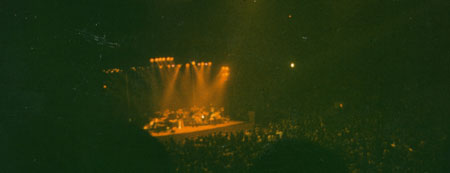
I remember vividly the opening chords of the first song: “Most Likely You’ll Go Your Way and I go Mine”. The Band may well have been the greatest back-up ensemble Dylan ever played with. Their performance was incredibly rich, textured, and vibrant. (“Before the Flood”, a double-album of performances from that tour, is worth having.)

Thirty-four years later, my son and I attended a Dylan concert in London, Ontario, at the John Labatt Centre. Like Maple Leaf Gardens, this is a hockey arena, so the acoustics were not great. His backup band was good, but not as good as The Band.

In 1972, Dylan and the Band played the complete concert, with the odd Dylan solo on acoustic guitar, and a few songs performed by The Band without Dylan.

The John Labatt Centre is a newer arena, well-furnished and gleaming. The staff seemed unduly concerned with stopping people from recording the concert with cameras or cell phones. This was a little baffling: who cares if someone creates a 160×80 grainy mpeg of this performance? Are they out of their minds? But the attendants stood guard near our seat, watching intently. When it looked like someone was using the camera on their cell phone or a real camera, they stepped in and asked the person to stop. I had to be clever to snap the few shots I did, and most of them are blurry.
The men sitting in five seats to the right of us seemed to have a dire need to go for beer or to the bathroom about once every song– that is not much of an exaggeration. The seats are so close together, I had to stand up to let them pass each time. It was annoying. Whey they weren’t drinking or peeing, they were yakking away, or making fun of Dylan’s incomprehensible voice.

The voice– unlike old copper or English gardens or Tom Waits– has not taken on an atom of patina or richness. If anything, I think he has become more shrill and spastic, and less coherent, than even in his “Street Legal” or “Saved” days. If I hadn’t already known most of his lyrics by heart I wouldn’t have been able to make them out.

Dylan played a keyboard exclusively – he didn’t touch a guitar– and every song featured the entire band.

Dylan’s encore was generous: four songs, including two of his most revered: “Like a Rolling Stone” and “All Along the Watchtower”. He sounded better singing these two than almost any other song of the night.

Dylan apparently is not content to simply perform the same songs over and over again as originally recorded. Several songs were radically restructured, musically, especially “Desolation Row”, “It’s All right Ma, I’m Only Bleeding”, and “Girl From the North Country”. He performed a generous mix of classics and more recent works. His voice is problematic, but give him credit for investing in his own work, taking risks, and reinventing himself.


Memories

I am fascinated by memory issues and this recollection of mine brought up a few.

I was able to determine that the concert was in 1972. Let me see if I can find the exact date: no it wasn’t 1972. It was in 1974, January or February. Surprisingly, I’m having a hard time googling the exact date.

Okay — it was exactly January 10th, 1974. I know because though he played two dates in Toronto (both at Maple Leaf Gardens), I vividly remember the first song I heard: “Most Likely You’ll Go Your Way and I’ll go Mine”, and only the January 10th concert began with that song. (The January 9th set began with “Rainy Day Women”

Where I found the info: www.bobdylan.com

What I don’t remember: how we got to Toronto. Who drove. I don’t remember anything about sleeping over other than the fact that we probably slept over somewhere. Or maybe not. I vaguely remember that the idea of sleeping over was vetoed by a parent. I seem to remember that we ate out at a Chinese restaurant in Kensington Market and then walked to Maple Leaf Gardens.

One person who claims to have attended the concert reported that Dylan came out in a Toronto Maple Leaf’s jersey. I think I would have remembered that. I think this person possibly has the wrong night.

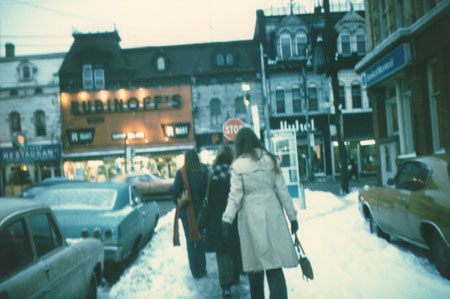
Who came with? Janie Lou Kannegieter — I see her in the picture in the beige coat. Pauline Hielema. Our teacher, Lambert Zuidevart. A smart, cultured student from the grade 11 who liked to write — Gertie Witte? I think that was her name. I am not sure about her.

I think the girl with the long brown scarf in the picture is Pauline.

So I was in grade 12. I graduated a few months later and then went to college.


As you can see from the pictures, oddly, I sat in roughly the same location at both concerts: high up on the left side of the arena looking towards the stage. The first is from 1972, the second from 2006. The third picture is Pauline Hielema, and Janie-Lou Kannegieter, and someone else walking ahead of me somewhere near Kensington Market. The picture is blurred, but I am fond of it, because it looks like dusk in winter in Toronto.


Beautiful Losers

A Lost Rant

Before I was out of high school I read the brilliant, obscene, and intoxicating novel Beautiful Losers, a gush of orgasmic narrative that forever demolished every remaining preconception I had of love as a delicate waltz of chivalric gestures and sentimental aphorisms.

From Beautiful Losers I learned that love was desperation and cunning, flagellation and mysticism, grunting and grasping and kissing and licking and scratching for the tiniest fragment of grace in a world of obscene emotional brutality.

Viet Nam 20 Years After Indifference

George Bush is about to travel to Viet Nam with a contingent of 200 business leaders, on the occasion of Viet Nam’s probable admission to the World Trade Organization. He will be attending the Asia Pacific Economic forum. Viet Nam hopes to showcase it’s emerging economy at this meeting: we’re ready to join the Asian tigers.

Bush has already met with Viet Namese Prime Minister Phan Van Khai.

It is 2006. In 1973, the U.S.-backed government of South Viet Nam collapsed and the U.S. army fled. Millions of refugees got into boats and ended up in refugee camps. Many were admitted to the U.S. The communist government of North Viet Nam unified the country and established a dictatorship. The U.S. went on it’s way to try to mess up Central America as much as possible, before watching the communist government of Russia implode (thanks largely to their disastrous attempt to foist a communist government on Afghanistan, leading to the triumph of the Taliban).

An objective person could be excused for wondering if there are lessons to be learned. In both cases, Afghanistan and Viet Nam, attempts to impose a friendly government (friendly to Russia, France or the U.S.) on a foreign nation conflicted with the nation’s own sense of identity and independence, and hostile political groups were able to take advantage and establish themselves as the representative of nationalist aspirations. The determination of the occupied to expel the occupiers was beyond the wildest imagination of the invader. Both Russia and the U.S. thought that superior technology and military might would, in the end, triumph.

What if the U.S. had decided, in 1963, to just leave Viet Nam alone?

What if the Soviet Union had decided, in 1979, to just leave Afghanistan alone?

Well, what if the Americans, who were funding the Mujahideen, who later became the Taliban, who later became Osama Bin Laden, had just minded their own business in Afghanistan as well?

And what if America had just stayed out of Iraq?

I think some generals already have come to the conclusion that as long as the U.S. remains in Iraq, they will be the focal point of opposition, and the opposition is always going to be led by the people most hostile to U.S. values and policies.

George Bush and his Republican apologists have been fond of saying that you couldn’t just leave Saddam in power. Well, you couldn’t just leave Viet Nam. And you couldn’t just not invade Cuba. And you couldn’t just not give military aid to the opponents of the Sandinistas. And so on, and so on. Time and time again, history shown that these kinds of grand schemes almost never work out.

Time and time again, the militarists are proven wrong by history, and proven right by their own delusions: they are always ready to enter a new quagmire.


The Peculiar Undeserved Rehabilitation of Marie Antoinette

How can you not root for poor, abused, exploited, and misjudged Marie Antoinette in Sofia Coppola’s fine film biography, “Marie Antoinette”? She’s nothing more than a naïve waif, an exuberant absolutist cheerleader and aesthete, with the charming hobby of playing at being a milk maid and gambling away her nation’s treasury.

It is a peculiarity of our times that historical judgments no longer consist of balanced assessments of all the facts and circumstances of someone’s life. Sofia Coppola does an extravagantly wonderful job displaying the spectacular indulgences of Bourbon court life, and she does a great job, in half the film, in dissecting the nuances of manner and gesture and style in the life of a 15-year-old princess newly introduced to the most dangerous and sophisticated social strata in Europe.

And then, suddenly, she draws back, evades, ignores, and her selectivity becomes transparent. We never see this Marie Antoinette contact royalist factions among the revolutionaries and try to arrange escape, and a counter-revolution, and civil war, all for the purpose of restoring her husband and herself to absolute power. We don’t see soldiers killing unarmed peasants. We don’t see the starving children of peasants, though we hear Marie’s children cry when the mob comes to move the royal family back into the palace in the city.

Marie Antoinette was hardly the monster her contemporary enemies portrayed her as, but she wasn’t this callow, harmless teenager either. And that leads me to the second failing of this film: no young woman, given the power that she had, could have survived court life as long as she did without developing the ability to manage, direct, and command others, not necessarily because she wants to, or because she’s a bully, but because she is royalty in an age that genuinely believed that God had appointed one class of people to scrounge and slave and suffer and die in poverty, and one class of people to collect almost all the wealth they created and rule over them.

We almost never see this Marie Antoinette do what princesses and queens do: order people about, dismiss them, communicate her wishes. We see her frolicking in her lovely, pastoral gardens, and we overhear a few snippets about the outlandish costs, and she cavorts with her attending ladies like a school girl, but Coppola never shows us the Queen of France exercising her will, and the people around her reacting to the immovable force of her preferences, her desires, her tastes.

We see her innocently imitate a milk-maid, but the servants who actually do the work of gardening and maintenance are all cheerful and picturesque.

The process of rehabilitation is easy. No one is a perfect monster, or, as in this case, perfectly trivial. It doesn’t strike me as particularly significant that, once France began to fall apart, we find evidence of Marie Antoinette dressing less extravagantly, and refusing more diamonds, or that she was a decent, loving mother, or that she had her charities.

Or, pity her grace, after her arrest and the death of Louis:  “some of the guards going as far as blowing smoke in the ex-queen’s face”.

But it is striking to me how this kind of historical revision seems to overcompensate. Louis XIV was an incredibly incompetent monarch, and France’s ruling class did almost everything possible to bring about a revolution by creating absolutely intolerable conditions for the poor and middle classes, while indulging their own tastes for unbelievable extravagance, and financing a war in America.

And, contrary to “Marie Antoinette”, both Marie and Louis conspired to arrange for an army from Austria to invade France, arrest and kill the revolutionaries, and restore the Bourbons to the thrown.   Had she carefully avoided association with the Austrian threats, and the attempt to flee to Varennes, she might have escaped.

There is no excuse for the omission of this central fact about the fate of Marie Antoinette.  She didn’t deserve to die– nobody did– but she was not innocent.

Drop that Bass! I Mean it! Don’t Make me use This!

Life gets more and more like Dr. Strangelove, the movie.

Read About Your New  Well-Armed Coast Guard Here.

The U.S. Coast Guard now, having carefully and rationally considered the threat of Al Qaeda storming Duluth from across Lake Superior, are going to arm their cutters with 7.62 mm machine guns capable of firing up to 600 rounds per minute.

Yes, the U.S. Coast Guard, having carefully and thoughtfully considered the threat of Al Qaeda infiltrating Port Burwell and Port Dover, Ontario, Canada, and hijacking high-speed fiberglass sail boats or diesel powered fishing vessels, or a kayak, and stealthily crossing the deceptively placid waters of Lake Erie, to launch a major anthrax or fertilizer assault on Erie or Toledo…. we will not let it happen!

The U.S. Coast Guard, armed, and tested, and resolute, and disciplined, will stand up with courage and determination, and give their lives, if necessary, to stop them… God bless you, U.S. Coast Guard.

I’ll bet you think I’m joking. Or maybe you think, well, doesn’t seem likely, but I’ll bet the Department of Homeland Security knows a lot more than I do about the threat from Al Qaeda and about exactly how rigid those screening programs for refugees coming to in Canada. My God! It’s another 9/11 just waiting to happen.

Or maybe not. Maybe you will vote for someone else in five weeks or so.

How Dare You Not Stop Everything When I Tell You Too

When construction crews at the site of the World Trade Centre found some human remains in an abandoned manhole last week, some of the families of the victims were “outraged”. They demanded a stop to all construction. They demanded that the world stop turning and the winds stop blowing, until their grief has been adequately recognized by a monument 1150 miles high, made of pure titanium, and costing more than a billion, trillion, zillion dollars.

And all of the other suffering people in the world– your suffering is not important or significant or worthy of memorials or cash awards because, you are not me.

Nobody will publicly take on the families of victims of 9/11 because their shrieking outrage will be deafening and the media is terrified of displeasing them in any way, so they get to make demands like this with impunity, without blowback, without anybody calling them out.

And one thing the media would not dare to do is raise the question of why other victims of government malfeasance or neglect, like black families living in poor neighborhoods because of red-lining,  polluted by lead factories or dumps of asphalt shingles or leaky refineries, suffering outrageously increased rates of cancer and lung disease, — why do these families never receive even a penny of compensation for their suffering?

Yes, we do know.  And it is an outrage.


Shut-up and Vote Like the Rest of Us: The Jury System

The jurors in the Heidgen case apparently considered that. Twice they sent the judge a note saying they were deadlocked. After the fourth day of deliberations, an 8-to-4 majority in favor of a murder conviction became 10 to 2, according to the jurors. In the fifth day, the last two holdouts joined the majority. But one of those two, the jury forewoman, said later that she had felt unbearably pressured by other jurors. She said she was still convinced that Mr. Heidgen was guilty of manslaughter, not murder.
New York Times, October 21, 2006

God help you if someone is on trial for his life, as Mr. Heidgen was, and you are on a jury and you are in the minority that doesn’t believe that drunk driving is the same thing as taking a knife and stabbing it into someone’s chest, even if the results of your criminal foolishness are very, very bad.

You will not have the option of voting against conviction on the more serious charge– murder. This is for a man who was DUI and got into an accident causing the death of a 7-year-old girl. Some members of the jury, while agreeing to convict of manslaughter, felt that what he did was not the same as taking a gun and shooting someone.

What is going on here? This is bizarre. We have a jury system. The prosecution presents its case. The defense presents their counter arguments, the jury discusses the case, and then they vote.

I don’t think it’s unreasonable to ask a deadlocked jury to go back, discuss some more, and then hold a second or even a third vote. But when some jurors declare that they are not willing to vote guilty and the judge sends them back over and over and over again, even after the rest of the jury has declared itself to be deadlocked, the judge is essentially ordering a verdict of guilty. He is essentially over-ruling the jury system: because in the jury system a man is not guilty unless the entire jury finds him guilty. Clearly, this jury, after what any sane person would deem “reasonable” discussion, did not attain unanimity. It should have been released and sent home. (Actually, they would have found Heidgen guilty of manslaughter instead of murder, which would have been, given the circumstances, a more reasonable outcome.)

The judge knew this.  The judge did something despicable and contrary to the principles of justice.

But then Neil Flynn would have been very, very unhappy.

And the prosecutor, who was elected on a platform of getting tough on drunk drivers, would have been unhappy. And the judge himself, also facing election, would have been unhappy.

So the majority of the jury was allowed to continue bullying and intimidating the remaining jurors until they got their way. There was no other result that will bring an end to the psychological torture being inflicted on the minority jurors.

This was a kangaroo court.

As difficult as it might be to summon any sympathy at all for a man who drives with three times the legal limit of alcohol in his blood and causes an accident that takes the life of a young girl…. Mr. Heidgen deserves better. We all do.


There is a video interview with the father of Katie Flynn on the NY Times website. How hard is it to lose sympathy for the father of a 7-year-old girl killed by a drunk driver? When “justice” starts to look more like vindictiveness and revenge.

Will Neil Flynn be happy after Martin Heidgen has rotted in a federal prison for 20 or 30 years? I doubt it. But maybe it takes a remarkable act of spiritual ascendancy to not want to just bash somebody after you’ve been the victim of an unjust act.

Every citizen should be required to see the movie “12 Angry Men” at least once in his or her life.

But I doubt it would make any difference.

And don’t tell me that Mr. Heidgen got “closure”.  What he got was revenge.