War With Iraq: Quagmire Awaits

Do you think George Bush is smart? No, you don’t. Even his conservative, Republican, oil executive supporters don’t think he is smart. But that’s okay. He is surrounded by smart people and he relies on their judgment.

That is logically ridiculous of course. Americans are suspicious of intellect– we know. They somehow think that a down-home country guy with a little cunning surrounded by competent managers is the ideal leader. He won’t get confused by details or messed up by the subtleties or ambiguities of complex realities. He’ll just go with his instincts. Instincts are always better than closely reasoned judgments. Aren’t they? They are in the movies.

Well, actually, less than 50% of the voters seemed to think that Bush was smart enough to be President. And, of course, a decisive majority of all the conservative Republicans on the Supreme Court, including the acute Clarence Thomas.

The trouble is, if you aren’t very smart yourself, how do you know your managers and advisors are smart? And when they give you conflicting advice, as surely Colin Powell and Donald Rumsveld and John Ashcroft have been doing, how do you sort out who is right? You kind of feel for it, right?

Is that good enough in 2002? Is that good enough for the world’s only remaining superpower, other than Europe, China, or India?

So you have this fixation on Iraq. Iraq is a crisis point for America right now because, well, George Bush Jr. decided Iraq is a dangerous threat. He seems to have made up his mind that he must invade Iraq and kill Saddam Hussein and set up a new government, so that oil can be extracted and sold by large American corporations, or democracy can be restored, or Americans can feel safe once again from all those Iraqi Scud missile attacks we’ve been experiencing lately.

Dick Cheney was so prescient about Iraq that while he was in charge of Halliburton, as recently as 1998-99, he did more than $23 million of business with Iraq. Didn’t he know that Saddam was a monster? Not until George Bush Jr. announced the “axis of evil”, apparently.

Do you think these men in charge of the White House have given thoughtful, intelligent consideration to these issues:

  • what if the Kurds, who are already itching to join the attack, decide, as they are likely to, to set up their own little country in Northern Iraq, right on the Turkish border? How would Turkey like that? Or Iran, which also has a substantial Kurd population that it is struggling to keep in check. Neither Turkey nor Iran would tolerate a breakaway Kurd republic on their borders.

Bush has extracted promises from the Kurds not to seek an independent state. And these guys are smart enough to believe them….

  • what if the hardline Moslems react to the war by tossing President Pervez Musharraf and setting up a hardline Islamic republic? With a bomb. And with an incendiary situation in Kashmir?
  • what if the same thing happens in Saudi Arabia or Yemen? What if hard-liners in Iran come to believe that the U.S. won’t be satisfied with deposing just one pole of the “axis of evil”?
  • what if the Shiite Moslems in the South of Iraq decide they would be happier united with their brethren in Iran than with Baghdad’s Sunni minority, whatever form that leadership might take in a post-Saddam Iraq?
  • what if the overthrow of Saddam doesn’t stop terrorism? (It won’t– it will probably increase it.) Who’s next?
  • can the officials of this administration name a single instance in which concerted military action (as opposed to negotiation and compromise) put an end to terrorist activities, anywhere in the world?

After Iraq, terrorists hiding out in Yemen, Pakistan, Egypt, Saudi Arabia, and elsewhere will continue to target U.S. military installations, diplomatic buildings, and the U.S. itself.

Since the U.S. seems incapable of actually tracking down and capturing real terrorists, it will have to find someone else readily available for a good bashing. Iran? North Korea? Somalia?

Your Fingerprints: Junk Science

When we were little children watching police shows like “The FBI” and “Adam-12” on TV, we became convinced, along with everyone else, that if a criminal’s fingerprints were found at the scene of the crime, it was case closed, proof-positive, open and shut.

Why? Because no two fingerprints, in the entire world, could be alike. How did we know that? How did we know that that was true? Because everyone acted as it it was true. Everyone acted as if no two fingers in the entire world could have matching patterns on them. Everyone acted as if this was the product of years of sound, thorough research conducted by revered scientists.

It is very odd, then, to discover, that there might never have been a good reason for believing that the evidentiary value of fingerprints has ever been established with any kind of scientific rigor. There really is no body of systematic research or scientific proof that fingerprints really are unique to each individual, at least, not in the way the movies and television would have you believe. In other words, nobody has ever systematically compared fingerprints to each other to establish just what the odds are that any two, from perfect strangers, might match.

In 1995, a proficiency test was administered to 156 law enforcement examiners. These are the guys called in to court to testify that the suspect’s prints — don’t forget, we could be talking about Lee Harvey Oswald here, among others– were found on the murder weapon, or a door knob, or a table surface, or something. Only 44% of these “experts” could correctly identify all five of a set of test prints. Read that again: less than half of the “experts” were proficient. And again: half of these guys got at least one of the prints wrong, out of five. Twenty percent. One in five.

I don’t know the details of the test, but I do know that the people who administered it considered the performance of half the experts to be inadequate and unreliable.

What has happened is that the Supreme Court of the United States has recently made some rulings that require courts to establish that “scientific evidence” really is scientific before it is allowed in the courtroom. What you have to imagine is some “expert” talking in obscure, difficult language about some scientific information which the jury doesn’t understand. The jury takes the guy’s word for it. The jury figures that the “expert” knows. The jury figures that he wouldn’t be testifying this way if he didn’t have a solid body of research and knowledge behind him. Think about fiber and hair analysis. Think about fingerprints. Think about those difficult cases where the prosecution actually has very little evidence so they scrounge around for “matching” fibers and hairs and semen and spots of blood. We have been trained by television and the movies to regard such evidence as definitive and decisive. Now we are beginning to know that such evidence can be constructed around a suspicion.

In France, 16 points of similarity, between fingerprints, are required before a “match” can be asserted. In Sweden, the number is 7. The FBI, in the U.S., won’t tell us how many it considers decisive. The FBI says it decides on a case by case basis. I thought that justice is exactly the opposite of that. Blind and impartial. Consistent. The FBI says, “trust me”. I wish I could.  Science does not provide standards that apply on a “case by case” basis.

Our system of justice– adversarial– encourages both sides to become advocates for their clients’ interests, rather than the truth. The police don’t just present facts– they invest in the suspect’s guilt, and advocate for it, and do whatever they feel needs to be done to “win” their case. It is apparent that often they feel that they know who did it– they just need to muster the facts necessary for a conviction. They sometimes regard the law as an impediment to justice.

They almost never willingly admit a mistake, even when DNA analysis proves they were wrong.

Occasionally, it is clear, they manufacture the “facts”. An expert, for example, will testify that a fiber found in the suspect’s car exactly matches a fiber taken from the victim’s sweater. So how do you assess the real degree of similarity, and the real likelihood that these fibers could have matched fibers from almost anyone else’s sweater? The lab is not presented with five samples and five potential matching fragments of evidence, and then asked to identify which ones match. They are presented with a set of fibres from the suspects home or clothing, and a set of fibres found at the crime scene. Do they match, yes or no? If no matches are found, we’ll find more fibres, and then more. The lab technician knows that the police will be happier if a match is found.

A suspect’s car– or any car– is loaded with smells, particles, dust, fragments of things, scraps of paper, coffee stains, oil and grease, residues, maybe even bodily fluids. If you took thousands of samples of every substance in a any car, how hard would it be to find something– anything– that matches something that can be linked to a victim– any victim? I’ll bet it wouldn’t be that hard at all.  Look at the Azaria Chamberlain case.

The Supreme Court is right. We should demand very high standards of “expert” testimony, before allowing smooth-talking partisan professionals to try to bowl over a jury with analysis that might well be nothing more than “junk science”.


Random Notes:

Until the 1880’s, the commonly accepted “age of consent” in America was 11.

2011-06: in the case of Casey Anthony, the prosecution is actually presenting “evidence” that traces of the smell of a decomposing body can be detected and analyzed from the trunk of Ms. Anthony’s car. This has all the hallmarks of the good old fibre analysis presented at so many cases by discredited forensic “scientists” in the past.

I hope her defense attorney has the intelligence to ask the prosecution to produce evidence of the smells of hundreds of cars compared to the smell captured from Ms. Anthony’s car and then have the “expert” blindly identify which one had the body in it.

You are Insane

According to two studies, the National Institute of Mental Health Epidemiologic Catchment Area Program (1980-85), and the National Co-morbidity Survey (1990-92), about 30% of all Americans will experience mental or addictive disorders in a given year and 50% will need mental health services in their lifetimes.

According to the February issue of The Archives of General Psychiatry, those numbers are too high. What a relief to find that out! The “correct” number of people who experience mental or addictive disorders in a given year should be about 18.5%. I didn’t see a corrected number for the second piece of data.

So if you ever thought that most people are nuts, you’re not too far off. The professionals agree with you.

Makes me wonder what would happen if the plumbers did a study showing that 50% of all homes need some plumbing. Would you rush out and hire a plumber to come in to check your house to see if it was one of the 50%? How likely do you think it would be that your house, indeed, was one of the needy homes, if you asked a plumber to check it?

Some car repair shops urge you to come in for free brake inspections. You bite. You bring your car in and wait twenty minutes while a repairman inspects your car. The repairman should probably be working on someone else’s vehicle up there on another lift, but he stops his work to look at your car. The impatient owner of the other car is reading three-month-old newsmagazines and drinking stale coffee in the waiting room. But they already have his car on the lift, so you get priority. Now imagine, if you can, that the mechanic comes back into the office and walks up to you and says, “everything looks hunky-dory down there.” Right.

Now you may believe that unlike car repair shops, psychologists and social workers aren’t after your money. They work in those professions because they want to help people. Right. And pop stars are in it for the love of music. And politicians because people begged them to lead. And lawyers because they love justice. I’m not saying they’re not. Necessarily. Just that their perspectives on the necessity of their professions might be influenced every so slightly by their pecuniary interests.

But psychologists, psychiatrists, and social workers are not plumbers. They do not work with fixed physical properties of objects. They work with your mind. They would like to believe that theirs is a “science”, beyond argument, and demonstrable with evidence and proofs. The assumption is that personal spiritual or philosophical values are secondary to the eternal and scientifically grounded principles of psychology and sociology. You can be manipulated. Fixed.

If about 20% of the population really does have a disorder, you would think that someone would realize that there is a serious problem in our society that needs to be fixed. There are too many casualties. If 20% of all airplane trips crashed or 20% of all ships sank, you can bet that all travel would be suspended until the problem was found out and solved.

The other possibility, of course, is that 80% of our society is nuts and 20% fully comprehend our predicament. Our predicament is that we have built a society that, in order to gratify the voracious appetites of the rich and powerful, has driven itself into a pathological system of destructive obsessive behaviors. The 20% understand that and have opted out and carry their belongings in shopping bags and fervently wish for a happy meal tomorrow. Beyond that, who knows?

The rest of us can just keep taking our medications.

A Visit to Ottawa – Part II

Bill’s Trip to Canada’s National Capital: Part II

I stayed in Ottawa recently to take a course in Oracle, the world’s most powerful and expensive data base. I stayed at the Lord Elgin, which is really pretty fancy, though I assure you it is priced very competitively with Holiday Inn. They took my car away from me from the moment arrived– I haven’t even seen my keys in four days– so I was forced to walk everywhere.

I walked down the Rideau looking for a Wendy’s. There were two Burger King’s, a McDonald’s, a Dairy Queen, and a food court in the Rideau Centre, a giant shopping mall. I ended up with a Mozza burger from A&W and New Yorker Fries and a complete waste of dinner.

On the way back, I stopped in at Chapters to try to find a book on humor by Gershon Legman. The staff were not helpful. Well, I’d never heard of him either until recently. The computers they have scattered throughout the store are supposed to help you find books. It found Legman’s book but it declared that not only was it not in stock, but it wasn’t even “available”. This is a book that some people with opinions I respect think is a very, very important book.

On the way back, I dropped into the Canadian Museum of Contemporary Photography. There is a long staircase descending from Rideau St. to a long, empty hall, and then another staircase that descends to the main hall. On the upper hall is a display of photographs of images from a television set of an 8mm camcorder video taken by a guy named Ho Tam. In these images, Ho “moves between the roles of observer and participant” and produces a series of “grainy yet sensitive pictures”. Ho reflects on his schooling experiences (the shots are taken in a Catholic school he attended in Hong Kong) and, “most importantly, the ‘lessons’ learned during those formative years— love, desire, discipline, trust, fear, and loss of innocence”.

To me, they looked like a bunch of badly lit, badly aimed Kodak Instamatic photographs. What’s in them? What did you think would be in them, given the description above– “loss of innocence”? They consist of a bunch of images of the buildings, the kids playing soccer or hanging around, and the toilets, and foliage.

Well, that’s the problem with modern art, you know. I say I wanted to see some very sharp, specific images of faces and people acting upon each other and their environments. The artist asserts that I am oppressing him with a paternalistic and fascist sense of structured literalistic meaning.

But let’s think about this. Why do we have modern art? Because artists since 1920 have been so wildly inventive and imaginative that they have single-handedly struck upon a mode of expression that contains the unparalleled potential to illuminate the zeitgeist of our own era? No. Modern Art exists because photography came along and removed the figurative, representational purpose of painting and sculpture. With nothing else to do, art turned in upon itself and became self-referential, drawing attention to it’s methods and material elements and structure. The next thing you know, it is mocking those very self-referential elements, and then it is trying to draw attention to the fact that it is mocking itself, and then it tries to be so cool that it doesn’t even seem to be mocking itself, all the while demanding that patrons pay outrageous sums of money in order to exhibit these products upside down in their living rooms.

So you have Jackson Pollock with his splatter-paintings, and Andy Warhol with his soup cans. So you have the Metropolitan Museum of Modern Art in New York fighting bravely for the honor and respect of modern art now caught in it’s own theological disputes over whether or not post-modernism really exists and should have a place to display itself.

And you have Ho with his deconstructed photographs. What is he doing?

He is using a technology to imitate an art form that is a revolt against his technology.

Is he a genius?

No, because he doesn’t understand what he is doing. What he thinks he is doing is making his photographs “artistic”. How do you make them artistic? Well, good heavens, not by finding interesting subjects and photographing them accurately. You make them artistic by finding uninteresting subjects and photographing them in uninteresting ways, with uninteresting angles, in degraded colour and low resolution, and then you mount them on the wall and point to them and tell people–you have to tell them, or they won’t know– that this is art.

Your artlessness camouflages the fact that you have no creativity to offer, that you didn’t do the hard work of composition, lighting, camera angle, colouration, and so on.

Most importantly, you ban cameras from the building.

I’m not kidding. I’m looking at these awful illustrations on the wall and reading a sign and the sign says that anyone trying to steal these images will be prosecuted for copyright violation. God help us, someone might try to steal a photograph of your bad photographs! It makes me think of an old, fat, diseased whore: “Don’t you even think of trying to get me to pose nude for you, my boy!”

Down the hall, in the main hall, don’t you know, are more mature works by a more respected visual artist– Pierre Boogaerts.

I am reading the program notes on Pierre Boogaerts. Is there any greater testimony to the bankruptcy of modern art than phrases like this: “… belongs to the generation of artist who adopted photography as their preferred means of expression in the early 1970’s”. Isn’t that bizarre? It sounds like elevator conversation– you have to say something, so say something inane. Anyway, his work is “marked by a conjunction of influences from Pop Art, Land Art, and conceptual art, and called into question the formulation and function of the work of art itself”.

That kind of consummate gobbledygook may have been excusable once upon a time, when the philistines were upon us, or when Stravinsky almost started a riot in Paris with “Rites of Spring”, but to write that kind of crap in 2001 of a mediocre artist like Boogaerts raises the question of whether the curators of this museum themselves must realize that it sounds like a joke.

There’s more:

“The Exhibition is selected from the entire body of work donated to the CMCP by Boogaerts in 1994. Poetry, an essential dimension of Boogaerts’ production, which is frequently masked by its conceptual art trappings, is highlighted in the structure of the exhibition through the use of analogy. This approach focuses attention on the visual beauty and associative processes inherent in the medium, which influenced the development of the artist’s ideas.”

Maybe you can rationalize away the word “entire”, as if he had another body of work that wasn’t “entire”, or the coy link to poetry, and maybe even “conceptual art trappings”, but I defy any sane person to excuse, in the name of literacy, “associative processes inherent in the medium”.

If you’re still interested, his photographs consist mainly of repetitious shots of leaves and buildings, arranged in various uninteresting collages or shapes and sizes.

I was the only person in the museum for the first ten minutes of my tour. Four or five other people came in while I was there. The staff, three people, well-dressed, behind the main counter, seemed discernibly alarmed when I came in. A security guard tried to follow me but I think she didn’t want to appear to be too suspicious so she hung back and tried to look nonchalant while making sure I didn’t stick a photograph of a leaf under my coat. They didn’t check me for anthrax or bombs or anything– does Osama Bin Laden know that the Canadian Museum of Contemporary Photography is a sitting duck?

It reminded me of a moment in Europe, in 1977. I toured the Rijksmuseum in Amsterdam, which was great, and very busy, and the Van Gogh Museum, also in Amsterdam, and the Louvre in Paris. At either of the latter two, I could easily have walked out with any painting, including the Mona Lisa. Shortly afterwards, a mad Dutchman sliced Rembrandt’s “The Night Watch” and that was the end of that era.

Everybody jaywalks in Ottawa, even the police. Well, perhaps I exaggerate. I didn’t actually see any police jaywalk, but I saw several of them sitting in cars or Jeep Cherokees near busy intersections and not one of them tried to arrest me for jaywalking.

Being the law-abiding sort, I wanted to wait for the lights to change, but this young girl who looked like she knew what she was doing blustered ahead of me and charged through the red “Don’t Walk Sign” so I followed. In fact, she demonstrated a convincingly degree of leadership, so I followed her for several blocks, at a discrete distance of course. She was good at it. She knew exactly when you could charge safely through a red stop sign and when it might not be safe.

We passed a demonstration near the National Arts Centre. I didn’t notice what it was for. I was instantly sympathetic with their cause…. until they started chanting. That’s when I am forced to tell myself that I could never be one with the poor and oppressed of this earth. I am genetically programmed to become nauseated at the first sound of a sing-along, group chant, slogans, and such. I would be a lousy demonstrator. When the woman with the bullhorn demands, “what are we going to do about it?”, I would shout, “I don’t know. What? Can we think about it?”

There was some kind of diplomatic gathering at Hotel Laurier. There were about twenty limos there with various chauffeurs standing around, shaking hands and gabbing. It looked like a United Nations get acquainted party. The cars, each with a distinctive red license plate, were parked all over the place, including on the sidewalks. I noticed that some of the “limos”, probably from poor third-world countries, were Neons and Jettas.

I saw something on the sidewalk and picked it up. It was some kind of identity card, which must belong to someone important. This person is so important, he doesn’t need his name or any other identifying marks on his card. It just has a magnetic stripe., and it is attached to some kind of belt clip with a yoyo type wire that reels back into a little disc. Very cool. I looked around at the chauffeur drivers but none of them met my eyes, so I walked off down the street with it. A few blocks later, I passed a cop and thought of turning it over to him, but then I thought it might arouse suspicion in these paranoid times, so I tucked it into my pocket and walked back to my hotel.

A Visit to Ottawa

I happen to be in Ottawa for a week to take a course on Oracle. Ottawa is actually quite beautiful in the downtown area but the political climate is such that you can’t help but think, boy, they sure are squandering a lot of taxpayer dollars here. The National Arts Centre is quite impressive. And if I look out the window of my hotel, I can stare right into the face of a huge office tower with the government logo on it. It’s 10:00 at night and all the lights are on.

But most of the big expensive buildings here are privately owned, like the Learning Tree Education Centre at 160 Elgin St. It looks like the tower is owned by Bell, which has it’s logo on the front, but you never know nowadays. It’s large by Ottawa standards. It’s gloriously finished, in marble and all kinds of gleaming, expensive materials I don’t know the name of. A man comes out the front with a broom and a dustpan and sweeps up the cigarette butts regularly, even in the evening.

These monstrous towers– dwarves, compared to the World Trade Centre– never made much sense to me. Who said we should allow people to build up 40, 50, 60 stories? Who said that just because you own a plot of land on the surface of the earth means you’re entitled to do anything you want with all of the space above it? Tall buildings take the sunlight away from people, of course. They create traffic problems, and block the view and, again, as the World Trade Centre showed, they’re not very safe. Not for the obvious reason– which isn’t very likely to happen anywhere else soon, but because firemen can’t reach the upper floors. In New York City, the highest floor that can be reached with fire hoses and ladders is the 37th. If there is a fire above that level, you might as well jump.

Which reminds me. I have a great idea to improve the safety of people who work in those towers. I believe that the landlords should be required to provide a hang-glider for every worker. You might think it would be crazy to try to hang glide through the downtown corridors of our modern cities, but it’s a lot better than the alternative.

The hotel is pretty nice but the bathroom is small and the towel rack hangs right above the toilet.

Oracle is the most expensive off-the-shelf software in the world, about $15,000 or more for the server version, and Learning Tree International charges thousands of dollars for a one-week course on how to use Oracle, but they can’t afford to buy enough computers for everyone in the class so I get to share mine with Ahmed. Ahmed’s a real nice guy but the trouble is that he and I are moving at different speeds here, so I sit in my $5,000 seat at times in frustration.

Learning Tree doesn’t scrimp on the amenities. They have these really cool coffee machines that take little plastic cups of freshly ground flavored coffee and whip you up a very tasty shot of caffeine in no time at all. They provide you with fresh fruit, muffins, yogurt. Our trainer works in the real world, usually, and knows his stuff. The lessons are well-prepared and thorough. They were giving us an hour for lunch but the class voted to start at 8:30 instead of 9:00, take 30 minutes for lunch instead of 60, and quit an hour earlier at the end of the day.

Most of my classmates looked bored and frazzled. It’s like trying to learn Russian in one week, immersion. People do exercises as if they have just been instructed on how to do heart surgery and must now repair an aorta, on their own, in fifteen minutes.

I am staying at the Lord Elgin. I don’t think it’s a cheap place, by any means, but other hotels have jacked up their rates so much that it’s actually fairly competitive even though it’s level of service is far higher than it is at, say, the Travel Lodge or Holiday Inn. The elevators are covered with brass. The lobby floor looks like some kind of marble or other high priced tile. There is a bellboy in his funny little uniform. But hotels can be a little crazy. You pay over $100 a night for a good sleep and then get woken up by loud vacuuming and door-banging at 7:00 a.m.

The telephone in the room rings. I kid you not. You don’t hear a phone ring very often anymore in this world. But it rings. It’s a shock to the ears at first, a flash of nostalgia, and then annoyance: the ringing sound really is quite annoying. You would think that at the rates they charge, hotels would be rushing to put in reasonably state of the art equipment, but this phone system has got to be 30 years old. The television too, an old Zenith, would look right at home in the Beverly Hillbillies era. It has one of those clunky brown boxes on the top. When you turn it on, it goes right to the offers for movies. They want $9.95 to watch a movie in your room. This is a big profit centre for hotels. You would think, for $9.95 on a crummy tv, that at least you’d be offered a pretty good choice of some reasonably current movies. Oh no. The offerings this night (October 31, 2001) are:

  • Rush Hour 2
  • American Pie 2
  • Planet of the Apes
  • Legally Blonde
  • Pearl Harbor

They have got to be kidding! All of these movies are either colossal losers or nearly out on video where I can rent it for $3.50, or both. But the real winners are:

  • Three Women and a…
  • On My Face (Mirages of Lust)
  • Nasty Pix 14 Triple Feature (Features 3 Adult Movies) for $12.99

Class joint, this Lord Elgin. On the outside, all expensive baubles and class. Inside, it’s as tacky as a Vegas strip club.

National Hysterical Orgasm

We are safe.

This is probably the least popular opinion I’ve ever posted here but I think the whole continent has gone nuts. And I mean really nuts. This is not just a case of the public or politicians getting a little carried away with paranoia and hysteria. It’s just a matter of idiocy on a grand scale. The world has not changed. We are safe.

What’s really going on? There was a massively successful terrorist attack on New York City. A lot of people were killed and a lot of property was damaged. That, folks, is about all we know so far. That’s it. That’s the whole thing. You think I’m nuts? What about the anthrax? What about the new threats? What about Saddam—isn’t he pointing his Scud missiles at us right now?

Everything aside from the initial attack is hype. CNN, which packages news about war, death, and destruction as entertainment, talks about nothing else. The only real news here is that otherwise rational people have completely lost their senses.

How often, for example, do you hear the actual number of dead? 10,000? 8,000? 5,000? It is closer to 4,000. That’s a big number, but it’s not 30,000, which is the number of body bags New York officials initially requested. Who made that judgment? Why hasn’t he been sacked?

It is getting comical. President Bush attends a ballgame in New York and we are given to understand that the holy and sacred Vice-President is being safely stowed away, in a Tupperware container somewhere near Camp David, I presume. It is an “undisclosed” location. Cheney himself probably doesn’t know where it is. Are we supposed to be reassured that the deputy sidekick of the unelected president of the United States is safe? For what? Comic relief? We’re supposed to be relieved that if something happens to George W., Dick Cheney will be in charge???

The anthrax? Do you know how many people have died from anthrax? Four. But we are going to spend about a billion dollars preventing a fifth victim.

What the hell does anyone really know about the anthrax attacks? The government is trying to set the all-time record in dissimulation and disinformation, but the bottom line is that nobody has brought forward even the slightest evidence that the anthrax letters came from anyone other than your usual all-American crackpot. I’m not saying that it’s not possible that some Islamic fundamentalist is behind it. I don’t think it’s likely, myself, but, unlike our noble leaders, I’m willing to admit that I don’t know. Until the FBI has some kind of proof, it is not only stupid but actually irresponsible to go around pointing the finger at anyone.

Every year, tens of thousands of people die at work and on the highway. But what is everyone terrified of now? Anthrax. Nobody is organizing massive numbers of safe-driving clinics, but everyone’s putting on rubber gloves when they handle the mail! How many people get injured or killed in hunting accidents, or accidents involving all-terrain vehicles, or fires, or incorrectly prescribed medicines? Way, way more than will be killed by terrorists in the foreseeable future.

According to the United Nations, 11 million children die every year of preventable causes. [NY Times, March 14, 2002] Nobody, yet, has sounded the alarm.

An actress– whom I never heard of– stated that she no longer opened her mail because of the anthrax scare. Aside from the absurdity of Osama Bin Laden targeting some second-rate unknown Hollywood actress, instead of, for example, Fort Benning, you have to realize that she didn’t say that her mail wasn’t being opened. In other words, good heavens, I’ll have my secretary risk her life instead…

President Bush and other officials have publicly linked the anthrax letters to Osama Bin Laden, while admitting there is no proof. This has the effect of focusing American anger even more intensely on a subject who seems more credibly linked to other terrorist acts. You get a muddying of emotions and intellect here. You get arguments in favor of harsh action against Afghanistan linked to vague feelings of hysteria towards the anthrax threat.

And what on earth is going on in Afghanistan? I thought there was a plan? The trouble is that most of the terrorists who crashed the planes into the World Trade Centre come from Saudi Arabia, and Egypt. According to Seymour Hersh and others, the Saudi Royal Family has been less than cooperative.

What’s really going on here? Not much, since the attack itself. But there are a lot of people with a lot of reasons why they want this “crisis” to be hyped as much as possible. From the cop putting in over-time guarding buildings that are absurdly unlikely to be targets of anyone, to the generals and the military suppliers who have enormous profits and power at stake.

I just watched a press conference in Washington at which the Mayor and various cronies discussed their response to the possibility of anthrax contamination at the local postal sorting stations. They are modeling their presentation on Giuliani’s highly regarded press conferences in New York. The people behind the mayor all look so very self-important and responsible. They’d like us to believe they are our noble leaders and fully in charge and competent. I’m starting to think there’s a bit of a contest here to get on TV and get your five minutes of fame and maybe get more funding and more staff for your department.

CNN, at this very moment, is using talcum powder to demonstrate that anthrax spores can leak through an envelope. Highly scientific. You go, oh my god, the powder is getting out! It’s everywhere! Run, run for your lives!

In London, Ontario, officials are searching the bags of three-year-olds attending the Children’s Museum. I’m sorry—with all due respect, I think these officials are idiots. Do they imagine Osama Bin Laden sitting in his cave in the mountains of Afghanistan and wondering if the suicide bomber he sent to the Children’s Museum in London, Ontario made it through yet?

In Peterborough, Ontario, an idiot school board cancelled a class trip to Holland to take part in a United Nations Conference.

Why? Because of the terrorism! What terrorism? What terrorism!? Are you mad! It’s everywhere. Planes are falling out of the sky! Bombs exploding everywhere! Anthrax in all the postal outlets…..

No. It’s hysteria, plain and simple, and God keep us out of the hands of hysterics. When a group of parents– with better sense than most–decided to send their children to the conference anyway (with proper chaperones and liability insurance) the school board, in a snit, decided to punish them by ordering teachers to give these students zeros for all assignments and tests missed.  How dare you make us look hysterical and paranoid?!

Well, you could argue that it’s simply good and wise to have more security than we used to have. The problem is that if you convince everyone to get hysterical, they lose all sense of reasonableness and proportion. Thousands of people die every year in this country, of disease, accident, neglect, and murder. We have accrued a widely shared body of wisdom about the relative immediacy and causes of these deaths. In a few short weeks, we have thrown all this common sense out the window. We go home and watch the cheesy and disreputable CNN and come to the conclusion that Osama Bin Laden is after us.

Now CNN is bringing on a professional “headhunter” to tell us which vocations are most at risk from terrorist attack.

I am getting roundly sick of idiot conservatives who see this whole crisis as an excuse to get rid of civil liberties and engorge the defense department with new high-tech toys. And I’m really getting fed up with conservatives who regard anyone who disagrees with their own personal views on how the war against Bin Laden should be run as patsies. “Oh, so you want to do nothing!” I don’t know of any liberal who wants to do nothing, but if you don’t go along with the current incoherent policies, conservatives can’t stand the thought that something not involving big explosions and blood-letting should even be considered.

The festering sore of the administration’s current policies is Saudi Arabia. It is becoming increasingly obvious to some that the Saudi’s may not only have provided 15 of the 19 hijackers, but they may actually have been paying off Osama Bin Laden for years.

Look, it’s not that complicated. Osama Bin Laden’s terrorists are not standing outside in Afghanistan waiting for American bombs to fall on them. Most of them are probably not even in Afghanistan. So you have the U.S. bombing one of the poorest and most unfortunate nations on earth. And you have the U.S. snuggling up to authoritarian leaders in Syria, Jordan, Iran, and Pakistan, all of whom faced potential insurgencies in their own nations.

Real police work…. How come the FBI can’t trace those letters? When they talk about funding needs for the agency, the bravado about how new, expensive technologies will enable them to magically apprehend criminals before they even commit a crime is invigorating. The reality, obviously, is more like Inspector Clouseau.

Some people have questioned the idea of bombing a country that is already in a state of near-collapse. Some conservatives have angrily retorted, basically, “how dare you?” Regardless of the strategic value of the bombing runs, and regardless of the fact that we are probably created an entire new generation of suicide-bombers among those very angry victims, you can’t ignore the fact that we have an immense military-industrial complex in the U.S. that is absolutely in lust with power and money. There hasn’t been a good war in a decade, while the military has been stockpiling weapons and delivery systems with unbridled but frustrated passion. This opportunity, for them, is a godsend, and I would wager that the desire of the military to use up as many bombs as possible and make frantic pitches for new weapons systems and more money, is without restraint.

Pabulaolum

Have you seen those new AOL ads, the ones about “Chelsea Buns”? This smug but concerned-looking mother talks about how her daughter was looking for a recipe for “Chelsea Buns” when, it is implied, she accidentally hit a porn site. The mom goes, thank god for AOL! She mentions that she also has a son who is deeply into… “X-Men”.

AOL controls your access to the internet. AOL decides which sites are safe for you to see and which ones are not. To add insult to injury, AOL won’t tell you what it’s criteria is, because it believes that it’s criteria is a trade secret. Like the recipe for Captain Crunch, or Barbie’s measurements.

Sometimes an ad tells you a lot more than it thinks it does. And what this ad tells you is that AOL is really not an online information service at all. It is a television network. Television is about corporate control over what you think and do. Entertainment is merely a vehicle for merchandising. The viewer is a passive recipient of logos, celebrity endorsements, lifestyle ads. Yes, even if you are stupid, you can have a fulfilling life if you have a credit card.

And I’ll bet this woman, so concerned about “Chelsea Buns” lets her kids watch gazillions of ads, three hours of television a day, without the slightest concern. Well, for heaven’s sake, her son is fan of the “X-men”. Violence and mayhem are okay. Sex is not.

These ads practically shout, “I want to be told what to think! I want my information to be controlled and doled out like Pabulum by giant soul-less corporations! Please—it hurts to be free!”

Conrad Black

So it’s now Lord Black.

I personally find it completely offensive that there still exists, within the British Empire, an institution whose very foundation rests upon assumptions about class and lineage that should be utterly repellent to any democrat. The House of Lords is a bastion of exclusive White Rich Male Privilege (no matter how many token women and blacks are added) and British Upper Class Twittledom. And now, Mr. Twittledom himself, Conrad Black, who started a newspaper (and did a good job of it) just so he could show bad pictures of Jean Chretien and declare the Alliance winners before the election was held, is a Brit and a Lord and gets to wear hysterically funny costumes that remind me of the arch stereo-type of British Lords as, well, er, gay. Shall we say, fops. Precious. Delicate and righteous.

It’s Barbara Amiel who really annoys me, though. She once wrote an interesting article on Leonard Cohen, and I believe admitted that she agreed to strip for him in exchange for the interview. Correct me if my memory fails me, Barbara. She also wrote an article for Chatelaine once– my memory is clearer about this– in which she provided a vigorous defense of the art of gold-digging, which is, of course, the art of offering sex in exchange for position, power, and vast amounts of capital. Other than the prostitution angle, I suppose, not much to quibble with there, but it should suggest to us that perhaps Lord Black wasn’t himself so passionate about the cause of privilege as his wife, who now gets to be known as Lady Golddigger. Perhaps Mr. Cohen, recently descended from Mount Baldy (I kid you not) would consent to strip for the aristocracy.

The only thing that disturbs me is that she was a fan of Leonard Cohen. She should have been a fan of Frank Sinatra instead. Maybe she was. That would have been perfect. Frank was exactly the type of man who could see the value in an expensive Lordship. Perhaps she admired both. That’s possible nowadays. There was a time when any person acquainted with the work of Leonard Cohen could be counted on to be a dissident in some way, and remarkable for independence of thought, and, perhaps, a passionate spirit. Nowadays, it is obligatory to honor Mr. Cohen, which is precisely what is beginning to make Mr. Cohen boring. I say it makes Mr. Cohen boring not because his earlier work has become boring, but because Mr. Cohen has begun to believe in it himself.

Which leads me to the question of how one becomes a Lord. Well, it’s quite simple, really. If you have any doubts about my insinuations above just ask yourself a really easy question: is there any way that you or anyone you know could become a Lord? Yes, there is, of course. You simply have to have enough money.

The Stature of Rene Leveque’s Statue

I have always liked Rene Levesque, and I think I like him even more in death than I did in life.

In life, of course, Levesque was a Quebec Nationalist, a separatist who dreamed of creating a Francophone state from the remains of Canadian Confederation. I didn’t agree with his politics– I’ve always believed that Nationalism is just a tarted up version of tribalism– but he was an honest man, and a straight-shooting politician. He wasn’t a hypocrite either. That’s quite an achievement for a Canadian politician.

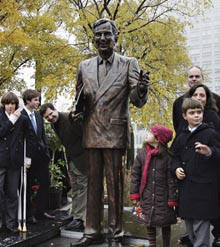
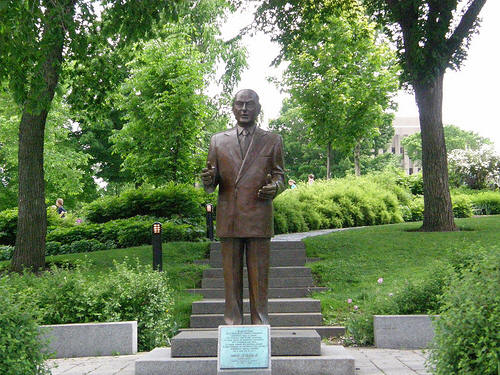
Levesque was 5′ 3″ tall. When the Quebec legislature decided to erect a statue of the former premiere, his family made it clear that they wanted none of that bombastic iconography that living hypocrites employ in honor of the dead. The statue would be 5′ 3″ tall.

Now you may think that it is only natural that a statue would be the same height as its subject. This is what the guy looked like. You can stand beside the statue and feel like this is a guy you could tell your problems to.

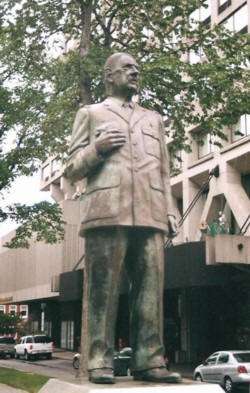
But most statues are not life-sized. Most statues, you see, are about 40% bigger than lifelike. Premiere Lesage stands about eight foot tall. When people walk by, they look up at this awesome man and think, what a hero!

Bourassa’s Statue.

Why is he a hero? Because his statue is so big.

Rene Levesque was also a heavy smoker. The statue makes it look like he should be holding a cigarette in his left hand, but the party leaders had to draw the line somewhere. The good citizens of Quebec generously stick real cigarettes into the bronze fingers: here, Rene, have one on me.

What goes through the minds of the functionaries, bureaucrats, and politicians when they decide on the size of a statue? Why would they make the statue eight feet tall? It seems to me that human nature is rather impure in this area. Monuments are rarely truly meant to honor the subject of the monument. They are made to honor the people who made the monument. France, for example, has innumerable monuments to wars and generals and battles. France, of course, has never won a single decisive battle in it’s history. These monuments are testaments to the spirit of denial and hypocrisy. These monuments say, “we are heroic, because we have monuments to heroes! Disregard the evidence of history: our leaders are giants!”

The monument to Levesque is unusual because it says, this was a guy who didn’t pretend to be any bigger or better than you or me. He was honest and real. He’d rather show you the unpleasant truth than a varnished lie. He knew what it was like to stand in a crowd of powerful, well-dressed men, and not be noticed. Quebec made him their first and best separatist leader.

But the leaders of the Party Quebecois want to put his monument on a pedestal so it will tower over the citizens of Quebec. They want the monument to reflect how they see themselves: Look at us and tremble! We are mighty giants!

I think they go to sleep in fear and trembling every night because they are afraid that after they die, someone will put up a monument to them, and it will be exactly the size it should be.

And Why Would the Police Lie

Why would the police lie about a thing like that?

Anyone who still believes in fairy tales might have a hard time explaining away the behavior of the Fort Lauderdale, Florida police and District Attorney’s office.

Chiquita Lowe claimed that she saw a man leaving the home of Shandra Whitehead in Fort Lauderdale on the night of April 14, 1985. Shandra had been raped and murdered. She was eight years old. Chiquita Lowe saw the man, she said in court.

The police had a suspect: he was Frank Lee Smith, a man with a criminal record. But they had no evidence linking Smith to the crime.

But they had Chiquita Lowe.

Chiquita saw Smith leave the house. The entire case– a capital case– sat on her testimony. Smith was convicted and sentenced to death. He remained on death row for eleven years, until he died, of cancer, in prison. He remained on death row for eleven years, even though Chiquita Lowe recanted her testimony. He remained on death row for eleven years while the prosecutors refused to do a DNA test to confirm or exclude his guilt.

Eventually, of course, the DNA test was done. Smith was categorically excluded. Not only was Smith exonerated, but another man, Eddie Lee Mosley, was matched to the DNA. Mosley is being held in psychiatric prisons after being found insane when he was brought up on two other murder charges.

Do the police go, “oops”?

Do they apologize?

And admit that the police can make mistakes?

Never!

Chiquita Lowe now says that the police pressured her to identify Smith. We now know enough about how the police work to imagine what they said to her.   We know the guy did it but we don’t exactly have the evidence. Do you want to be responsible for his next victim if he walks? It’s your duty to testify as to what we think you saw that night….

She also says the police never showed her a picture of Mosley though the police claim they did, and the police claim that she did not recognize him.

The police claim she did recognize Smith.

Who are you going to believe?

Lowe testified about all this at hearings to reopen the case in 1991 and 1998. The police and prosecutors said she was a liar and completely unreliable. The judge agreed. The judge didn’t seem to realize that he had just rejected as “unreliable” the only witness in support of the prosecution’s original case, a case so thin and insubstantial that it makes you wonder if there is any system at all to justice in America.

How can a judge, with a straight face, declare that a man’s life should be taken based almost entirely on the word of a single “unreliable” witness?

Well, now that the DNA evidence is in, what do the police have to say for themselves? You know what they say? You won’t believe it. They say that Smith must have been burglarizing the home at the same time that Mosley was raping and murdering little Shandra Whitehead. That’s why, they say, Lowe did see Smith fleeing the house. That’s why, they say, detectives really did overhear Smith say something incriminating as they were escorting him to jail. That’s why, they say, the police are really never wrong, though sometimes strange things happen… who knows?

The problem is not that the police occasionally make a mistake. The problem is that the police, encouraged by conservative law and order politicians and incompetent judges, have developed the habit of picking a likely suspect– preferably someone poor and uneducated and with a history of convictions– and then hanging a case on him.

It’s so much easier than investigating the crime and making a case against a real suspect.