Bush League

In a speech at a conference at McGill University recently, former U.S. President George Bush responded to charges that former Prime Minister Brian Mulroney had been too cozy to the U.S. President, selling out Canada’s needs and aspirations in order to cozy up to those big American mega-corporations. “However close our relationship was, the prime minister always had Canada’s best interests at heart.” Spoken like a true tart. He sounds like Dracula praising a woman for her lovely, long neck.

Brian Mulroney himself later proclaimed that where-ever he travels in Canada, “I am just about received in triumph”. It’s a very telling phrase: just about. I picture two old ladies with pom-poms asking if it’s true that Joe Clark is making an appearance. Just about.

Somehow this doesn’t jive with the reports of Conservative campaign workers who found, in the election following Mulroney’s resignation, that doors were slammed in their faces as soon as they identified themselves as representatives of Mulroney’s party. Doesn’t jive, either, with the election results: the Progressive Conservatives under hapless successor Kim Campbell were pretty well wiped right off the map. No one seriously believed this was a vote on Kim Campbell. The Conservatives still haven’t recovered. Mulroney claims that the media made him look bad. The media and about 10 million voters.

Well, when Bush wasn’t busy singing Mulroney’s praises, he lavished a few compliments on former Mexican President Carlos Salinas. Mexico certainly hasn’t lost it’s desire to see Mr. Salinas– he is hiding out in Ireland right now avoiding extradition on charges of pilfering the state treasury. Mr. Mulroney must have blushed with delight at having risen to such lofty heights– to be praised in the same breath with a corrupt former Mexican dictator!

What is so offensive about Mr. Mulroney’s attempts to rehabilitate his “image” is his cold conviction that he really was a great as he thinks he was, and it is only a matter of sufficient determination and persistence on his part for the rest of us to be so enlightened. One gets the impression that he thinks that the people of Canada were tricked into believing he was a creep, and they can be tricked back into believing he was a genius.

The problem with that is that if Canadian public opinion was really so wishy-washy, who would want the blessings of its favour?

Bush has the same problem in the U.S. He is generally regarded as a light-weight president, a man who led his country into the most one-sided and hollow military victory of this century, and, for all that, couldn’t manage to get himself re-elected while running against a shifty womanizing chameleon from Arkansas.

Ketchuppy

Heinz recently held a bit of a pageant. They were looking for a new advertising agency. They already hold about 46% of the ketchup market, but they wanted more.

Maybe they saw the khaki ads for The Gap on TV and thought, “Hey! They’re cool! They’re hip! We want to be cool and hip. Are we cool and hip? I don’t think so. Let’s find someone to help us be cool and hip.”

The two finalists were Leo Burnett Co. and TBWA Chiat/Day. Chiat/Day is famous for some weird new office concept they introduced a couple of years ago: nobody would have a desk or a computer or an office. Everyone would just wander around until he or she found a nice place to work. You could borrow a computer from the front desk. You could sit in a portable cubicle if you had a private meeting. You could haul your files around in a little red wagon. It didn’t work.

The Burnett Co. created the famous “Anticipation” ads for Heinz many years ago– you know– showing ketchup slowly dripping from the bottle while playing the Carly Simon song.

Anyway, the Leo Burnett Co. must have been watching those khaki ads too. They won the contract. How did they do it?

They met with teenagers at restaurants and tried to figure out what the “essence” of ketchup was to these kids. They asked, “if ketchup was a TV character, who would it be?” The answer: the Fonz.

Ah! Oh! Now we understand! Unfortunately, when asked if ketchup was important to them, most teenagers said, “nah”.

What! Ketchup is not important to you! Egad! Outrageous! How can we remedy this state of misguided culinary atrophy?

A Beavis and Butthead spoof? Passé.

The solution was to give ketchup “a personality”. To give it a hip, iconic personae, that can withstand the rigors of adolescent ironic detachment. “Even ketchup advertising can be edgy” chirps Newsweek.

Heinz wasn’t sure. They called in a consultant named Gary Stibel. “Yes, ketchup advertising can be edgy. Here’s my bill.”

Burnett won the contract. Their ads will “focus on teens’ desire for control by showing ketchup smothering fries ‘until they can’t breath’ and highlighting its ability to make food taste ‘ketchuppy’ “. The ads “avoid traditional product-touting or slogans, which might turn off media-savvy teens”.

Ketchup is a good product. I like it on my fries and hamburger. And Heinz makes the best ketchup– check out the number of restaurants that buy a cheaper brand and then pour it into Heinz bottles. Heinz thinks I should put ketchup on my pizza and grilled-cheese sandwiches. Right.

And they think they are pretty smart. They think they can manipulate teenagers by being iconic. They think they can fool us by deconstructing their own motivations: we are not here to sell you a product. We are here to sell you an image. You’re sitting there at a table in a restaurant with your friends. You’re worried about whether or not your friends like you. Do they find you sophisticated enough? Do they find you sufficiently ironic and detached? Are they convinced that you cannot be manipulated or deceived by adults?

You reach for the ketchup. You’re cool.

“Into Thin Air”: on Climbing Your Ego

For a while, Edmund Hillary and Tenzing Norgay were the only two persons to have set foot on the top of the world’s tallest peak. They did it on June 2, 1953, just before coronation of Queen Elizabeth II. The news electrified the world in a way we can hardly imagine today. The North Pole had been found, and the South Pole, and almost every other remote location in the world had been explored and conquered and claimed. British climbers had been trying to ascend Everest for at least 25 years before Hillary and Norgay, using bottled oxygen, finally succeeded.

Since then, there have been more than 615 successful ascents of Mount Everest– and 142 deaths. In 1996 alone, there were 30 expeditions, all up there during the same two-week period in May, the only safe– if you could call it that– time to climb Everest, between the winter snows and the spring typhoons.

So it’s not a very exclusive club any more. Nor is this club confined to extraordinary athletes: in 1985, climber David Breashears escorted a wealthy but fit 55-year-old Texan to the top, proving, so it seemed, that almost any reasonably healthy person could do it. Everest lost some of its lustre and soon serious mountain climbers were going after more exotic records, like “first person to climb the highest mountain on all seven continents” and “first person to climb a mountain on a bicycle” and “first person to actually camp on the summit”, and so on.

Every year now, dozens of climbers make the attempt, and a good number of them make it. It’s become big business, for the guides, for the Sherpas (12 or more required for each expedition), for the climbers (witness the glut of books and films), and for the governments of Nepal and Tibet, the two nations bordering on Everest. These governments charge up to $70,000 for permits for each expedition. Legitimate expenses? Right.  Because the government has to cover some costs involved in these expeditions.  Do they?  So how come volunteers from around the world have to clean up the cast-off oxygen bottles and torn tents? Cash grab? Probably.

Still, it would be a mistake to underestimate the resolve, discipline, courage, and determination required to plant your foot on the highest spot on the planet. One out of five never come back.

It’s not as if you can just take a bus to the base of the mountain and then give it your best shot. The journey to “Base Camp” itself (at 17,500 feet, the starting point for all expeditions to the top) requires a flight to Katmandu, a ride in a battered, aging Soviet helicopter to the town of Lukla, 9,200 feet up, and then a long trek, usually about 3 or 4 days, through mountainous passes and wobbly foot-bridges over winding rivers. There are no Holiday Inns on this journey: you stay overnight in rambling, leaky stone lodges. You may pick up a dangerous parasite if you are not careful about what you eat and drink. And if you do get the runs, you’ll have to relieve yourself in an outhouse– if they’re not overflowing.

All of the supplies necessary for a summit attempt– food, water, oxygen bottles, medical equipment, and radios, and so on, must be laboriously hauled up narrow, winding mountain paths by yaks.

There is only about 1/2 as much oxygen in the air at base camp as there is at sea level. Above 25,000 feet, there is only 1/3 as much. Climbers must slowly acclimatize themselves to the thin air, a process than can take up to eight weeks, of grueling excursions up and down the lower ranges of the mountain.

The ascent begins with a harrowing trip through the Khumbu Icefall, a unstable white maze of fractured glacier and towering seracs that has taken more lives than any other part of the mountain, including the summit. In some places, climbers must walk across three or more rickety aluminum ladders strapped together over a crevasse hundreds of feet deep. The glacier itself moves 3 to 4 feet every day, and is covered with a thin layer of snow and ice that can conceal treacherous gaps.

After a few trial runs, you camp above the glacier in temperatures that can descend to -20 C. Then climbers ascend the Lhotse Face, a sheer icy wall of 3000 feet, and camp about halfway to the top of it, at 24,000 feet.

When someone says “mountain climber” to us, we tend to picture a blonde yodeling alpinist ascending a steep rock face with ropes and pick axe. Most of Everest, however, including the Lhotse Face, is more like a very steep walk. Most climbers attach themselves to ropes strung along the face for safety, but they basically walk up a very steep, hard, icy incline of about 30 degrees. It is the incredible cold, the wind, the snow and ice, and that thin oxygen that makes it so fearsome.

The tents are nestled into little ledges carved out of the ice by the Sherpas. The Sherpas don’t carve out ledges for themselves, though: they prefer to go on up to the South Col at the top of the Lhotse Face and camp where it’s safer.

The film version of “Into Thin Air” (a dramatization– not a documentary) shows Chen Yu-Nan, a Taiwanese climber, coming out of his tent on the Lhotse face clad only in his boot liners. He slips and falls down a hundred feet or so and then drops into a crevasse. In the film, he died then and there, but in real life, he died a few days later, while trying to make his way back to base camp. The Taiwanese team proceeded without him.

Above 20,000 feet, the adventurers travel very slowly, resting every few steps. Many climbers develop a hacking cough, dizziness, and insomnia. If you ascend too fast, you can develop altitude sickness– your body fails to produce enough red blood cells to keep your brain fed. This can also lead to High Altitude Cerebral Edema (HACE) or High Altitude Pulmonary Edema (HAPE). Blood vessels in the brain, starved for oxygen, swell up, causing disorientation, loss of motor functions, and even coma. Climbers lose weight quickly, making them more vulnerable to the cold.

As if that isn’t enough to deal with, the sun and snow combine to create unbearable heat and light during the day, giving climbers splitting headaches and dehydration. Once the sun has gone down, the temperature can drop to 20 or 30 below zero or worse. If you were to spend the night near the summit itself, you might encounter a wind-chill of well below -50. Few of the climbers who have been stranded near the top overnight in a blizzard live to tell the tale or make the talk show circuit.

Keep in mind that, even in this day and age of phenomenal technological breakthroughs, Everest remains one of the most remote places on earth. Helicopters cannot ascend higher than 20,000 feet (the air is too thin to provide thrust to the rotors), so there is no rescue possible for climbers trapped near the summit in a raging blizzard, other than the assistance of your depleted and exhausted fellow climbers.

Much of the current fascination with Everest can be traced to the media coverage of the disaster in 1996, when 12 climbers died over a three-day period. Writer Jon Krakauer was on one of those expeditions and wrote a searing, compelling book on it called “Into Thin Air”. This unusually honest and self-examining account of the many lapses in judgment that led to the disaster unleashed a storm of controversy that continues to simmer today.

Krakauer claims that some of the guides behaved irresponsibly, rushing ahead of their clients to the summit and then descending before their clients were safe. One of the key Sherpas wore himself out carrying 80 pounds of useless communications gear for writer Sandy Pittman so she could send “live” dispatches from the summit. Lines were not strung over the difficult Hillary Step until climbers had been waiting in the freezing cold for 90 minutes– a delay that may have cost several lives. It is clear that all of these problems were aggravated by the fact that there were 39 people trying to summit on the same morning. Bottlenecks formed. Climbers in difficulty were lost in the crowd. Guides lost track of who was where.

When a storm struck late in the day, two of the expedition leaders, Rob Hall from New Zeeland, and Scott Fisher from the U.S., were trapped on the mountain, along with several exhausted clients. Doug Hansen, a client with the Hall group and a postal worker from Washington State, disappeared and was never found. Andy Harris, a guide with Rob Hall’s group, probably slipped over one of the sheer cliff’s that surround the peak while trying to assist Hall. A group of climbers barely made it back to the South Col, the location of their advanced base camp, but couldn’t locate the tents in the howling wind and snow. They huddled in the cold growing weaker and weaker until ace climber Anatoli Boukreev (who had descended early, ahead of his charges) found them. Beck Weathers and Yasuko Namba (the oldest woman to ever summit Everest) were left for dead. The others were almost carried back to the camp.

The next day, to the utter astonishment of Krakauer and the others, Beck Weathers walked into camp under his own power. He was put into a tent and made as comfortable as possible, but it was expected that he would not last the night. The next day, he was found lying in the open– his tent had collapsed and torn away in the night and his sleeping bag was half off. He had been shouting for help for hours but nobody had been able to hear him. He ultimately lost his hand and nose to frostbite.

Ed Viesturs and David Breashears, who were waiting at the base camp to make their own summit bid, helped rescue Weathers, an action that became a bit of a sub-plot of the IMAX film. Viesturs and Breashears did a good thing, but the film plays coy with the facts. You are left with the impression that Beck Weathers got into trouble and Viesturs and Breashears heroically rescued him, and that was that. The IMAX film glosses over the rest of the disaster, partly because real disasters don’t sell very well, are complicated to explain, and raise questions about the whole idea of celebrating a summit of Everest.

A few days after Weathers was helicoptered to Katmandu from base camp, Viesturs, Breashears, a Spanish woman named Aracelli Segarra, and Jamling Norgay, the son of Tenseng Norgay, the first Sherpa to summit Everest, made their own successful summit.

The Viesturs team made a film of the trip for IMAX. It’s a big disappointment. For one thing, Viesturs got ahead of the team and reached the summit without benefit of cameraman. So what was supposed to be the climax of the film ends up being a verbal footnote. And when Segarra and Norgay make the top with the camera-man, you are left with the absurd impression that they filmed themselves. They celebrate, embrace, look out over the world, while the narrator trills their accomplishment… and you wonder who the heck is filming this, and why haven’t they said anything about him? How did he get there? Wasn’t that remarkable? Why are you pretending he isn’t there?

* * *

Many people don’t think much of the idea of climbing Everest. Why risk your life for an achievement that is completely symbolic, and of no scientific or humanitarian value whatsoever? Why should we feel sorry for climbers who die on Everest, when it is plain that their goals are entirely ego-centric?

The Viesturs expedition tried to patch a gloss of scientific necessity to the risk they took, much the way Robert Ballard tried to make his efforts to find the Titanic look useful and valuable, and NASA tried to make manned space missions seem necessary. But it is clear that there are really only two reasons people climb Everest. Firstly, to gratify one’s ego: I climbed Everest. Wow. Secondly, (and less dubiously), for the sense of personal accomplishment.

I have some respect for those who climb for the sense of personal accomplishment. It is still a remarkable achievement, of endurance, determination, and mental stamina. As I read through Krakauer’s book, I found myself experiencing an odd sense of longing for that bleak, windswept, arctic landscape near the top of Everest.

But I found that sense diminished when I considered that there would probably be another two dozen climbers up there at the same time.

Krakauer’s book is a powerful antidote to any illusions you might have about mountain climbing. It is a very rare little gem: an honest, intelligent book about sports– for that is what mountain-climbing really is– competition. Who got there first? Who did it the fastest? Who did it the most? Krakauer’s book has soul.

George Leigh Mallory

George Mallory was the mountain climber who, when asked why he wanted to climb Mount Everest, replied, “Because it is there.” This has generally been taken to mean– “because it exists, because it is a challenge, because it has been put before us as something we must conquer!” In fact, he may have simply been expressing his exasperation at hearing the same question over and over again. “Because it’s there…  Stupid.”

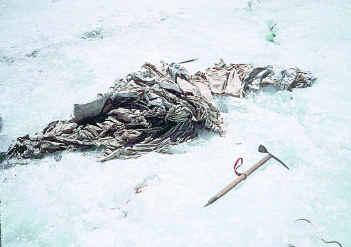
Mallory was lost somewhere high on the North side of Everest on June 8, 1924. A few weeks ago, his body was found by an expedition filming a tv special for PBS’s NOVA. It is remarkably well-preserved. The exposed skin is ivory white, smooth, and hard. He appears to have fallen: one leg is broken, and there is a shoulder injury, and he is facing down, his arms spread out as if he was trying to stop himself from sliding down the mountain. It looks like he fell, injured himself, and then just lay there for some time, waiting for the inevitable end. It was a sad, lonely way to die.

There was no sign of Irvine. Another intriguing mystery: did his climbing partner Sandy Irvine, see the fall? Did they both fall (they were likely tethered) and end up in different locations? Did Irvine survive the fall and set off on his own to descend only to become lost?

Mallory, as noted, was lost on the North side. Most expeditions to Everest nowadays (and the first successful expedition in 1953) follow a route up the South side, considered more accessible, but back in 1924, foreigners were generally not permitted into Nepal.

The location of the body raises the intriguing question of whether Mallory and his partner Andrew Irvine may have summitted before disaster struck on the way down. Nobody knows. The last person to see them alive, Noel Odell, reported that they were within a few hours of the summit at about 1:00 p.m. When his body was found, his sun-goggles were stuffed into his shirt pocket. That suggests that it was past daylight at the time he fell. And the location of the body, well below where he was last seen, suggests that he was on his way down, not up, at the time of the accident.

There is a very difficult notch in the summit ridge just below the peak, an almost vertical climb of 80 feet or so. The problem with the theory that Mallory summitted is the question of how he got over that notch. In the early 1960’s, the Chinese finally got over the notch by pushing a man up through a crevice, but he had to use his bare hands to make it and suffered some frostbite. Once they got a man up there, they tied a ladder in place, and almost all climbers since have used the ladder. (How does that play with your perception of just how athletic mountain climbers are?)  However, the team that found Mallory’s body is incorrect in saying that nobody else has ever climbed the North Ridge without the ladder: last year, another expedition, finding the ladder damaged, did manage to climb it, as did a member of the expedition sent to find Mallory’s body. So he could have done it.

If he had not been able to climb the step, then he would probably have turned around well before daylight expired, and thus would not have tucked his goggles away into his pocket before reaching the slope where his body was found. It’s an intriguing mystery. History may yet be rewritten.

On the other hand, as some, including his son, have pointed out, it’s getting back down alive that counts.

The answer may be contained in Mallory’s camera, if they can find it. Kodak says they can probably develop the film, even after 75 years.

Mallory’s body was left on Everest. That is a tradition among climbers that is the product of necessity: it is very difficult to recover bodies from the unforgiving mountain. He is among the first of 142 bodies currently residing on the majestic mountain.

2013-06-21

Let’s dust a bit of the blather about nobility and honor and class off this story, shall we? At least one excellent climber (Richard B. Graham) was excluded from the team because he was a Quaker and hadn’t participated in the slaughter of World War I. Another was excluded because he was Australian (George Ingle Finch) and, ho ho, pip pip, I say, we can’t have a bloody Australian on the summit along with an Englishman! It’s just not British!

Wikipedia describes how Mallory and Irvine, after failing to climb Everest or to return, were acclaimed as “national heroes”. That’s really quite fascinating. It certainly isn’t the result of a great achievement, because many other men ascended as far as they did without conquering the summit and none of them have been acknowledged as heroes. I think it is a rationalization. They died. Their lives must not have been wasted in a frivolous attempt at personal or national glory. Therefore, they are “heroes”. To say otherwise makes you disloyal and disrespectful.

Exxon Sues Itself

I’ll bet I know something about the 1994 Exxon Valdez oil spill in Prince Edward Sound that you don’t know.

The Exxon Valdez was the worst oil tanker spill of all time, polluting more than 1000 miles of Alaskan coastline and endangering a vital, delicate ecosystem. Lawsuits followed of course. BIG lawsuits.

The plaintiffs in the case against Exxon were awarded $5 billion, which is about as much as Exxon earns in profit each year. That’s a pretty fair fine, I think. What’s the use of a five or ten million dollar penalty when a corporation sees an amount like that as a mere operating expense? Do you think $5 billion is a deterrent? I think it is.

A group called the Seattle Seafood Processors banded together to sue Exxon for compensation for lost income and all that jazz. Exxon settled with this group out of court. The settlement was SECRET. They get to settle out of court, and we get to wonder if they got anything, and Exxon gets to hide the cost of the settlement from their stockholders, the media, the public, and the other plaintiffs. Maybe there was something about their case that was peculiarly alarming to Exxon. Whatever.

Anyway, people did find out eventually that the agreed upon amount was $70 million. Good deal, right? I mean, these guys get to take a vacation and everything – they can’t fish anymore—and get paid for it! How much do you want to bet that they just laid off all their workers and kept the money for themselves? Well, hell, why not? This is America.

But here the story gets interesting. If somebody does some damage to you and you sue them and then you settle out of court, your case is done, right? You are out of the picture. You sign an agreement saying that Exxon has compensated you for your losses and you have no further claim.

That’s what you think. What happened is this: the Seattle Seven continued their lawsuit, with the full knowledge and consent of Exxon. The very lawsuit they had settled! And they won! Big time! $700 million! Hurray for the lawyers, who get to collect about $100 million of that for themselves. Hurray for America! Hurray for everyone!

Wait a minute. It seems that Exxon is now taking the Seattle Seven to court. What! How can this be? What a strange reversal! Did the Seattle Seven dump a bunch of dead fish on Exxon’s front lawn or something? No! It seems that Exxon had a secret deal with the Seattle Seven that stated that, in exchange for the $70 million, the Seattle Seven would continue their legal action and, if they won, Exxon would collect all of their winnings.

I am not making this up.

Whoa Nelly! What a concept! Exxon was betting that the Seattle Seven’s lawyers were really, really good, and would win a much larger settlement in court than $70 million. The Seattle Seven were pretty stupid, don’t you think? Why didn’t they hire worse lawyers (if such a thing is imaginable)? Then they wouldn’t have been out $630 million.

But wait! Hold on to your hats! The Seattle Seven don’t want to give the $700 million to Exxon anymore. They want to keep it all for themselves! Well, for themselves and their lawyers. Exxon is quite upset about this turn of events. That’s why Exxon’s lawyers are taking the Seattle Seven to court. Give us back your money!

Do you have this all straight? Yes, you’re right: Exxon sued themselves. Can you picture their lawyers in their solemn robes, celebrating after the verdict? Woohoo! We got $700 million! We’re rich! Now we can pay off our lawyers!

Strange story, isn’t it? Why did Exxon make this preposterous deal? Nobody knows for sure. The only people who benefit, of course, are the lawyers. The lawyers who negotiated the deal for the Seattle Seven probably got most of the $70 million. The lawyers who won the lawsuit probably got about $200 million—I am NOT kidding. Contingency fees typically end up in the 25-40% range. Exxon’s lawyers got money too. How much? Well, if the tobacco industry settlement is any guide, they probably persuaded Exxon to sign an agreement paying them a percentage of the difference between the maximum amount of liability given a worst case judgment, and the deal that was actually struck. It sounds like they didn’t do very well. I’ll bet they thought the maximum liability would be somewhere in the $500 – $750 million range. I’m just guessing now. I’ll bet they expected to earn $100 million by keeping the liability below $1 billion.

I’ll bet they didn’t offer to give Exxon a refund of their fees because they did so poorly. That’s not the way life works for the rich, my friend. If you are a baseball player and you hit 30 homeruns, you will get a new contract worth $10 million. If you then hit 5 home runs, do you give the money back? Are you kidding? Do stock brokers convicted of swindling people out of millions of dollars suddenly walk or take public transit?

But if you are supposed to load a truck in two hours and you do it in eight instead, do you think you’ll get paid?

The only advantage to Exxon—had the settlement agreement with the Seattle Seven stayed secret– is that it looks like they are paying a lot more damages than they really are. The $700 million is part of a shared settlement with fishermen and hunters and others who were harmed by the Exxon Valdez disaster. The total of the settlement is $5 billion. It’s hard to believe that Exxon could be so stupid as to figure on coming out ahead of this deal. On the other hand, this is a corporation that hired an alcoholic captain to steer a vessel loaded with oil through one of the most hazardous and sensitive coastal ecosystems in North America.

Maybe the $700 million is tax deductible. Actually, since it is subtracted from their earnings, it quite probably is tax deductible. Who does pay the taxes on the $700 million? The Seattle Seven? For money they will never receive? Exxon? For a judgment they are paying themselves?

Exxon, incidentally, has not yet paid a penny of the $5 billion, though the judgment was awarded five years ago. Exxon is sitting on $5 billion that it owes other people. If you were sitting on $50 that you owed Exxon, you would be in jail in very short order, my friend.

A judge, meanwhile, has annulled the secret agreement between Exxon and the Seattle Seven and ordered Exxon to pay out the $700 million. Exxon is appealing. Well, why not? They have lawyers.

Well, let’s say you are as outraged as I am about this deal.

What are you going to do? Get a lawyer?

Quagmire

The U.S. likes to call itself the “World’s Only Superpower”. Superpowers, of course, have responsibilities. Right now, for example, there is a disastrous civil war taking place in Sierra Leone, the poorest nation on the face of the earth. At least 100,000 civilians have been driven into refugee camps and are facing starvation or cold-blooded murder. Where is the world’s cop? At home debating a stained dress.

A few years ago, a civil war broke out in Rwanda, which led to the deaths of more than 200,000 people. Where was Uncle Sam?

When civil war broke out in Bosnia, George Bush took one look, heard the word “quagmire” whispered somewhere softly in the wings, and ran for cover. Not only did he not support military intervention—he actually tried to prevent the Bosnian Moslems from acquiring weapons with which to defend themselves against Serb aggression. But, hey, Bush had “character”, whatever that was.

Every time the U.S. considers military intervention in some far-flung part of the globe, a chorus of nay-sayers (including Colin Powell generally) raises their voices and squawks the one magic word that stops the Pentagon dead in their tracks every time: QUAGMIRE.

The application of the word “quagmire” to Viet Nam first occurred, as near as I can tell, in the title of David Halberstam’s excellent book on the subject, “The Making of a Quagmire”, which was published—get this – in 1965.  Yes, eight years before the U.S. began its exit.  That is a remarkable piece of foresight.

Unfortunately, contemporary journalists don’t understand what the problem with Viet Nam really was. They think the problem was that most Americans didn’t really, heartily support the war. They think the Viet Cong were so unrelentingly savage that our “good” boys, with their innate decency and “character”, were corrupted by their involvement.

The real problem was that we chose, as usual, the wrong side to support. In 1954, the remnants of post WW II Viet Nam, were partitioned by the United Nations into a North and South, under two different governments. The keystone of this agreement was a promised election in 1956 which would be fair and open and involve all opposition groups, and which would reunite the two partitions into one nation under one government.

Unfortunately, the regime of President Diem, which ruled the South with the support of the French, realized that it could not control the results of the election and postponed it. Diem also began to systematically repress all opposition political leaders and parties. When it became clear that he had no intention of giving up power, the remnants of the army that had liberated Viet Nam from the Japanese (the Vietminh) began organized opposition to the regime. The French were unable to dislodge the Vietminh so the Americans thought they would give it a try. They believed that the Chinese and Russians were aiding the Vietminh, and that if Viet Nam fell to the communists, Thailand, Laos, and Cambodia, and the rest of Asia would be sure to follow: the infamous Domino Theory.

At first, the Vietminh included a diverse coalition of political forces, including socialists, Catholics, and other democratic movements. But the corruption of the Diem government and the intensity of the fighting soon polarized the competing forces until the Vietminh, under the umbrella of the National Liberation Front led by Nguyen Huu Tho, was dominated by communists.

The Diem regime never did control the countryside around Saigon. South Viet Nam’s army, the ARVN, was commanded by political appointees more loyal to Diem than to their own generals or the war effort itself. They were arrogant and oppressive and they alienated the peasants who lived in the small villages around the Mekong Delta. As a result, the Viet Cong were easily able to operate, hide, and control large areas of the countryside.

The American “advisors” sent by Kennedy were efficient and sensible, but some of the most important early military initiatives were hamstrung by ineffective local leadership and corruption. U.S. ambassador Nolting continued to send cheery reports back to Kennedy, while reporters (including legendary figures like Peter Arnett, David Halberstam, Neil Sheehan, and Francois Sully), who actually traveled into the battle zones, were accused of disloyalty for reporting what they saw. What they saw were villagers who were hostile to government forces, ARVN battle groups that avoided fighting whenever they could, incompetent commanders, and bad planning. They saw an insurgent force that was quick, efficient, and brutal, and which commanded the respect and loyalty of the general population. They saw, at the battle of Ap Bac, 200 guerrillas defeat a combined force of U.S. and ARVN regulars ten times their number. Halberstam was one of the first to realize that the combination of domestic politics (Kennedy couldn’t afford to look “soft” on communism) and local corruption, including the dependency of the Diem government on U.S. military support, could lead to a unresolvable situation. It was not necessarily in the best interests of the Diem regime to bring an end to the war.

America was pouring in aid at the rate of $1.5 million a day. A lot of this money lined the pockets of Ngo Dinh Diem and his brothers, Can, Luyen, Thuc, and Nhu, and his sister-in-law, Madame Nhu, and his other cronies. It is quite possible that Diem never was interested in defeating the Viet Cong, thereby removing the incentive for lucrative American aid. It would be hard, otherwise, to comprehend the massive stupidity of the South Viet Namese government.

In June 1963, a Buddhist monk, protesting political and social discrimination against Buddhists by the Catholic Diem and his brothers, doused himself with gasoline and set himself ablaze in a public square in Saigon. This signaled the beginning of a summer of protest by Buddhists that gained increasing popular support. Diem’s response? His soldiers broke into Buddhist temples, looted their treasuries, and arrested Buddhist monks and nuns. A move more calculated to incite mass protests and rioting could not be imagined. On November 1, 1963, with tacit U.S. approval, a group of conspirators under the leadership of General Duong Van “Big” Minh turned their troops on Saigon and drove towards the Presidential palace. Diem was captured and killed. Seven more coups or attempted coups would follow. The quagmire was in full tilt. The U.S., blindly, foolishly, willfully plunged into the greatest debacle of its history.

When General Colin Powell talks about Bosnia, he tries to sound like some wizened old war horse who’s seen it all and can’t be fooled into risking the valuable lives of his young, well-trained killers on some frivolous mission to merely save people’s lives. He talks about Viet Nam, as if he thinks he understands all there is to learn from that experience, but experience doesn’t teach you right from wrong. Sometimes, he merely sounds resentful of the military disgrace. One senses, beyond the petulance, a fundamental commitment to the selfsame principles that caused the Viet Nam debacle in the first place, namely, that the guiding principle of foreign policy should be military strategy. At times he sounds like the living embodiment of Metternich’s dictum: “War is too important to be left to the politicians.”

The failure of the U.S.’s involvement in Viet Nam was entirely due to the social, cultural, and political realities of South East Asia. The U.S. made only sporadic and half-hearted attempts to force the South Vietnamese government to try to develop some kind of popular support. When Diem refused to fight corruption in his own government, reform his armies, and win the loyalty of the hamlets and villages in the Vietminh dominated areas of the countryside, the U.S. should have walked away, with the realization that victory was not only unlikely, but impossible.

What does “quagmire” mean in terms of current realities? The key difference between Viet Nam and Rwanda and Bosnia and Sierra Leone is that the latter three nations are not proxies for a world superpower conflict. They do not require the U.S. to make an alliance with unsavory dictators, and pour in military aid to prevent some expansionist foe from gaining the upper hand. And Russia is not only not interested in manipulating the crisis, but incapable of financing proxies. Cuba is out of the picture. China cares only about internal security. The U.S. is free to intervene on behalf of freedom, peace, and justice for all. They are free to be the good guys. How ironic that they no longer want to play.

March 22, 1999

Well, NATO has finally decided to try to stop the Serbs from “cleansing” Kosovo. And some critics, like Senator John McCain—future Republican presidential candidate– are already complaining that the U.S. does not have a credible exit strategy. Look, folks, we just got here!

A more interesting question is this: will the NATO attacks lead to peace? Will the Serbs be more willing to negotiate now?  If bombs and missiles are so effective, why is Saddam Hussein still ruling Iraq? Won’t this lead to intransigence, and a brooding hatred for all things American, and an intensified desire to defy NATO, knowing full-well how unlikely it is that we will ever see ground troops?

The inherent absurdity of bombing Serbia into submission is that bombing does not threaten the interests of the ruling class. Ruling classes everywhere know how to ride disaster: you reinforce the troops, barricade the palaces, and control the distribution of scarce goods—ensuring that you yourself will never suffer the slightest privation. The war footing ensures the success and acceptance of martial law. The crisis justifies harsher repression than usual. Milosevic cannot be threatened unless bombing reduces his country to total ruins and the people rise up in rebellion against him. But NATO cannot go that far, for it would be charged with committing atrocities against civilians, and it would almost eliminate the possibility of any kind of peaceful coexistence afterwards, between the Serbs and the Kosovars. So NATO must be content to strike military targets.

Slobodan Milosevic will be unmoved by the destruction of military installations and buildings as long as he can maintain his control over the army and government. I suspect that the only way he can be prevented from carrying out further atrocities is for NATO to invade with ground troops. At this point, NATO seems extremely reluctant to make that step.

March 31, 1999

And now they have hostages. Three American soldiers captured in Albania. And Bill Clinton goes on TV and announces that that is why he doesn’t want to bring in ground troops. He might as well say to Milosevic, “if you can tolerate the bombing for a few more weeks, we’ll eventually get frightened and go home.”

The whole point of intervention was to force Milosevic to stop the “ethnic cleansing” of Kosovo. I don’t know why anybody would have thought at any time that bombing alone would achieve this objective, when it has not achieved anything like that anywhere else in the world where it has been used (with the exception of Japan, after Hiroshima and Ngasaki).

And if the Americans are going to panic with every single casualty, they might as well go home right now, and relinquish the title of “World’s sole remaining superpower” because a superpower has a responsibility and a superpower does whatever it takes to stop genocide.

Why is Microsoft Windows So Bad?

Is Windows so bad because Microsoft’s engineers are incompetent? Or is there a conscious strategy here?

It didn’t make sense to me for a long time. Microsoft is a big company. It hires some of the best programmers in the world to work on their products. They have endless resources and talent. So why can’t they come up with an operating system that doesn’t crash all the time?

You have to consider a few basic facts, first of all. How many “power users” are there out there? What I mean is, how many people out there are smart enough to manage their own computer systems properly? Let’s think of percentages. I would say that, of the people I know, about 10%, at the most, are potential “power users”.

Whoa! Let’s step back! Only 10%? Isn’t that kind of insulting to the vast majority of computer users?

Well, what is a power user? Someone who meets these qualifications:

  • creates his own logical directory structure for storing his files
  • backs up his data to a portable, removable storage media, because his work is important
  • installs programs himself, and maybe some hardware, like CD ROMS
  • knows how to fix problems with the computer
  • sets up and configures his own internet connection
  • customizes applications to be more productive (in vain—they will crash regardless).

Okay? So there you go. Power users are basically like people who renovate their own homes: they want to design the system to work for them.

What do we call non-power users? Consumers. Consumers live in malls. Consumers don’t want to be challenged: they want everything provided to them on a silver platter. They don’t care about the environment or monopolies or long-term interest rates. Consumers, after all, just want to consume.

Consumers want to turn on the computer with that knob on the front and then play Doom or cruise the internet for pictures of Alicia Silverstone. That’s about it. And maybe send e-mails to friends that consist mostly of messages like this: “Hi. I have e-mail now. Isn’t this cool. Send me something so I know it’s working.” Of all the people I know, about 90% are potential computer consumers.

Think about that. 10. 90. 10. 90. If you were Microsoft, which would you rather have as your customer base?

That’s why Microsoft expects you to store all your documents in “My Documents”. You don’t get to name this directory something logical like “work” or “data” or “letters”. Oh no. You can’t even delete Microsoft’s “My Documents”. It’s like mom telling you what to wear every morning. “Here’s your turtleneck.” “Think I’ll wear a t-shirt today.” “Here’s your turtleneck.” “Have you seen my t-shirt?” “Here. It’s your turtleneck.”

And that’s why Microsoft puts all your applications in “Program Files” even though, when you go to the dos prompt, you can’t type “CD Program Files” but have to type, instead, the idiotic abbreviation: “CD Progra~1”. Of course. What consumer would go to the DOS prompt anyway?

That’s why Microsoft is constantly trying to run your computer life for you. When you go to the DOS prompt, it puts you into the Windows directory. Why? What idiot wants to go there? When you use Windows Explorer to go looking for files, it displays the names only, without size, date, or type. Why would you want to know those things? You’re just looking for “letter to mom”. Microsoft is pushing modem and printer manufacturers to design their equipment so that it only runs on Windows, even if that means taking precious processor cycles away from your CPU. They don’t tell you, when you buy one of these modems or printers, that they only work on Windows, and that, in a couple of years, you are going to have to replace that equipment because Microsoft will make sure that the software that runs it will be out of date.

Microsoft Word even tells you when it doesn’t like the way you write. Fix it, or I’ll annoy you to death with colored squiggly lines all over the page. All of your family and friends will know that you write stupid.

Microsoft isn’t the only offender here. Quicken used to be a useful, snappy little checkbook manager that did it’s job and got out of the way. Now it tries to reach into your wallet and take control of everything you do. It wants to hook you up to the internet every time you fart in the direction of the phone. It tries to create new accounts and categories for you every time you don’t type something just the way you want them to. When you enter a new check for a payee you have entered previously, it helpfully copies details into the current transaction— including the “reconciled” flag!  Great idea!

Norton Utilities and Norton Anti-virus have the same attitude problem. These tyrannical little programs really get out there and try to push you around, constantly harassing you about rescue disks and live updates and all that baloney. And you know, it wouldn’t be quite half as bad as it is except that most of these programs don’t work! Norton keeps begging me to let it update it’s files, so I say, okay, go ahead. What does it do? Lock up. Norton anti-virus crashes my Windows 98 every time it boots, so I now have to step around it. Uninstall the program? “This application could not be uninstalled”. Best of all, some of the third-party uninstall programs won’t even uninstall themselves!

Netscape thinks you would like nothing more than to go the Netscape web site every time you turn on your computer.

You can see why Linux is getting so popular. Microsoft is like your Mom, constantly harassing you about what you should be doing. Linux is like your Uncle Max. You go up to him and he says, “What do you want?” At first, you might think he’s a little rude, but if you say you want to go out for a beer and a smoke, he’ll say, sure, what do I care?

Les Miserables Los Angeles

Some people don’t believe me when I tell them that a black man in Los Angeles has just been sentenced to 25 years in jail for stealing a loaf of bread.

I don’t have a lot to say about something like this. Some things, like gun control, are quite debatable, though I still think the debate is one-sided, in terms of logic. But putting a homeless man in jail for 25 years for stealing a loaf of bread is beyond all logic and sanity and reasonableness. It will cost the State of California at least $1 million to keep this “threat” to society locked up. From a strictly economic point of view, how many of California’s politicians would have been willing to chip in $2.50 to buy the man a loaf of bread and save the taxpayer a million bucks?

How many of the legislators who voted for the “three strikes and you’re out” law go around pontificating about the decline of moral values in our society? What is a “moral” value? Locking up an indigent man because our society cares so damn little about the poor that we tolerate extreme poverty in our midst while squandering billions of dollars on new military toys for men who award themselves medals every time they fart in the direction of the enemy?

Only two states (California is one, I don’t know the other) apply the “three strikes and you’re out” law to non-violent crimes. Tom Hayden is trying to change the law in California but they say he doesn’t have the 2/3 votes he needs to do it.

If I were a cop in California and I was called in to arrest somebody for stealing a loaf of bread, I’d pay the shopkeeper the two bucks myself and turn the guy loose.

The Last Refuge of These Scoundrels

The U.S. Senate Judiciary Committee has just approved a proposal to pass a constitutional amendment which would make it a crime to “desecrate” an American flag. The vote was 11-7. Who are the patriots? Who are the scoundrels?

flagburn.jpg (13093 bytes)

What is a flag? It’s a piece of cloth. That’s all. There is nothing sacred about a piece of cloth. Who is harmed by the “desecration” of a flag? No one. What utility does it serve to attribute such magical power to a symbol that the law must protect it from those who do not subscribe to it’s mystical power? None whatsoever. Unless you believe that it is a good thing when men are stirred by symbols to incomprehensible feelings of loyalty and devotion and are, then therefore susceptible to manipulation by evil men and scoundrels.

So the purpose of this law would be to protect the dainty affectations of scoundrels, who, as we all know, take refuge in patriotism. In other words, the purpose of this law is essentially religious. The flag is the bible, the cross, the alter of nationalism.

Nationalism is a religion. It’s values cannot coexist harmoniously with the values of any other mainstream religion. Nationalism demands of us greed, selfishness, and brutality. It demands that we place our interests first. It demands that we worship our ancestors who fought in wars. It demands uniforms and parades and brass bands and cemeteries and monuments and medals and solemn oaths and hymns and eyes teared over with myopic miasmic melodrama– crocodile tears– and myth and lies and “saints”. We always say that these “saints” sacrificed their lives for our noble cause. We act as if our armies are not equipped to kill and destroy, but to preserve life, even at the expense of their own lives.

We ask, are you willing to die for your country– as if this is a good idea– instead of the honest question: are you willing to kill for your country?

I know why militarists and nationalists love the flag. Because they are idiots. Anyone who has examined the history of western civilizations over the past 500 years cannot have missed the fact that nationalism is responsible for more carnage and evil than any other single factor. From Napoleon to Hitler to Stalin, humans have done more evil to each other in the name of nation and state than they ever did in the name of any other religion.

“Without a strong value system, our children cannot distinguish good from bad or right from wrong,” says Orrin Hatch, one of the Lewinsky conspirators, who may have a point here, but one that has nothing to do with flags.

The simple question is, what values is Orrin talking about?

Most of us agree that selflessness and the love of justice are good values. So is compassion, mercy, and toleration. Hatch’s logic is hypocritical: the exact purpose of a flag is to arouse patriotic fervor in the service of selfish nationalist impulses. A flag is used to stir patriotic feelings, and patriotic feelings are used to persuade men to join armies, where they are taught to act with aggression and strength, to obey orders without question, to kill for no reason known to themselves. In other words, to over-ride good values and replace them with bad values.

A constitutional amendment banning “desecration” of any national symbol is nothing less than an intrusion of the state into religion. If Orrin and the other Senators want to bow down and worship the flag, they are welcome to do so, in their own cathedrals, on their own time. Keep the government out of it.

School Killers

I can’t think of any sensible thing to say when two students dressed in black trench coats bundle themselves up with explosive devices and guns and set out to achieve their 15 minutes of fame by killing as many of their classmates as they can. We think the world is a pressure-cooker out there in the Stock Exchange and the Bank Towers and the Emergency Wards– it’s a pressure-cooker out here too, in our vacuous suburbs, with our mall-rat status-rated designer running shoes and gilded suburban off-road super-trucks and Hollywood heroic bionic mega-metal men with laser guided killer stilettos whipping the forces of darkness without concept, idea, abstraction, or reflection, and our moral barometric Wall-Street pressure pages of translucent stock quotes: all on a race to achieve, obtain, impress and express, communicate and digitate in the soft blue glow of television on the sideboard at dinner with whatever molecules of your nuclear family are available tonight.

So a couple of boys in their color-drained coats mull over their failures and fantasies. Those girls with the curled blonde hair, up so early to remake their faces… those studs in the Tommy Hilfiger sweats reaping their squeals and nuzzling nipples with their slam-dunks and hail marys… those geeks in the turbo pascal class hacking their uncles pims and measuring their dicks for Harvardized condoms… those fay artistes craving exclusivity through obscurantism… those achievers with the part-time jobs and daddy’s RAV on the weekends and drinking parties and future flatulent frat freaks… those fundies with their pre-school bible studies and Samaritan smiles… the fat girls leaning with desperation… those skinny girls colluding behind their compressed lips… and you just can’t get the grease off your face or the smell off your fingers or lose that dull inviscerating impression that your life is going to end in one long interminable trailer park whimper. And so you trade it all in for your 15 minutes of fame, and you’re going to be bigger than fucking Charles Whitman or Richard Speck and you’re going to know it, for who’d have thought a few hours— hours and hours — who’d have thought it’d take the police that long to find you in this gleaming chromium diaphragm of literate washfulness, here, here in the library, with the brains of your class-mates splattered around you, here among the books of which you never finished a one without thinking it was small or irrelevant, here below the sirens, and the helicopters, and the cameras, and CNN With A NEW SPECIAL LOGO AND MUSIC just for you, my sweet, now that your immortality has bled down the wires and who’d have thought it would take them four hours to find out your blood wasn’t even hot enough to face down your own killers?

And I’m curious as hell about those last moments– not even alone, like Whitman in his tower– Charles, of course, not Walt– not even alone, as if there was something you could say to each other, like Jesus, we really showed them, didn’t we– and you wouldn’t probably even be quite so obvious as to say you have their attention now, would you? What were your last words to each other? Where have they gone? Where are they now? Where are the blondes and the geeks and the jocks and the brains and those oh-so-ephemeral have everything to die for most-popular and likely to succeed barbies and kens, who formerly, obliviously, oh so vacantly, surrounded us—- yes, they noticed.