
The Grievance Aesthetic: The Fannys

First of all, I had never before heard of Fanny.   Fanny was an all-female band that formed in 1970, consisting of June Millington (electric guitar), Jean Millington (bass), Alice De Buhr, and Nickey Barclay.  The women were remarkably talented– no doubt about it: they could play.
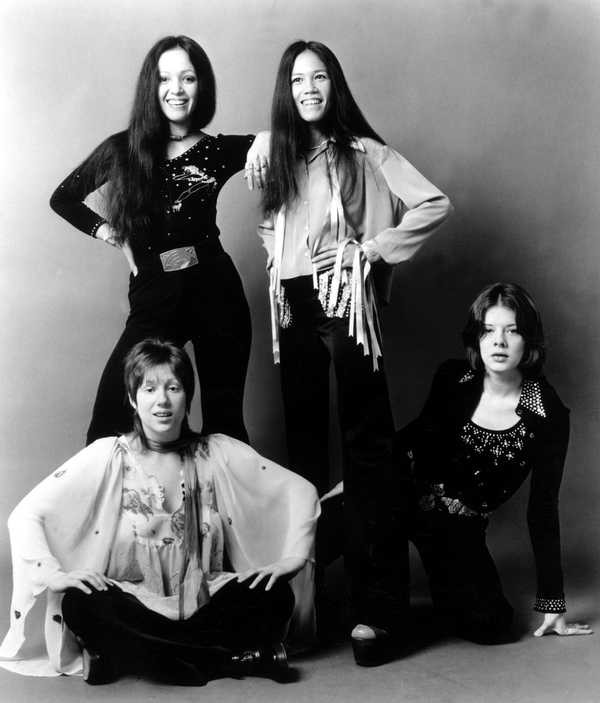
I have been following music closely since I started listening to Bob Dylan when I was ten years old.  I have followed it closely throughout the last 55 years.  I never heard of Fanny that I can remember.  After listening to their songs, I feel apologetic.  I feel dispossessed.

Come on– they are absolutely fabulous.

Let me be clear: hard rock is not my preferred style.  I find it abrasive, noisy, sometimes propulsive, sometimes dull.  I crave good lyrics, the use of musical space, nuance, and subtlety.  I don’t have a single hard rock song on my personal list of the top 25 songs of all time, though I suppose Springsteen’s “Thunder Road” or “Backstreets” or “Adam Raised a Cain” might qualify at least as “hard edged” rock.

I recently watched a documentary on PBS, “Fanny: The Right to Rock”.   To my utter disbelief, this variation of the film is clumsily censored, words beeped out, images of breasts blurred out.  Fuck you, whoever did that.  I found a good copy elsewhere.

If I had been in charge of this project there is one thing I would have asserted right from the start as absolutely essential to the objective of this film: at no point should the esteem or lack thereof of their music be attributed to sexist, patriarchal oppression, sexism, and discrimination.  The fact that Janis Joplin did succeed where Fanny did not tells you that there was more to it than sexism.  And to be fair, the members of the band on the record in the documentary don’t belabor the point.

[Incidentally: it’s a product of BBC IV and if you can find the original BBC version, you can avoid the contemptible censorship savaged on the PBS version, notably including scenes of the girls frolicking half-naked in Hedy Lamar’s former house in Los Angeles.]

But why?  Isn’t that the essential story of the band?  Well, if it is, the band is not worthy of this tribute.  If the band should be known to you because they broke barriers and because they were really better than anyone thinks they were because their singular lack of popular and critical success is due not to any deficiency of talent but to the obstacles placed in their path by sexist (and racist — they were Philippine) attitudes, then you have to prove it by providing me with the songs and musical achievements that deserved more recognition than they got.

What you should want more than anything– what you should positively crave– is for viewers to be convinced that Fanny produced some extraordinary music that stands on its own merits without qualification.  That, this documentary failed to do.   To declare that their work was important or significant because they were women is defeatist.  It is to admit that their work really wasn’t good enough to earn distinction on its own.

They should instead insist on their music being heard on its own terms: very, very good hard rock.  Four very good musicians creating respectable, admirable songs.  In particular, Jean Millington’s vocals are probably as good or better than Janis Joplins’– and she could play bass — really play– to boot.

Jean Millington later said that Fanny had to have a strong live presence in order to overcome audience’s perceptions that women could not play rock music well.  Wiki

Well, we don’t really know.  Do audiences really sit there and think, oh, I think they sound pretty good but they’re female so they can’t be as good as they sound?  Or do audiences simply sit there and think, “they don’t sound that great” and it’s the band and the feminists who think it’s because of their gender?  I am at a loss.  Listen to them: how could an audience not be impressed?

They didn’t “break through” into real success.  To do that, you absolutely have to have at least one song that really amazes people, that demonstrates originality and style and inventiveness and a compelling melody or vocal or all of the above.  A “More Than as Feeling” or “We Don’t Need no Education” or “Eighteen” or “Hit Me With Your Best Shot” or, crossing genres, “Have You Never Been Mellow” or “That’s the Way I’ve Always Heard it Should Be” or “Anchorage” or “First We Take Manhattan” or, even better, “The Hammond Song” by the Roches, a female group (in folk) that really did stand out for the quality of their music– not because they were female.  Fanny had many very good songs, but I can’t identify one that could have crossed-over into a pop hit.  But then, there were so many crappy pop hits.  And, of course, the promotional efforts of the record industry plays a big role.  They did have notable TV appearances, so you can’t say they didn’t get anything.  Just not enough.

What were they aspiring to?  Pop success?  They say they just wanted to be known for their talent, not their looks, but it was clear that they were not really good enough to be successful for their brilliant artistic achievements like, say, The Band or Steely Dan.  The bands that cite them as an inspiration, the Go-Gos, the Bangles, and the Runaways, were also pop bands with more success at creating the catchy pop single.  None of them were as good, from a purely musical perspective, as the Roches.

David Bowie’s appreciation of the band is frequently quoted:  “They were extraordinary: they wrote everything, they played like motherfuckers”.  Yeah, well, David Bowie was dating Jean Millington in 1973.  He was being asked to judge his girl.  But, okay, he was actually right.

Like almost all musicians, they were cruelly ripped off by their own management and the record companies.  But that is at least partly due to their own ignorance.  They allowed their producer and the record company to fire Brie Brandt because they wanted them to resemble the Beatles.  Seriously?  Because they had four members?  The rest of the band was very sad about cutting Brie out of the band, but it did not seem to occur to them that there is a universe in which young musicians can decide personnel matters for themselves.  It was as if God told them to fire her and they did.  They talk about it as if there really was no choice, because they don’t want to admit that the choice was between Brie and the commercial backing of the label.

There are bands that refused to compromise on issues like that and still found success.  There are probably even more bands that made the same compromise and, like Fanny, went nowhere.

The inevitable reunion is covered.  Nickey Barclay is mysteriously absent.  There is a clip of them performing live which is conspicuously deceitful: it’s the studio recording playing over the video of the band.  Not all viewers are dumb enough to not ask themselves immediately why they don’t play the live audio.

The broadcast version I saw beeped out “offensive” language.  Seriously?  It’s 2023.  You’re doing a documentary on this courageous, ground-breaking, revolutionary, ballsy female band, and you have to careful not to offend the delicate sensibilities of your projected audience?  [As I mentioned earlier, check out the BBC original if you can.]

The Candidates:

Aint That Peculiar

Fairly upbeat love song (the more you hurt me the more I love you).  Slide electric, pretty good bass.  Not bad, but not particularly distinguished.

Blind Alley

Typical Fanny: extremely busy, dense, vocals typical of thrash metal bands–  like, have you ever heard of space?  Vocals are “stretching”, a habit developed by metal bands from trying to be heard above their own noise.

Last Night I had a Dream

All the lousy little poets coming round trying to sound like Janis Joplin…

Place in the Country

Nicky Barclay sounds more than a little derivative of Janis Joplin (did Joplin cop a few strokes from Barclay?  They are active around the same time), but without the variety of tone and pace.


The Thought Police Strike Again

Once again the thought police have sprung into action.   The Canadian Broadcasts Standards Council has banned the original version of Dire Straits “Money for Nothing”.

The Canadian Broadcast Standards Council is a “self-governing regulatory body for Canada’s private broadcasters”.  What does that mean?  That means it can’t arrest you.  It is reminiscent of the Hays code, Hollywood’s attempt to clean itself up before Congress did it legislatively.  It is the CRTC, thank god, that has the real power, but I assume that the CBSC has some sway.

And how do you get the CBSC to ban a song you don’t like?  Hey, it’s a free-for-all!  Just contact them and announce that humble little you, just one out of 30 million citizens, has decided that you must step in and decide which songs should be played on the radio no matter how many people like it.

I am curious now: what if I filed a complaint.  What if I alleged that the censorship of “Money for Nothing” is deeply offensive to my delicate little sensibilities about truth and integrity and honesty and historical accuracy?  I am veritably traumatized by the idea that my precious memories of dramatic depictions of real personalities and social values are being erased by repressed puritanical little zealots with a political agenda.  Does my objection count?

Yes, I am enraged.  I feel threatened by a world that is sliding towards banality and antiseptic homogeneity.  Hey, can I file a complaint about vocalists using Autotune?  If ever there was a legitimate complaint to be made to a “broadcast standards” council that would be it.

Not only do they want to correct your current misshapen and erroneous ideas and feelings; they want to go back in time and correct your past iniquities.  Do you remember “Money for Nothing”?  It was a snippet of a certain attitude at a certain time and place.

Let’s get one thing absolutely clear and straight right off the bat:  “Money for Nothing” is not a dramatization of Mark Knopfler’s thoughts and feelings about MTV or gay people or microwave ovens.  It is a clever, insightful, reasonably accurate depiction of the attitudes of a working class schlub working at an appliance store watching MTV and thinking, geez, I could do that.   Are we clear?  Do you understand the difference between and artist and the subject?  Do you understand what drama is?  Do you get that when a writer tells you that a character committed a murder that the artist himself is not committing murder?

Here are the “offensive” lyrics:

See the little faggot with the earring and the makeup?
Yeah buddy, that’s his own hair
That little faggot got his own jet airplane
That little faggot, he’s a millionaire

I knew people who thought like that.  I don’t need any one to tell me to not remember him or his attitudes.   I don’t need anyone to try to erase the record of that person from public discourse.

Is the next step to go through Shakespeare and Dante and Dostoevsky and remove all the violence and murders and even the insults from their works?  Why not?  We no longer think people should be murdered.  It distresses people to see murder depicted in a play or movie.  Let’s remove it.  Let’s remove the rape scene from “Streetcar Named Desire”.  We don’t approve of rape any more.

And how does “Walk on the Wild Side” (Lou Reed) and “Hit Me With Your Best Shot” get away with it?   How about this, from the innocuous Elton John and Bernie Taupin (“All the Girls Love Alice”):

And who could you call your friends down in Soho?
One or two middle-aged dykes in a Go-Go
And what do you expect from a sixteen year old yo-yo
And hey, hey, hey (hey, hey, hey) oh don’t you know?

And please, please, please:  “All the Girls Love Alice” is not “by” Elton John.  The salient component here is the lyrics which are by Bernie Taupin.  Would the internet please grow up and get this straight?  Most of the songs it says are “by” an artist are actually merely recorded by that artist.  They do not deserve the holiest credit of all, the act of creation, which most of them don’t deserve even in respect of their vocals.

You think, well, we can’t gut one of America’s greatest works of drama, can we?  “Streetcar Named Desire” is a classic.  It is untouchable.  But how does that make a difference when public morals are at stake?  And what is the difference between the character saying “faggot” in “Money for Nothing” and the character raping Blanche in “A Streetcar Named Desire”?  They are both dramas of believable human behavior.  They both tell us, this is something someone would do (and has done, in real life), in the setting and circumstance depicted.  What is the problem?

There is no real problem.  What there is is a bunch of pious, self-righteous individuals trying to assert their own virtue by punishing a perceived miscreant.  Burn the witch.

If I was a gay man of any prominence I would have issued a statement– like the self-righteous guardians of public morality do– and insisted that Dire Straits keep the fucking lyrics exactly the way they are, just as “Huckleberry Finn” should retain the word “nigger” used in reference Jim, the escaped slave, just as Stanley should continue to rape Blanche in stage productions of “Streetcar Named Desire”, just as Ophelia should continue to commit suicide in any staging of “Hamlet” (spoiler alert).

And Leonard Cohen should never have excised “give me crack and anal sex” from his searing original version of “The Future”.    (Here, in a supreme act of gutlessness, Cohen jumps the shark and changes it to “careless sex”; am I harsh?  Yes, I admit it.  When you were influenced by an artist to embrace the authentic, the true, the audacious, and then he starts embracing compromise– yes, I’m harsh.  The odd thing is that as I am getting older, unlike Cohen, I feel less and less inclined to cater to the more delicate sensibilities around me.  Maybe it’s just a phase.  And here, expanding his audience for the sanitized version, he appears on– god help us– Letterman (!), changing  “crack” to “speed” and interjecting the awful “careless sex”.)  He didn’t have to castrate anything here:  he’s on the Ralph Benmurgui show.  And if you’re curious, here’s the original lyrics attached to inane video effects.  Finally, thank you, thank you, thank you Erlend Ropstad & the Salmon Smokers for this!

Finally, let me note the hypocrisy.  Here are the lines no one seems to object to:

It’s lonely here
There’s no one left to torture….

There’ll be fires there’ll be phantoms on the road
And the white man dancing…

Destroy another fetus now

Lie beside me baby, that’s an order

“Nigger” is what white people called black people at that time in history.    If I was teaching a college class on racism, I would discuss how the word “nigger” was used in America for years as a label of contempt and expression of white superiority.  “Faggot” is what straight working class white men called gay men at the time Mark Knopfler wrote that song.  “Dyke” is what they called women who were either gay or had turned down their advances.

We have reached a new pinnacle of stupid when a writer has to explain to the audience that this song or story is about someone who really existed and really thought that way.  Listen.  Consider it.  Be glad that we have made some progress (never enough, but some).  Tell your children that that’s the way working class white men used to talk about gay people.  Tell your children we now know better.

Tell your children is wrong to try to rewrite history into something false in order to avoid offending the delicate sensibilities of the weakest among us.

Senator Tim Scott

During the summer 2011 debate over raising the U.S. debt ceiling, Scott supported the inclusion of a balanced-budget Constitutional amendment in the debt ceiling bill, and opposed legislation that did not include the amendment. Before voting against the final bill to raise the debt ceiling, Scott and other first-term conservatives prayed for guidance in a congressional chapel. Afterward, he said he had received divine inspiration for his vote, and joined the rest of the South Carolina congressional delegation in voting No.   Wiki

The New York Times columnists seem to think highly of Mr. Scott, if not as president, then as VP.

I don’t think much of anyone who has the unmitigated arrogance to declare that he has the ear of God and the authority to relate unto us mere peons what the will of the almighty is.  In this case, the stupid idea of compelling the national U.S. government to balance its books every year.  There are very sound economic reasons why this is a preposterously unfeasible way to manage the national budget.  Even more preposterous is the idea that the Republicans would not immediately break their own rule in order to increase the military budget without having to actually raise taxes in order to do it.

This is a man who has laid the theoretical foundation for making all abortions illegal, terminating Social Security and Medicare, and abandoning the United Nations.  God told me to.  And if I tell you that that is what God thinks, I am right you are wrong.  There can be no debate with God.  There can be no compromise.

Tim Scott appears to be a decent man– by Republican standards.  He is civil.  No personal scandals that I know of.  And here’s an oddity, like Lindsay Graham, he is unmarried.   Born in 1965, which makes him about 60, and unmarried.   What does that mean?  Does it mean what I think it means in regard to Lindsay Graham?  I feel free to speculate because there is nothing wrong with being gay, but he is opposed to homosexual marriage, which would raise a host of fabulous intricacies in the perception of his social values.

His Justice Reform Bill, which got 55 votes in the Senate (not enough to bypass the filibuster) is not all bad.  It’s not enough, but it’s a step in the right direction.  He wants to rescind the Affordable Care Act and replace it with something more anodyne to Republicans, a nod to the fact that the act has actually become pretty popular.  How to reduce the phenomenal growth of health care costs?  Tort reform.  It’s the “Mental Health” red herring for health care: something that will have virtually no impact on the problem it is supposed to solve but makes it sound like the Republicans are doing something about it.

He rather pathetically dodges reporters’ questions on the abortion issue but says he is against it but would sign a national 20-week ban if he was president.  That is really a very odd position.   He knows he desperately needs the votes of the most hypocritical demographic in the nation– evangelical “christians”– so he can’t be in favor of abortion rights, which makes a national ban at 20 weeks problematic.  So he says he defers to state governments on the issues, which is the very epitome of passing the buck, equivocating, and, frankly, lying.

We know how Republicans handle deficits.  When we have all the reigns of government (as they were in the first two years of the Trump Administration) they cut taxes which balloons the deficit and refuse to cut program spending because they know how unpopular that would make them.  So the deficit is suddenly not a problem.  (Trump added more to the deficit than any previous president).

It is only when the Democrats have the White House that their crocodile tears appear.  I don’t expect Scott to be any exception.  If he won, by some ridiculous sequence of events, like every other republican president in the past fifty years, he will do nothing about it.


The Indefinite Obscurely Described Effusively Vague President of the Television Political Drama

I’ve pretty well had it with TV dramas and their predictable, formulaic, antiseptic, generic piss-pot features.

I watched about ten minutes of the Netflix drama “The Diplomat”.   The first bad sign is also the most fatal: what political party does the President belong to?  The answer?  None.   Apparently, the biggest, most central, most essential dynamic of American politics is absent– like Barbie’s Ken’s penis– because the fucking makers of this show don’t want to offend the half of America that doesn’t like the other half’s political party.

Oh, the British prime-minister is identified as a Tory.  I presume that is so they can safely mock him.  But it makes it even more bizarre that Rayburn is not identified as a Democrat, which is obviously what the show’s creators intend Democrats to think.  Republicans will have to be content imagining that there could be an intelligent, ethical Republican president, and will be gratified to discover that Rayburn is not identified as otherwise in an obvious manner.  But everybody knows that an intelligent, rational, educated leader will be a Democrat or John McCain.

This has been a monumentally stupid component of American mass entertainment since the beginning of television time, right up to just before “The West Wing”, and immediately thereafter.  “The West Wing” brilliantly defied this convention and that’s why it is still regarded as one of the best Television dramas of all time (along with “The Wire”).

Go ahead and tell me if I missed anything.  Keri Russell, using her most anguished constipated oh-I-suffer-so face, plays Kate Wyler, a spunky but smart and competent American diplomat who doesn’t get the respect she deserves even though she is clearly way smarter and spunkier than President Rayburn and his fat, bald Secretary of State Miguel Sandoval, who disapproves when (sigh) Kate “goes rogue to get the job done”.

Kate is not only an overly familiar trope; she is a cliche.  Hers is probably the most familiar trope in entertainment right now: the supposedly tough, roguish, smart, feisty female who shows up all the privileged white men.  The female fans go, “oh — I’m like her. I’m smart and capable and feisty– and smoking hot!– and I don’t get the respect and admiration I deserve!”  This is the media’s form of masturbation.  There will almost certainly be a scene in which she is dragged kicking and screaming to some big event in a fabulous gown and high heels.  Because if she willingly dressed in a fabulous gown and high heels she would be revealed as a vain, superficial, poseur.

Having just watched “State of Play” (the terrific BBC version; not the lame movie with Russell Crowe and Helen Mirren), my taste in political drama has been corrupted.  I’ve watched extensive patches of the contrived “The Americans” and the tediously suffocating “Homeland”.   But after watching “State of Play”, I allowed myself to expect reasonably credible story lines, and I expect characters to be a little less transparently self-serving and narcissistic.

There is no way that any politician or executive with the privilege that they wield would put up with a self-righteous little snit like Kate Wyler telling them they are wrong and they should listen to her and do what she tells them.  Nobody in a position of power will tolerate it.  It’s an affront to their self-respect and egos.  Even if she’s right, they won’t keep her around.  Actually, especially if she’s right.  And in “The Diplomat” aside from the usual defensively scripted token “error” (her only fault was she cared too much), Kate is going to be right all the time, and the men around her are going to be wrong over and over again, and yet they will thrash that dynamic at you over and over again because it is so fucking gratifying to the quasi-feminist audiences out there they will just eat it up.

Incidentally, in some later episodes of “The West Wing”, the writers had Toby and Leo arguing vigorously with President Bartlett and telling him he was doing something unethical or stupid.  These were the weakest episodes of the series and betrayed the fundamental intelligence of the first four years under Aaron Sorkin who understood that no President, no matter how competent,  would tolerate an underling lecturing him on ethics — at least, not for any longer than it would take to have them hand in their resignation.

Wide, Wide Awake

I keep hearing, about the banking defaults, that regulators were “asleep at the wheel”, and that’s why it happened. After hearing about Barney Frank’s role in dismembering his own regulatory legislation it has become clear that the authorities were not “asleep” at the wheel. They were actually wide, wide awake.

Frank, who helped craft the legislation imposing tighter regulations on banks after the 2008-09 crisis, was hired by– guess who– “Signature Bank” for two years for $2 million. In that role, he lobbied congress to emasculate his own “Dodds – Frank” package of regulations, which enabled Signature Bank to more than double in size with little regulatory oversight. A Republican congress passed the reforms and Trump signed it.

Nobody was asleep. They were wide, wide awake.

Pope Francis’ Deficiencies

Ross Douthat writes as if there is a real core Catholic faith that is being smothered by Francis’ liberal leanings. But after decades of evangelicals proclaiming themselves to be the party of spirituality and faith and integrity and humility and all the other values derived from the example of Christ and then stampeding into the arms of the most repugnant narcissist to ever run for office, one might be forgiven for regarding Douthat’s tears about the state of the Catholic church as disingenuous as best. Thanks to this embrace of Trump, and the sexual abuse scandals, and the residential school scandals, and the Magdalene laundries scandals, and so on and so on, it is very, very hard to regard any religion as anything more than a charade, a club, an exclusive confederation of self-righteous hypocrites. I gaze at these pious individuals in wonder and ask myself, what do you really believe? Anything, other than gaining advantage for the members of your club? Francis should declare that the era of Big Church is over and leave every locality to indulge in their own preferred hypocrisies.

Oh My God! We’re Getting More Anxious

Ross Douthat of the New York Times— the token conservative commentator on the opinion page– accepts the results of a study by the Centers for Disease Control and Prevention that show that teenagers today– especially–omygawd! girls– are more anxious, more depressed, and more unhappy than ever before.

By “social liberalism” I don’t mean the progressivism that took off in the Trump era — antiracism and diversity-equity-inclusion and #MeToo. I mean the more individualistic liberalism that emerged in the 1960s and experienced a second takeoff across the first decade of the 2000s. Its defining features were rapid secularization (the decline of Christian identification accelerated from the 1990s onward) and increasing social and sexual permissiveness — extending beyond support for same-sex marriage to beliefs about premarital sex, divorce, out-of-wedlock childbearing, marijuana use and more.

And it’s all because of the liberals!  Douthat doesn’t think gun violence should depress anyone, or the cut-throat competitive nature of the U.S. economy, or the fear of being bankrupted by medical expenses, or the fact that a sexual predator and psychopath was elected president in 2016.  Oh no.  It’s the widespread availability of sex, gay or hetero, as a woman or a man or neither, and, of course, drug use.  Have we heard this before?

I have two points.  First of all, we hear about these studies all the time– and I mean ALL the time.  Sociologists and social scientists just love asking teenagers if they are happy.  Now, imagine for a moment you are a teenager.  And life is not great, but it’s not all bad either.  You’re kind of getting through it.  You have some hopes and dreams and know you might have to work hard to achieve them.  You have friends.  Then someone comes along and asks you if you are happy or depressed or anxious.  They ask you again an hour later.  They ask you again the next day, and the next, and the next.  You read articles in the New York Times or see pieces on CNN that tell you that a big problem today is that teenagers are not very happy.  You start to wonder.  Maybe I am unhappy.  Maybe I’m depressed.

I don’t deny that it might be true.  What I question is the assumption that these numbers represent a net change from previous eras, like the 1940’s, the 1950’s, and 1960’s.   How would we know?  It’s a great question to thoughtfully ask yourself: how would we know?

Nobody studied issues like this in the same comprehensive, systematic way in the 1950’s as we do now.  We didn’t have the internet, obviously, or social media, and even television and radio was completely different than they are today.  We didn’t have as many books or magazines or records or films.  We didn’t have as many family photographs or recordings, let alone video.  We had numerous wars around the world, and the U.S. itself was embroiled in Korea, and about to get embroiled in Viet Nam.

We had a lot of obvious racism, whites only schools, whites only restaurants and drinking fountains.  We had a lot of drunk driving and date-rape, both of which now are severely punished, but were not back then.  In fact, the consensus on rape seemed to be to not report it at all.  We had a lot of teen pregnancy, “shotgun” weddings, and groping and petting.  We had a society that blindly worshipped the military and the police.  (It is no coincidence that Douthat, a conservative, would harken back to an era of such “stellar” values even if he doesn’t make explicit those particular values).

I suspect that a big part of our perception of the 1950’s has been shaped by unrealistic media portrayals, most emblematically, in “Happy Days” and the movie “American Graffiti”.   Have a look at “The Last Picture Show”, “Diner”, “Rebel Without a Cause”, or “Badlands” for a corrective.

Secondly, Douthat clearly implies that enthusiastic membership in a church is a viable corrective.  If only we had a study that showed that teenagers who are active members of churches are happier, less depressed and less anxious,  and happier, than those who are not.   We have no such study.

What studies we do have that compare church-going folk with non-church-going folk seems to show that we are all largely the same, holy or profane, saved or damned.  We all indulge in porn.  We all cheat and lie.  (But only one side votes for Trump and loves guns and only one side believes you may have been born to the wrong gender and the world is warming.)

Even for Douthat, this column is unusually contrived in his desperation to find some way to blame liberals and progressives for the sad state of America.   Like all conservatives, he knows that his side, the side of regressive, low tax, deregulated economies, benefits by promoting a sense that we are on the brink of catastrophe.  Nothing new.  We’ve been on this brink according to the Douthats of the world since Elvis first gyrated his hips.

Social Toxicity in Action: Your Cockatiel is Missing

CTV news had a story about a local woman who lost her pet cockatiel. I thought, well, I’m glad I live in a country where this is a news story. Beats the alternatives. Then I read the comments on the story. Some people actually expressed the wish that the bird would be killed and eaten. Others were dismayed that this story displaced more important stories about the earthquake or the new Russian offensive in Ukraine. There were comments by people who hated the first comments, and then by people who hated the second comments, and then by people who hated the people who made the hateful comments about the hateful comments. Humanity at its toxic worst.

The other night, PBS News had an interview with a Democratic governor, Phil Murphy of New Jersey, and a Republican governor, Spencer Cox, of Utah. The two men sat together, beside each other. They were civil, constructive, engaging, and respectful. They liked each other a lot, even though they had fundamental disagreements in many policy areas. They were working together on various important issues and trying to find common ground in areas where they disagreed. It was marvelous. It was inspiring. It was a powerful contrast to the toxic national political scene right now. It was reason for hope.

I’m not sure if that leaves me optimistic or pessimistic right now.

And yes, of course I wished the two of them would form a ticket for President and VP in 2024. And I am very sure that a majority of voters would love a team like that.

But it is a truism in American politics that you probably can’t win a nomination from your party right now if you don’t join the toxicity. The voters say they hate lying, compromised, attack-dog candidates but they vote for them. “We have met the enemy and he is us.”

And now, let’s shoot down another ‘balloon’.

Deficit Attention Disorder

Let’s see: to reduce the deficit, you have to increase tax revenue or cut spending. To cut spending, you have slash funding for programs that might be popular. Voters won’t like that. That’s why so many Republicans who claim that the deficit is a serious problem, when interviewed on the subject, refuse to say what they would cut. Coincidentally, while Trump was running up the deficit and Republicans had control of the House and the Senate, they didn’t cut any programs; they actually increased military spending and cut taxes thereby increasing the deficit significantly. (Since the last balanced budget in 2000, the Republicans have run up $12 trillion in new deficit while the Democrats have racked up $13 trillion.) Now that a Democrat is in the White House, they are popping up everywhere declaring that the deficit sky is falling. Again, when asked where they would cut, they conspicuously refuse to answer.

Most economists do not think the deficit is a serious problem, but refusing to raise the debt ceiling– in essence, refusing to pay the bills that are due for mandated programs approved by Congress– would be a very, very serious problem.

It appears to be slightly hypocritical to complain about the deficit now when not a single Republican voted against the Trump programs that dramatically increased the debt.

That took longer to read than a CNN screen crawl. You see the problem? You see why some people want to talk all day and all night about secret documents and Hunter Biden’s laptop instead.

Free Speech, if you Already Have it

‘I am against censorship that goes far beyond the law. If people want less free speech, they will ask government to pass laws to that effect. Therefore, going beyond the law is contrary to the will of the people.”’  Elon Musk.

Because people sometimes ask the government to make speech less free?  Censor us!  We don’t deserve to have a voice in our nation’s affairs!  I wish to disagree in silence!

What Musk is really talking about, of course, is the obligation we are beginning to impose on gigantic social media entities to regulate and restrict what kind of speech they allow.  We are beginning to realize that shouting “fire” in a crowded virtual theatre through Twitter is potentially just as harmful as it is in a real theatre.

The whole essential principle of free speech is to protect the rights of minorities, not the right of a majority to shut them up.