
Dan Rather’s Big Lie

After 50 years, I remain fascinated by a single incident related to the Kennedy Assassination. And I really believe that you may find it as fascinating as I do no matter what you believe about the Kennedy Assassination. Actually, I don’t think that’s true at all, but I don’t care. You should be fascinated by it– it makes no sense. And it makes all the sense in the world.

It was known almost immediately that someone had shot a film of the assassination. In fact, there were several films, but there was only film that captured the essential event in glorious colour, with sharpness, and reasonable proximity: that is the film, of course, shot by clothing merchant, Abraham Zapruder, who was standing on a kind of pagoda with the assistance of his assistant, Marilyn Sitzman. A reporter chatted with Zapruder after the assassination. If you are into conspiracies– and who can resist– you will note that the reporter offered to put Zapruder in contact with a Secret Service Agent, who, we would have assumed, would have loved to have a beautiful, clear, colourful, cinematic souvenir of them all standing on the follow-up car staring at the assassination event.

The Secret Service accompanied Zapruder to a local television station and then to Eastman Kodak’s local processing plant, and then to another processing plant, the Jamieson Film Company, to have some copies made. The Secret Service had a look at this film. And then Richard Stolley, an editor from Life Magazine, amazingly arrived to negotiate with Zapruder for exclusive rights to the film and all prints from the film, for about $150,000. Richard Stolley worked for a man named C. D. Jackson at Time-Life.

C.D. Jackson was a close friend of the CIA, and helped establish the Bilderberg Group. You couldn’t make this shit up. Yes, this guy who had obtained custody of the most compelling evidence of a conspiracy in the Kennedy Assassination worked with the CIA.

We now know it didn’t work, but, if you were the suspicious sort, what this looks like is the conspirators jumping in to make sure that nobody ever sees the evidence that might disprove that Oswald and Oswald alone killed Kennedy, from the 6th Floor the Texas Book Depository, from behind.

I say it did not work. Or it worked better than in their wildest dreams.

Zapruder had a nightmare about people paying to see his film in Times Square. He didn’t mind the paying part. But I guess his nightmare included people being repelled about the idea of him selling frame 313, in which Kennedy’s head explodes. So a condition of sale was that frame 313 could not be shown. He kept his money.

Life Magazine eventually published very poor quality prints taken from the film, but that was all the American public would see of the film for a long, long, long time.

Understandably, there was considerable curiosity about the film. Once it became clear that a “commission” of sterile old fat white men was going to pin the whole thing on a “lone nut” no matter what the evidence was (I’m not sure why they even bothered to hold hearings or examine anything: they disregarded any evidence that opened any doors), there was even more curiosity. One of the central tenets of the Warren Commission’s findings was that all of the shots came from behind, from Oswald’s “sniper’s nest”. But some witnesses and conspiracy theorists didn’t believe Oswald could have fired all of the shots. Some people in Dealey Plaza thought the shots came from the grassy knoll. There was some discussion even at Parkland Hospital about an “entry” wound in the neck, and about the head snapping backwards, and even about an entry wound in the forehead.

In the midst this hot and heavy discussion rode CBS reporter Dan Rather to the rescue. The public was told that, as little children, as tiny, irresponsible, wee little children, they could not be trusted to view the best evidence of who killed their president, but Dan Rather would assume this burden for us, almost like Jesus going on the cross. And so Dan Rather watched the film very, very carefully– this was by far, the biggest news story of the decade, after all, so he wouldn’t want to miss a detail– and then, instead of staying to try to outbid Life Magazine for the film, he ran as fast as he could back to the local CBS affiliate so he could breathlessly report to the American public that the film, indeed, showed Kennedy’s head going violently forward with the impact of the third shot. “Forward and to the right”.

“forward and to the right”

I am still astonished at this. Kennedy’s head, of course, jerked violently backwards, to the left. It’s the most obvious thing about the third shot: backwards and to the left. As if Kennedy might have been shot from the front.

I leave aside the complicated argument that a shot from the rear could have produced that motion.  It is possible, but complicated.

So, Dan Rather, with a chance to be at the center of the biggest news story of the decade, lies to millions of people. Why?

Was it a mistake? Could it be that Dan Rather, for all his fame and all of his promotion and self-promotion, and self-aggrandizement, and posturing, was a complete idiot who couldn’t tell left from right, up from down, or in from out? Could it be that he could not, fifteen minutes later, remember which direction Kennedy’s head was going in when his skull was blown open by a rifle shot, after viewing the most shocking, important 22 second film clip in history?

Did Dan Rather know that the assassination was to be pinned on a lone gunman shooting from above and behind and that all conspiracies were to be excluded? It seems unlikely: Rather saw the film on the day of the assassination. On the other hand, everyone knew, by then, that the suspect had worked in the Texas Book Depository, and I’m sure Rather’s instincts were that the American public needed to be reassured that there was no conspiracy regardless of whether or not there had actually been one. Oswald was in custody. He knew the outlines of the conspiracy. He certainly could have been aware of which conspiracy would be the preferred conspiracy.

But perhaps Dan was already prepared, emotionally and intellectually, to play his role in American politics and culture over the next forty years, that of a superficially liberal journalist, of slight but discernibly progressive inclinations, but fundamentally establishment in orientation and interests. This is someone who might eventually think that Nixon should be impeached, but only after he has observed that all political parties do dirty tricks. This is someone who would become opposed to the Viet Nam war only after every other credible authority has long before switched sides, and then he would try to make it sound like he was being courageous. Rather would observe that peaceniks are naïve, because, after all, real enemies will really resist all our attempts to take all their oil.

It was this kind of faux liberalism that led the New York Times to endorse the Iraq war at the time the Bush Administration was hustling it.


About the Camera

The Camera: a Bell & Howell Zoomatic Director Series Model 414 PD
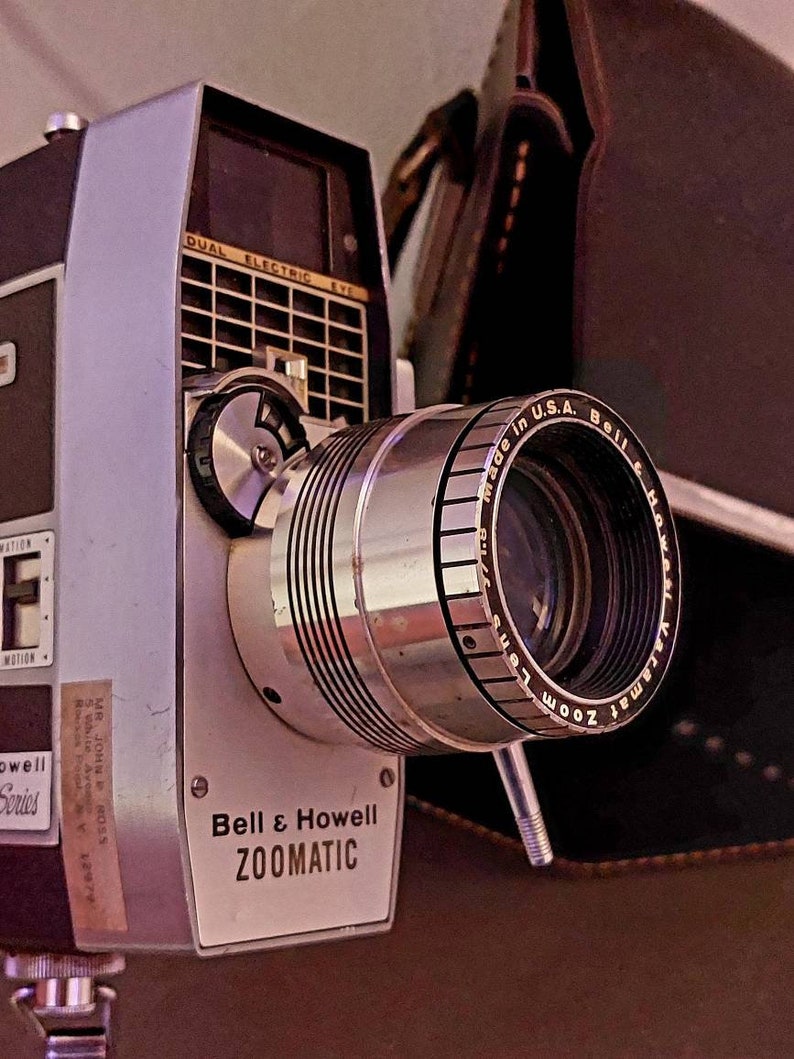
1960 Bell and Howell Camera DUO Power Zoom Zoomatic its the image 1

Dan, do you wish that, fifty years later, people would just leave it alone? Sorry. You don’t deserve that kind of forgetfulness.

About Mrs. Kennedy

There is another surprise. Rather — accurately, for a change– described, in his first recorded account of the film, how Mrs. Kennedy had tried to get out of the car in the middle of the assassination. The next day, the day after the assassination, CBS decided to have Rather broadcast his experience of the film live again (Rather was being groomed after all). But, they told him, leave out the part about Mrs. Kennedy. It was considered indecorous. America, they said (according to Dan) was not “ready” to absorb the image of the first lady trying not to get shot.

In fact, I still believe Mrs. Kennedy was trying to retrieve part of John Kennedy’s skull, which had been blown off and was slipping down the back of the limo. It was later recovered by a bystander and “returned” to the Secret Service (and flown up to Bethesda to be reunited with the body.)

I am astonished, but then not astonished, at how casually the establishment decides for Americans what they should or should not know. Just astonished. The omission of important information about what happened is bad, bad journalism, dishonest and irresponsible. And it is these same people, these same institutions who turn pale and almost feint when the idea of getting your news through the internet is raised…. unmediated!! You must be mad!

My Theories on Conspiracies

The Magic Bullet


Charlton Heston’s Naked Butt

I was watching “Planet of the Apes” on PBS the other night and there was that famous shot of Charlton Heston being presented to the ape officials for disposal, naked, from behind.

I have seen this movie at least three times, on television. I have never before seen Charlton Heston’s naked buttocks blurred out. But here it was, on PBS, the “enlightened” network, blurred out, just like Stewy’s naked butt on “Family Guy”.

What the hell? Has PBS joined the hoards of frigid hysterical puritans who have decided that the moral life of the nation is threatened by the back view of a man’s naked buttocks? In a country that enjoys dismemberment, explosions, bikinis, gratuitous sex and violence, and Fox News? Spare us.

Oscars 2013

Jennifer Lawrence at the Oscars: was this a put on?

I think it was. And I think she will get away with it because she is young and bit dorky and funny. But it could not be helped: she has slimmed down, after complaining, last year, about how Hollywood wants everyone to look anorexic. Yes, they do, and you do. Whether she becomes even more successful depends on lot on how she chooses her next films. She could be the next Sally Field. Or she could be the next Sally Field.

Or the next Amy Adams, who must have the worst luck of any actress in Hollywood: she is one of a handful of really interesting actors around, but hasn’t yet found the break-out role that will define her career.

Poor Anne Hathaway: I doubt she’ll ever again, for sheer artistic interest, match the moment in “Brokeback Mountain” where she told Ennis, on the phone, what had happened to Jack, and made it beautifully ambiguous: did she know what was really up or not?

It’s pretty clear she did know– but it was wonderfully done.

No one gave a better performance in any film this year than Amy Adams did in “Junebug”.  I know for a fact you have never seen it: do so, now.

The Mirth of Hollywood Money

(Paul Schrader says…)

In the case of Bringing Out the Dead, I was opposed to Nick Cage because the character I had written was about 27 years old and Nick can’t really, plausibly be less than 35 on the screen. I thought that this was really a young man’s thing going on here.

But it was a very tough story, in terms of Hollywood. Scorcese likes to take his time. He likes to spend money shooting. Last night they were doing a shot that I would do in a hour, and they were spending six hours on it.

That shows up on screen, but it costs money. So, a film that I could have made for 8-9 million dollars here in New York, they re spending 30-35 million. So financial justifications come into play, because you have to justify that 35 million dollars. Nick Cage, at the moment, gets around 20 million dollars a movie and he’s one of the highest paid actors at the moment. He s had a whole series of successes. But Nick read this and the idea of doing Schrader and Scorsese and a night in New York again – he agreed to do it for a million dollars.

That protected Marty. He knew that once he had Nick in his pocket for a million bucks, nobody would touch him. There wouldn’t be no studio interference, there wouldn’t be talk about changing the script, talk about having a different ending, or whatever.

So he opted to go with Nick, so that he could make the movie he wanted to make. If he went with an unknown, he would have had a lower budget or he would have had to make some script changes.

Paul Schrader, from an interview at Euroscreenwriters.

Some people don’t believe me when I tell them that I believe that the only reason Leonardo DiCaprio– the worst “name” actor of his generation– got a certain role in a “big” film like “The Revenant” was because his name, attached to a project, brings in millions of dollars of investment from the movie studios. Do I seriously think the movie studios would hire a bad actor for a good part in a movie by a great director because they want to ensure a return on their investment?

Well, when you put it that way.

Leonardo DiCaprio is not popular and famous because of his great acting ability.  He does something that always looks like acting but never actually is.  He grunts and moans and moves his mouth but he reveals nothing about the character he is playing that couldn’t be derived from a comic book drawing of him.  He certainly doesn’t reveal character the way Christian Bale, or Robert Duvall or Joaquin Phoenix or Meryl Streep or Cate Blanchett does.  He is popular because he projects the kind of anesthetized de-sexualized appeal of gay men that adolescent girls adore and don’t feel threatened by.  He and Andrew McCarthy and Johnny Depp and Elijah Wood and Tobey McGuire are better actors,  I suppose, probably, than the cast of “The Brady Bunch”, but they really aren’t in  the same league as the others I named.  Watch DiCaprio with the alluring Kate Winslet in “Titanic” and ask yourself this: if I was Kate Winslet in this scene would I be worried about what Jack Dawson might do to me?

It’s a giggle.  He’s completely harmless.

All right– a certain segment of the population says, “no, I wouldn’t be worried, because I would want Jack Dawson to make love to me”.  But that is because the entire scenario, a rich, cultivated, young British woman, offering, in 1910, to pose naked for a strange little American boy, in an exclusive cabin, in the first class section of a ocean liner, is preposterous.  I’m not saying you couldn’t make it work– a real writer absolutely could– but James Cameron doesn’t have even remotely the skill required to do it.   Unless you accept the rest of awful cartoonish melodrama of Cameron’s “Titanic” as worthy of seriousness.

But DiCaprio is immensely popular with a large segment of the movie ticket buying audience.  He is so popular that his presence in virtually any professional production guarantee’s tens of millions of dollars in revenue.  Thus DiCaprio as J. Edgar Hoover, as Howard Hughes, as Hugh Glass.  That’s why people refer to his character in the movie not as J. Edgar Hoover or Howard Hughes or Hugh Glass but as Leonardo.  Did you see when Leonardo fought with the bear?  Did you see when drew the portrait of the naked girl?  Did you see when he invented that big airplane?   Did you see when he nearly drowned?

And thus, Scorcese.

It is so common a practice, to give a prime role to celebrity actor rather than someone with real talent in order to lock in a big budget, that I look for it at the beginning of every big, serious Hollywood production, and even some independent films, even when the director is someone like Terence Davies, whose work I generally adore. We just watched his “House of Mirth”. Even with Gillian Anderson and Eric Stoltz in lead roles, it’s a gorgeous film, beautifully directed and scored; it’s thoughtful, delicate, subtle. And it has Laura Linney, a terrific actress, in the part of Bertha Dorset.

I really had no expectations about Gillian Anderson in the lead role. I thought, you never know– someone famous for her work on a slightly interesting but formulaic TV drama might turn out to be a good actress. Might. But she didn’t, and while it looks like she’s giving it everything she’s got and it looks like Terence Davies does wonders with what he’s given, she ends up reminding me of Lucy Ricardo.  And then you watch Laura Linney  for a few minutes and wonder why the hell she wasn’t playing Lily, and why Gillian Anderson was even in the movie. And the answer is obvious: Gillian Anderson was a huge star at the time the film was made (2000); she was a celebrity. She brought the money for an expensive movie.

She was at least serviceable in “House of Mirth” and the movie survived her shortcomings. Not so with Leonardo DiCaprio in “J. Edgar” or, ridiculously, “Aviator”. How far can Hollywood push the idea of using a celebrity to play parts for which they do not seem remotely suited? DiCaprio as J. Edgar Hoover?  Are you fucking kidding me?  As Howard Hughes?  Are you nuts?  Why not Churchill? Why not Jesus?

(Oh my god! I just discovered that they have actually cast DiCaprio as the lead in a remake of “The Great Gatsby”. Wow.)

Renee Zellweger as Brigit Jones? Can she even do the accent? Can she even handle a role that is as light as a feather in a film that consists mostly of gas?

Tom Hanks as anything? (Although, he is at least improving as an actor, as evidenced in “Cloud Atlas”.)  We all love Tom Hanks– I want him to be my neighbor.  But he cannot act.  Ringo is a better drummer than Hanks is an actor.

This is the Hollywood disease. Actors are chattel: an investment, a product to be promoted and placed where-ever opportune, and exploited for as long as possible, even when you have to have a 70-year-old romancing a 20-year-old.

Well, that’s not entirely unrealistic: I just a picture of 82-year-old Robert De Niro holding his 18-month-old daughter.

God forbid you should have to go through the expense of introducing a new actor, promoting him, getting him onto the talk shows and into the gossip columns, getting his picture out there, his story, his rugged perpetual 5:00 shadow. It’s an investment, like fork-lifts and aprons and saucers and pig-iron.

As for real acting: it’s something best left to young, independent directors to uncover, in young, unknown actors.   Watch the film “Winter’s Bone” with Jennifer Lawrence before she was famous.

Watch her now.

It’s sad.


Remember the Idiots at the Alamo

It will be placed in a Mylar sleeve, mounted between sheets of antireflective plexiglass, placed in a crate and transported from Austin to San Antonio by a fine arts shipper with an escort of state troopers. It will be displayed in a custom-built case that will filter most ultraviolet light. Officers known as Alamo Rangers, private security guards and plainclothes off-duty police officers, will patrol or stand guard. The project will cost more than $100,000, the majority of which will be private donations.

NY Times, October 3, 2012

The document in question is a letter from William Travis sent from The Alamo in the days just before Santa Ana arrived with the Mexican army. It is a relic of an absurd and futile military action and this hysterical worship of it is ridiculous. Travis writes “Victory or death!” Rick Perry repeated the phrase, with a straight face, when he ran for president last year.  Because thousands of Mexicans were coming for him and his life was at stake.

The purpose of the security precautions, with the “Alamo Rangers”, off-duty police, and private security guards is to try to convince you and I that there really is something very, very important about this letter. There really is. It is so sacred, so holy, and so monumental, that nefarious persons all around the world would take it if they could. It must be guarded by very straight-faced armed men. It must be transported in a special vehicle with an escort of state troopers at vast expense.

The board that overseas the archives commission was not impressed with these precautions and warns that it might not approve the transfer of the document to San Antonio to be displayed, in February, at the Alamo.

Lt. Col. William Barret Travis was an idiot.

Travis sacrificed something of infinite value– his own life– for a brief and bloody flip through a fringe way-station on the path to manifest destiny. The fight was not about freedom: it was about taking land from Mexico on behalf of American speculators and slave-traders. These people were not fighting for freedom of religion or expression or the right to vote or join a union or put up a Christmas tree. They were fighting to perpetuate a land distribution system that allowed a select few to accumulate very, very large swatches of land through trickery and deceit so they could resell it to “pioneers” at inflated prices. The pioneers could then use slave labor (illegal in Mexico) to farm their lands.

They always cry “freedom, freedom” and they always take your gold, your oil, your wheat, your children, your drugs, your land. They cry “freedom, freedom” while protecting your pimps and casinos (Cuba). They sing glorious praises of freedom, freedom, as they sell you out to Exxon or IBM or Shell.

General Sam Houston didn’t think much of the Alamo in terms of strategic importance– for reasons that became obvious– and chose to abandon it. This was a perfectly rational, sound decision. He wasn’t surrendering to Santa Anna: he was conducting a strategic retreat so he could regroup his army and fight again another day, on better terms, and with less needless sacrifice of lives. Houston was an oddity for military commanders in his day: careful, prudent, cautious. He eventually prevailed, at San Jacinto, but he took some heat in the meantime.

Needless? Texas, you may not know, was a part of Mexico in 1821 (it was originally part of the Spanish colonies). The United States negotiated a border with Mexico which confirmed Texas as Mexican territory. However, American settlers ignored the agreement and violated the treaty by moving into the territory. Santa Ana, in the meantime, had rescinded the Mexican constitution and made himself dictator.

Eventually, the American settlers organized, formed an army, and declared independence. One of the reasons? Mexico had outlawed slavery.

The Battle of the Alamo took place February 23 – March 6, 1836. The decisive battle of the war was fought shortly afterwards in San Jacinto.  The Mexicans were badly routed there and Santa Ana capitulated and signed a new treaty. He had been captured dressed as a common soldier, but was given away by his own men when they acknowledged him as “presidente”, apparently.

In 1845, Texas, having completed the transitional charade of independence,  was granted statehood.

The monument in San Jacinto says this: “Measured by its results, San Jacinto was one of the decisive battles of the world…” It would have been fun to sit on the meeting that chose that phrase. I would have liked to hear their ranking of “decisive battles of the world”.  Come on– tells us.  Waterloo?  Stalingrad?  Marathon?  Gaugamela?  Metaurus?

Houston, as I said, didn’t think it was smart to defend the Alamo against a vastly superior force. He sent James Bowie to the fort to remove the artillery and destroy the entire complex. It was Colonel James Neill who decided that the men under his command should honor his own ego with the sacrifice of their lives. Then he left.

Bowie, Travis, and Davy Crockett stayed. Travis and Bowie argued over who was in charge. Neill returned to settle the dispute and then left again. This was a wise decision.

When the Mexican army arrived, Bowie tried to negotiate a surrender. Yes, he did. Travis, mad for self-abasement and morbid glory, disagreed with Bowie and fired a cannon at the Mexican camp, and sent his own hard-liner to meet with the Mexicans knowing he would not reach an agreement.

The Mexicans, in any case, were not in the mood for taking prisoners. Apparently there is a kind of flag you raise if you intend to murder any prisoners who survive the battle. They raised this flag.

Most of what you have heard about the Alamo since is blather. The Americans seem to think that out-killing the Mexicans from within a fortified compound was the most incredible awesomest achievement of any army anywhere in the entire history of the entire world. The movies (cue John Wayne) and the bombast are intended to encourage today’s young people to sign up for more bloodletting when required, as when our oil supplies are in question.

Glory, glory, hallelujah.

Uncompromising Films: The Proposition

Did he ever question the morality of what they did? “I’m very proud that there were people in my family who made difficult choices in a difficult time,” he says.  Matthew Bondurant

I haven’t seen “The Proposition” but some critics compare “Lawless” favorably to it. That is, they liked both films: “uncompromising”. So I saw “Lawless”. Basically, it’s a story about blood, guns, blood, guns, fast cars, guns, blood, brass knuckles, knifes, throat-slitting, with a few characters and plot points strewn around to disguise the sequences as “film”. Beverly Hillbillies meet The Godfather. “Uncompromising”.

If you made a film about sex as uncompromising as “Lawless” is about violence, you would have lots of shots of sexual organs, sexual intercourse, oral sex, sodomy, and so on, with intermittent snatches of dialogue, and then, I suppose, someone could say it was an “uncompromising” film about something. Implying, of course, that that was a good thing, an artistic thing– something of which you might reverently whisper: “authentic”.

Roger Ebert loved “The Proposition”. I’ll have to see it to judge for myself, but the plot summary sounds even more violent than “Lawless”. [I just noticed that Ebert did not like “Lawless”. See link on the right.] Both films were written by Nick Cave, renowned for his “authentic” music, including the inimitable “Curse of Millhaven”, a very dark song I like very much.

Uncompromising it is.

It is films like “Lawless” which have led me to question the value of films that sell you, as it’s main virtue, a lack of compromise. Here’s the key thing, the bait and switch: the compromise is not in the sense that it shows you things that are so troubling and disturbing and honest that you will be discomfited– no, no. In fact, what it is selling you exactly is the most comforting, cliché-ridden, boring truths imaginable: people do bad things to each other. If someone does something bad to you, it is pleasant to do something even worse to them. And if someone does something unpleasant to a member of your tribe (be it family or friend or nation), it is extremely pleasant to unleash a torrent of violence upon them, especially if it includes lots of explosions, fires, and helicopters crashing.

Teenage boys, especially are convinced that the violence in movies like “Lawless” imbue the story with some kind of profound meaning.

Nor is it uncompromising in the sense that it humanizes people who appear to be monsters. No, they really are monsters. Not that we should all get hysterical about what monsters they are. No, we need to grow up and acknowledge that people are monsters. If you have already done that, there is nothing shocking in “Lawless”. They are human, all right. Though the film is embarrassingly sophomoric when dealing with Bertha and Maggie (poor Jessica Chastain– a very good actress– has almost nothing to do in the second half of the film, except to look solemn and concerned whenever Forrest feels any pain).

What is a little shocking is how much pleasure people take in watching other people suffer horrible pain. People are lined up at the theatres to see these films. They love them. There is nothing that is more pleasant to the average citizen than to go watch a movie that depicts violence, sadism, and torture. Are we really all that shocked when something like Aurora happens? Or is it all a big put-on? “I would never do something like that because I am a good person”.

What’s also shocking is the romantic attachment we seem to feel to these rogues who make money by selling addictive substances that destroy people’s lives and inflict untold misery upon millions of children and spouses. I don’t mind that anyone humanizes them or portrays their characters in depth, but it is fascinating that the only constituency of moon-shining that is not given the slightest regard in “Lawless” is, say, the children of some alcoholic farmer who gets his supply from the Bondurants. That alone doesn’t make them monsters but an “authentic” film would tell us that this is what they, the Bondurants, and the corrupt police, are selling. The film-makers want us to believe that Jack is honorable in some way because he’s loyal to his family and nice to Bertha.

He’s also stupid if he thinks selling moonshine is a harmless vocation.

I don’t reject the use of explicit violence in film. Both “Bonnie and Clyde” and “The Godfather” featured unusually explicit, bloody murders, but both of them also offered some insight into character and culture. In a sense, Michael Corleone stands in for all of us who think we value family more than almost anything. What does that mean anyway? Given a different place and time are most of us capable of murder?

Today, in the same Franklin County, it appears to be methamphetamine that these same tight-knit families are selling.

So Matthew Bodurant proposes the ultimate euphemism, spoken like a true writer, with a genius for finding some way to tell us that he doesn’t approve of his moon-shining, homicidal distant relatives… of whom he is so proud.

They didn’t commit crimes: they made “difficult choices”.


Gosh, even Ebert didn’t like this one.


Bill’s list of truly disturbing, “uncompromising” films:

    • Carnal Knowledge
    • Cool Hand Luke
    • We Need to Talk About Kevin
    • The White Ribbon
    • The Third Man
    • Autumn Sonata
    • Dr. Strangelove
    • The Seventh Seal
    • Coma
    • The Conversation
    • The Godfather
    • Shoah
    • The Pianist
    • Midnight Cowboy
    • My Winnipeg
    • Kid with a Bike
    • Monsieur Verdoux (Perhaps the most genuinely subversive film of all time)


Geronimo: the Movie

Mr. Hill, telling why he had to fiddle with facts, said: “The audience doesn’t go to a movie for a history lesson; it wants entertainment. At the same time, they don’t want something that trashes history; so it’s a delicate line.” Ny Times, December 5, 1993

It is a very delicate line. The line, unsaid, is “audiences want the illusion of something serious and historically accurate without actually having to make the slightest effort to learn anything or to actually think beyond stereo-types and clichés: we cater to the audience’s prejudices; let’s leave education to the schools.” No no– we say they want to be “entertained”.

Firstly, the idea that maintaining a semblance of historical accuracy when using historical events to titillate audiences could cause boredom is utterly untrue. It’s not boring: it’s just not titillating and comforting.

Or I could say, “it’s just entertainment”. Not art. Not serious.

But that overlooks the fact that the changes made to make it more “entertaining” are often not related to action or visualization or sound or any of the aesthetic traits of the story. For example, the Hollywood film about the capture of the Enigma machine made the submarine American instead of British. Does that actually increase the entertainment value of the film? Not artistically. But it opens the film to an audience of small-minded parochial viewers who don’t really care about history at all.


Geronimo did something sickeningly awful. During one of his raids, he took a young white girl and hanged her, alive, on a meat hook.

John Milius wrote this incident into his original script for the movie but it was deleted in re-writes. Milius might argue that leaving incidents like this out distort the picture of Geronimo given to the viewers of the movie. That is true. You could argue, however, that it is in the nature of movies that single events can become sensationalized, and can assume an importance out of proportion to other events, like the slaughter of women and children by the U.S. Calvary and by white settlers. You could make that case.

Late in life, Geronimo became a Christian. He then spoke about how well-treated he was by “the white-eyes”, which he contrasted to the treacherous Mexicans. Is the fact that he became a Christian related to his whitewash of American-Indian relations? If so, that is a very, very sad comment on something.

Second Lieutenant Britton Davis, a man with very respectable credentials, described Geronimo thusly: “This Indian was a thoroughly vicious, intractable and treacherous man. His only redeeming traits were courage and determination. His word, no matter how earnestly pledged, was worthless.”

That seems about right, in respect of the historical record.

As much as we would love to see shades of gray here, the Apaches were a violent, ruthless tribe that raided neighboring tribes and peoples for livestock and goods, and brutally murdered anyone who got in their way– before they were themselves tricked and destroyed by the powerful Americans.

Geronimo died of pneumonia in 1909 after he fell off his horse and lay in a cold ditch over night. Do not consider the fact that he was stoned out of his mind at the time.

Rob Reiner Trashes a Scene

It was cheesy anyway.

There it is again– in a brief biography of Nora Ephron at the New York Times– a reference to the allegedly memorable “fake orgasm” scene in “When Harry Met Sally”.

At least the Times has the good taste to describe it merely as “probably best remembered”. I am thankful for small things. You have probably heard, many, many times, that this scene, in which Sally tries to prove to Harry that women can convincingly fake orgasms, is the funniest scene in the movie, and, maybe, the funniest comic bit ever filmed.

It’s not true. It’s not really very funny at all. Rob Reiner, who directed it, kept asking Meg Ryan to do it over and over again, bigger and broader each time, until it was what you saw in the film: a ridiculously over-the-top caricature of actual humour, perfectly adapted to the talents of Jerry Lewis or Jim Carrey.

If it ever was funny, it’s not funny by the the time Reiner has had his way.  It’s not funny. It would have been more amusing if it hadn’t been ridiculous. And the allegedly funny riposte by the woman at the next table– Rob Reiner’s mom– is poorly delivered by –Rob Reiner’s mom. “I’ll have what she’s having.” Do you need to ask why she was chosen to deliver this funny line? Yes, it is a good line. It’s a hint: that scene could have been very funny.

The truth is, that scene would have been much, much funnier if Ryan had made the grunting and moaning and yelping believable, and the camera could have picked up Harry suddenly realizing an unpleasant truth that had been hidden from him for years and years. You might also have seen a few faces at nearby tables, mildly aghast, or befuddled.

The point was lost: if that is what a “fake” orgasm sounded like, nobody would ever have been fooled. Reiner destroyed the funniest element of the scene. The best comedy is revelatory– that could have been a brilliant moment for the film, but Rob Reiner trashed it. He slapped custard pie all over it and made into something feeble and crass. He made it into something you love to quote around the water cooler but really isn’t that funny as you are watching it.

I imagine a richly imagined, subtle, teasing rendition– with that intimation of resistance and the loosing of reserve and the building intensity, all while Harry — in recognition– signals increasing anxiety. Maybe, at the end, he is incredulous: “That was fake?”

Come on– that’s funnier.

Then, a real actress does the line: “I’ll have what she’s having..”


What Rob Reiner did to that famous scene is what Gary Marshall (“Happy Days”) did to Fonzie: you like that “EEEEHHHH!”? You do? I’ll do it again. And again. And again. And again. Ten times an episode. No, twenty, thirty… no forty times! And at every public appearance. And on every talk show. And ….

What? You’re sick of it already?

Incidentally, “You’ve Got Mail”, also written (and directed) by Ephron, was also about as bad as “Happy Days” in it’s worst moments, monumental in it’s simple disregard for any kind of plausibility or psychological insight.

More recently, “Julie & Julia” was moderately amusing, enlivened, as it was, by Meryl Streep’s performance.

All right– you want a really funny scene: rent “Planes, Trains, and Automobiles” and watch for the scene at the airline car rental counter with Steve Martin and a brilliant Edie McClurg. Yes, it’s rude, but it’s more inventive and original than the fake orgasm scene because McClurg sounds close to believable as the clerk. You recognize the attitude, the manners, the “I don’t think I like the way you’re talking to me sir.”

I would have loved to hear her do the line in “When Harry Met Sally”: “I’ll have what she’s having”.

It would have been funny.


Why Shirley Maclaine Should Stick to Acting: The Children’s Hour

Shirley MacLaine, in the documentary The Celluloid Closet, said that nobody on the set of The Children’s Hour discussed the ramifications of the issues regarding homosexuality that are implied, but never spoken about outright, in the film. She said, “none of us were really aware. We might have been forerunners, but we weren’t really, because we didn’t do the picture right. We were in the mindset of not understanding what we were basically doing. These days, there would be a tremendous outcry, as well there should be. Why would Martha break down and say, ‘Oh my god, what’s wrong with me, I’m so polluted, I’ve ruined you.’ She would fight! She would fight for her budding preference. And when you look at it, to have Martha play that scene – and no one questioned it – what that meant, or what the alternatives could have been underneath the dialog, it’s mind boggling. The profundity of this subject was not in the lexicon of our rehearsal period. Audrey and I never talked about this. Isn’t that amazing. Truly amazing.” (IMDB)

One can only suppose that if Maclaine were involved in a remake of “Huckleberry Finn”, she would re-imagine the 19th century as an era of enlightened, respectful attitudes towards race and lovable colorful ethnically diverse towns and villages. The word “nigger” would never appear. Why indeed does Martha break down and declare that there must be something wrong with her? Because it’s the 1950’s (or 40’s or 30’s, when the play was written by Lillian Hellman). Of course Martha would believe there was something wrong with her! That is precisely what was wrong with attitudes towards homosexuality back then. Martha, incubated in a culture of ruthless heterosexual orthodoxy, would have had no choice. It is only in the modern era that homosexuals, knowing that the courts and the larger public are on their side, see a viable path in standing up for their rights, and, indeed, assert a claim on the definition of marriage.

And Maclaine’s humanistic declarations aside, it would have been an artistic mistake to incorporate anachronistic attitudes into a play set in the 1930’s. The beauty of “The Children’s Hour”, the film, is it’s incisive observations about society and children and young women trying to establish themselves in the 1930’s. Incorporating modern attitudes about identity and self-actualization would have only served to allow casual viewers to pat themselves on the back for being on the correct side of this issue.


The character of Karen (Audrey Hepburn), in “The Children’s Hour” must rank up alongside Atticus Finch as one of the most admirable creatures of fiction ever created.

What does “anodyne” mean? Nice word. It means: “not likely to provoke dissent or offense”. That’s a very useful word.

Hoosiers Hokum

Firstly, let me acknowledge that most people don’t give a damn whether an inspirational story they liked is actually true or mostly bullshit. Personally, I don’t see anything inspirational about stories that have to lie to you to convince you that the inspirational behavior actually results in success.

In the case of “Hoosiers”, we’re supposed to be inspired by the example of the 1954 Milan basketball team: if you really work hard and show determination and try your best you can overcome incredible odds and win championship basketball games.

PBS ran the movie tonight, uninterrupted by commercials or facts. Now, there are one or two facts. The school upon which the story is based, Milan, actually did shock a much larger school by winning the state championship in 1954. And they did win the final game in the last few seconds.

Most of the other stuff in “Hoosiers” did not happen in real life.

  • they won all of the games leading up to the final by lopsided scores, sometimes in double digits, not with last second comebacks.
  • the real coach didn’t work them particularly hard: he liked to just play with them at practices; no big inspirational speeches either. In fact, these scenes look a bit cheesy in the movie.
  • the team didn’t have six players, they had ten.
  • the coach was 26 and married, not 40-something like Gene Hackman, looking for redemption, and looking silly hitting on Barbara Hershey.
  • the team manager did not come into a game and drop two “granny shots” in the last minute for a stunning victory– oh please.
  • Milan had been to the quarter finals the year before, so the whole season was not quite as shocking as the film made it seem. The movie didn’t show that. Why not? Every ask yourself, why not? Because that would indicate that what the Milan team had was talent and skill, already. The hard work and determination helped, but it’s not quite as inspirational if you know that they were born with it.
  • and I repeat: the last six or seven games were not close: not a single last minute victory among them.
  • one of the teams Milan beat was Montezuma High which had an enrollment of 79! Who was the underdog? Even so, Milan used the “cat and mouse” or chicken-shit strategy (see below) against them in the fourth quarter. Excuse me? Against a team with about half your enrollment? What is inspiring about that?
  • the Dennis Hopper character did not exist
  • it was not the first time Milan had played in the Butler Fieldhouse, so they were not likely to be intimidated by the large venue as they are depicted in the movie, with Gene Hackman melodramatically showing them that the court was exactly the same size as their home court, and the hoops were exactly the same height.

Now, I guess most basketball fans don’t have a problem with the strategy of getting close or ahead of your opponent and then dragging the ball for four minutes. I’m not exaggerating: in the final game, Milan was trailing Muncie at 28-26 and their star player, Bobby Plump, held the ball for four minutes before taking a shot. Coach Marvin Wood, in fact, admitted that he thought they would lose if they simply played basketball against Muncie. He didn’t think they could hang on. He didn’t think, in other words, that there was anything particularly inspiring going on out there on the floor.

So he had his team hang on to the ball. Just stand there, holding it. Then he had Plump take a shot… which he missed. Brilliant strategy!

So Muncie, now in possession and leading 28 to 26, did not go the chicken-shit route. They played the game like you are supposed to, like athletes with class and integrity.

They did the honorable thing.   Was there ever a more monumental fuck you to the idea of integrity and honor in sports than the decision to erase this fact from the story?

For that, they are treated as the villains in this story.

And they shot. And they missed.

Milan regained possession and hung onto the ball again until Plump was fouled. He sank both shots to tie the game. Muncie, of course, took possession.

And then, inexplicably, miraculously, Muncie gave the ball away. They ridiculously gave the ball away with two minutes left. They handed it to Milan. Milan then killed off the clock and scored and the game was over.

That’s inspirational?

It’s exciting and dramatic, like the a baseball through the legs of the first baseman, but it wasn’t the particularly brilliant play of Milan that won the game for them: they actually lost the game, in terms of strategy and play. They won it back on sheer preposterous luck, a gift from Muncie, who had the game in their hands.

The strangest thing of all, to me, is that what actually happened is a far more compelling story than the Hollywood version– it gets a bit tiresome watching all the boring speeches and the last second come-backs. Bit what really happened had drama!


I grant you that “Hoosiers” tells you up front that it is a fictionalization and does not claim to tell the accurate story of the 1954 Milan.

That’s in the details and they understand perfectly that most of the audience will fixate on the “true story” part of the tagline and believe that the story told in the film is “reasonably” accurate.

I don’t blame the movie makers for the fact that audiences routinely embrace these kinds of distortions and dishonesties.


Other Hollywood True Stories and Lies

Partisans of the movie will tell you that they had to fictionalize the movie because that’s just how they do it and otherwise it wouldn’t be a good movie.

Of course they do.  That’s not the issue.  The issue is when they change facts that are absolutely germane to the appeal of the story, like when they make the people who captured the Enigma machine in World War II American instead of British, to cater to the vanity of American audiences, or when they show Nash’s wife being loyal and still married to him at the time of his Nobel Prize so they can have her shedding tears in the audience.

It amazes me that anyone accepts this logic. Nothing is more interesting than honesty, and the the only reason the film is at all suspenseful is because of an infinite supply of self-delusion.