Fast Cuts: Mediocre Directors

All right, you’ve finished shooting. You assemble your video and your audio and your special effects and start trying to pull it altogether into a coherent whole. You think you’re finished and the big moment arrives– you show it to your friends, some crew, film company execs, sponsors, whatever. It’s boring. It’s dull. It doesn’t “move”.

You are mortified. What can you do? Don’t give up! You promise everyone you’ll go back into the editing suite and fix it. But you can’t reshoot, because the actors have gone home, the crew is dispersed, the light’s different…

No problem. Just shorten every cut. Shorten every cut to about .6 seconds. That’s right, less than a second. Cut, cut, cut. Then add some more sound effects, lasers, metal on metal, whoosh! More cuts. More, until you have about 40 cuts a minute, if not more. Loud music, loud effects. Now, let’s jiggle the camera, as if your camera was drunk, staggering around in circles, totally discombobulated. That’s it– makes it look like this is really happening to Brad Pitt, right. You can tell it’s really happening because the camera man is jiggling the camera, man. That like a documentary! Looks real. Looks really real.

Fast cuts never make any scene look great, but they prevent lousy scenes from looking really, really bad. You can’t tell any more– each shot is only on the screen for a second or less. What you have is the illusion of action and movement, which is analogous to being able to be the eyes in the heads of five different people in rapid succession. This does not reveal anything to the viewer: it merely keeps him from realizing that the director is unable to develop an interesting sequence of actions from a single point of view.

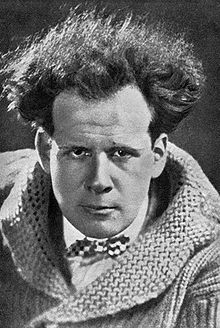
This is not the same as Eisenstein’s theory of montage: in Eisenstein’s view, each cut provides a comment on the previous and succeeding cuts, thereby creating a coherent sequence that gives meaning to the action. The famous scene of the baby carriage rolling down the steps and the Cossack holding his sword aloft and the woman about to scream…. Modern action films simply provide a succession of shots without any inner coherence at all. That would require work.

Sergei Eisenstein, also known as the Soviet Eraserhead.


Why do ALL the previews now have quick cuts going to black? Can’t anyone do anything on their own nowadays? Who started it? Who did it first? Who said now everyone has to do it the same way: short, quick cuts, fade to black, fade to black, fade to black. The audience can really tell that this film has lots of action, so they will want to see it. Do not, under any circumstances, give the audience any idea of what the movie will actually be about, because it’s not about anything: it’s guns, helicopters, and babes, and moving cameras, and explosions, and revenge and mayhem.

Event the trailers for the films that appear to be about relationships or character are now chopped into tiny little disconnected shots, fading to black…

Vertiginous Spectacle

“Who could object to being tricked in this way? The audience, knowing more than Sugar does, is rendered dizzy by the vertiginous spectacle of one movie star so shamelessly “doing” another. ” New York Times article on Tony Curtis as Josephine being “seduced” by Marilyn Monroe in “Some Like it Hot”, directed by Billy Wilder.

In the scene referred to above, Tony Curtis, who recently died, is pretending to be a wealthy playboy named Shell Oil Jr. He has convinced Marilyn Monroe that he is impotent. Good sport that she is, Monroe is determined to end his agony and “cure” him. But the “doing another” reference above is not actually a comment on the seduction– it’s a comment on Curtis deliberately playing Shell Oil Jr. as Cary Grant.

I don’t think it’s a mean-spirited parody. It just, probably, seemed like a fun thing to do, and Billy Wilder, a very good director, obviously decided to go along with it.

I’m more interested in the word “vertiginous”, which means, according to Wiki, “characterized or suffering from dizziness or vertigo”. So I guess the writer, above, means that Curtis’ performance is so exciting that the viewer may be left dizzy, which, in fact, he suggests in an earlier phrase: “rendered dizzy”, making the entire sentence sound like “the audience was rendered dizzy by the dizzying spectacle of Tony Curtis” blah blah blah.

I like the word and I will try to remember it the next time I need to describe someone or something that causes me to feel dizzy. There was a staff member last week— shall I? “Last week I had the vertiginous experience of attempting to correlate B’s specifications for a web site into actual html and css code.”

I just ran into another word: anodyne, in reference to the names of various associations in the U.S. which are fronts for conservative donors and which run ads in various districts attacking the Democrats. Anodyne means “not likely to cause dissent or offense”. Such as “American Growth Fund” or “Keep America Strong Foundation”.

Most of politics, in the U.S., and elsewhere, consists of providing anodyne expression of vertiginous debacle.


Upstairs, I hear K. D. Lang’s collection of Canadian classics playing. So far, without exception, they are terrible.

K. D. Lang has a voice, a technical instrument of great virtuosity. If that’s what you listen for in a piece of music, by all means, she’s your man. But “Helpless”, for example, is about a feeling of desolation, of disconnect, and vulnerability. You can’t make a song sound like that by showing off your pipes, but Lang can’t resist doing it because that’s what she does.


Meg Whitman in California has spent close to $130 million of her own money on her campaign so far (for governor). Jerry Brown, her democrat opponent, has spent about $4 million. They are tied in the polls.

[added December 6: Brown won.]

I am an Important Person

They cite my favorite piece of sociological data: In 1950, thousands of teenagers were asked if they considered themselves an “important person.” Twelve percent said yes. In the late 1980s, another few thousand were asked. This time, 80 percent of girls and 77 percent of boys said yes. David Brooks, NY Times, July 18, 2010

That’s a fascinating piece of information. If it is to be taken at face value– and I’m not sure it is– our society would seem to be in big trouble. Our kids think it’s all about them.

The social workers and therapists rise as one in a chorus of outrage: but everyone is important. This is great. This is progress. Finally, we have society in which most of us have positive self-esteem.

And I think that is probably correct, if regrettable on some level. Have you ever worked with someone who had low self-esteem? It can be unpleasant. Sometimes a person with low self-esteem can be a bit paranoid and resentful and lacking in initiative– because they are afraid of screwing up. People with healthy self-esteem seem to me more willing to take initiative, trust their own judgment, and expect good results.

Brooks connects this stat to Mel Gibson–he of the infamous drunken tirades– even though Gibson is from the humble generation, the low self-esteem group. In fact, I think Brooks has it all wrong. A lot of Gibson’s fury probably derives from his low self-esteem, not from his ego. This is a man who has to demand respect from people, because, deep down, he knows he will never be able to earn it on his own merits.


And I note the adventures of Carl Friedrich Goerdeler and the Mendelsohn Statue in Leipzig (May 22, 1930–March 31, 1937).

Who was this strange, puzzling man, who advocated the destruction of Poland, the ascendancy of Hitler, .. and, most mystifyingly, the preservation of a statue of the composer Felix Mendelsohn in front of the Gewandhaus concert hall in Leipzig? He traveled around the world warning everybody about the danger of the Nazi regime, while begging foreign governments to respect Germany’s desire to regain control over their colonies, and the Sudentanland. He spent hours trying to decide which of the Hohenzollerns would occupy the throne once he had personally removed Hitler.

Streep’s Choice

Sophie is not a Jew, of course: she is a Pole. In fact, it is at times suggested that she is an anti-Semite, and Nathan certainly accuses her of it.

Hollywood simplifies. Reality is complex. Read this document about the remarkable experiences of Eleonore Hodys. I respect “Sophie’s Choice” for leaving intact the complexities, and thus giving us a taste of the astonishing ability of real events to confound our expectations.

As I said, I basically like “Sophie’s Choice”, but if you are a bright young author out there and you’re writing your first great book, please resist the temptation to have your characters fall over themselves praising your talent, as Styron does in “Sophie’s Choice” (Stingo is obviously a stand-in for Styron as a young man in New York); Sophie and Nathan, of course, think he is brilliant.

* * *

The mystery of Meryl Streep: it’s a great performance… that constantly calls attention to itself. It’s hard to describe what is meant exactly by that phrase– “calls attention to itself” — but I know it when I see it. (Dustin Hoffman — in “Rain Man” for example– is another great practitioner of the art of calling attention to himself being a character.) She’s so good in other respects, it’s almost possible to completely ignore it. But there are scenes when Streep is so much the actor being a brilliant actor that you almost forget the character: all you see is technique. Brilliant technique, but still technique. It’s so obvious in her performance that I could never believe in the relationship with Nathan– there doesn’t seem to be room in her technique for him, let alone a real passion.

The greatest flaw in actors like Streep (Ryan Gosling is another) is that they intuitively demand that every scene be absorbed into their performance. I always felt that any actor could have played Nathan– all you had to do was stand there an let Streep paint the colours of her day on your canvas. It’s the kind of technique that wins awards.

Streep is a very, very good actress at times, but one of the least generous actors I’ve ever seen. By generous, I mean giving the other actors and the film-maker space within which to do their own work. I mean studying the other actors to see what they’re doing and how you can contribute to the overall effect, rather than just call attention to yourself.

Kate Winslet is the opposite of Streep– look at her in “Heavenly Creatures” or even “Titanic”–: not as accomplished as Streep, but far more generous, and often more convincing. In “Heavenly Creatures”, she makes Melanie Lynskey, her co-star, look brilliant.

Michael Caine, Robert Duvall, Amy Adams– all generous.  Rachel McAdams is usually generous.  Meg Ryan is generous in “When Harry met Sally”: she gave Crystal room to ham it up.

Barbra Streisand and Robin Williams and especially Jim Carrey: utterly selfish. Every scene they are in is always only about them.

Next time you’re at a movie, ask yourself if the actor you are watching intently on the screen is contributing to the impact of the other actors.

And one more note: according to Wiki, Streep obtained an unauthorized copy of the script before it went into production and went to Alan Pakula’s house and threw herself onto the ground and begged for the role.

Smart girl: she knew it would win her an award because,

a) it has Nazis,
b) it has an accent.
c) it’s a period piece

[added 2019-11-20]

The Magdalene Sisters (2002)

“The Magdalene Sisters”(2002)

My biggest gripe with Hollywood movies, like “Shawshank Redemption”, “Freedom Writers”, “The Blind Side”, “The Fisher King”, and, most egregiously, “The Dead Poets Society”– and many others– is the way they try to convince their audiences that they are having a deep, authentic experience, by showing you things that seem edgy and profound, but which, in fact, have been carefully packaged and cauterized to remove anything that might be genuinely provocative or compelling.

They habitually simplify life into villains who practically announce their nefariousness, and angels who practically wear halos. You might think this is a benchmark of cheesey action flicks, but “The Blind Side” and “Freedom Writers” and “Mr. Holland’s Opus” and the rest all do it with just as much cheese. The audience is clued in on who to cheer for and who to hiss at. The villains conveniently stand and listen in humiliation as the hero makes his or her grand speech. Then they crawl away in defeat as virtue triumphs and goodness prevails. When the film is supposedly based on a true story, these straw men are often fictionalizations.

What happens to the audience? Because the film is careful to clue them in as to who is “good” and who is “bad”, the audience feels that they possess the ability to make those judgments in real life, even if the people they know don’t look like Morgan Freeman or George Clooney. (They feel even better if it’s Freeman– I am not a racist!)

In real life, however, the good guy, the misunderstood artist, the person with the disability, don’t have the charisma of George Clooney or Julia Roberts. So we treat them just as badly as they are treated in the film. If only a camera crew were around to record us, we might begin to recognize ourselves. But not in the roles we expect.

I believe it encourages hypocrisy. It encourages people to publicly embrace one set of values and believe they actually believe in them, while glibly practicing another. Hollywood actually trains us to look for certain simplifications and signals that don’t exist in real life. We are convinced that if we saw the right clues, we would make the right choices, but those markings never appear in real people. We believe we would know a Van Gogh if we saw him, but most of us buy our wall decorations from Walmart.

So I recently re-watched “The Magdalene Sisters”, and I was struck at a number of times it refuses to cater to that uplifting feel-good Hollywood spirit. For example, one of the “victims”, named Bernadette,– whom we’re supposed to root for in the Hollywood version– is caring for an older woman who is dying. This older woman was not as cruel to the girls as the nuns were, but she did supervise the girls. Bernadette, listens to the older woman ramble on about how she herself had a child out of wedlock years and years ago, and she didn’t want to go to the hospital, and she wishes someone would stay with her. But Bernadette is impatient to get on to her other jobs. She says she has to go. The older woman begs her to stay and comfort her for a while. Bernadette hisses at her: the nuns don’t care about comfort. They only care about getting the work done. They don’t care about you and I don’t care about you either. “So why don’t you do us all a favor and hurry up and die”.

It’s a stunning moment, shocking, and yet utterly believable, and powerful. But wait– Bernadette is one of the “victims” of the movie– she’s supposed to be admirable and virtuous, so we can give her a rousing cheer when she escapes in the final reel.

But of course, that’s not life. It’s not the reality of life. It’s the rose-tinted picture we are given by Hollywood, and, all too frequently, by the news, but it’s not reality.

So when I read this review of “The Magdalene Sisters” by Steven D. Greydanus, I was puzzled by his distress:  [2022-05-09 update: I believe Mr. Greydanus has revised his review since I first read, possibly in response to my comments which he acknowledged reading.  Fair enough.  So I give you a link to his apologia for rejecting the film.]

the film simply presents its nuns, priests, and parents as cruel, judgmental, and evil — end of story. Its sole interest in them is insofar as they are responsible for the unjust suffering of the girls.

Well, we know that the Magdalene laundries existed, and we know that up to 30,000 girls were imprisoned in them, and we know that many of them treated the girls abusively, like slave labour. There’s not much dispute about that.

So whatever does he mean? Does he believe that the girls’ memories are wrong– that actually, it was all more like “Bells of St. Mary’s”?

I found the portraits of the nuns convincing and very believable. No, the film wasn’t about the nuns, so it didn’t spend a lot of time looking into their background or their personal lives outside of the convent– but, seriously, does Mr. Greydanus believe they might actually have been nice?

In fact, I thought the strength of the movie was that it tried very hard to create a feeling of authenticity by leaving things in the movie that are not easily explained. At one point, Crispina takes her night gown and soaks it in cold water. Then she puts it on and goes back to bed. Why? We don’t know. It isn’t explained to us. The Hollywood audience walks out– I don’t get this movie.

But it struck me as exactly the kind of inexplicable detail a person would relate to somebody in real life. When the real life listener asks “why”, the answer is, “I don’t know”. To leave these things out of the movie, would be to create a false sense of logic and linearity to the plot that we never, ever experience in real life. Real life is full of little puzzles and unpredictable turns of events. In real life, events are often directed by hidden compromises and arrangements that aren’t revealed to us by a narrator.

Astonishingly, Mr. Greydanus then proceeds to compare “The Magdalene Sisters” to “Birth of a Nation”, D. W. Griffiths’ tribute to the KKK. I don’t have enough bandwidth to explain to you why that is unimaginably perverse if you don’t already know. But Mr. Greydanus feels he has to defend Christianity against this film– which is truly absurd. Real Christianity has as little to fear from this film as capitalism has to fear from the sub-prime mortgage scandal. Wait a minute…

At one point in the film, Sister Bridget decides to “treat” the girls to a showing of “The Bells of Saint Mary’s”, the saccharine Bing Cosby/Ingrid Bergman picture about saintly nuns and priests helping disadvantaged youth in Brooklyn. Sister Bridget introduces the film by confessing a “shocking” sin: from the time she was a young girl, she has had a secret love…. films. It tells you something about Greydanus that he sees this as a token, inadequate attempt to “humanize” the nuns. In fact, it is clearly a revelation of just how twisted they have become. Sister Bridget expects the girls to find this “confession” endearing, and we see just how this has more to do with her own deluded self-image than with any genuine attempt to be kind to the girls.

It is a direct comment on those ridiculous lives of the saints stories that are in endless circulation wherein they try to tell you that St. Stuffedwig or whatever was not always incredibly pious and devoted, but could sometimes actually be mischievous and fun-loving. Aaaahhh. So you see, Sister Bridget (a wonderful performance by Geraldine MacEwan) is not really the stuffed shirt she seems to be. Greydanus got it completely wrong, just as he got the entire film wrong.

And that’s when I realized that his criticism that the film was not realistic was actually criticism that the film was not Hollywood enough– it didn’t give you a single evil character who was responsible for the evil that happened to Bernadette and Margaret and Crispina and who could then be vanquished by the forces of goodness in the end. The problem with the film, though Greydanus doesn’t admit it, is that it places blame squarely within the institution of the church. The sisters are cruel to the girls because that’s what they do: they try to bend the recalcitrant back to the will of God through brute force. That’s what the church stood for when it built these institutions, and that’s what the nuns and priests were trained to do by the church. If Greydanus wishes to be an apologist for the faith, he is right about one thing: this film, unlike cartoons like “Dead Poet’s Society”, is a genuine threat.


Sure enough, Greydanus likes the very Hollywood “The Blind Side”, though even he has to acknowledge that Michael Oher is merely a prop for the Tuohys’ amazing virtue, even though he doesn’t admit that the scene of Mrs. Tuohy charging onto the field to encourage Michael to defend his quarterback is a far more ridiculous distortion of reality than anything in “The Magdalene Sisters”.

He also loves “Star Wars”, perhaps one of the most trivial popular films of all time. He even gave “Episode VI: Return of the Jedi” an A- ! Perhaps because Darth Vader, as opposed to Sister Bridget, is such a richly developed, nuanced character.

In a separate review of a film called “Amish Grace”, about the willingness of an Amish community to forgive a man who murdered their children, Greydanus is dissatisfied with the depiction of some journalists. His comments are instructive:

A subplot involving a TV news crew investigating the sincerity of Amish forgiveness is the film’s most notable weakness. These outsiders are meant as bridge characters mediating between the audience and the Amish, but their merely journalistic investigative curiosity about the facts of the case is an obvious screenwriting foil. A more effective approach might have been to give the journalists complacent, dismissive assumptions about the Amish, about whom they presumably know little or nothing, and then gradually challenge and overturn those assumptions over the course of the story.

Here we have the naked Christian reviewer: he openly admits that a “true story” should have made up, out of whole cloth, a negative depiction of the media.

Here we have a reviewer actually suggesting that the film would have been improved if the film-makers had only reduced a character to a stereotype. He wants them to cater to that conservative Christian canard about the “liberal” media and it’s alleged bias against true religion and traditional values.

My personal experience is that a lot of journalists have more respect for the Amish, who appear to at least be sincere about their religion, than they do for two-faced bigots like Michael Medved.

Kitty Cat: Tolstoy’s “Anna Karenin”

“The Shcherbatskys consult doctors over Kitty’s health which has been failing since she realizes that Vronsky did not love her and that he did not intend to propose marriage to her, and that she refused and hurt Levin, whom she cares for, in vain. A specialist doctor advises that Kitty should go abroad to a health spa to recover. ” From the Wikipedia synopsis of “Anna Karenin” by Leo Tolstoy.

“Anna Karenin” is allegedly the greatest novel of all time. Well, on some lists. “The Brother’s Karamazov” is often at the top of the list, and so is “Ulysses” by Joyce, and Flaubert’s “Madame Bovary”, and “In Search of Lost Time” by Proust.

So Kitty needs to go to a spa to recover. That, in essence, is the problem I have with Anna Karenin. The whole book is about extremely privileged people committing stupid acts and then having nervous breakdowns and scooting themselves off to a spa or an estate somewhere to “recover” from their awful, horrible, traumatic experiences. It’s sounds like a Russian “Gone With the Wind”. We all want to be rich and privileged just so we can have such beautiful crises.

In the film “The Last Station”, Sophia, Tolstoy’s wife, is informed that Tolstoy has run away from home. Yes, he did, at 80, fed up with his wife’s nagging him about giving her the copyrights to his books. There are a lot of terrible flaws to this scene that are emblematic of the entire film.

Firstly, Sophia immediately becomes hysterical and tries to throw herself into the pond. But you thought, he just left on a train, right? And she’s been married to him for 30 years, right? It’s simply hard to believe in that reaction. Dramatically, that moment cries out for a few moments of “what do you mean he left on a train? Where to? Why didn’t he tell me?” You would expect some annoyance on her part, rather than this immediate, overwhelming despair.

She really does throw herself into the pond and sort of drowns. It’s a silly scene. It’s not like she picked some lonely time and place where no one was likely to rescue her. Her family and friends haul her out and turn her on her side, but she hasn’t swallowed any water and doesn’t vomit, and then, later, she reacts comically when she is told that Tolstoy was merely concerned about her. You do wish that someone would grab her and shout, “don’t be pathetic!” Send her to a spa.


I started reading Tolstoy again because of a reference by Philip Yancey, and because of the recent movie “The Last Station”, which, by the way, is as melodramatic and overwrought as “Anna Karenin”.


“Vronsky, embarrassed by Karenin’s magnanimity, attempts suicide by shooting himself. He fails in his attempt but wounds himself badly.” Wikipedia Synopsis.

Is this tragic or comic? When I first read this novel back in the 1970’s, I thought it was gloriously, beautifully, astonishingly tragic.

Now, I find it a bit ridiculous.

My personal list of the best novels ever written?

1. Crime and Punishment (Fyodor Dostoevsky)

2. Brothers Karamazov (Fyodor Dostoevsky)

3. Beautiful Losers (Leonard Cohen)

4. The Stranger (Albert Camus)

5. The Pearl (John Steinbeck)

6. The Castle (Franz Kafka)

7. Animal Farm (George Orwell)

8. Huckleberry Finn (Mark Twain)

9. Slaughterhouse Five (Kurt Vonnegut Jr.)

10. Anna Karenin (Leo Tolstoy)

But don’t put too much weight on my list: literature is not American Idol. There is no point to this competition, except perhaps to draw peoples’ attention to great books.

“Wolf Hall” by Hilary Mantel is also a great book. So is “Life of Pi”.

More uptodate:  Jonathan Franzen’s “The Corrections” and David Foster Wallace “Infinite Jest” and “Brief Interviews with Hideous Men”.

Junebug: Accommodations

I forget who it was, but one reviewer (maybe Ebert) of “Junebug” noted that all of the major characters in this film had made some kind of secret accommodation with the rest of the family, and that accommodation was the key to understanding the characters’ motivations, reactions and behaviours.

Most Hollywood movies never reveal these hidden arrangements. A movie like “The Blind Side” presents each character as if they exist only at face value. Leah Ann Tuohy just wants to do good for this poor boy, Michael Oher. Oher shows his gratitude by plowing his opponents, especially when, we are given to understand, he imagines them threatening his saintly benefactor.

In real life, the hidden arrangement here is with the Tuohy family, and Michael Oher, all of whom know better, but accept the distortions of the movie because they flatter, and the movie makers, who distort the reality of Michael Oher’s relationship with the Tuohys because it makes a better story.

Nobody, it seems, cares. A lot of people will tell you openly that they would rather have the good story.


The first time I saw “Junebug”, I found the story somewhat baffling, in a good way. A film can baffle because it lacks inner coherence, and because the writers and directors cheat in order to increase the suspense, or try to make something more shocking than it really is. That is a weakness. But a strong film can baffle because it presents characters and situations that echo real life characters and situations that also baffle us. When Johnny hurls his wrench at his brother near the end of “Junebug”, we are baffled even though the film has prepared us for this scene– it makes perfect sense given the character of Johnny and his uncomfortable, acutely disturbing accommodation with his family. But we’re baffled as to why it comes out in that impulsive gesture, just as we would be in real life. We’re baffled with the characters, not at the characters.

If you look closely at your own family, you wouldn’t be shocked to realize that it also has a lot of secret accommodations.

My own take on the wrench? He resents Johnny for being the loved one, the favorite son; everything he does is blessed, as when his mother tells Johnny “there aint a blessed thing wrong with you” in a kind of strange, creepy scene, that nevertheless makes perfect sense, even though he is the one who wants nothing more than to escape his family.

“Junebug” is the best film I have ever seen about the split in American culture, between the rural conservatives and coastal elites.

Crazy Heart

Even “The Village Voice” liked this movie. I liked it too but my expectations were too high. I found it hard to forgive the totally unnecessary, contrived, phony crisis that you could see coming a mile away.

Roger Ebert mentioned that a friend of his compared it to “The Wrestler”. I did too, but not to its advantage. Both films are about old, failed entertainers trying for one last shot at redemption. Both of the heroes fall short. But “The Wrestler” did not make the compromises “Crazy Heart” made. It didn’t pander. It didn’t become dishonest. When Bad writes his new song and Jean gets all weepy because now she’ll only remember her bed as the place Bad wrote that great song in before he left her… awful.

The other movie I thought of was “Once”. “Once” did something remarkable: it set you up for a song that is supposed to be great and delivered. Better yet– it didn’t force the actors to stand around afterwards telling you what a great song that was that you just heard– it just delivered it. Beautifully. The most memorable shot: the drummer, in the studio, listening for the rhythm. In “Crazy Heart”, he would have flashed a godawful grin at just how fabulous this poor misunderstood artist was. The director wouldn’t have cared what a drummer really looks like– he would only be concerned about hammering it home to the audience that this is a great song. He wouldn’t have trusted the audience to draw their own conclusion. In “Once”– amazingly– you can see the drummer listening for his rhythm.

Bad doesn’t seem to have a singing voice when he’s working on a new song. He doesn’t handle a guitar like a career performer handles a guitar. His dialogue with the sound crew at the concert with Tommy Sweet struck me as contrived: it’s too tidily what I think they think you think it would sound like.

I also had trouble believing that Jean would fall in love that quickly or easily with washed up, alcoholic, smelly old Bad Blake. I was waiting for the moment of charm or amusement or inspiration. Instead, I saw the neediness, the carelessness, and the desperation. Those are not usually attractive traits. “Crazy Heart” was in too much of a hurry to move on. It didn’t take up the challenge. When does she begin to see romantic possibilities, and why?

Anatomy of Cultural Irrelevance

Why do Christians keep doing it? Shooting themselves in the foot by posting reviews like this of the 1959 movie “Anatomy of a Murder” starring Jimmy Stewart?

It doesn’t matter that this is one of the best courtroom dramas ever filmed, or that it is extremely unusual in it’s honesty about the our system of justice, the compromises, the cheating that goes on, or that it is well-acted and superbly written, or that George C. Scott and Lee Remick give startlingly good performances. It doesn’t matter that this is one of the most thoughtful courtroom dramas ever made, and that it was based on a real case, and that it offers a wealth of psychological insights into the minds of a killer, a neglected wife, an ambitious attorney, a not-so-ambitious attorney. Oh no. That all doesn’t matter.

What matters is that the word “pantie” was used. In public! And that Jimmy Stewart’s dad was so mortified by the movie that he took out an ad in the newspaper urging people not to see it.

Jimmy Stewart, by the way, turned down the role of “Atticus Finch” because he thought the film was too liberal.

It doesn’t matter. The American Film Institute rates this as the 7th best Courtroom Drama of all time.

As good a film as it is, apparently it does not do justice to a pivotal scene in the book wherein the defense attorney absolutely shreds the testimony of a psychiatrist who didn’t even interview the subject of his “expert” opinion.

It is so unusual to find a film that tries to give viewers a realistic grasp of court proceedings that I kept wondering about the director. What possessed Otto Preminger to do it? He couldn’t have been hoping to broaden his audience.

It tells you a lot about the state of Hollywood that the last explanation I could think of was that he wanted to make a great film.


A Christian posts a Review of the pernicious “Anatomy of a Murder”.

There are other Christian websites that not nearly as Pollyannaish as the one above.


Some Great Courtroom Dramas

12 Angry Men
To Kill a Mockingbird
The Verdict
Witness for the Prosecution
Anatomy of a Murder


A fascinating paragraph on manipulation of testimony, from Wikipedia.

In protracted litigation, confabulated memory – filling in the blanks and recreating memories – is common, and research has documented the tendency. Repetitive and suggestive questioning tends to plant the seeds of memory.[12] This book and the movie are among the most cogent examples of the lawyers’ dance. “Horse shedding” of witnesses is well known, if controversial and potentially unethical; it is not just an occasion to directly orchestrate perjury. More problematic, it is probable to reach a point where “if you believe it, then it isn’t a lie.” Thus, even letter-perfect bona fide certainty of belief is not equivalent to a certification of accuracy or even truthfulness. This process is called “horse shedding,” “sandpapering” or “wood shedding” – the first and last names relating to the place of the “collaboration.”[13]

“Horse shedding” comes from a practice in the 19th century in New York in which lawyers would hide witnesses in a literal horse shed to “prepare” them for testimony in the court house next door.

To Kill a Stereotype

Ebert’s Review of “To Kill a Mockingbird“.

I usually find Roger Ebert overly generous in his appraisals of new films, so I have to tip my hat to him for his brave review of “To Kill a Mockingbird”– he gives it a very modest (for him) 2.5 stars out of 4.0, after noting that it is rated as the 29th greatest film of all time by the users of the IMBD.

I’ve always liked the film, but I’ve always been conscious of the fact that I liked the film more than I admired it. I totally respected the liberal sentiment behind it. I just didn’t respect the contrived plot developments, the squeamishly overwrought emotions (of the scenes with Boo Radley at the end, for example), or the generally weak performance of Mary Badham as “Scout”.

Aside from being way too old for the part (a problem with the book is that her perceptions and actions seem beyond her age as given) her big scenes look as if they were hacked together from short snippets of adequacy, rather than from a single decent shot. This is especially evident in the scene with Walter and the molasses. But she is affected and deliberate in all of her scenes. I’ve always suspected that she did great at the auditions but once filming started– too late to try someone else–didn’t live up to expectations. I cannot believe that a director was happy with her performance.

You really can’t blame TKAMB for the “white savior” syndrome: it practically invented it. But you can blame the weak characterizations of the black characters, especially Calpurnia, on the source material and the movie.

2019-03-15

Incidentally– here’s a piece of heresy for you: “To Kill a Mockingbird” really is kind of a mediocre book, and Harper Lee never wrote another novel in her life (I don’t count the sequel as a genuine second book) because she didn’t have it in her. She knew that if she did sit down and write a completely new book that her inadequacies as a writer would be laid naked. So she never did.

This is complex because I do like the book. It is indeed likeable, and the era, and the setting are intriguing. But it’s actually quite contrived and psychologically trivial. There’s no depth to most of the major characters.


Similar contemporary film: “Blind Side”.

Hollywood does scads of deplorable remakes of films that were perfectly fine the first time out (“The Taking of Pelham 1-2-3” being the latest travesty). Why not wise up– “To Kill a Mockingbird” is a film that should be remade.

Firstly, the contrived plot twists should be improved upon– can’t there be a better way for the kids to realize that Boo Radley is a human being than to have him save their lives?– and, secondly, the tone could be changed so that, as Ebert observes, the blacks in the film don’t serve as props for the virtue of Atticus Finch. (Calpurnia could be shown to have an actual personality and life, for example.)

I didn’t know this– Jimmy Stewart apparently turned down the role because he thought the story was “too liberal”. How about that.

What is the least respected profession in the United States? Right. And who is the most admired fictional character? That’s right– Atticus Finch, a lawyer.


Best things about the film? Gregory Peck’s Hollywoodized dream dad. Scouts funky haircut. Elmer Bernstein’s exquisite theme. The lovely opening credits, with the cigar box full of collected items that breathe nostalgia. A skinny misfit named “Dill” standing in for the real Truman Capote.

Worst, most unconvincing moment in the film? Scout cozily sitting on the porch swing snuggling up to the Boogey Man himself, Boo Radley (Robert Duvall, in his debut), shortly after he saved her life from the evil Mr. Euell.

This scene reeks of the adult picturing it as it ought to have been. But Scout does not behave like a child who probably would not even have fully comprehended what happened, even with Atticus’ explanations, and certainly would not have warmed up to a creepy adult male neighbor that quickly, no matter how marvelous, as an adult, we think he really is.

In the remake, have Boo disappear as quickly as he appeared. Leave us with Scout’s face, wondering.