William Wilberforce: Drug Addict

William Wilberforce, the hero of the abolitionist movement, and patron saint of all evangelicals who hate it when liberals paint them as regressive on social issues, did drugs.

Wilberforce was probably not quite as heroic as portrayed in the film “Amazing Grace”, nor, probably, as insufferably pious. (I kept thinking, as I watched the film, that if Wilberforce had been this maudlin and humourless in real life, I might myself have voted against abolition.) The role of Thomas Clarkson seems historically correct– but the heart of the director isn’t in it. We get clear displays of Wilberforce’s physical sufferings (he had some form of digestive ailment) as if he alone paid a personal price for the abolition of slavery. This is the process of conferring sainthood upon someone who, though eminently worthy of honour, had faults we will soon know nothing about. Unless we think in terms of, “that I cared too much”.

In actual fact, many historians feel that Wilberforce was too gullible and respectful of authority to lead the movement, and that slavery would have been abolished earlier (and without quite so many “exceptions”) had a more forceful leader taken up the cause. In fact, at least one historian observed that Wilberforce was finally moved to lead the movement when his friend, William Pitt (the Prime-minister), pointed out that another leader was preparing to take up that role and he– Wilberforce– wouldn’t get credit for it if that happened.

He was also– wait for it– God help him!– a drug addict.

Yes he was. Wilberforce used opium for most of his life, on a very regular basis. The movie “Amazing Grace” honorably makes a point of showing his regular use of laudanum. Dickens also used it. So did Edgar Allen Poe. Lincoln’s wife, Mary Todd, was prescribed laudanum for a sleeping disorder. She became addicted. She was later committed to an asylum.

Interestingly, laudanum is still available by prescription in the U.S. It can be used to treat diarrhea.

Anyway, the support cast of “Amazing Grace” is brilliant, and the sets are wonderful, but Ioan Gruffud is a complete disaster as Wilberforce and drags down the entire film.


From Wilberforce’s son’s biography:

His returning health was in a great measure the effect of a proper use of opium, a remedy to which even Dr. Pitcairne’s judgment could scarcely make him have recourse; yet it was to this medicine that he now owed his life, as well as the comparative vigor of his later years. So sparing was he always in its use, that as a stimulant he never knew its power, and as a remedy for his specific weakness he had not to increase its quantity during the last twenty years he lived. ‘If I take,’ he would often say, ‘but a single glass of wine, I can feel its effect, but I never know when I have taken my dose of opium by my feelings.’ Its intermission was too soon perceived by the recurrence of disorder.

All very nice, but unconvincing. Wilberforce’s son is quite careful to assert that his famous dad was “sparing” in the use of a known narcotic, yet he tried and failed several times to stop using it. It’s hard to understand why, if he had no consciousness of it’s effects, he would make the attempt.


What exactly is laudanum?

Added December 30, 2008:  Apparently George Washington took laudanum because of his teeth.

Oh We Forgot About the Shah

This past Sunday, 60 Minutes presented an interview with Mr. Mahmoud Ahmadinejad, the president of Iraq.

60 Minutes is a good program– sometimes very good. But one should never forget that it is also completely controlled by a group of old white men (with the exception of the late Ed Bradley) and that, ultimately, like Time Magazine and the New York Times, it is an appendage of the corporate and governmental establishment, and thus can’t stray too far from conventional thinking on certain issues.

For 60 Minutes, it is okay to be different, but not too different. 60 Minutes devoted hours of coverage to jazz greats like Louis Armstrong and Ray Charles, and of course, they adore classical giants like George Solti and Luciano Pavarotti. But they only acknowledged the Beatles and Bob Dylan and Bruce Springsteen long after their significance was clearly established– but not among old white men. The counter culture was a little too counter for them, the punk movement ridiculous– couldn’t you just organize a petition? Independent films barely rate a mention– where’s the party where I get to have my picture take with Steven Spielberg? Alternative music? Alternative to what? Do you mean Stravinsky?

So Scott Pelley sat down opposite the leader of Iran and spanked him. How dare you supply weapons to Iraq, as George Bush has been telling us? How dare you try to build a nuclear bomb as those old reliables, the CIA and NSA have been telling us? How dare you display ingratitude to the nation that deposed your arch foe?

Here are some questions Scott Pelley could have asked but didn’t:

  • How does an Islamic state fit into the world’s family of nations?
  • Who are opposing you, in your quest to create a more just society that provides more benefits to the poor and disenfranchised?
  • Are there some in your country who exploit Islamic beliefs for the purpose of acquiring personal wealth?
  • What role should Iran play in the future of Iraq?
  • How close are your ties with Shiite tribal leaders in Iraq?
  • Do you believe that the U.S. will invade your country? What evidence do you have that freedom-loving America would ever consider invading an Islamic Arabic State. Oh yeah– other than that.
  • Is Iran a democracy?
  • What is the role of women in Islamic society?
  • Is there any common ground between you and George Bush– are you both religious fundamentalists?
  • Will Iranians ever forgive America for installing and supporting the Shah for all those years from 1953 up to 1979?  Why are you so upset about the torture?
  • We feel that only a subhuman monster of epic malevolence would ever consider exploding a nuclear bomb in a populated area. How would you ever learn to live with yourselves if you did that? Oh…
  • If we agree to allow international inspectors into our nuclear sites will you? Scratch that…

Scott Pelley: but the American people believe your country is a terrorist nation…

I am unaccustomed to 60 Minutes correspondents making that kind of bizarre, blanket statement.

Firstly, if a majority did believe that, it is clearly because they are told that by George Bush and the so-called “liberal” media. Most Americans couldn’t find Iran on a map, let alone know anything of it’s history, or whether it “exports terrorism” (like Saudi Arabia, from where most of the 9/11 hijackers came?)

Secondly, how illuminating is this kind of question? How about, “why does your country support the creation of a Palestinian state…” Or, if you want to be harsh, “why is it that the Islamic states won’t take in Palestinian refugees…”?

Or, even better, how about this:  Is your country still angry that the United States and Great Britain together overthrew your elected government and installed the Shah as dictator in 1953, and supported his regime right up until 1979 even though he imprisoned and tortured all political opposition and threw him incredibly expensive, lavish coronations, at the expense of the citizens of Iran?


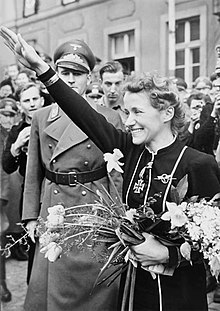
A Sweetheart Like You: Hanna Reitsch

Reitsch promptly formed a Suicide Group, and was herself the first person to take the pledge: “I hereby… voluntarily apply to be enrolled in the suicide group as a pilot of a human glider-bomb. I fully understand that employment in this capacity will entail my own death.”

Some Christians are convinced that anyone who does not believe in an after-life cannot really feel that his or her life is meaningful. When you die– that’s it. There is no transcendent, eternal purpose to what you have been and what you have accomplished.

So why would a Nazi like Hanna Reitsch offer to kill herself on behalf of the most jaded ideology to ever see the light of day? What’s in it for her?

The trouble is, Hanna was not that unusual. At least one study (sorry– can’t remember where I read about it– probably NY Times website) has come to the conclusion that many “Islamic” suicide bombers are not necessarily devout Moslems, and many of them do not believe they are really going to ascend to heaven at the instant of death to be greeted by 47 beautiful virgins. What they do have in common is little prospect of any kind of meaningful, long-term employment or prosperity. Many are poorly educated (hence, gullible, I suppose). They are all young– how many 38-year-old suicide bombers do you remember hearing about? Hence gullible, again. Hence passionate. Hence foolish.

The same equation always applies, to old white Republicans or old Arab Imans: impotent, self-aggrandizing old men send impressionable young men and women off to die for their causes.

It is amazing how many young people find these old men convincing, when the overwhelming fact staring them right in the face is that none of the old men are going to volunteer to do it. They are not going to lead by example.

Hanna Reitsch was a beautiful, petite blonde and Hitler’s favorite test pilot. When they were working on the V-1 rocket and having great difficulty calibrating the navigation system, she volunteered to fly one. I am not making this up.  She climbed inside, and it was launched from a bomber, and she landed it. The data she accumulated during this test flight proved crucial to the eventual “success” of the weapon. At least– now that I think about it– that’s what they told Hanna.

She also flew an airplane into Berlin during the last days of the war, and then flew one out. She said she realized then that the Fuehrer was a little whacko. Really? What tipped you off?  Did you really think that at the time, or after the war, when it suited your own post-Nazi narrative?

Way after the war, John Kennedy invited her to the White House. If you think she might have explained to him how smart, daring, devoted people like herself were duped by Hitler into supporting a vicious political ideology, and a lost cause, think again. Towards the end of her life, she told a journalist, after questioning the manhood of German men in the post-war era, “Many Germans feel guilty about the war. But they don’t explain the real guilt we share – that we lost.”

Her lover, the last Field Marshall appointed by Hitler, Robert Ritter Von Greim, committed suicide rather than allow himself to be turned over to the Soviets.


When she was young, Hannah wanted to be a flying missionary doctor. That didn’t work out, so she became a Nazi test pilot instead. I’ll bet a lot of missionaries have secret ambitions of becoming Nazi test pilots….

“We should all kneel down in reverence and prayer before the altar of the Fatherland.” Hanna Reitsch.

She clarified this to mean “why, the Fuhrer’s bunker!”.


Bundesarchiv Bild 183-B02092, Hanna Reitsch.jpg

Hanna’s Wiki Entry


Demythologizing the Myth-crackers

Demythologizing the demythologized.

Did they really?

The 300 Spartans were accompanied by some 5,000 other Greeks. An indeterminate, smaller number of these Greeks remained behind with the Spartans for a last stand after the Persians surrounded them.

Yes, judges in Medieval Europe, in many instances, believed witches would float, and that they copulated with the devil himself…

They didn’t burn witches in Salem– they hanged them.  In one instance, they “pressed” a witch: put a board on him and loaded it with rocks until he died (one “witch” was  man, Corey).

And after years of see-saw analysis, it looks like most researchers accept that a disproportionate number of rich people made it onto the Titanic’s lifeboats, which is what Walter Lord observed right at the start. They didn’t need to elbow people aside: the stewards simply made sure that the 3rd class passengers did not reach the boat deck until well after the first class had the opportunity to get into the boats.

Al Gore never claimed to have “invented” the internet– he claimed that he took the “initiative” in supporting it’s early development. Gore was in fact an early congressional supporter of the progenitor of the internet, Arpanet. For all practical purposes, that statement is substantially true, though his choice of phrasing was unfortunate.

On the other hand, the statement that he claimed to have invented the internet, while not accurate, does reflect something of the pomposity of the way Gore phrased his statement. It was clumsy. It should have been passed over quickly, but Republicans love to point out that their candidate is the stupid one who would never, in a million years, ever be mistaken for anyone who could have invented anything of any importance, whereas the Democrats nominated someone who arrogantly achieved things.

Marie Antoinette? The quote might well be apocryphal, but the perception that she was indifferent to the suffering of the poor, while leading a ridiculously extravagant lifestyle–even gambling and “playing” at being a milk-maid– is substantially true. I find it somewhat nauseating to now see websites aimed at high school students encouraging them to get to know this remarkable woman, with tie-ins to the movie. This is flat out ridiculous.

Yes, Joseph McCarthy persecuted innocent people.  He persecuted some guilty people too, but he persecuted many innocent people, destroyed their careers and livelihoods unjustly, and behaved like a bully and a pig.

Yes, Eva Duarte slept her way to the top.  Absolutely.  Please, please don’t accept Madonna’s spin on history.

And yes, 38 people were aware (to somewhat varying degree) of the murder of Kitty Genovese in Kew Gardens and did nothing.

The video of Arabs dancing in the street to celebrate 9/11 has long ago been debunked.  The video was of some other event.

How about “Does Donald Trump really have the world’s greatest memory?”  Judge for yourself.  By almost all accounts of individuals who worked with him, he never read any position papers or memorandums that were submitted to him, because he preferred articles with pictures and television.  [2022-05-08]


Kitty Genovese: The Immediate vs the Reimagined Truth — “Of course I heard the screams”.

It is somewhat inevitable that every genuinely sensational and shocking news story will eventually generate hype and exaggeration and distortion. We never seem satisfied with even the most surprising story. So humans rewrite and exaggerate and distort, and, after a time, it becomes difficult to know what really happened. Did 300 Spartans really hold off 5 million Persians all by themselves? Did judges in Medieval Europe really believe that witches float? Did they burn witches at the stake in Salem, Massachusetts in the 17th century? Did the rich really elbow their way into the lifeboats on the Titanic? Did Joseph McCarthy really accuse completely innocent people of being communists in the 1950’s? Did Marie Antoinette really suggest that starving peasants should eat cake?  Answers here.

Did Al Gore really claim to have invented the internet? Did some Arabs really dance in the streets to celebrate 9/11?

Did 38 people really stand by and do nothing while Kitty Genovese was murdered on the streets of New York in March, 1964?

Did Evita Peron “whore” her way to the pinnacle of power in Argentina?

The funny thing is, the core truth of many of these stories, if you can see beyond the ridiculous exaggerations imposed on them by later generations or Hollywood, is often quite remarkable. It is only in comparison to the hype that people sometimes think the gist of the story is not true. Often, that is a mistake. And then you will always find contrarians willing to throw the baby out with the bathwater, so to speak.

Public shorthand for shocking events does tend to simplify and distort and exaggerate. At the same time, there is undoubtedly a temptation for a journalist or historian to uncover the exact truth and shout, “eureka– the public has been deceived” when, in fact, the essential truth of the original story is still quite compelling. We know there will always be some exaggeration and distortion in the retelling of human events.  But immediate first-hand accounts are often quite accurate.  They are less likely to be edited in memory by the spin imposed on events by public hysteria.

We also know, for example, that some of the people Senator Joseph McCarthy persecuted really were or had been communists. Anne Coulter, who wrote a book on the subject, would have you believe that this a shocking revelation that changes the meaning of “McCarthyism” and proves that Joseph McCarthy was actually a hero.

But then, someone else will come along and go back to the original story and discover, all over again, that Senator Joseph McCarthy was a repulsive, vainglorious, vindictive alcoholic thug and bully, and that his tactics really did constitute “persecution” and that he really was engaged in a “witch hunt”, in which refusing to answer questions made you just as guilty as a confession, and, of course, that most of his victims were innocent.

And so someone named Joseph De May has made the shocking discovery that 38 people did not actually watch Kitty Genovese’s murder from beginning to end.

De May’s “discovery” is only shocking if you have ever actually believed that 38 people actually saw the killing, with their eyeballs, from beginning to end and clearly saw a knife and saw Kitty Genovese bleeding to death and did nothing. I’m sure some people remember the story that way. I wonder how many reasonable people do.

You first have to appreciate that De May believes that the word “witness” should only apply to people who saw an event, clearly, with their eyes. He believes that that is what everyone else thinks too, and he spends a lot of time trying very hard to prove that 38 people did not see the murder.

My memory of the event is that 38 people heard or saw something of the attack and that not one of them called the police or offered any assistance to the young girl. After all of De May’s convoluted explanations, that information remains essentially accurate.

I don’t remember anyone ever insisting that most or all of the 38 actually saw the attack clearly. I don’t know why that would make a big difference to Joseph De May who admits that at least 12 people saw some part of the attack and at least 20 other people heard part of the attack and knew something was going on on the street below their windows. The New York Times editor, Abe Rosenthal, who wrote a book on the subject, insists that no New York Times reporter ever stated that 38 people saw the attack. The article uses the term “witness” as I would: people who heard or saw.  People who were aware of the incident at the time it happened.

I don’t think it would even have occurred to me to think about whether all 38 people saw the entire attack from the beginning to the end. Why would that make any difference?

De May insists that there were two separate attacks, not three.. Again, I’m not sure why he thinks that makes a big difference. Are we supposed to go, “Oh, well then, I can understand why no one went down to assist the girl. They were waiting for a third attack…” Furthermore, his case on that point is not as air-tight as he seems to think it is. He finds very little evidence in the official court record, but there is some witness evidence that Moseley went away and then came back twice. It’s not clear– and it doesn’t really matter– if he counts that as two attacks or one.

The essential facts as reported in the initial New York Times article remain substantially correct. The one disputed fact that would matter is this: De May claims to know of someone who did phone the police after the first attack. His evidence for this is not very compelling. A former New York City cop claims to have known an unidentified “old-timer” who told him that he had worked at that precinct the night in question and had received the first call. This was reported to De May 30 or 40 years after the events. Remember — the New York Times article was written the same month as the attacks, before people had a chance to “interpret” their memories.

There is as much– no– less!– evidence for this blockbuster claim than there is for the assertion that there were three, not two separate attacks. It’s unaccountable hearsay by someone who would have an interest in proving that his family or friends were not indifferent to human suffering.

Talk about a scoop! And Mr. Michael Hoffman– the retired cop–decided, in the face of all the publicity about this case, to keep this information secret until just recently! That’s is truly astonishing. It is even more astonishing that Mr. De May was not embarrassed to put this into the public record without even being able to supply the name of the police officer who told someone who told someone.

Then he proceeds to report that Andree Picq also called. Why, there was a veritable torrent of phone calls. Except that Andree felt her throat constrict and didn’t actually say anything on the phone before hanging up. So how do we know she called? She says so. The police, who indisputably did respond when they received a real call later, have no record of her call.

De May quotes the Times article about a man who saw the second attack. He told the reporter that he didn’t call the police because he was tired. He went back to bed. De May stunningly excuses this man because the Times reporter did not provide details of what the man thought he saw– only of the fact that he went back to bed right after he claimed he saw it. The man, by the time he talked to the reporter, knew a murder had taken place. He knew that what he was claiming to have witnessed resulted in the death of a young neighbor, and he knew the reporter knew that. Yet he casually dismisses his responsibility with “I was tired”… and De May exonerates him.

The rest of De May’s article consists of a lot of quibbling. It was rather dark. It was cold. It was not unusual for boisterous people to make a lot of noise in the streets nearby. Genovese got up after the first attack and may not have staggered quite as dramatically as some people believe she did. She seemed to walk slowly.

But even De May does not deny that Kitty screamed, “Oh, my God, he stabbed me! Please help me! Please help me!” But he actually quibbles over whether Winston Moseley stabbed her before or after she screamed! If he stabbed her first, then the witnesses who came to their windows could not have actually seen a stabbing. So then… you can’t blame them for ignoring the cries of “he stabbed me! Help me! Help me!”?

De May tries to argue that many of the witnesses would likely have thought that the noise coming from the street was not unusual for a neighborhood with a bar on the corner. But he had already admitted that people came to their windows to try to see what was going on– he argues that they couldn’t see very much. Why would they bother going to the window at 3:00 in the morning if they thought the screaming was coming from just one of many inebriated couples having a quarrel?

De May seems to think that people generally believe that most of the witnesses told police that they didn’t call because they didn’t think it was any of their business. I don’t know why anyone would think everyone would say the same thing.

Rather astoundingly, De May, defending the indifferent bystanders, actually lists five instances of people who testified in court that they heard Kitty screaming but did nothing. He quotes a witness as stating that he heard Kitty say “help me, help me” as proof that he did not hear Kitty say “he stabbed me”, and therefore… therefore what? Therefore had no obligation as a human being to react? To help? To at least call the police? The question is not whether the witnesses had an accurate perception of what was happening. The question is whether what the majority of witnesses heard and saw should have compelled a responsible citizen to at least investigate further. Some witnesses opened their windows. How large of a step is it to the point at which you shout to Kitty Genovese, “Are you okay? Do you want me to call the police?”

De May admits that the reporter whose article he claims to debunk, Martin Gansberg, interviewed virtually all of the same witnesses the police interviewed, immediately after the event. The product of Gansberg’s intimate familiarity with the feelings and attitudes of these witnesses is the conclusion that most of these people did not care enough about what they heard to investigate further, to provide assistance, or even to phone the police. De May admits that at least a dozen people heard something at 3:00 a.m., got out of bed, went to the window, and then went back to bed, or just stayed at the window and watched. Why? Because, he says, they justifiably believed nothing important was happening. And none of them decided to investigate further, even though what they heard was compelling enough to get them out of bed?

We enter into the realm of ridiculousness when De May starts describing how complicated it was to call the police with a telephone in 1964– before 911. A reasonable person could be forgiven for believing that many New Yorkers might actually be familiar with the process, or might have the number near their phones.

Karl Ross, who did finally instigate a phone call to the police– by asking another neighbor to do it– told the police, “I didn’t want to get involved”. Another woman told the police that she told her husband not to get involved.

I can’t find any evidence in De May’s website to prove his rather astounding claim that some people did in fact call immediately after the first attack. He claims that the police might not have recorded such a call. But the police responded immediately to a specific call that was made too late. Why would anyone think they had ignored an earlier call, but not this one? They were at the scene in 3 minutes.

Given the publicity this case generated, if someone had called, why would they not have come forward? Why doesn’t De May identify the person? Such a person would have been received as a hero. But the police, who interviewed everyone who lived in the area, could not locate a single person who claimed to have called them earlier than the neighbor asked by Mr. Ross.

De May argues that some of the witnesses may have been reluctant to call the police because they feared retribution. Well, this has become pathetic. After trying very hard to convince us that the witnesses never saw anything anyway, De May now wants us to believe that these good citizens were simply wisely looking after themselves and that’s why they closed their windows and went back to bed. So now he concedes that a number of people, had they not feared retribution, could have been expected to call the police?

Here he has clearly entered advocacy mode. He is no longer really interested in clearing up some misconceptions about the attack: he wants to restore the reputations of the citizens of Kew Gardens. Amazingly, just before making this argument, he argues that Kew Gardens was so crime free, that most of the witnesses probably didn’t believe they were actually seeing a murder. Or was it that they were so used to drunks leaving a nearby bar that they didn’t see anything remarkable about a woman screaming at 3:00 a.m., though it was remarkable enough to draw them out of bed and to their window, and for some of them to open their windows and try to see what was happening?

As proof that the 38 witnesses were not indifferent, De May quotes this one:

Of course I heard the screams. But there was nothing I could do. I was afraid. My hands were trembling. I couldn’t have dialed for an operator if I’d tried. I never even thought of it. I was too afraid.

That sounds about right. I don’t know why De May thinks this would correct my impression of what happened that night. It is one of what I would expect to be many reasons given by the 38 as to why they chose not to do anything. The “of course I heard the screams” is a ringing indictment: obviously many of the witnesses heard the screams.

What we have is revisionism. Now that the notoriety of Kew Gardens has been established, the people involved have revised their memories.

None of the reasons each individual had for inaction are very good. Each individual excuses, while unfortunate, is not preposterous. But what was compelling about the story of the murder of Kitty Genovese and remains just as compelling today is that a large number of people had good reason to be concerned about what was happening in the street just below them and chose to do nothing.

Joseph De May Fixes History

De May’s “research” [the website is down] into the issue was neither scrupulous nor objective. One of many examples was his complete trust in single-sourced anecdotal evidence that there were earlier calls to the police. The original news story relied on interviews with dozens of residents of Genovese’s apartment building.

[The original website about Kew Gardens is no longer there.]

Update 2011-11: David Brooks in the New York Times casually referred to the “mostly apocryphal” Kitty Genovese case. What shocked me is that only one respondent called him out on it.

More Update: a new angle has emerged with the fact that Kitty Genovese was gay, and living in a relationship with another woman at the time of the murder. Was that a factor in the indifference of her neighbors to what was happening? I’m skeptical.

Wikipedia stumbles: I like Wikipedia and I think that it is generally an extremely reliable source of information. However, it’s entry on Kitty Genovese is a bit strange. On the contentious issue of whether anyone else called the police before Karl Ross, Wikipedia reports, without citation:

Records of the earliest calls to police are unclear and were certainly not given a high priority by the police. One witness said his father called police after the initial attack and reported that a woman was “beat up, but got up and was staggering around.”

There is no objective contemporaneous news source for this claim. It sounds a lot, to me, like someone is hoping to rewrite history.

Furthermore, Wikipedia states flatly:

Moseley also testified at his own trial where he further described the attack, leaving no question that he was the killer.

“No question”? Albert DeSalvo claimed to be the Boston Strangler and provided the police with details of the crime scenes that, supposedly, only the perpetrator could have known. If you read the book by Gerold Frank, you know how convincing this story was. How else could Albert DeSalvo had known, for example, about a notebook hidden under a bed, or what kind of scarf was used to strangle Joann Graff, and so on?

DNA evidence later proved that he was not the man who murdered and raped Mary Sullivan, who was widely regarded as the last victim of the Boston Strangler. For good reason, many now suspect he didn’t commit any of the murders.

Apparently, the police can sometimes carelessly let those details slip into the conversation while trying to build a convincing confession… or not so carelessly. Several persons involved with the investigation later ran for political office: there was enormous pressure to solve the case. According to the Crime Library, top investigator John Bottomly clearly fed DeSalvo information to make the confession look convincing.

These murders occurred in exactly the same time period as Kitty Genovese’s murder. I have never heard anyone question whether Moseley actually did it, but some of the parallels are interesting, including the lack of physical evidence linking him to the crime, the quick voluntary confession, and the lack of eyewitness corroboration.

Here’s the alarming bit: Moseley also confessed to at least one other crime for which he was never charged… because police firmly believed they already had the culprit in custody.  That flashes a big fat red light, considering what we now know about unethical police interrogation methods.

Has anyone ever taken up this case? I don’t believe Moseley himself claims innocence– but then again, what would be the point? I think Moseley probably did do it– I just don’t think anyone should be glib about it given the lack of physical evidence.


Allan Bloom & Leo Strauss and Real Political Correctness

The 20th was a century unlike any other.

I am this moment interested in one particular difference– the democratization of knowledge– the massive influx of middle-class and poor students into post-secondary institutions of higher learning that occurred in the 1960’s, and our ever-so-sweet, controversial, apocalyptic moral decline. Here we are. We’ve declined. We have the morality of alley cats. How did we get here?

For all the white noise and rhetorical flashes over the issue, it’s really not all that complicated. Until the 20th century, only the children of very rich, very privileged people could receive a higher education. These were children of people who benefited from the status quo. They were the status quo, either the church or the aristocracy. And all intellectual conversation took place on their terms, in their language, in a manner congenial to their ultimate self-interests, especially when it concerned noblesse oblige.

And then suddenly you have democracy and a prosperous middle class and suddenly children of hard-working middle-class parents get to go to college, and buy records, and go to movies, and read books, and suddenly Leo Strauss and Allan Bloom are whining about the tragic loss of culture and learning when what they really mean is that their privileged little ivory towers no longer command the landscape, and those suckers, those helplessly inane but physically peerless farmer’s boys, were no longer mindlessly willing to go immolate themselves on spears and in trenches in order to preserve Allan Bloom’s right to buy $4,000 dinner jackets, smoke Cuban cigars, and troll the streets of Paris looking for rough trade.

The same elitist attitudes certainly exist today. There has been no decline. If anything, there is probably more elitist achievement and behavior today than there ever was before. But the elitists are outnumbered. And they hate it. They just can’t stand the fact that Bruce Springsteen sells more copies of his songs about seducing New Jersey girls named Sandy with tight unzipped jeans, than the Chicago symphony will ever sell of any work by Beethoven. More people have seen “Blade Runner” than will ever see “Hamlet”. Besides, I’m not all that sure that “Hamlet” really is more important, or more of an indication of sophisticated and developed taste than “Blade Runner” is.

The bottom line is never surprising. Neo-cons like Bloom and Strauss and their disciples (who don’t occupy quite as many positions within the Bush administration as they used to) want to build a world in which their social and political class get to dictate culture to the masses. For all their bitter complaining about the “nanny state”, they are far more authoritarian, and far more willing to over-rule popular taste.

They are and always have been the real advocates of “political correctness”: patriotism, chastity, prurience, and consumerism.


300

Now that I’ve seen the movie, I have a one line review: the only things missing are the Nazi arm-bands.

Seriously, this a movie about how wonderful and beautiful and spiritually rewarding it is to die in warfare. We don’t know whether it’s good to die for a cause, because Sparta wasn’t really a “cause”– just a repository of mindless war and oppression.

In real life, the Persians were rather enlightened and well-regarded as far as empires go. They gave Jerusalem back to the Jews and ordered the Babylonians to return all the sacred relics to them.

In real life, Athens was worth fighting for: the prize of culture and learning and philosophy in the Greek world. Can you think of any Spartan philosophers, play-writes, or kings, other than Leonidas?

And it was the Athenians that inflicted the more significant wound on the Persian Empire with their naval victory at Salamis.

Oh, by the way, of course, the Spartans actually had an army of 5,000 other Greeks with them at Thermopylae. Didn’t notice them in the film, did you? There is a core of truth, in that 300 Spartans were a particularly effective force within the over-all effort– oh, what the heck, let’s just go crazy.

Before anyone rushes off to worship at the alter of “300” and rhapsodize about the beautiful, fit Spartans and how courageous they were to give their lives for freedom and liberty and their lovely, sexy wives, it ought to be remembered that Sparta was to freedom and beauty and life what Reverend Jim Jones was to true religion. The Spartans hated freedom, as much as they hated Athens, which did stand for freedom. Every soul in Sparta was expected to sacrifice his or her personal interests for the military good of the state, to the point of death.

If a soldier fled the battle scene, every soldier in his group would be executed for cowardice.

Yes, yes, let us duly note that compared to modern times, the notion of “freedom” in Athens in 400 BC was relatively constrained.

In Sparta, Plutarch tells us, when babies were born, they were tested for toughness and strength. If they failed the test, they would be abandoned on the side of Mount Taygetos.  (This, apparently, is a myth.)

Young boys were sent for military training by the time they were seven, at which time they might also enjoy the privilege of serving as the object of sexual gratification of an adult male.

It wasn’t all bad. Women in Sparta had many rights, including the right to hold property, and to go where-ever they pleased. Divorce laws were the same for women as for men. It seems that Spartan women were allowed to bring lovers into the house if they pleased, and to bear the children for other men– for the benefit of the entire commune. They dressed in short skirts, while the Athenian women wore bulky, long dresses and robes. This was remarkable for it’s day.

Sparta’s women were also educated, and they took part in athletic competitions, and there are accounts of Spartan princesses leading troupes into battle. Really, it’s kind of extraordinary. Why doesn’t someone make a good movie about this?

Sometimes these women would hold a contest to see who could take the most severe flogging. I am not making this up. More movie material.

So the primary benefit of the courage and fortitude of the Spartans is that they help preserve Athens from the potential ravages of the Persians.

In terms of Spartan art and culture, relics are conspicuously absent. It appears that it just didn’t exist.

If you could picture an entire society that operates and functions like an American college football team, complete with token curriculum and cheerleaders, you have Sparta.

13 Old White Men

Someone recently observed that the people whose assumptions and dispositions got you into a mess are very unlikely to get you out. I can’t remember who said it. Maybe lots of people. But it’s true.

[According to BrainyQuote, Albert Einstein said it:  “We cannot solve our problems with the same thinking we used when we created them.”]

But they’ll never stop trying, or insisting that they are the only ones who can get you out, because if what they tried at first didn’t work, they need to try the same thing harder, or more often, or faster. Or admit that they didn’t know what they were doing in the first place. When they come up with a “new” idea, it’s usually actually one of those variations: more, faster, bigger. Then you blame the messengers. Then you blame your own staff or soldiers or followers. Then you blame the people who never believed in your ideas. Then you blame the victims.

They will try again because they cannot admit they failed. They cannot admit that they failed because, given their inflexible mind-set, they cannot imagine that the mechanics of reality are different from the stopwatch in their pockets.

And so it is that George Bush proposes more troops for Iraq. More. Bigger. Faster. That will solve this intractable problem of Arabs hating our guts. That will keep every Arab male youth between 18 and 24 around the world from dreaming about killing an American.

Here’s a picture of the Iraq Study Group. Even the token black (Vernon Jordan) and token woman (Sandra O’Conner) are clearly actually old white men. Look at Time Magazine’s summary of their “qualifications”– they might just as well have announced, each is a veritable old fart of certifiable fossilization in corporate groupthink, and completely immune to new modes of thought, startling ideas, or innovative approaches. These are exactly the kind of people who got the U.S. into this mess. They’re “new approach” can only get the U.S. deeper into the mess.

Okay. So we have a group of old white men, mostly lawyers or businessmen, and they are going to look at the Iraq situation because it is a disaster for the U.S. and they are supposed to come up with some new approach that the current administration, including those mind-blowing non-conformists Dick Cheney, Paul Wolfowitz, Donald Rumsveld, Richard Perle, Stephen Hadley, etc. hasn’t already thought of. And this is going to solve the problem.

I can look into my crystal ball right now and tell you what is going to happen. This Study Group will not be able to even imagine any solution that is not based rigorously on 19th century ideals about “American interests” and “global strategic importance” and democracy and free enterprise and stability and authority and rule of law and so on and so on, and they will recommend more of the same, faster, bigger, better.

If your son is serving in the U.S. army, be prepared to go into denial, for when he dies in the coming year you will be one of the ones who will know that it was for nothing, that it was for Bush’s vanity and Cheney’s megalomania or Powell’s indecisiveness. Your son or daughter will die in vain.

So we will endure until we can blame the Iraqis and get out.

But it is clear now to any sensible person that the U.S. cannot win any more in Iraq and the only reason they don’t leave immediately is because that would make a resounding statement to everyone about just how stupid this whole idea was in the first place.


Who was not in the Iraq Study Group?

1. an Iraqi
2. a non-American
3. a Brit or Canadian or German
4. anyone under 60 years of age.
5. any women. (O’Conner doesn’t count: she hasn’t been a woman in 20 years).
6. non-Christians.
7.  liberals.
8.  scientists
9.  journalists
10.  political scientists
11.  soldiers
12. Iraqis
13. Israelis…

Anastasia

As if the story of the Russian Revolution and the end of the Romanov dynasty was not strange enough, we have the endlessly fascinating story of Anna Anderson who claimed to be Anastasia, and succeeded in convincing a number or relatives and acquaintances of the Romanov’s that she was the real thing.

The Grand Duchess Anastasia

Anna Anderson was found attempting suicide in a river in Berlin in 1920 and taken to a hospital. Two years later, one of the other patients, Clara Peuthert , after seeing pictures of the Grand Duchess in a magazine, identified her as the Grand Duchess Tatiana, one of Anastasia’s older sisters.

A former member of the royal court circle, Baroness Buxhoeveden, came to the hospital to see for herself; she immediately called her a fraud: she was too short to be Tatiana.

Anna Anderson subsequently identified herself as Anastasia instead. On the right are the pictures: Anastasia, then Tatiana, then…. a polish peasant girl who had gone missing about the same time Anna Anderson was found in the river, Franziska Schanzkowska. And then, Anna Anderson.

Anna Anderson (Franziska Schanzkowska)

Anna Anderson

So why did anyone ever seriously consider her claim to be Anastasia? Apparently some Russian émigrés had designs on the rumoured millions in gold Nicholas had supposedly shipped overseas to fund a government in exile. When they heard about Anna Anderson’s claims, they saw a route by which to lodge legal claims against the estate of the Romanovs.

I had never realized before how stunningly similar Anderson looked to Tatiana, at least, from the pictures, who was stunningly similar to Franziska Schanzkowska. Except, of course, for the height, the fatal flaw.

As it turns out, DNA testing eventually proved that Anna Anderson was, almost certainly, Franziska Schanzkowska. In retrospect, it is hard to even accept that she was merely deranged. If she was not Anastasia, she had to have worked on the job of impersonating her, especially when she had been put to the test so many times. She had to have had help– most likely Gleb Botkin, the son of the the Romanov’s family doctor, who also died at the hands of the Communists.

That doesn’t explain how she was able to fool so many people for so long. How she apparently acquired the ability to speak English and French. Or why she appeared to be three inches shorter than Franziska’s claimed height.

Does it need to be explained that so many people were taken in by her even though she couldn’t speak a word of Russian? But then, some supporters came to believe that she could at least understand Russian, and speak a few words of it. But then again…. the Romanovs, apparently, preferred English.

It is duly noted that Anna Anderson’s height and shoe-size did not correspond exactly to Franziska Schanzkowska’s, and that she showed many scars and injuries that Franziska, it is a alleged, did not have at the time she disappeared. I don’t find this evidence as compelling as the DNA evidence, but it has given ammunition to a small number of determined supporters to continue insisting that Anna Anderson really was Anastasia.

It’s a very strange story. If Anderson definitely resembled Franziska and Franziska bore an uncanny resemblance to Tatiana and Tatiana is Anastasia’s sister–

By the way, the movie, with Ingrid Bergman and Yul Brynner, is lame. But you can see why they tried: there is a brilliant movie in there somewhere.


Incidentally, I am intrigued by the number of contemporary writers, sympathetic to the Royal Family, who enjoy enumerating the vast list of atrocities some editorialists had ascribed to Rasputin, as if the obvious exaggeration meant he really wasn’t all that bad of a guy. Why? Because he only seduced a hundred women instead of a thousand? Because he was a lunatic but not a madman? Because he practiced extortion but not mass murder? The same applies to Nicholas II and Alexandra: the fact that they were not the monsters the Bolsheviks made them out to be doesn’t mean they were not appallingly bad leaders who, convinced they had been appointed by God, blindly and stubbornly led their own nation to ruin. Had Nicholas instituted a few reasonable, modest reforms at the right time, there would have been no Russian Revolution, and history would have been kinder to millions of people.

If you insist on believing that Anna Anderson might well have been the Grand-duchess… read this.

Interesting Trivia: the grand duchesses slept on the same metal cots wherever they traveled. They were folded up and taken with. Give me the simple life…. Interesting Trivia #2: the Romanov family mostly spoke English in the house, not Russian.

The Peculiar Undeserved Rehabilitation of Marie Antoinette

How can you not root for poor, abused, exploited, and misjudged Marie Antoinette in Sofia Coppola’s fine film biography, “Marie Antoinette”? She’s nothing more than a naïve waif, an exuberant absolutist cheerleader and aesthete, with the charming hobby of playing at being a milk maid and gambling away her nation’s treasury.

It is a peculiarity of our times that historical judgments no longer consist of balanced assessments of all the facts and circumstances of someone’s life. Sofia Coppola does an extravagantly wonderful job displaying the spectacular indulgences of Bourbon court life, and she does a great job, in half the film, in dissecting the nuances of manner and gesture and style in the life of a 15-year-old princess newly introduced to the most dangerous and sophisticated social strata in Europe.

And then, suddenly, she draws back, evades, ignores, and her selectivity becomes transparent. We never see this Marie Antoinette contact royalist factions among the revolutionaries and try to arrange escape, and a counter-revolution, and civil war, all for the purpose of restoring her husband and herself to absolute power. We don’t see soldiers killing unarmed peasants. We don’t see the starving children of peasants, though we hear Marie’s children cry when the mob comes to move the royal family back into the palace in the city.

Marie Antoinette was hardly the monster her contemporary enemies portrayed her as, but she wasn’t this callow, harmless teenager either. And that leads me to the second failing of this film: no young woman, given the power that she had, could have survived court life as long as she did without developing the ability to manage, direct, and command others, not necessarily because she wants to, or because she’s a bully, but because she is royalty in an age that genuinely believed that God had appointed one class of people to scrounge and slave and suffer and die in poverty, and one class of people to collect almost all the wealth they created and rule over them.

We almost never see this Marie Antoinette do what princesses and queens do: order people about, dismiss them, communicate her wishes. We see her frolicking in her lovely, pastoral gardens, and we overhear a few snippets about the outlandish costs, and she cavorts with her attending ladies like a school girl, but Coppola never shows us the Queen of France exercising her will, and the people around her reacting to the immovable force of her preferences, her desires, her tastes.

We see her innocently imitate a milk-maid, but the servants who actually do the work of gardening and maintenance are all cheerful and picturesque.

The process of rehabilitation is easy. No one is a perfect monster, or, as in this case, perfectly trivial. It doesn’t strike me as particularly significant that, once France began to fall apart, we find evidence of Marie Antoinette dressing less extravagantly, and refusing more diamonds, or that she was a decent, loving mother, or that she had her charities.

Or, pity her grace, after her arrest and the death of Louis:  “some of the guards going as far as blowing smoke in the ex-queen’s face”.

But it is striking to me how this kind of historical revision seems to overcompensate. Louis XIV was an incredibly incompetent monarch, and France’s ruling class did almost everything possible to bring about a revolution by creating absolutely intolerable conditions for the poor and middle classes, while indulging their own tastes for unbelievable extravagance, and financing a war in America.

And, contrary to “Marie Antoinette”, both Marie and Louis conspired to arrange for an army from Austria to invade France, arrest and kill the revolutionaries, and restore the Bourbons to the thrown.   Had she carefully avoided association with the Austrian threats, and the attempt to flee to Varennes, she might have escaped.

There is no excuse for the omission of this central fact about the fate of Marie Antoinette.  She didn’t deserve to die– nobody did– but she was not innocent.