Copyright: Subsidizing Obsolescence

The world has changed. Get over it. I think people still immersed in the old business models see their infrastructure crumbling but can’t see how the new possibilities might be even better– as Apple clearly did with the iPod.

I hope Viacom has their wish: Youtube will delete all their videos– that’s their policy if they receive a complaint. Then Viacom will pay millions of dollars to show clips in ads on regular TV. Duh!

The “principle” of copyright is indeed in trouble. The trouble is that people don’t really understand the original purpose of copyright. The trouble is also that people have this illusion that Walt Disney’s “The Little Mermaid”, for example, is “original” (Disney stole it or bought it, along with “The Lion King” Pinochio, Aladdin, and most of everything else they produce). Most rock’n’roll is derived from long established models of chord progressions and riffs. Art steals from landscapes or objects (Warhol’s Campbell Soup can is only the most obvious example). Ever see a TV episode in which one major character seems to have forgotten another major character’s birthday? Lucy? Mr. Ed? Gilligan? Edith? Maude? Homer?

The sad truth is that most of the current big corporations fighting for stricter copyright enforcement could not themselves have been profitable without outright theft. (Exactly how many “reality” tv shows are there, by the way? Hey, I got an idea: we get a bunch of people on a show, have them do something, then kick one of them off every episode!…)

We have simply entered an era in which definitions of “original” and “copy” and “collage” and “edited” and “found” are rapidly changing. We’ll survive. We’ve never had as much money to spend on diversions as we do now, and the money is madly flowing in all directions. The groaning and creaking we are hearing is the sound of decrepit old business models struggling to re-orient themselves to the new realities. The nimbler minds at Google, and Apple, and YouTube, and Myspace, etc. have already found their way. The older models are not only inefficient — they’re boring.

It would be very, very bad policy for the government to try to artificially prop up those old monsters, the way some governments and unions used to try to require stokers on diesel trains. The DMCA was a clumsy attempt to do just that and I hope it dies slowly, the death of a thousand YouTubes.

Reel to Real: The Aiwa TP-40

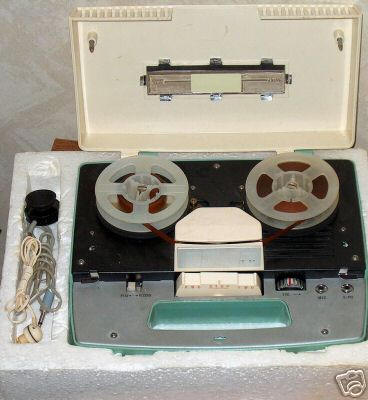
Somewhere around 1966, my brother Harry gave me a tape recorder exactly like this one.


I loved this tape recorder, the Aiwa TP-40.  (Amazingly, someone posted a video of the unit in its original packaging!)  It was my first real electronic device. It had a microphone and an ear plug and a built-in speaker. I actually used it to record music from the radio. If you didn’t have the record back then, that was the only way you could hear a song over again when you wanted to, short of buying the record.

So this was the tool of my first act of musical piracy.

I’ve always liked the looks of the reels turning around. I’ve even toyed with the idea of picking up a used Nagra recorder for the pure visceral thrill of seeing a finely crafted machine actually do something, visibly. The television show “Mission Impossible” used to use a Nagra for the famous “your mission, should you decide to accept it…” sequences at the beginning of each show. It was cool.

The Nagras, however, are such marvels of engineering that even though they are completely obsolete they still command very high prices on eBay. I saw one for over $1000. That makes no sense– you can buy a very, very good digital recorder for $150.

I have a little minidisc recorder which, compared to my little Aiwa, is a Boeing 747 compared to a Spitfire.

Bob Dylan Live: London, Ontario, 2006-11-03

I saw Bob Dylan and the Band in 1974 at Maple Leaf Gardens in Toronto. I was 17 and it was my first major concert. Our music enrichment class at Beacon Christian High School went, with Lambert Zuidevaart, our music teacher. I believe we stayed overnight at his friend’s apartment. We visited Kensington Market, ate at a Chinese restaurant, then walked to Maple Leaf Gardens. That’s what I remember. It was 32 years ago.
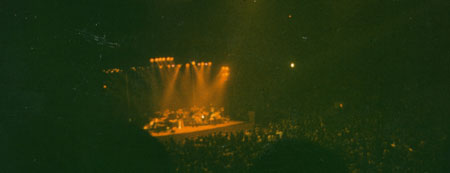
I remember vividly the opening chords of the first song: “Most Likely You’ll Go Your Way and I go Mine”. The Band may well have been the greatest back-up ensemble Dylan ever played with. Their performance was incredibly rich, textured, and vibrant. (“Before the Flood”, a double-album of performances from that tour, is worth having.)

Thirty-four years later, my son and I attended a Dylan concert in London, Ontario, at the John Labatt Centre. Like Maple Leaf Gardens, this is a hockey arena, so the acoustics were not great. His backup band was good, but not as good as The Band.

In 1972, Dylan and the Band played the complete concert, with the odd Dylan solo on acoustic guitar, and a few songs performed by The Band without Dylan.

The John Labatt Centre is a newer arena, well-furnished and gleaming. The staff seemed unduly concerned with stopping people from recording the concert with cameras or cell phones. This was a little baffling: who cares if someone creates a 160×80 grainy mpeg of this performance? Are they out of their minds? But the attendants stood guard near our seat, watching intently. When it looked like someone was using the camera on their cell phone or a real camera, they stepped in and asked the person to stop. I had to be clever to snap the few shots I did, and most of them are blurry.
The men sitting in five seats to the right of us seemed to have a dire need to go for beer or to the bathroom about once every song– that is not much of an exaggeration. The seats are so close together, I had to stand up to let them pass each time. It was annoying. Whey they weren’t drinking or peeing, they were yakking away, or making fun of Dylan’s incomprehensible voice.

The voice– unlike old copper or English gardens or Tom Waits– has not taken on an atom of patina or richness. If anything, I think he has become more shrill and spastic, and less coherent, than even in his “Street Legal” or “Saved” days. If I hadn’t already known most of his lyrics by heart I wouldn’t have been able to make them out.

Dylan played a keyboard exclusively – he didn’t touch a guitar– and every song featured the entire band.

Dylan’s encore was generous: four songs, including two of his most revered: “Like a Rolling Stone” and “All Along the Watchtower”. He sounded better singing these two than almost any other song of the night.

Dylan apparently is not content to simply perform the same songs over and over again as originally recorded. Several songs were radically restructured, musically, especially “Desolation Row”, “It’s All right Ma, I’m Only Bleeding”, and “Girl From the North Country”. He performed a generous mix of classics and more recent works. His voice is problematic, but give him credit for investing in his own work, taking risks, and reinventing himself.


Memories

I am fascinated by memory issues and this recollection of mine brought up a few.

I was able to determine that the concert was in 1972. Let me see if I can find the exact date: no it wasn’t 1972. It was in 1974, January or February. Surprisingly, I’m having a hard time googling the exact date.

Okay — it was exactly January 10th, 1974. I know because though he played two dates in Toronto (both at Maple Leaf Gardens), I vividly remember the first song I heard: “Most Likely You’ll Go Your Way and I’ll go Mine”, and only the January 10th concert began with that song. (The January 9th set began with “Rainy Day Women”

Where I found the info: www.bobdylan.com

What I don’t remember: how we got to Toronto. Who drove. I don’t remember anything about sleeping over other than the fact that we probably slept over somewhere. Or maybe not. I vaguely remember that the idea of sleeping over was vetoed by a parent. I seem to remember that we ate out at a Chinese restaurant in Kensington Market and then walked to Maple Leaf Gardens.

One person who claims to have attended the concert reported that Dylan came out in a Toronto Maple Leaf’s jersey. I think I would have remembered that. I think this person possibly has the wrong night.

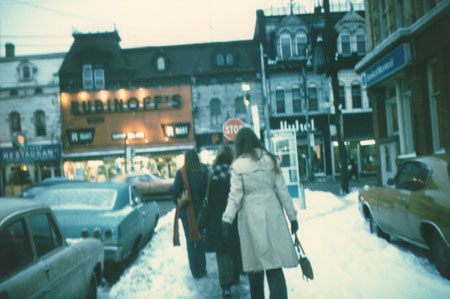
Who came with? Janie Lou Kannegieter — I see her in the picture in the beige coat. Pauline Hielema. Our teacher, Lambert Zuidevart. A smart, cultured student from the grade 11 who liked to write — Gertie Witte? I think that was her name. I am not sure about her.

I think the girl with the long brown scarf in the picture is Pauline.

So I was in grade 12. I graduated a few months later and then went to college.


As you can see from the pictures, oddly, I sat in roughly the same location at both concerts: high up on the left side of the arena looking towards the stage. The first is from 1972, the second from 2006. The third picture is Pauline Hielema, and Janie-Lou Kannegieter, and someone else walking ahead of me somewhere near Kensington Market. The picture is blurred, but I am fond of it, because it looks like dusk in winter in Toronto.

“That’s What You Get for Lovin’ Me”

…is a song by Gordon Lightfoot which falls into a kind of genre of “love ’em and leave ’em” songs. These are songs about (usually) a man who romances a woman, seduces her, hangs around for a short time, but then gets restless and can’t help it but hit the road again. The woman, of course, always wants him to stay. What fun would it be (for the man) if the woman said, “Okay. Well, I guess you feel the urge to go, you should go.  It was nice meeting you. ”

I’ve had a hundred more like you, so don’t be blue
I’ll have a thousand ‘fore I’m through.

Here’s a list of some of them:

  • For Lovin’ Me (Gordon Lightfoot)
  • I’m Not Saying (Gordon Lightfoot)
  • Green Green (New Christy Minstrels)
  • Greenback Dollar (New Christy Minstrels)
  • We’ll Sing in the Sunshine (Gale Garnett – odd reversal: here the
    girl announces she will hang around for one year, and then leave)
  • Ramblin’ Man (Allman Brothers Band)
  • Freebird (Lynyrd Skynyrd, with pale imitation “Travelin’ Man”)*
  • Rose of Aberdeen (Ian Tyson)
  • Heard it in a Love Song (Jimmy Buffet)
  • Baby, the Rain Must Fall (Glen Yarborough)

That last one– after explaining why he must desert his girl, with a booming, incontrovertible voice:

Baby, the rain must fall
Baby, the wind must blow,
Where-ever my heart leads me,
Baby I must go,
Baby I must go.

This was a very popular song in it’s day, around 1965, and also gave it’s title (and theme) to a movie starring Steve McQueen as an aspiring singer. Wow. Weirdness prevails. Anyway, this guy, in the song, is telling his girlfriend– or maybe, in these enlightened times, his boyfriend– that he can’t stay. He has to go. He just has to. It’s not that he’s a no-account bum who exploited her, took advantage of her feelings, and is now setting out to cheat on her. Oh, no no no. He just, well, has to go. It’s a force of nature, the incontrovertible will of God, fate, destiny– all of that. Like the wind must blow. Like blowin’ in the wind, which is where the answer to the question, “did you know this before you seduced me” is.

It’s not that I’m unsympathetic. If some guy feels an utterly compelling urge to travel and see the world, hey, more power to him. And if he is able to convince some woman that he would be a fine, temporary lover– hey, go for it. It’s just that I suspect that most of these rambler-gamblers are probably a little less than forth-right about those facts at the start of a relationship.

Or maybe they’re just gay. Maybe I’m missing some code here. Maybe the whole thing fits better into the “Brokeback Mountain” sort of scenario. Can’t you just picture Jake Gyllenhaal singing, “Baby, the Rain Must Fall” as he gets back into his little pickup truck to head back to Texas? And Heath Ledger weeping in his trailer?

In that respect, the first song on the list, “For Lovin’ Me”, by Gordon Lightfoot, is refreshingly frank:

That’s what you get for lovin’ me,
Everything you had is gone, as you can see
That’s what you get for lovin’ me.

…I’ve had a hundred more like you,
So don’t be blue.
I’ll have a thousand ‘fore I’m through.

That’ a refreshing tone. It’s like 2:35 seconds of so long, sucker.

Dylan wrote a few, but they’re different. Try “It Aint Me Babe”. He doesn’t have that bitchy God told me to see the world tone that the other songs have, which may make you suspect that that God-told-me-to-see-the-world tone is largely bullshit.

You say you’re looking for someone
Who will promise never to part
Someone to close his eyes for you
Someone to close his heart
Someone who will die for you and more

How good of a lyricist is Bob Dylan exactly? “Someone who will die for you and more” is brilliant. So is “close his eyes” and then “close his heart”. He is unparalleled as a lyricist.

Not one of these other so-long-baby songs can hold a light to the greatest “I’m a-leavin’ yah” song of all time, also with one of the greatest put-downs in the history of popular music, also by, of course, Bob Dylan:

Don’t Think Twice, It’s All Right (Bob Dylan)

Now I aint saying you treated me unkind
You could have done better,
I don’t mind.
You just kind of wasted my precious time,
Don’t think twice, it’s all right.

Whoa! Wasted his precious time! A line that makes Meryl Streep in “The Devil Wears Prada” sound like Florence Nightingale, with her: “I’m disappointed in you…”

Love sucks.

* added 2014-04-20


SCTV’s brilliant “Gordon Lightfoot Sings Every Song Ever Written“

James Ward

I was never really a big fan of James Ward. You don’t know who James Ward is? Not surprised. It is a very bad sign when the home page of a performing artist hasn’t been updated in a year.

James Ward is a gospel singer who began his career in 1972. I saw him at Trinity Christian College. He sings a kind of hybrid gospel/blues, with unusual fidelity to the blues side, stylistically. His lyrics are generally devotions or meditations on the bible. He sounds a bit like Stevie Wonder at times, often in falsetto. Not a style I was ever fond of.

I did a search on the internet for music by James Ward, which I hoped to illegally download. No– I’m being coy. I own several of his records, so I have the right to download copies of those songs, if I could find them. But I couldn’t.

Would James Ward be happy to know that nobody out there is stealing his music on the internet? Obviously, right? He would be making more money, wouldn’t he?

Ha ha! Obviously not. The fact that nobody in the entire world has gone through the trouble of ripping a James Ward CD and dropping the MP3 files into the “share” folder on Kazaa or eMule or whatever… no. He can’t be happy about that.

His early albums are not generally available on CD. Sounds like it’s a problem. It costs money to do it right, but Ward likely doesn’t have a lot of resources. He is trying to raise donations to cover the costs of recording a new album.

According to his website, he is available for concerts, but is also very active working with choirs and church musicians and participating in worship. He is employed as music director at New City Fellowship Church. I think he is genuinely humble man who believes that an artist should never be above that sort of task. It is very, very unfortunate that so many “Christian” musical artists are just as full of themselves and wrapped up in their own achievements as any non-Christian artist.

I used to write reviews for a few Christian journals, and I reviewed Ward a few times. I think I was lukewarm. Having listened to his albums again recently, I think if I were writing the review today, I would stress his artistic honesty and the relative sophistication of some of his lyrics: his religious belief is not banal. I would say he has put together a few “fine” albums. Not great, but “fine”, which means, worth a listen. He’s written four or five good songs, which is an achievement. (The older I get, the more I think writing a few good songs is more than a little achievement: it’s really some thing.)


The James Ward Website.  See?

I have noted that the website is not up to date, and seems a little frumpy and bland.  But then, Ward makes a virtue of his honesty and down-to-earth earnestness, so I don’t mind.


How many artists have had to change their names to get something pleasingly sonorous to use for the stage and album covers?  James Ward was born James Ward.

Other James Wards:

The Painter
The Software Developer
The Actor

Excommunication

I am listening to an mp3 of a sermon by the pastor of the New City Fellowship Church in Chattanooga, Tennessee. The pastor is saying that New City Fellowship Church never excommunicates anyone for sinning.

No no no– they only excommunicate people who refuse to stop sinning.

Not very aphoristic is it? Not a neat little parallel statement: my intuition is, what’s the difference? And I don’t think my intuition is altogether mistaken on the issue.

Pastor Randy Nabors talks as if sins were discrete, isolated acts that violate clear and simple rules issued by God in the bible, in English, and which are readily available in printed form, comprehensible and unchanging.

That was the mistake of the Pharisees, of course. And the first thing we deny is that we are, in fact, behaving exactly like the Pharisees. We just can’t help it.

The truth is, we love rules, because we love strutting around pointing out that other people have broken them. We deny that we are being legalistic or proscriptive or simplistic or pietistic or moralistic and we do all those things by saying that you can only be forgiven if you stop sinning, as if there was the remotest chance in hell that we could ever stop sinning or that you who demand that we stop sinning are not, at this very moment, sinning yourself.

I don’t believe it. I don’t believe that you have repented and are therefore forgiven at the moment when you have stopped sinning. I believe that you “repent” when you acknowledge that all of us are corrupt human beings who are utterly unworthy of God’s grace and unlikely to receive it on our own through our own virtuous actions.

You see– that’s the part I don’t believe Pastor Nabors and most Christian preachers really believe– that they haven’t “earned” it. Theologically, of course, they might say they haven’t, but they don’t really believe it. How can you possibly identify other people as sinners– so bad, they must be expunged from a congregation– unless you truly believe yourself to be so worthy that you can sit in righteous judgment?

They will object:

When they begin their judgments, they say, “of course we are all sinners, but” and then they should stop.

They’ve already said the important thing: they too are sinners. That’s enough.

There is no “but”, no qualification that suddenly, miraculously entitles them to sit in judgment.


“When they said, repent, repent, repent, I wondered what they meant.” Leonard Cohen, the Future.

Pastor Randy Nabors’ sermon was supposed to be about Jezebel, but it turns out it isn’t about very much at all. It is 34 minutes long, and it consists of a long sequence of utterly unremarkable observations and rules. Surprise, surprise, those rules you have heard repeated to you 30,000 times by now are true the 30,001st time and the 30,002nd time too. Maybe. Now do you know what the rules are?

I was really disappointed. New City Fellowship is a very diverse congregation and seems to be involved in some genuinely interesting urban ministries. But there was nothing in this sermon that sounded the slightest bit interesting: don’t sin, Jesus loves you, Jezebel was evil, don’t marry people who don’t respect me (non-Christians).

Why is this same message repeated every Sunday? You can’t remember it? Or could it be that the message is not meant to be teaching or preaching.  It’s a public expression of the sinlessness of the faithful listeners, isn’t it? You affirm your own purity and worthiness by receiving this sermon and looking at your neighbors and receiving their approving looks (unless you have a nose ring) smiling and nodding and saying, “amen, brother”, for I am not a sinner like those people…. Me too– I’m against Jezebel.

Bob Dylan: “As I Went Out One Morning”


We have been thinking of possible band names for the last few days. How about:

  • The Taliband
  • Fractal Mode or Fractal Chords
  • Mortuary Beserck
  • Phantom of the Oprah

Enough. I was also thinking about a Bob Dylan song from “John Wesley Harding” (1967), and album which may well be his finest. The song is “As I Went Out One Morning”.

Like all of the songs on that album, the arrangement is clear, sparse, simple, economical, and crisp: drums, bass, and acoustic guitar, and harmonica. Dylan’s nasal voice is confident and nuanced.

As I went out one morning
To breathe the air around Tom Paine’s
I spied the fairest damsel
That ever did walk in chains

Tom Paine was a celebrated pamphleteer at the time of the U.S. war for independence, best known for his tract “Common Sense”, written in 1776, which advocated an end to the British Monarchy. Paine provided Franklin and Jefferson with some of the inspiration for their own theories about the state and authority and the individual, and these worked their way into the U.S. constitution and Bill of Rights. Paine himself later returned to England where, among other things, he advocated the creation of pension plans, and progressive taxation. The man was ahead of his time.

I offered her my hand
She took me by the arm
I knew that very instant
She meant to do me harm.

The girl seems to represent religion. She is enticing, with promises of spiritual reward, and he offers her his hand. But then she demands more: she takes his arm. In the economy of this song, we waste no time: he immediately suspects she is up to no good.

“Depart from me this moment,”
I told her with my voice
Said she, “But I don’t wish to.”
Said I, “But you have no choice.”
“I beg you sir,” she pleaded
From the corners of her mouth
“I will secretly accept you
And together we’ll fly south.”

Religion? Or utopianism? Does she represent Dylan’s brief faith in the idea of human progress? Unfortunately, we’re not likely to get a straight answer from Dylan anytime soon, so our only clue is her suggestion they “fly” south. To paradise?

I love the amazingly stripped down lines, especially the first four of the verse above, with that inverted “said I”.

Tom Paine comes to his rescue. The spirit of liberty himself? Or the spirit of “common sense”, of a kind of rational agnosticism?

Just then Tom Paine himself
Came running from across the fields
Shouting at this lovely girl
And commanding her to yield

Why did I think the girl represented religion? I believe it was a review by Greil Marcus that came out shortly after the album that first made that suggestion. That makes less sense to me now, and given subsequent developments in Dylan’s religious views, it does seem more likely, now, that the girl embodies utopianism or socialism. Alluring, but basically a means of enslaving the individual in favor of the collective.

On the other hand, “ever did walk in chains”, suggests that her true spirit was constrained in some way, shackled by something. That is more suggestive of religion, strait-jacketed by the spirit of conformity and collective ennui, though it could also evoke the idea that a socialist utopia is always accompanied by the chains of authoritarianism.  Tom Paine represents just plain old common sense: the illusion of utopia is contrary to what we see and know about human nature.

And as she was letting go her grip,
Up Tom Paine did run
“I’m sorry sir,” he said to me.
“I’m sorry for what she’s done.”

It’s a strange, very beautiful song. If you’ve never heard it… you haven’t, have you?

Modestly revised Februrary, 2007.


The entire lyric of “As I Went Out One Morning”.

The Night They Drove Old Dixie Down

One of the few advantages of having lived a few years is that you get actually find out which works of art, tv shows, dramas, movies, and songs really stand up over time. Sometimes you find out that a brilliant piece of music or drama is far more rare than you had ever imagined.

Sometimes something you once thought was brilliant turns out to be pedestrian.

“The Night They Drove Old Dixie Down” (first released in September 1969) is simply a terrific song, whether you prefer the raucous version by the Band, or Joan Baez’s cool, crisp, symmetrical rendering. I almost always prefer the versions performed by the composer, and I love the Band, but in this case I like the version by Baez more. For one thing, it’s tight construction prevents Baez from indulging in too much warbling or emoting– makes her sound like she really does have a good voice. For another thing, it’s a damn fine arrangement of guitar, bass, and drums.

The hardest element of music to describe, teach, or duplicate is rhythm. Sometimes people even call it “feel”, as if it was something you can’t see or taste, or even hear in a literal sense. Baez’s version has the same intangible as Dire Straits “Sultans of Swing” and Dylan’s entire “John Wesley Harding” album. At the time of it’s recording, you heard this kind of crisp, tight rhythm more often in Nashville recordings than you did in Los Angeles or New York. These are cracker-jack musicians.

Virgil Caine is the narrator. His rustic “voice” dryly recounts how he worked on the Danville train until the tracks were torn up by Stoneman’s (Union) Calvary. Then he took the train to Richmond just before it fell and the Confederacy surrendered. “It was a time I remembered oh so well”. Robertson’s clever lyric then has the people singing nothing more specific than “na na na na na na, na na na na, na na na na na”, as if life goes on no matter what disasters befall us, and the disaster is too great for words.

Many have commented on the fact that the song takes the voice of a southerner, at a time when many people regarded the South as an embarrassment of bigotry and repressiveness. It’s a brilliant stroke and almost everyone who hears the song immediately realizes how right and true it is. Not a few attribute this unique perspective to the fact that Robbie Robertson was a Canadian, who saw the South without jaundiced eyes, and fell in love with the mystique, the cadences, and the culture of the South.

There is another angle to this song that is a bit disturbing. Levon Helm claims that he “helped” Robertson write the song. Helm is from Arkansas, a Southerner, and some commentators on the Band think that there is some bitterness between him and Robertson over the song. Does the song belittle the South? That would be totally contrary to almost everyone’s impression of the song, which is the opposite. Or is it something to do with the credits? Who knows?

One oddity. Why does “Robert E. Lee” in the Band’s version become “the Robert E. Lee”, a steamboat in the Baez version? Turns out that it could be because Robert E. Lee never passed through Tennessee after the war, but the Robert E. Lee did. Less forgivable is “I took the train to Richmond, it fell” for “On May the 10th, Richmond had fell”. I don’t know what problem Baez had with that– other than the fact that Richmond did not fall on the 10th– the entire confederacy did. Richmond “fell” on April 2. And utterly contemptible is the “so much cavalry came” for “Stoneman’s calvary came”. Joan Baez, do you think your audience is too stupid to accept the name of an obscure Union officer who was responsible for executing Grant’s scorched earth policy instead of “so much”? Geez!

Doesn’t matter. If you read the website at the link above, you will notice two thing: endless, obsessive fussiness over the details of the song, and boundless admiration for it. A typical comment: it is easily the best popular song ever about the Civil War. And that it is.


On The Band

There was a horrible tendency of bands of this era to indulge in long, utterly incomprehensible overtone-laden guitar-solo driven codas, in the mistaken belief that something “deep” would reach out and contact them.  You have to keep that in mind to appreciate just how stunning “Music From the Big Pink” was.

There is a lengthy and somewhat bizarre dissection of the lyrics here.  Is it “mud” below Virgil’s feet or “blood”?  Did Robert E. Lee actually pass through Tennessee after the war? 


Update 2022-05-02

In performances, Joan Baez has corrected the lyrics.  It wasn’t malice: just carelessness.  Now that she knows the right lyrics, she sings the words Robbie Robertson wrote.

Four Great Songs of the Early 1960’s

The the late 1950’s and early 60’s were generally weak years for popular music– so weak that four merely good songs stand out clearly as “great” amid the rolling surf of mediocrities and manufactured product.

Early rock’n’roll like “Heart Break Hotel” and “Sh-boom” had been supplanted by look-alike drones and novelty tunes issued by the recording industry as after-thoughts to feed a market they thought was sure to disappear shortly. Serious musicians went into folk or classical. The fascists went for country. The teeny-boppers when for Fabian and the Italian studs like… Frankie Avalon and Bobby Whatever or Tony Twister.

So a very small number of outstanding singles made it onto the play lists:

  • Runaway (Del Shannon)
  • I Fought the Law (Bobby Fuller Four)
  • Needles and Pins (Searchers)
  • Suspicion (Terry Stafford)

The last-named is really a rather blatant rip-off of the Presley version– one of the few Presley songs I really like. If you search the internet long and hard, you might find a recording of the song including stops and retakes and comments by the musicians, including Presley.

And I can’t remember what the fourth one was. I’ll think of it eventually. [I did. It was “Needles and Pins”. Not really, but it will do.] It was not “Sherry”, which is a novelty tune. In the meantime, to properly appreciate the achievement of the songs listed above, you have to spend a few hours listening to nothing but all of the 2:30 long singles by the Chiffons and the Shirelles or even the Supremes. Don’t believe the revisionists who will try to tell you that the Chiffons were actually brilliant: they were always mediocre. As for the Supremes… you can’t hurry love.

They got on the radio because the airwaves were not controlled by listener preferences but by the backroom deal, payola, as it pretty well is today.


The best driving song ever, bar none: “Echo Beach” by Martha and the Muffins.

The next best driving song: “July 4th, Asbury Park” (Sandy) Bruce Springsteen.

All right– it’s ridiculous to think there is only one or two best driving song. There are several, including “Satisfaction” and “Thunder Road”.

For some weird reason, not a single Beatles song ever sounded really great in your car at 50 mph with your window open. They just don’t. Well, maybe “Obladi Oblada”.

Bob Seger’: “Night Moves” does pretty well.  So does “Reelin’ in the Years” by Steely Dan.

The Worst Pop Singles of All Time

Of course these are not really the worst singles of all time. Most people have never heard the worst singles of all time– like “The Times They Are A’Changin'” by Rabbi Abraham Feinberg, or “Clouds” by Leonard Nimoy or “Big Yellow Taxi” by Bob Dylan or “Mr. Tambourine Man” by William Shatner– because they simply have never been played on the radio.

So, actually, these are songs that stink even though they were massively promoted and acquired a certain following.  Note that in a few cases, the song itself, like “Smells Like Teen Spirit”, might be pretty good: it is this specific performance that makes the list.

  • Wonder Wall (Oasis)
  • Seasons in the Sun (Terry Jacks)
  • I Write the Songs (Barry Manilow)
  • The Night Chicago Died (Paper Lace)
  • Honey (Bobby Goldsboro)
  • I am I said (Neil Diamond)
  • Cracklin’ Rosie (Neil Diamond)
  • Candle in the Wind 1997 (Elton John)
  • Popcorn (Hot Butter)
  • Achy Breaky Heart (Billy Ray Cyrus)
  • Smells Like Teen Spirit (Paul Anka)
  • Hanky Panky (Tommy James and the Shondells)

Honorable Mentions (added November 2007)

  • Three Times a Lady (Lionel Richie)
  • Every Thing I Do (Bryan Adams)
  • Puppy Love (Donny Osmond, written by Paul Anka)
  • Glamour Boy (Guess Who)
  • We Will Rock You (Queen)
  • Never Been to Me (Charlene)
  • Feelin’ Groovy (Simon & Garfunkel)
  • Do Yah Think I’m Sexy (Rod Stewart)

Most ill-advised single of all time:

  • Pet Me, Poppa (Rosemary Clooney).

Most horrible earworm (tie):

  • “Mandy” (Barry Manilow),
  • “Sweet City Woman”, (Stampeders)

Note: the writers of “Hanky Panky”, Jeff Barry and Ellie Greenwich, have no illusions: they wrote the song in the hallway of a recording studio to be on the b-side of a new single.  Both admit it is a terrible piece of work.


Dissent:

Wonder Wall” was recently voted the best pop song ever by a segment of the British public which is probably also responsible for the tabloids and Benny Hill. I don’t get it. I can’t even finish listening to it once. It sounds to me like your older brother, when you are 11, and he is about 13, and he is making fun of a song you like, by singing it in as unpleasant a voice as he can manage, without any noteworthy accompaniment. And it sounds like he is making up the lyrics at the same time, in a kind of sing-song, nasal, whine on the “now”.


I was just stunned to learn, recently, that “I’ve Never Been to Me” was first released in 1977!  1977!  Was it written by a man?  I knew it!  Written by Ron Miller, Kenneth Hirsch!  How did I know?  Because almost all bad songs written about women’s roles are authored by men:  “Having My Baby”, “I am Woman”.

And a good one:  “You Don’t Own Me” performed by Leslie Gore.

A British Worst
Singles
 of All Time List.