The Good Old Days

My response to a post on Facebook about “the good old days” when a single breadwinner (the man, mostly) could support a family, buy a home and a car, and send his kids to college on one salary.

The basic core of this is certainly true. From 1945 to 1980, the working classes did very well in our economies. Then the ownership class realized that working stiffs were getting a big share of the wealth and set out to take it back, and largely succeeded, thanks to marginal tax cuts and government subsidies, and diminishing unions. But I will point out that the “average” family in that era did not have a cell phone, big screen tv with cable, electronic games, advanced appliances including dishwashers and driers, air conditioning, travel, the surfeit of clothing and accessories we all have now, a lot of our pharmaceuticals and health care options, and so on. You sometimes see documentaries about a family doing the pioneer life, living in a log cabin, raising and eating animals and vegetables, and so on. When will someone do one with a family going back to the 1960’s, with landlines, unreliable cars, primitive color tv’s with antennae, and so on. It would be fun. Thomas Piketty’s book “Capital” is a good, detailed analysis of the general economic trends, but, yeah, it’s a slog to read.

Crowning Prince Poilievre

Before everyone rushes to proclaim Pierre Poilievre the inevitable Prime-Minister of Canada, let’s consider a few inconvenient facts.

By the time Canada gets around to the next federal election, Trump will have been in the White House for at least 6 months.

Now, it is possible that he may prove to be a smashing success, leading a unified government that reduces inflation (something Biden already did for him), low unemployment, increased manufacturing, lower housing costs, and peace in the middle east.  Poilievre, glistening with overflowing luster as the Canadian Trump, glides to a smashing victory, reducing the Liberals to two seats.

It is more likely that Trump’s idiotic policies lead to resurgent inflation, high interest rates, less trade, reduced manufacturing, increased trade deficits, ridicule from foreign leaders, and a circus of bickering party members sabotaging their own party’s administration from the House.

Suppose the Liberals, with a new leader– likely, Mark Carney– provide a engaging contrast. Suppose he cleverly distances himself from Trudeau’s murky political sloganeering and tepid policy initiatives and stakes out a new course of his own.

The thing is, I don’t think most Canadians actually like Pierre Poilievre.  They say they will vote for him because they despise Justin Trudeau, but I rarely hear anyone say that they will vote for Poilievre because they like him.  There will be debates.  I doubt that Poilievre charms the pants off anyone in these debates, if he is genuinely challenged by a more formidable Liberal candidate.

Don’t forget that Quebec has a lot of seats, and the PQ might or might not take a lot of them.

The NDP, as long as they retain Singh as their leader, will be a non-factor.  Singh has lost almost all of his credibility, even among people like me who used to often vote NDP because, well, they used to have the good leaders like Ed Broadbent and Jack Layton.

It’s not likely, but it’s possible we could end up, in Canada, with another minority government.

The overwhelming consensus among political commentators right now is the Poilievre will win a decisive majority in the next election.  That is the kind of uniformity that raises my suspicions.

It reminds me of the belief that Hilary Clinton would crush Donald Trump.


Poilievre was recently interviewed by Jordan Peterson.

Peterson draws fans who are searching for meaning in life and want to learn from someone they see as a great thinker, and his huge social media reach makes him a coveted interview for right-wing politicians.  From Here.

Peterson is not a great thinker.  He reminds me of Malcolm Gladwell (though they have opposite political dispositions): smug and pompous writers who devise compelling anecdotes that cherry-pick facts and prove nothing but serve to assure miscreants that they’re really smarter than educated, competent people.

Peterson recently interviewed the neo-fascist Brit Tommy Robinson, a far-right rabblerouser known for inciting mobs against immigrants in the UK and calling Islam a “mental disorder”.  Robinson’s X account was restored recently by Elon Musk, after he had been barred for his inflammatory anti-immigrant rhetoric.

So Poilievre is happy to be hosted by an enabler of a very far right activist who is currently in Cyprus at a five-star hotel hiding out from an arrest warrant.

Poilievre told Peterson that young women just can’t wait to get pregnant and take up domestic chores again, after years of tiresome feminists lecturing them about equality and professional achievements.  He also wants to boost energy production to serve the mega-corporations lust for AI processing.

Poilievre thinks climate activists are “loons”.

Poilievre is extremely confident at the moment.  He is probably supremely disappointed that he won’t have Trudeau to run against– perhaps for good reason.

I don’t think most Canadians have looked closely at the man.  And I suspect that once they do, they will discover that he does not have the charisma he himself thinks he has at the moment.


Fat is Thin, White is Black, Music is Noise, Art is Shit

There inevitably comes a point at which some clever writer or critic seeking prominence will proclaim that contrary to established opinion, this shitty artist or musician is actually great and should be adored but only us truly sophisticated or pure thinks can appreciate the utter brilliance of the man or woman or fish.

And it’s usually bullshit.

Justin Bieber really is a genius.   Michael Jackson actually matters.  Look at how many records Paul McCartney has sold.  Frank Sinatra — the phrasing, the world-weariness!  Leonardo DiCaprio’s desperate commitment to his roles!

We’re all supposed to go, oh yes, I’m cool, I can see how the contempt for that artist is just snobbery.  Andy Kim really does belong in the Canadian song-writers Hall of Fame for “Sugar Sugar”, along with Leonard Cohen and Neil Young.   That guest on CBC’s “Q” that Tom Powers is desperately sucking up to (“Is it possible that you are so great that it actually works against you?” and “when did you first realize that you were a genius?”).


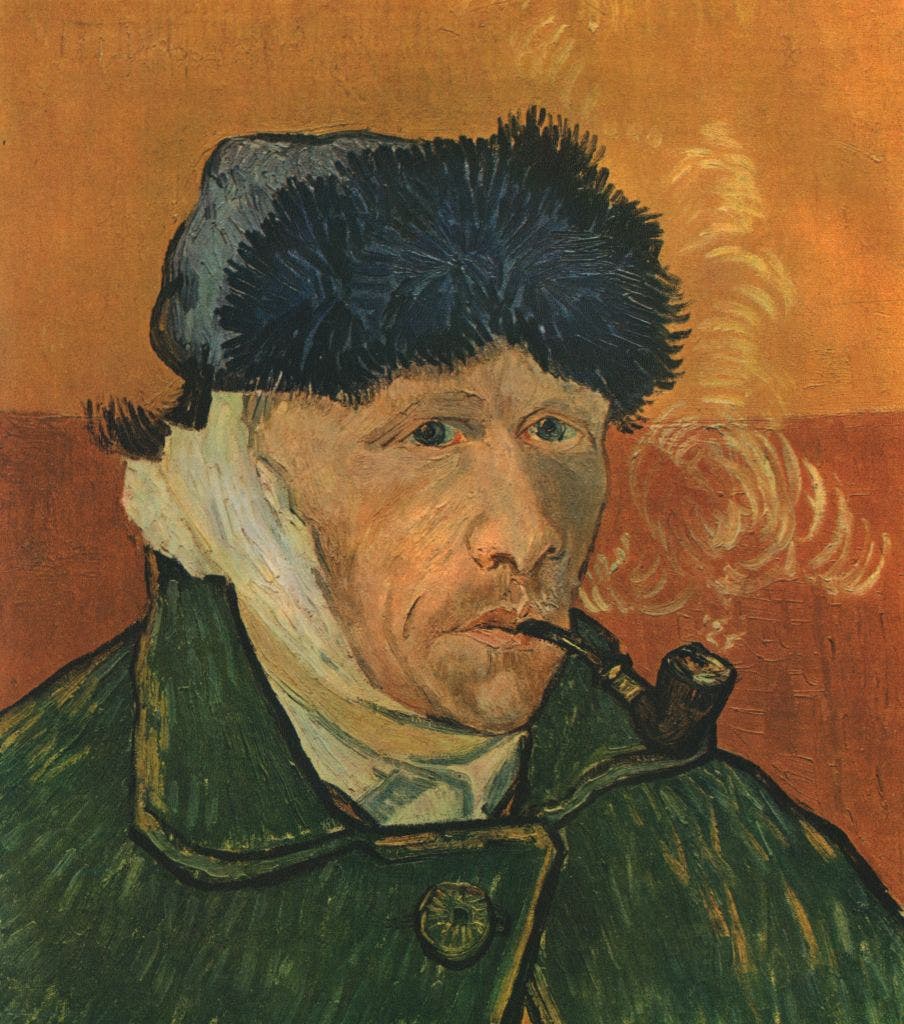
Trump’s Ear

Some of Trump’s followers apparently see God’s providence in his survival of the assassination attempt. I wonder if maybe God just isn’t a good shot.

On this day in history, December 23, 1888, Dutch impressionist Vincent van Gogh cuts off his ear | Fox News


Apparently some Republican politicians skipped the Politics 101 class where you learn that politicians criticize each other. And they used to mock self-pitying victimization tropes. So while they go around claiming that Biden has destroyed the country and the Democrats are communists and child-molesters, they get all whiney and teary-eyed when a reporter makes fun of Sarah Huckabee’s worshipful enthusiasm for Trump.

“You can’t believe the media”? I get the feeling that they don’t want you to believe the media because sometimes it reports stuff like the crime rate going down, unemployment at the lowest level in 50 years, sea levels rising, Putin imprisoning journalists, the Taliban winning the war in Afghanistan, Trump having planned to withdraw all U.S. troops the same way Biden did, Hamas didn’t care who was president when it attacked Israel, Brexit was an economic disaster, immigrants are far less likely to commit crimes than native Americans, most fentanyl comes into the U.S. through land border crossings, vaccines work, Biden won the 2020 election fair & square, and 10% tariffs on everything along with a strict immigration ban will drive inflation up.

Haven’t seen anyone comment on the fact that Trump’s agreeing to debate Biden before the convention might, in the end, be the biggest blunder of the election year.

Mumblecore

This is my response to a Facebook post praising actor Tim Robbins, especially for his super, mega, amazing role in “The Shawshank Redemption”–a highly over-rated film that substitutes the outward trappings of “significance” for real depth.  (Watch “Cool Hand Luke” for a film that really is what “Shawshank” thinks it is.)

Here it is:

It’s called “method acting” and I cringe every time I encounter it in a film. Makes me love British actors and others who speak in normal tone. The delusion is that, by mumbling, you latch into some kind of elusive authenticity or, better yet, convince everyone that you’re like Brando. (Brando could get away with method because he really was a very good actor at times.)

Devotees of the method will even mumble, absurdly, when speaking into large crowds or from distance. It’s like you believe that if you use the same plates and silverware as a gourmet restaurant your food will be just as good.

My comments on Reddit about the magnificent opulence of John Williams movie soundtracks:

I know I’m a minority (sigh) but I don’t think there is a single piece of music by Williams that moves me. Most of it reminds me of brass bands in parades. Most of it is pretty similar– individual pieces never stand out to me. In movies, Williams provides big crescendos to tell you to be impressed by the director, and the quantity of movement in the scene (armies, machines). Does he have a single melody you could say is “haunting”?

Music in movies that did move me: Yann Tierson (“Amelie”); Ennio Morricone “The Good, the Bad and the Ugly”. Maurice Jarre (“Doctor Zhivago”), Nino Rota (“The Godfather”). The theme from “To Kill a Mockingbird” by Elmer Bernstein is quite beautiful and lifts the movie. The music from “The Third Man” is not my favorite but it is at least very distinctive.  Far more distinctive and evocative than Williams.

Profound Contrived Authencity: Little Bird (the MiniSeries)

Together, they reached for what Moscovitch calls “profound authenticity,” and created an opportunity for narrative activism: the idea that victims can help heal their trauma and change attitudes by telling their stories.  Globe & Mail

I don’t mind if someone wants to make a film or mini-series that “will help heal trauma and change attitudes”.  Just don’t put it on my playlist.

Changing attitudes is not the mission of real art.  Real art is about expression, revelation, insight, and beauty.  The minute you say, “oh, and we want people to  adopt our political views”, you have sold out the aesthetic dimension to the social dimension.  To make a film to tell people what to think about the way indigenous people were treated in Canada is to make a bad film.  To make a film about the way indigenous people were treated in Canada, just make a good film.  And if you are authentic about it, tell us what you know about the subject: not what you want us to think. And be honest: don’t caricature or exaggerate or make things up just to drive your point home.  Watch a film like “Come Sunday” which makes its point without dumbing down the issues.

So when my wife asked me to find the series “Little Bird” for her to watch, I checked it out.  I thought, it might be good.  I might want to watch it.  I looked for reviews on line and found the “review” (it’s not a review: it’s a press release disguised as news) linked above.

I suspect this series is about making liberal viewers feel great about themselves: I watched a sad story about injustice and felt bad for the victims for I am a good person.

I watched the first ten minutes.  As I feared, it starts by showing the girls who were abducted by the Canadian Child Family Services and RCMP living in nearly idyllic conditions with their happy affectionate parents.   Even worse: there’s that jerky hand-held camera work that immediately conveys “oh look how authentic we are we’re pretending we’re actually filming the real thing which wouldn’t be possible if we had a tripod” vibe.

I am immediately repulsed by most films that show parents being incredibly tolerant and affectionate and patient and loving with their kids as a setup for imminent tragedy or threat.  Nobody interacts with their children the way these parents do.  It’s manipulative and dishonest.  It is the hallmark of bad direction.  And that is how “Little Bird” starts.

In “Little Bird,” Bezhig is driven by her newly emerging repressed memories.  Variety

Oh no.  Seriously?  We’ve been through this movie before and it did not turn out well.  Not at all.    Not this time either.

Podemski: We looked at all the various ways in which trauma presents itself. Especially when it has been repressed for many years . We worked with our two story advisors, Nakuset and Raven Sinclair, who supported us in shaping the way in which our lead character, Esther, experienced PTSD through intrusive memory. We were able to express this authentically through the use of acoustic and visual layers which I think played very authentically throughout the story.

Okay, firstly, it’s not the trauma that has been repressed but the memory of it.  And memories are not repressed.  That is a fake trope from the 1980’s that has pretty well lost all credibility.   And the method by which they decided to tell the story of the “repressed” memories sounds more like therapy than art.  But please don’t try to claim anything like “authenticity” when you are clearly constructing a narrative that projects a political and social idea rather than any particular real human experience.


A CBC article on the movie contains this flag:

WARNING: This story contains distressing details

Oh please fuck off with your trigger warnings.   This is bullshit.  What kind of news is “distressing”?    A man falsely accused of rape while feminists claim that women never lie about sexual assault?  Al Franken resigning his seat in the Senate over ridiculously trivial allegations of inappropriate behavior?  Tax-payer subsidized sports stadiums?  Music by Neil Diamond?  Senile white men running the U.S. government?   Prescription drugs developed at publicly-funded universities which cost pennies to manufacture selling for $30,000 a pop?


Evita, Hamilton Family Theatre, Cambridge, 2023-10-26

With the rise of populism in various countries around the world (Hungary, Poland, India, United States, Italy, etc.) it is worth seeing “Evita” in Cambridge at the Hamilton Family Theatre. It’s a very good production and touches on the nature of populism, the irrational belief people might have that a narcissistic, corrupt, self-serving figure like Evita Peron (and a certain orange-haired American politician) will save the nation, bring social justice and equality, and stick it to those educated, rich, smart-alecky elites that control the media and preside over government bureaucracies.
Regardless of the politics, it’s a fascinating story, and they could have written an entire second opera on what happened to Eva’s body– and Juan Peron– after her death, and, of course, the corpse of the Argentinian economy.
An object lesson in mass media as well: the people thought Eva was saintly because she created a foundation and personally wrote checks to poor people who lined up to see her. The specific stories made great anecdotes, with saturated media coverage, but most of the money probably ended up in the pockets of Juan and Eva Peron.  There is no reason to not account for the income and spending except to hide where the money went.
There is a bit of a drive out there to rehabilitate her image, and argue that Rice’s lyrics for “Evita” are based on a rather biased biography.  It is probably true that she was not as bad as her enemies made her out to be, but there is ample evidence to suggest that her charitable works were never not substantially self-serving even if she did promote unions that bettered the lives of working class individuals in Argentina at the time– and promoted her husband to the presidency and, she hoped, herself to the vice-presidency.
There’s a bit of a feminist angle to the “rehabilitation” of women of historical importance like Josephine, Cleopatra, Marie Antoinette, and Evita.  Most of the time, yes, the negatives stories have been exaggerated over time, but the essential details of their lives remain the same.  And in some cases, the “rehabilitation” glosses over historical facts in order to cleanse their reputations.  Marie Antoinette was involved in conspiracies to restore her husband to the throne; Josephine did not inspire Napoleon’s great strategies or legislative accomplishments, Cleopatra reign was oppressive, and Evita was a self-centered narcissist who used her sexuality to achieve her position of privilege under the Peronist regime.

The New Speaker: Mike Johnson

The new Speaker of the House, Mike Johnson, is known to be a devout Christian. He prays very often, leads bible studies, podcasts his wisdom on Godliness and spirituality, and fights passionately against renewable energy, gun control, and anything based on science or fact. Amen. Jesus and Exxon. Amazing how his politics align so much with Trump and so little with actual scripture. He argues that scripture commands individuals to be hospitable to “the stranger at your gate” and treat them well, but governments can pretty well tell them to go to hell.


This man believes in the Bible the way McDonald’s believes in nutrition.

Dune – Just Another Fascist Sci-Fi Pornographic Fantasy?

By “pornographic”, incidentally, I don’t mean sexually pornographic.  I mean in the sense of distilling an artistic entity into it’s most obvious, banal, and debasing parts.  I mean it in the same way that I would tell you that Disney is mostly pornographic: it is film that caters to banal fantasies and fetishes about heroism and suffering.

I have never read “Dune”.  I tried but it bored me, very quickly.  I generally despise banal fantasies.  I might try again some day– certain people keep telling me it’s great– , but for now I’m going to build a personal synopsis using online resources.  Yes, I know: that is inadequate.  But before I commit to reading 900 pages of dreck, I want to know if there is anything worthwhile in there.  I’m getting old.  I don’t have that much time left to waste.

Synopsis of Dune:

First of all, we have an Emperor.  Are science fiction writers congenitally incapable of imagining a universe without a royal family?  (Well, P. K. Dick did, in “Blade Runner”).  And if we have a royal family, we have a princess, in this case, Timothee Chalamet, (because I guess Leonardo Di Caprio and Andrew McCarthy and the princesses are getting too big now).

So we have House Atreides headed by Leto and the emperor Padishah. Emperor Shaddam IV orders Leto to rule the planet Arrakis (which is the putative Dune of the title).    Arrakis is where you get LSD.

Leto has a concubine, a witch, with magical powers, like Peter Pan, Lady Jessica, who is an “acolyte” of the Bene Gesserit, a very, very mysterious group.  So mysterious, we can’t tell you anything about it.  Just wallow in the mystery, okay?

Oh, there’s too many characters, none of whom sound interesting yet.  Lady Jessica bears Leto a son, Paul, who is so obviously a Christ figure that Frank Herbert can count on most reviewers not mentioning it for fear of appearing crass.  Paul passes a test with higher marks than anyone else ever– he’s just so special.  After all, he’s a princess.  That’s why we have Timothy Chalamet.  And less interesting now, because we know that this sequence is merely a device to keep us from thinking Paul wants to be the chosen one.  The chosen one never wants to be the chosen one.  He is always dragged, reluctantly, kicking and screaming, to his DESTINY.  The same way princesses are always compelled to wear glorious dresses and jewelry and accept the worship of the masses of people who think that princesses should be worshipped.

So they move to Arrakeen– Leto, Jessica, Paul, and the indentured servants.  Arrakeen is a “stronghold”– nice — on Arrakis.

And we have the bad guys, the Harkonnens.   And the perfidious Suk doctor Wellington, who has mixed motives, and thus becomes more interesting than he was, but still, he BETRAYS our hero, Leto, and brings suffering to the real hero, the Christ figure, Paul.

The name… Paul?  Seriously?

And what makes Paul utterly dull and lifeless: he acquires magical powers of by drinking the “Waters of Life” which are supposed to poison males (here we get all the suffering again, to prove that Paul is no greedy little parvenu, but a suffering, selfless, honest-to-god hero.  Here the reader feels good about himself.  He goes to sleep fantasizing he is Paul, and everyone loves him because he suffered for his power– he didn’t take it because he was a fucking, greedy little arrogant twerp, which is probably the truth.  It is almost always the truth.  Show me a ruler who actually sat back and waited for authority and power to be thrust upon him?

If you believe Hollywood movies, heroism is bestowed upon humble reluctant protagonists by accident or fate or whatever– anything except personal ego and ambition.  Just the opposite, in fact, of Shakespeare.

So Paul is now dull: he prevails, when he prevails, not because he tries harder or is witty or clever or well-educated or has learned to lead– no, no, no– he has magic.  It’s way easier and saves the novelist years of work.  And now he really is the “messiah”, the Kwisatz Haderach, the fruit of the long-term Bene Gesserit breeding program.

Doesn’t that all just sound fascinating to you?  No, not me either.  We already have a bible, and Greek myths, and Star Wars (God spare us the ultimate mediocrity in sci-fi).   We already have a film version of “Dune” by David Lynch that was so bad that he disowned it.   And I suspect he disowned it not because the studio destroyed his film, as he insisted, but because he couldn’t believe how bad his own work was.  The studio didn’t invent Sting’s costume, or Kyle MacLachlan’s incomprehensibly British accent or the voice-over of every character.

Why Dune?  What is supposedly so original or powerful about it?  Villeneuve made “Blade Runner 2049″ and “Arrival” both of which were, frankly, dumb.   What can he do with the “Dune” franchise?  (“Incendies“, on the other hand, was fine.)

Helen MacDonald interviewed director Villeneuve for the Times.  I generally want to trust my sources here but she says this, as she is about to interview Villeneuve by Zoom:

When I held up my “Star Wars” mug to demonstrate my sci-fi credentials, his eyebrows rose high over his half-rim glasses, and he grinned.

Seriously?

You are trying to tell me that “Dune” is profound and complex and smart and original and brilliant, and yet you are a fan of the dumbest science fiction franchise in the known universe?

And you tell me Villeneuve “grinned” when you said that?

Let’s see if she can rebuild her credibility.   No, she can’t.  “Star Wars” was purposely conceived of as a “B” franchise, a dumb, childish, unsophisticated story of princesses and cute robots and lasers and space ships and rogues and almost nothing genuinely interesting about man or science or space.   It is worse than uninteresting: it actually saps genuine curiosity and wonder from the viewer’s brain.

Helen MacDonald, author of the wonderful “H is for Hawk”,  is clearly a fan-girl or maybe she’s hoping Villeneuve will take on one of her own books in the future: she is a major suck-up.  She writes, “Timothée Chalamet described him as ‘one of the most beautiful souls.’ ”  She blathers about how nice he was to her on the Zoom call.

Give it a rest, mom.



A Bill Jamesian Analysis of Voter Suppression

This fascinating article in the New York Times gives a surprisingly anodyne perspective on voter suppression efforts by Republican (and some Democrat) State Legislatures.

The key takeaway is that, for all the fuss, most of the Republican efforts to reduce voter turnout among perceived Democratic constituencies have little overall effect on the outcome.

Why?  Partly because many of the legislative changes don’t work.  Voters continue to turn out, even if voting times and locations are reduced, and voter id is required.  Partly because some of the policies also impact Republican voters.  Partly because the numbers involved are actually quite small.

In baseball, many fans have the impression that the 50-home run hitting first baseman is irreplaceable, because they don’t take into account the fact that his replacement will also hit a lot of home runs.  You don’t lose 50– you lose maybe 10, maybe 15.  And the intentional walk– yes, you reduced the chances of a good-hitter driving in a run, but you also increase the chance that that hitter who is now a baserunner will also score.   It’s a wash and now most astute baseball commentators and managers recognize it.

So take the actual number of voters who don’t turn out and subtract the number of them who vote for the other party and then calculate that as a percentage of the total number of voters– and you have a marginal effect.

I admit, I was a bit surprised.  What do critics of this analysis say?  They don’t say it’s wrong.  They say that the principle of voting rights is more important than the actual effect, and I agree with that.