Reversed Progress

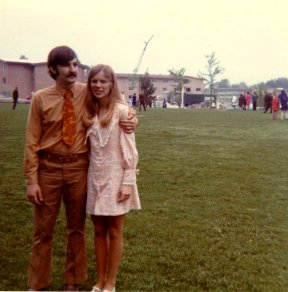
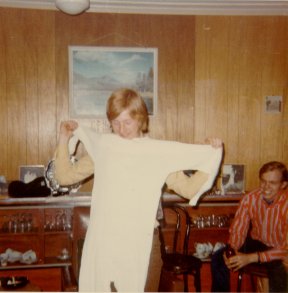
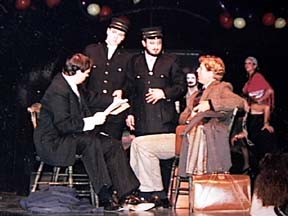
Here is an illustration of backwards progress.  Yes, I know, all these pictures are reduced to 72 dpi for display on computer– these are illustrations.   To give you real samples to analyze with me, I’d have to post some files that are very, very large, to show what the pictures look like, for example, at 400 dpi. However, anyone with an actual collection of photos can verify my argument.  You can  see that the black and white photos from the 50’s and 60’s have better resolution than the Instamatic or Polaroid shots from the 60’s,  70’s, and 80’s.

brownie50.jpg (13454 bytes)
Kodak Brownie Picture, 1950’s.  Large negative format = decent print.

brownie1.jpg (17509 bytes)
Brownie Picture – 1960’s still quite decent.

bw35mm1.jpg (12144 bytes)
35mm black and white, 1960’s: very sharp.

brownie_c.jpg (18931 bytes)
Brownie colour photo, 1960’s.

instamatic_c.jpg (16654 bytes)
Instamatic Picture, 1960’s. 


pocket1.jpg (14880 bytes)
Pocket Camera, 1977.  Ever try enlarging one of these sandbags?

polaroid1.jpg (17934 bytes)
Polaroid Picture, taken in 1980’s. Yecch.  To the turtles too.

cabaret.JPG (14680 bytes)
35mm colour, 1992

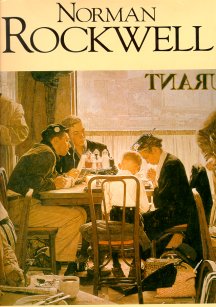
Norman Rockwell

I never liked Norman Rockwell paintings. They had this kind of smug middle-American arrogance to them. Every one of them seemed to shout at the viewer: “Why would anyone in the world live other than we as Americans live? We’re so great!” They are the most purely American of artifacts. They idealize conservative American values: church, boy scouts, the military. In a portrait of a citizen speaking out at a city hall meeting, Rockwell seems to say, yes, in America, the average citizen has a say in the way things are run around here. Right. The average citizen and the Fortune 500 and the military industrial complex and Rush Limbaugh. But I’ll bet that guy speaking up at that meeting got his parking ticket reversed.

Later in life, however, he began to turn out works that actually alluded to real problems in the real world: “The Problem We all Live With” shows a black girl about to enter a segregated school, surrounded by marshals, whose faces we cannot see. Very moving. Politically correct, of course. But artists are supposed to be visionaries. They’re supposed to be true to a powerful inner voice tell them that this is the way things are no matter what anybody else says. Rockwell was not exactly ahead of the curve here: he did his painting in 1964. Even the U.S. Federal Government was on-board by then.

Norman Rockwell died in 1978 at 84.

There have always been those who argue that Rockwell was a GREAT artist who belongs in the company of Picasso, Millet, Miro, Pollock, or maybe even Andy Warhol (ha ha). Why, they ask, should an artist be held in contempt, just because he is popular? We need to revise our opinion of Rockwell. We need to put his “Fixing a Flat” right up there on display next to Bacon’s “Man in a Box” and Monet’s “Lily pads #4,378”. .

Well, people can revise their opinions of anything they want. Sometimes, when the obvious has been with us for so long, and for good reason, it becomes fashionable to assert that the obvious was never true. William F. Buckley Jr. decides that “Tail-Gunner” Joseph McCarthy was a hero after all. William Goldman decides that John Lennon was a jerk. Everyone is supposed to go: oh! How brilliant! He saw what everyone else missed! Rockwell really is a brilliant artist!

The thing is, sometimes things are obviously true because they are, well, obviously true. Anyone who has seen the video tape of McCarthy holding a hand over a microphone and smirking while whispering to his aide, Roy Cohn, surely suspects that the man was an idiot. And anyone who has tape of John Lennon talking to reporters from his “bed-in for peace” knows that he was a lovable idealist who wished harm to no one and was far less foolish than he appeared.

But Rockwell a great artist?

No, he isn’t. He is a great illustrator. But you can’t be a great artist if you are constantly pandering to your audience. Rockwell clearly selected subjects and meanings that he knew his audience would accept, adore, and admire, and he presented these subjects and meanings in an idiom that was utterly conventional. Here you are: you imagine that Americans, in the late 20th century, still go down to the fishing hole, or stop at the side of the road to skinny dip on a hot day, or glance with awed respect at little old ladies who pray before they eat their meals in a restaurant. Dream on. These are popular images because they appeal to people’s illusions about themselves. That’s not art. That is propaganda.

rockwell1.jpg (23485 bytes)

It somehow doesn’t surprise that Rockwell did also did advertisements for Crest and Jell-O and other companies. I don’t think Rockwell was embarrassed. Why should he be? He was an illustrator.

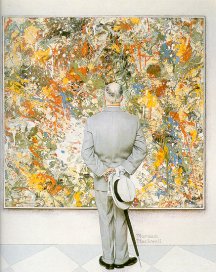
Rockwell himself certainly believed he was an important artist. He did a painting of a man standing in an art gallery staring at a Jackson Pollock splatter

rockwell2.jpg (23179 bytes) painting.


You can’t see the face but you can picture the quizzical expression from the body language. The man is fair: he’s giving the painting a chance. He’s staring at it, trying to understand it. But you know and I know that the painting makes no sense to him. And that, to Rockwell, is all that there is to modern art.

Rockwell seemed proud of the fact that he was able to credibly, he thought, recreate the Pollock painting himself, using the celebrated splatter technique. Nothing to it. I could paint like that if I wanted to.

Well, I kind of agree with him. Abstract art, or non-figurative art, or whatever you want to call it, has followed it’s own course into oblivion and self-parody. It has become an industry of critics, painters, galleries, art teachers, and students, all trying to define the absurd, all attempting to establish themselves as authorities or experts on something that ridicules expertise and authority.

But I’m not ready to say that the public is right either. Rockwell isn’t the only figurative painter in the world. Van Gogh, Rembrandt, Delacroix, Michelangelo, Da Vinci, Boticelli, Van Eyk, and even Picasso, were all figurative painters at one point or another, but it’s not hard to see that there is a substantial difference between their work and Rockwell’s.

And the public never accepted Van Gogh in his own time. He sold one painting in his entire life. One. So if Rockwell had had any guts– and insight– he would have paired that painting with one of a rumpled Frenchman scratching his head while standing in front of “Starry Night”.  That would have been a far richer, more subtle comment on modern art and the average American consumer.

But that would have made the opposite point that Rockwell intended. It would have shown that the public can be absolutely, totally, completely wrong about what is “good” art. It would have shown that the vast majority of people can be utterly foolish. It would have proven that it was quite possible for a mere illustrator to be the most popular artist in America.

This all begs the question. Is modern, abstract art, and its various derivatives, any good? The public has thrown up their hands. They don’t know and they don’t care.


Reversing Progress

Progress that isn’t

Innovations that took the world by storm while leading us backwards

Have you ever looked closely at photographs from the 1950’s? Then look closely at photographs from the 1960’s. Colour! Right! Great, eh? Except for one thing: resolution. Try this—try scanning in your pictures on a computer. Set the resolution to 600X600. Chances are, your black and white pictures from the 1950’s look great, especially if they were taken with a typical Kodak Brownie. Chances are your pictures from the 1960’s look like shit, especially if they were taken with a Kodak “Instamatic” or one of those awful, disgusting, contemptible, “pocket” cameras.

Do your photos all have that nice, flat, “satin” finish? Right. That’s what you want, right? Because it looks so nice. Right. Well, scan those in, and you’ll see why I always order my pictures printed on “glossy” paper. Do you want to know when and why they invented “satin” finish? That’s right—in the 1960’s and 70’s. That’s right—when they invented those crappy little camera’s with the lousy little negatives and plastic (not glass) lenses. The satin finish makes those pictures look better than they really are because, with a satin finish, you can’t notice the lack of detail.

Now look closely at a Polaroid photo, if you have one. Well, you probably don’t have very many. Why not? First of all, they weren’t much of an improvement over the Instamatic. The resolution is a little better, but the colour reproduction is not as good. But, as everyone knows, Polaroid pictures were very expensive, compared to other colour pictures. And anyway, I never could figure out why anyone would want a picture instantly, while you could still see the thing you were taking a picture of. I suspect that the biggest use of Polaroid cameras was for pictures you might be embarrassed to send to the local photo shop for processing.

Then we really did have progress. In the 1980’s, everyone went 35mm. Good photographers had used 35mm for years, but in the 1980’s, the general public suddenly developed an appetite for better pictures and these complicated but excellent cameras became quite popular. One of the reasons they became quite popular was because they suddenly became automatic or semi-automatic. You still generally had to focus the camera yourself, but shutter speed and aperture could be set automatically. Good. That’s progress. Look at the pictures from the 1980’s. Aren’t they great? Well, they would be, except that we still use that ugly satin finish. Why? The pictures were now good enough to look good, once again, on glossy paper. So why do most processors still use the satin finish?

Probably because many people still use the stupid little “Instamatics” and pocket cameras, and a lot of people buy disposable cameras, and the processing companies will be damned if they have to buy two kinds of paper.

So now it’s 1999. And what do we have? The electronic camera! Hurray! Progress again! But wait a minute. Look at those prints! They’re awful! What happened? Well, how about that. For a mere $1200 you can now buy a camera with a resolution of 640 by 480: the same quality as a Kodak “Instamatic”. Yeehaw! And you even get to give up your telephoto, wide-angle, and zoom lenses for a good old-fashioned fixed-mount single-lens camera! [Note: a decent 35mm photograph has a resolution of 1200×1200.]

I can’t believe that people are going out and spending over $1,000 for electronic cameras with a single fixed lens such poor resolution. Why? I figure these cameras should sell for about $125. Even better, someone should market an adapter that lets you shoot electronic photos on your existing 35mm equipment, so you can keep using your valuable lenses, flashes, filters, and other accessories.

The one part of electronic cameras that makes great sense is the cost of processing. Zilch. Zero. Nothing. You just download it onto your computer.

Do you realize that anything that cost nothing will eventually be worth nothing? Electronic photos will never be valued as highly by people as printed photographs are. But that does mean that your old printed photographs will be valued very highly, in the future. So don’t throw them out. They will be loved, as artifacts of an age of strange progress.

Other products that took the world by storm but were inferior to the products they replaced

  • VHS (replaced the vastly superior Betamax).
  • Microsoft Windows (annihilated OS/2, Geos, the Macintosh, Amiga, and numerous other superior operating systems).
  • the CD: a lot of people won’t believe this but a well-made turntable attached to a good amplifier produces better sound than the best CD player does. This is because sound has to be filtered and reduced in order to fit on a CD. Imagine if the same amount of innovation and design that was invested in the CD had been invested in turntables. So why did CD’s win? Because transportation is one of the largest costs of distribution. You can transport about five times as many CD’s as LP’s in the same space. But, as the music industry quickly discovered, you can charge the public more for the CD! The CD case is also one of the worst designs ever foisted on an unsuspecting but gullible public—it’s flimsy and awkward and stupid.)
  • the computer mouse (the truth – and every good keyboardist knows this— is that the keyboard is way, way faster for doing anything on a computer than a mouse is. The difference is, a mouse makes it possible for any moron to use a computer. The mouse has a legitimate use for graphics, but that’s about it. That’s commercial progress, but not a technological improvement).
  • the ball point pen (replaced the elegant fountain pen, and the utilitarian pencil, with this sloppy, blobby, leaky contraption). And how come you never see ads for pens anymore? Kind of strange, isn’t it? Remember all those Bic ball-point pen ads, showing how indestructible they were? We still see ads for disposable razors and diapers and toilet tissue—why not for pens?
  • rear-wheel drive (don’t forget that front-wheel drive was invented not in the 1980’s but in the 1950’s. It lost out to American-made rear-wheel drive behemoths for almost 30 years, until the Japanese proved it’s superiority, a thirty-year detour of unimaginable mass idiocy).
  • television (vs. high resolution tv. do you realize that you’re looking at a color picture that was designed in the 1950’s and first mass-produced in the 1960’s? Yes, your television picture is obsolete, but nobody wants to invest in the hardware required to improve it. The U.S. government has finally shoved the industry, kicking and screaming, into the next century, with requirements of HDTV broadcasts within the next five years. By that time, of course, the technology will be outdated again.)
  • Sound in Movies: If you ever in your life summon the self-discipline and determination to do something unusual and exotic, go to the video store and pick up three or four of the better silent films and sit down one night and watch them. Until you do, you probably have no idea of what was lost when films gained sound. Buster Keaton and Charlie Chaplin were unparalleled geniuses whose work almost disappeared entirely when sound was introduced and the movie-going public flocked to see and hear the novelty. Try Chaplin’s “City Lights” or Buster Keaton’s “The General” and remember, there were not computer-generated special-effects in those days and Chaplin and Keaton did their own stunts. And what did we gain in sound? Movies shot entirely in rooms in studios. It took years for the camera to regain it’s mobility and for Hollywood to master sound editing and effects. For all that, name a single movie produced in the last twenty years that is as good as “City Lights”, if you can.
  • Winmodems- the “mopeds” of the computer world. Real modems do a good deal of the work of converting packets of internet data into digital 1’s and 0’s so your computer can understand them. Winmodems shove all of this work onto your computer’s main CPU. Think about that. If Windows 98 is so fast on your computer that you would just love to slow it down a little so you can save $50 on a modem—please go for it.
  • And while you’re at it, you might want to look at this beautiful typewriter with a LCD display I’m trying to sell….

So why are Winmodems so popular? Did you ask for one? Did you tell the computer dealer—”hey, I think it would be a great idea if my next modem slowed my computer down a little”? No, you didn’t. But the profit margin on Winmodems—which actually consist of nothing except a pipeline from the phone line to your CPU—is much higher than on real modems.

Photoplay and Copyright

Photoplay

I just can’t leave the issue of copyright alone. It comes up everyday in one situation or another.

Today, it was my son remarking that he wasn’t allowed to use an Albrecht Durer woodcut as the basis of a project he was working on because his teacher was afraid it would violate some rules of copyright and plagiarism. He argued that a painter who has been dead for 400 years can’t possibly have any works under copyright anymore, and that it isn’t plagiarism if you acknowledge the use of the work. This teacher was so paranoid of the copyright police, however, that she still refused permission.

Here’s an interesting fact. Though most “classic” paintings are no longer under copyright, a photograph of the painting can be.

Whoa! Let’s think about that. Let’s think a lot about that, because a lot of museums, including our own Art Gallery of Ontario, won’t let you take pictures inside their galleries anymore. Even when the paintings are hundreds of years old, as in the case of the “Old Masters” show they did recently. So if you can’t take your own picture, then you have to get a copy from somewhere else. A logical place to look is in an art history book with lavish illustrations. But, according to the copyright police, you can’t copy that picture because, though the work of art itself is public domain, the photograph of it is not.

[Added 2022-04-12: I am pleased to note that many museums do, in fact, allow photography of the art work, as long as you do not use a flash.]

Now, photographers who create original pictures can definitely copyright their work. If I am walking along a boulevard in Toronto and I see a bum who looks like Mike Harris poking through a garbage bin and I take a picture and then publish it in the Toronto Sun, that is my copyrighted work. I saw the image. I took the picture. I chose the aperture and the angle and the type of film. If I was a professional photographer, I may have developed the picture and printed it myself. I may have edited it on my computer, before handing it over to the Sun for publication. Fair enough. It’s my work. I deserve to get paid for it. Let’s leave aside the question, for the moment, of whether or not the bum should also get paid. The photograph has a certain value because of the intellectual and physical effort of the photographer. That seems pretty fair.

However, the same photographer walks into the Louvre in Paris and snaps a picture of the Mona Lisa. His goal is not to create something new and original (unless, like Marcel Duchamps, he wants to put a moustache on it). His goal is to create an exact, faithful rendering of the original, so that art students can study it in a text book at a mediocre high school somewhere in Peoria. The value of the image is determined entirely by the value of the work of Leonardo Da Vinci that went into it. But since Da Vinci has died years and years ago, the image has now become a part of cultural heritage, for all to share.

So why is this image copyrighted? Legally, in fact, it is. That’s an outrage. It isn’t entitled to copyright protection anymore. It really isn’t. It’s absurd. I refuse to accept this copyright. I refuse to acknowledge it. If I choose to scan that image into my computer’s memory and show it on my web page, I will.

Here’s another interesting case of aggressive copyright imperialism: the company that sells sheet music to high school bands insists that the band is not allowed to make any copies of the actual sheet music itself, no matter what. No photocopies, no overheads. But, we are told, the copyright laws apply to intellectual property, not physical property. Remember, this is why you can’t copy software or music CDs. Because even though you own the physical disk, it is the content of the disk that is protected.

So if a school buys sheet music for the entire band, and decides to prevent the paper copies from deteriorating by photocopying them and handing the copies out to band members, there should be no problem. Remember, the school has paid for intellectual property to be used by each student in the band. What difference does it make whether they read it off the original print or a copy of it? The school didn’t buy half a copyright. It didn’t pay $20 a sheet for paper. It paid for use of copyrighted material by each member of the band. If so, there is no ethical or moral reason why the band can’t access that material in any way they choose, including computer screens.

If that is true, there should be no obstacle to making copies of the protected material for your own use. For example, I used to tape all of my vinyl LP’s as soon as I bought them, in order to minimize the wear and tear on the fragile plastic itself. I paid for the LP. I own a right to use the intellectual property on it.

Well, the record companies are finally coming around to the fact that they can’t very well have it both ways. If the copyright applies to the physical object, the CD itself, than either the intellectual property is what is copyrighted—in which case you can make as many copies as you want for your personal use—or it’s the physical object that is copyrighted, in which case you can make as many copies as you want for almost anybody.

Who else should get Copyright Protection by These Standards?

My son plays bass in a high school orchestra. They recently issued a CD as part of a fund-raiser. They carefully obtained the correct copyrights for any piece of music that was not public domain.

However, my son frequently improvises the bass line. So he creates, through his own original and unique thought processes, a piece of music that is utterly his own. Should he be able to demand royalties for each CD sold?

That bum that looks like Harris—he owns his face, his hands, his ragged clothes. He owns his posture, the look on his face, the minute the photograph is taken. But it is the photographer who collects the royalty, not him. He doesn’t even get a share.

And who should get copyright protection but doesn’t have it yet…

That’s right—you and me. Your name and my name. Your address and my address. I chose to move to this address and I chose to have this particular e-mail address. I hereby copyright it. No use without permission. I’m not kidding. If you use my name and address on your printed envelope or your electronic mail, you owe me $50.

I register a software package I have purchased to do my home accounting. The software company sells my name and address to another software company, with the result being that I get more garbage in my mailbox, inviting me to subscribe to some stupid investment service. How dare they? What right do they have to sell my name? Who decided that I can’t copy one of their software applications to give to a friend—who would be pleased with the favor–but they can sell my name to another software company—to my great annoyance?

So I propose a simple act of parliament or congress that simply assigns the copyright of a person’s name, and his address and any other personal information, including medical or credit histories, to the person him or herself. Done. From now on, anybody who wants to sell this information must pay a copyright fee to the owners. The only exception would be the standard copyright exception: research, journalism, and reviews. Done. Justice at last.

Numbers Sanctify

One of the biggest problems with movies these days is the fact that so few of them are truly subversive, in any sense of the word. That’s right. Films today are not subversive enough.

We live in a screwy society. Rich criminals get to drive their limousines to the golf course. Poor criminals spend decades in filthy, violent prisons. The Third World sends the First World more cash in debt repayments than we send them in foreign aid. Schools are allowed to shove advertising down the throats of our students. Everyone sues each other over the slightest problem. What we need is something that undermines this state of affairs. We need more subversion, not less.

Oh, many directors like to see themselves as subversive, or at least, “shocking”. But these days, “shocking” refers almost exclusively to special-effects enhanced gore and splatter, or frontal nudity. “Natural Born Killers” comes to mind. For all the pompous strutting about by Oliver Stone, proclaiming, with every jiggly camera angle, with his incoherent script, and abrupt uneven edits, that this film “rocks”, “Natural Born Killers” is an utterly conventional film. The police generally behave like the criminals because our society believes that that’s the only way to deal with criminals, and the media try to exploit both sides. Everyone is trying to get something, and the preferred strategy is confrontation and violence. Instead of challenging the viewer’s assumptions about reality, “Natural Born Killers” merely affirms our most paranoid assumptions. It is an utterly boring film. It is a conformist film. Most people would walk out of the theatre without a single new thought in their heads.

Critics frequently toss around adjectives like “bold” and “shocking” when some new film reaches for new heights of explicit violence or sex. What is bold or shocking about that? It has been almost 30 years since “Bonnie and Clyde”, with its celebrated slow-motion machine-gunning of Beatty and Dunaway in that elegiac last scene. Since then, it’s been largely more and more of the same, to the point where explicitness can no longer be said to be subversive at all. Even drug movies, like “Trainspotting”, really don’t tread any ground that hasn’t already been stampeded through by “Midnight Cowboy”, “H”, “Drugstore Cowboy”, “Sid and Nancy”, or even “Days of Wine and Roses”. Been there, done that. What else can you show me?

There are a few, of course. Terry Gilliam’s “Brazil”. Todd Solondz’ “Happiness”. Maybe “Bulworth”. But “Brazil”, as imaginative and original as it is, still ends up telling us something we already know: mindless bureaucracies suppress individual freedoms. “Happiness” is more interested in personal emotional fulfillment than society. “Bulworth” suggests that the fundamental institutions of our society need merely be reformed.

You might be surprised to learn that one of the most subversive films ever made in the United States is almost 50 years old. It is Charlie Chaplin’s “Monseiur Verdoux”.

“Monseiur Verdoux” is based on the life of the infamous Henri Desire Landru, the French serial killer. Landru seduced over 400 women and murdered 10 of them. He was executed by guillotine in 1922.

Orson Welles thought it would be interesting to make a film of his life and suggested the idea to Chaplin. Chaplin fictionalized the story somewhat, to suit his own purposes (he wanted explicit links to the depression and World War II). But the most sensational aspect of the case remains intact: a supposedly rational, ordinary man makes a business out of marrying wealthy spinsters and widows so he can murder them and keep their money. The real Landru disposed of the bodies, sometimes, in an outdoor stove. So does Chaplin’s Verdoux. Neighbors in both accounts noticed the smoke for days but thought that nothing was amiss.

In Chaplin’s version, Monsieur Henri Verdoux is a former petty clerk at a bank with a charming wife (Chaplin, in one of his rare misjudgments, put her in a wheel chair—are we supposed to feel more warmly towards him now?) and young child. He lived a honorable, petty little life in the South of France until the faceless administrators at the bank decided to restructure and he was tossed out of his job. Until this point in his life, he resembled T. S. Eliot’s J. Alfred Prufrock, who “measured out” his life “in coffee spoons”.

Facing dire poverty, Verdoux picks himself up and goes into a different business. He travels around France seeking and seducing wealthy married women. After a time, he murders them and takes their property. He invests most of the money into land and the stock market, and supports himself and his family on a modest scale. He clearly sees this activity as nothing more than an extension of business to its’ logical conclusion, the way, as Chaplin described it, Clemenceau saw war as an extension of diplomacy. His family thinks he is a traveling salesman.

At one point, Verdoux, experimenting with a new poison, picks up a waif from the street. The script called for a prostitute, but the studio opposed that idea (this was the post-Fatty Arbuckle era of the Hayes Office and Hollywood’s voluntary repression of vice in the movies), so Chaplin had to make due with subtle suggestion. As he prepares a meal for the girl, with a poisoned glass of wine, Verdoux questions her about her life, expecting to find her hopelessly pessimistic. Instead, she is happy. She thinks life is wonderful. And she is optimistic. She is convinced that life is going to get better for her. Verdoux changes his mind, gives her a few francs, and sends her on her way.

It wouldn’t be Chaplin without the physical comedy. His attempts to murder one wife (played by the inimitable Martha Raye before she became a parody of herself and started doing Bounty ads on tv) are constantly interrupted. He takes her out into a lake (she can’t swim) and is about to toss her overboard when a group of yodelers appears. He mixes her some poison, but the maid thinks it’s peroxide and uses it on her hair. Finally, he smothers or strangles her (off camera) and cheerfully takes her money, sells her house, and moves on to his next conquest. It is his urbane self-possession here that viewers find most offensive. He is no madman, no self-loathing sexual pervert. Merely a businessman conducting his “business” with the same ruthlessness with which his superiors at the bank liquidated him.

There is a charming scene of Verdoux checking with a flower girl about some bouquets he’s been sending to a prospective victim. He phones the woman from the shop and rhapsodically proclaims his complete and passionate devotion to her. The flower girl, over-hearing, becomes breathless and can hardly tell him his change.

But Verdoux’s luck eventually changes. The stock market crashes and he is wiped out. His wife and child die—we aren’t told exactly why, but can presume he couldn’t afford medical care or adequate food or housing anymore.

Years later, we see an embittered Verdoux on the street. His face is a mask of dark sorrow and cynicism. A beautiful woman in a limousine recognizes him and calls his name. It is the prostitute. She is now married to a rich and successful munitions manufacturer. Grateful for his earlier kindness to her, she takes him out for lunch at an exclusive restaurant. Unfortunately, he is also recognized by another guest, the brother of one of his victims. The police are called and Verdoux is arrested.

At his trial, Verdoux is described by the prosecutor as a monster, a savage beast of relentless fury and remorseless cunning. Verdoux thanks the prosecutor for his compliments but claims he is not worthy of them. He catalogues the atrocities of recent and imminent wars and notes that Generals are awarded medals and described as heroes for murdering millions. In comparison, he is a mere “amateur”. He says, “numbers sanctify”. He smiles at the judge and jury and tells them, with horrifying prescience, that they will all be joining him very soon. For my money, it’s one of the great moments in film.

“Monsieur Verdoux” was pulled from the theatres after two weeks of savage criticism from the church, the public, and the media. Chaplin himself was driven out of the country and had his visa revoked a few years later (he had never become an American citizen) and lived the rest of his life in exile in Switzerland. Ironically, one of the issues raised was his support of the Soviet Union. This support was given during speeches he made in support of the war effort at a time when the Soviet Union was an official ally of the United States in the war with Germany! This was of a piece with the outrages that prompted Joseph Welch’s famous, “at long last, have you no shame?”

Why did Chaplin make such an offensive film? Why would anyone want to dramatize the life of a blue beard and scoundrel?

Chaplin saw, in Verdoux, the personification of the ruthless practices of big business corporations in the U.S. and Europe. Things haven’t changed much. Read through any Time Magazine or any newspaper and you will see that rich, successful businessmen like Bill Gates and Donald Trump—no matter how ruthless or greedy they are—are routinely worshipped and admired. Furthermore, it is very clear that when the rich swindle stockholders or investors out of millions of dollars, they never serve a day in jail—in fact, they never even give up their limousines and four-star hotels, even if they owe millions–whereas the poor are locked up and brutalized without a second thought.

Chaplin, having grown up in poverty himself, was acutely aware of these injustices. “Monseiur Verdoux” is simply a dramatization of the same ethics that drove Bill Gates to a fortune of billions applied on a more personal, immediate level, without the layers of lawyers and bureaucrats and advertising agencies that cushion today’s executives from the consequences of their policies.
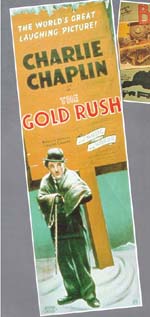
chaplin_keaton.jpg (13349 bytes)

With bimbo cheerleaders like Time Magazine and the Wall Street Journal waving their pom-poms from the sidelines, we have all come to accept that it is appropriate and right for businesses to operate in a cut-throat fashion, in order to ensure that the stock markets rise and profits increase and men like Bill Gates become fabulously wealthy—wealthy beyond the means of any sane man to ever possibly indulge. What happens to all those workers who are down-sized? How many families are disrupted? How many divorces? How many suicides? What about the damage to the environment? Why are governments using tax dollars to clean up the toxic wastes generated by profitable private corporations? Why are people being cut off from welfare while the government awards billions in tax subsidies to the wealthy shareholders of corporations like Boeing, or major league baseball teams?

Numbers sanctify. It is probably the most subversive film ever made in America.

Bernita: What’s Wrong with Hicksville?

When I went to college, I met a beautiful, very bright girl named Bernita*. She was from a small town, Hicksville, in Southwestern Ontario and came from a very conservative, bible-believing family. She and her room-mate wandered around campus together, laughing, teasing, and having a good time.

I never got to know Bernita real well, but we did have a late night chat or two, and I found out that she didn’t believe in God. She didn’t think the idea of God made any sense. But she didn’t tell this to anyone else and she went on with her theology, sociology, history, and introductory psychology courses at this Christian College as if she was a believer.

Bernita had a boyfriend back home. You know what usually happens with those relationships, of course. The girl goes off to college, broadens her horizons, meets a lot of new, bright men, and, before you know, it’s “Dear Ralph…”.

Well, that didn’t happen this time. Not exactly. Bernita was interested in this one guy with long hair but it didn’t work out. She went home at the end of the second semester unattached. By the end of the summer, Bernita was pregnant. She ran off to British Columbia. Then she returned to Hicksville to face the music. Standard procedure in conservative Christian communities? She married the guy. She never went back to college.

You don’t often meet these people again in life.  I did.

It’s twenty years later: she still lives in the same small town, with her five children. She is a stay-at-home mother. She is involved in the PTA and stuff like that. Her oldest child is already in college himself. I don’t know if she believes in God now or not, but she goes to church and she sends her children to the Christian school.

So you’re eighteen and you’re beautiful and you’re smart and you’re 500 miles away from home, living in one of the great cities of North America, with it’s blues bars and great restaurants, and the fabulous Art Institute, and Wrigley Field, and the Sears tower. The whole wild and crazy world and a future of untold experiences and insights opens up before you. You’re frightened and thrilled. But you go home one weekend for some stupid reason you give in this one time (that part’s a mystery to me: why?) And you end up spending your entire life in some wretched little hick town in the middle of Ontario’s own Green Acres. My wife says I’m too harsh, and that there’s nothing wrong with living your entire life in a small rural community. I thought she was right for a while. What’s wrong with Hicksville?

We lived in Hicksville ourselves for about 15 years. The trouble with Hicksville is that after a while you really do forget that there is a broader horizon out there beyond the dusty cornfields and windmills. You forget that people have different experiences of different lives. You think you have made a reasonable judgment about things when you reject certain possible alternatives, and forget that there are possibilities that you haven’t even imagined.

Hicksville allowed malls to be built on the edge of town, and then, when stores in the downtown area started to lose money and go out of business, demolished the only building with architectural distinction and built another mall right downtown. That finished it off. Now the mall itself is half-empty. That’s Hicksville: yesterday’s solutions for the problems we will create tomorrow. The whole debate about this building, the former city hall, featured a lot of ridicule about “preservationists” and their granola-crunching ilk. Meanwhile, towns like Stratford and Oakville were thriving by preserving their old buildings and renewing their city cores. How much do you want to bet that in ten years, when that trend has run it’s course, Hicksville will just be embarking on it?

Maybe it’s not fair, but I shed a little tear inside when I think of Bernita. I wish she’d finished college and taken a job in Toronto or Vancouver and traveled a little before she got married and settled down and had kids. But I bet that if I asked her now if that would have been a good idea, she’d answer, “why?”

Upon Further Reflection…

I had believed that Bernita eventually changed her mind about God and became a believer. Probably she did. But it’s not unlikely she simply submerged her real beliefs for the sake of expediency. When you are a beautiful daughter of a controlling, conservative family, one form of liberation is to run off to college, but another is to get married to a jellyfish whom you can dominate and control because, after all, you’re a lot smarter than he is, and he’ll do anything to have your gorgeous body.

He’s the one who will continue to vote to keep women out of church offices. You’re the one that rules the roost. You are not going to rock the boat too much because your life is pretty good. People have been bought and sold before for far less…

Exploiting a Tragedy

It might have been a wonderful story. Well, not a “wonderful” story. It’s a horrible story, actually. But part of the story would have been very appealing to a certain constituency: when one of the teenage killers at Columbine High School held a gun to the head of Cassie Bernall and asked her if she believed in God, she courageously said “yes”. Then he blew her away.

Oh wait. What do you mean “might have been a wonderful story”? Didn’t it happen?

The Christian community in the U.S. has seized upon this incident. It has a lot of appealing elements for them. First of all, Cassie was a young, attractive teenage girl. She had gone through a rebellious stage, including, allegedly, some dabbling in witchcraft, but her parents had straightened her out by sending her to a strict “program” at West Bowles Community Church. She wore a “What would Jesus do” bracelet. She carried a bible to school every day and was reading it at the moment the carnage began. She confessed her faith in words loud enough to be heard by her cowering classmates, though she knew it might mean her life.

So the story seems to provide a little of everything. Cassie was courageous because she confessed her sin. When she had rebelled, her parents no-nonsense, “tough love” measures worked. She carried a bible to school, where, of course, thanks to the godless liberals and feminists, prayer and bible study is no longer permitted. She was murdered by two young boys who were heavily immersed in video games, violent Hollywood movies, and rock’n’roll. Most importantly, she was murdered because she was a Christian. Because America turned it’s back on God when it banned prayer in school.

The latest fad among the ultra-right in the U.S. is to assert that they are now a persecuted minority. In a perverse way, this is the rationale they now use to assert their traditional privileged status in society. They claim that they are the only religion not allowed to have prayers in school (ignoring, with twisted logic, the fact that no other religion ever had a large enough constituency to even attempt to assert such a right in the first place, and ignoring the fact no other religion is or ever was allowed to lead classes or assemblies in prayer at any time).

It’s a story that plays into the social and political attitudes and platitudes of the Christian right.

The trouble is, the story is not exactly true. Well, it’s not true at all, essentially.
The report originated with one of the boys who was in the library, and who survived the assault. He was the brother of Rachel Scott who was killed outside of the school. He told the police that he heard the conversation and recognized Cassie’s voice.

The police later tried to verify the story. They took Mr. Scott through the library, as part of the process of meticulously reconstructing the sequence of events at Columbine. When Mr. Scott showed them where Cassie had been during the exchange, the police knew that the voice did not come from Cassie Bernall. Cassie’s body had been found in a different location. In fact, Cassie had been hiding under a table with Emily Wyant, quite some distance away from all of the other students. This is information that is not difficult to confirm.

This much is true. The gunman—most likely Dylan Klebold—asked a girl if she believed in God. The girl was not Cassie Bernall but Valeen Schnurr. Valeen did indeed answer yes, courageously, yes. But the gunman did not shoot her. In fact, he allowed Valeen, who was seriously wounded, to crawl away, without further harm.

What does it mean?

What does it mean?

The Christian community has adopted Cassie Bernall as a symbol of all that is forthright and courageous and virtuous in America, just as they have come to see Klebold and Harris as icons of deviance, immorality, and godlessness. Every hero needs a villain. Even Valeen Schnurr says she doesn’t mind that this spurious story circulates because it might bring someone to Jesus. Meanwhile, she has come under some abuse herself by “Christians” who are upset at her for disabusing them of their congenial myth.

So, she goes along with the silent consensus here among people who should know better: a little lie can be excused if it furthers the greater good.

I have trouble with this. So some minister is going to tell the story of Cassie Bernall at an evangelical service somewhere and fifteen young people, as a result of the story, will come to the front to pledge their lives to Jesus. No harm done? Not if they find out some day that Christian leaders knowingly perpetuated a lie? No harm done when reputable scholars and writers and journalists are aware of the deceit and draw negative conclusions about the integrity and honesty of the Christian community as a result? No harm done when a Christian congressman like Asa Hutchinson stands up in Congress and argues for a bill and some wavering delegate sits and listens and thinks, “Well, this is the guy who still goes around flogging the story of Cassie Bernall even though he should know better….”

If Christianity is true, would it’s adherents willfully lie about a thing like this?  If Christianity means something to its adherents– if it means anything– why does this happen, often?


Just Say No

Universities in Canada got 60% of their funding from the government in the 1960’s. Now they get 40%. The rest comes from tuition and corporate donations.

The Corporate sponsorship is disturbing.

Apparently, according to the Canadian Association of University Professors, many of these agreements are secret, especially in regard to intellectual property rights. It was this kind of agreement that led to the University of Toronto trying to silence researcher Nancy Oliveri when her research showed that there might be harmful side effects of a drug produced by Apotex.

In a related story, a professor at McMaster University imposed a new policy on all researchers at that facility: no meetings with representatives of drug companies. Why? Because he felt that medical research was becoming compromised by the intermingling of the interests of the drug companies with those of the universities and the medical profession itself.

Perhaps the most laughable slogan of the entire 1980’s was pet phrase of Nancy Reagan’s: “Just say no to drugs”. Just say no to drugs? Ritalin! Valium! Prozac! Viagra! Lithium! Etc. Etc. Etc. We are the most drug-addled society on earth! Say “no”? And bring the stock market crashing down?!

Our society loves drugs. Institutions love them because violent patients can be sedated into harmless mindless sacks of inert flesh. Doctors love them because they provide convenient and speedy personality modifications to persistently annoying patients, and spare them the aggravating ordeal of actually trying to find a real remedy. Drug companies love them—naturally—because they provide incredible profits, since they can charge far in excess of the actual cost of the chemicals in the prescription, to cover—ha ha—research and development. Research scientists love them because drug companies provide them with millions of dollars to conduct research to arrive at just that conclusion (and if they don’t reach that conclusion—see above—the money is withdrawn).

So what’s with this “just say no” campaign? Well, you see, those poor inner city blacks don’t play by the rules. First of all, their drugs don’t include a healthy royalty to some large pharmaceutical firm (just imagine their apoplexy had Nancy Reagan added—”and let’s all try to do with a little less Prozac and Valium ourselves, shall we?”). Secondly, they haven’t developed this wonderful rationale of how stressed out they all are and how they’ve all seen so many psychiatrists and been to all the doctors and just can’t get over this severe depression that’s been limiting their ability to work, you know… The truth is this: in the U.S., blacks constitute 14% of the drug-using population, but they constitute 58% of those convicted for drug use. Look at those numbers carefully. Think of all the movies and tv shows you see about drugs and crime. Think about the reality. The war on drugs is the war on black America. And this war cost $18 billion a year (Harpers Magazine, November 1999). And it is the most one-sided debacle in U.S. history. It has been lost over and over again but America continues to fight it because it’s a winner as an election issue.

It is at moments like this I feel somewhat pessimistic about the human race.

There is a pretty good argument to be made that marijuana, especially, is illegal today because it provides the same sort of hit that Prozac and Valium provide, but at much, much less cost. In fact, you could grow it yourself in your backyard, if the police would let you. A similar argument could be made for cocaine. So, even though I feel pessimistic, I must admit that there are signs of hope. In seven states, voters have indicated, by substantial margins, that they approve the use of marijuana for medical purposes. Representative Bob Barr, in fact– he of impeachment fame– used some nefarious and obscure loopholes to prevent the results of the vote in the District of Columbia from becoming known. When it was finally released, 70% of the voters supported medical use of marijuana. But Mr. Democracy, Bob Barr, has blocked the implementation of the law on a technicality.

It might strike you as surprising that it is only recently in human history that drugs like Cocaine and marijuana have been made illegal. The prohibition of these and other “recreational” drugs coincides perfectly with the rise of the large pharmaceutical companies (who also tried to ban or hobble sales of herbal remedies).

Ah, you say—but aren’t those evil, illegal drugs addictive? Precisely. Why some of them are almost as addictive as, say, lithium. In fact, many of the heavy duty, most frequently-prescribed pharmaceuticals are at least equally addictive.

So what am I saying?

First of all, I am not saying that drug use is good. Get that clear. I don’t drink more than two or three beers a YEAR myself. I dislike anything that messes with your mind. And I certainly don’t use any prescription drugs and whenever I hear of someone who is depressed or disturbed, I hope they find some way to deal with problems that does not involve pharmaceuticals.

However, just as Prohibition of alcohol failed, the war on drugs has failed. And just as most people came to realize that Prohibition did more damage than good, people should come to realize that the war on drugs does more harm than good. The war on alcohol produced powerful criminal organizations that branched out into prostitution, gambling, and murder. Does that sound familiar?

As shocking as the idea sounds, the fact is that some countries have already tried legalizing drugs. In Holland, marijuana and hashish are freely available. And surprise, surprise, more adolescents try marijuana in the U.S. than they do in Holland!

That drugs like cocaine and marijuana should be legal? Well, think about it. Alcohol, in terms of sheer quantity, does far more damage to our society than marijuana. Yet it’s perfectly legal. In fact, it is downright easy for any teenager to get a six pack or a bottle of wine.

We did try banning alcohol once too. Of course, we all know how disastrous that was, and how it led to the development of powerful criminal organizations in North America that branched out into other forms of crime and plagued our society for years afterwards. Does that sound familiar?

Now, the U.S. Supreme Court, featuring embarrassingly second-rate minds like Antonin Scalia and Clarence Thomas, appointed during the twelve years of Republican Administrations between Carter and Clinton, have been steadily eroding constitutional rights protecting citizens from “unreasonable search and seizure”. Police in helicopters can now peer inside your windows, and officers can search your car just because they feel like it. What does this mean? In California, according to Harper’s, an elderly grandfather was shot twice and killed by police who burst into his house in a hail of gunfire searching for a suspect who had lived next door fifteen years earlier. In New York, a mentally retarded, menstruating young girl was dragged naked from the shower and hand-cuffed while police searched the house. Again, no drugs were found.

Nor were any apologies offered. Why should we apologize? We’re the police! We’re in a war on drugs! You don’t apologize to civilian casualties during a war!

And those two cases are just the tip of the ice berg. Under the Supreme Court’s relaxed rules on search and seizure, it has become very profitable for police to pull suspects over the side of the road, seize their cars and property, and leave it to the hapless citizen to “prove” that the property was not used for the purpose of drug-dealing. Not every citizen is smart enough to respond within the 10 days allowed, or rich enough to afford a lawyer, or patient enough to challenge the constipated U.S. criminal court systems. It’s easier, quicker, and safer to please guilty to a reduced charge and turn snitch, thereby providing the police with fresh leads on new property to seize.

It’s utterly incredible, contemptible, and outrageous. Why isn’t this on the front pages of the newspapers, the lead story on television?

Because there’s no sex.

Hollywood stars can afford lawyers.

Everyone has been convinced by successive administrations that drugs is the number one problem in our society and nobody– not Al Gore, not George Bush Jr., not Bill Bradley, not even John McCain– has the guts to stand up to his juggernaut of imbecilic brutality.


Abraham Lincoln and the Evangelicals

According to biographer Allen Guelzo, Abraham Lincoln might have believed in a divine maker, but he certainly did not believe in Jesus Christ–in a personal savior. He did not belong to a church. He believed that people were generally in charge of their own destiny and had the capacity to build a better society together.

In short, Abraham Lincoln was one of those evil, secular humanists that people in the Christian right in the U.S. constantly badger us about.

Lincoln?

Thomas Jefferson? Benjamin Franklin? Thomas Paine? How convenient that they are dead and unable to speak for themselves. These “heroes” of the American Revolution have their names invoked time and time again by Republicans, homophobes, militant evangelicals, and tv preachers, as paragons of Christian virtue and “traditional” values.

Do you believe me? Or do you want to believe Jerry Falwell and Pat Robertson?

You know, it’s not very difficult to find the truth in this matter. There really isn’t a controversy, like there is, say, over the efficacy of gun control or feminism or the Equal Rights Amendment. You can read the original works by these guys in any library. They were NOT—I repeat, NOT—Christians. They did not base the constitution on scripture. They did not base the Bill of Rights on scripture. They based their work on the ideas of people like John Locke and Jean Jacques Rousseau.

So when someone tells you that America needs to return to the moral virtues of the past, and to the examples of stalwart men like Washington, Franklin, Jefferson, and Paine – I say, “Amen, brother!”

Well, no, I don’t, exactly. You see Jefferson owned slaves and he sired children by one of them. Benjamin Franklin had quite a reputation in Paris, when he was American ambassador. And George Washington certainly didn’t think Martha should be entitled to equal pay for work of equal value.

So there you go. You see the danger of trying to read the past into the present or, even worse, the future.

The truth is, we are here and now and we have to try to find the best answer to our various social and economic and moral problems all by ourselves. We can learn from the past, but you can’t go back, and America can’t go back.

The Founding Fathers, fearful of invasion by Britain, believed that every man should keep a gun handy. Today, 40,000 people a year a murdered at least partly because it is easier to get a gun in the U.S. than it is to get a firecracker.

Time to move on, I say.

Banning MP3

It’s been quite a while since the Recording Industry Association of America tried to have MP3 players banned but I am still so steamed about this issue that I have to give it another rant.

Think about this. The Diamond company created a little portable device called the Rio that allows you to listen to music that has been recorded and compressed into MP3 files. That’s all it does.

Anyone with the right software and hardware can create an MP3 file on a computer. You can record yourself, or you could take the Windows sound effects, or you could take a CD or tape you already own and record it onto the computer and convert it to MP3 format.

What’s the big deal? How could anyone have thought this should be illegal?

Well, the record industry says that you could take a commercial, copyrighted recording and convert it to MP3 and play it on your portable MP3 player. Again, what’s the big deal? You paid for the CD. You are perfectly entitled to convert it into different formats so you can listen to it on different devices.

Ah—but the music industry thinks that we will all shortly start copying our Celine Dion and Back Street Boys albums onto our computers and giving copies away to our friends! Then your friends won’t want to buy the albums (especially after hearing the Back Street Boys).

Well, well. So it appears that you could do something illegal with an MP3. Well well. The truth is, you could also take your Rio and bang someone on the head and kill them, but you don’t see the government trying to ban them for that reason.

Now you have to remember here that the government of the U.S. allows almost anyone to buy a handgun at any time, on the assumption that just because a person buys a powerful, easily-concealed weapon that can blow a hole the size of an orange through somebody’s head does not necessarily mean that this person is likely to commit a crime with it.

This government also allows people to buy alcohol, gasoline, rope, fertilizer, and Barry Manilow records. All without the slightest restriction.

What we have here is a classic case of the rich and powerful throwing their weight around and abusing the legislative and judicial processes in order to exploit the hapless consumer. They have already succeeded in preventing DAT tape drives from getting a foothold in America. And the Disney corporation has succeeded in extending the copyright of the Mickey Mouse character. How? Easy. You simply pour money into the re-election campaigns of influential senators and congressman.

It is shameful and disgusting. At the next election, ask your congressman how he feels about this issue. If he supports the RIAA initiative, jam your Diamond Rio up his nose.