Exxon Sues Itself

I’ll bet I know something about the 1994 Exxon Valdez oil spill in Prince Edward Sound that you don’t know.

The Exxon Valdez was the worst oil tanker spill of all time, polluting more than 1000 miles of Alaskan coastline and endangering a vital, delicate ecosystem. Lawsuits followed of course. BIG lawsuits.

The plaintiffs in the case against Exxon were awarded $5 billion, which is about as much as Exxon earns in profit each year. That’s a pretty fair fine, I think. What’s the use of a five or ten million dollar penalty when a corporation sees an amount like that as a mere operating expense? Do you think $5 billion is a deterrent? I think it is.

A group called the Seattle Seafood Processors banded together to sue Exxon for compensation for lost income and all that jazz. Exxon settled with this group out of court. The settlement was SECRET. They get to settle out of court, and we get to wonder if they got anything, and Exxon gets to hide the cost of the settlement from their stockholders, the media, the public, and the other plaintiffs. Maybe there was something about their case that was peculiarly alarming to Exxon. Whatever.

Anyway, people did find out eventually that the agreed upon amount was $70 million. Good deal, right? I mean, these guys get to take a vacation and everything – they can’t fish anymore—and get paid for it! How much do you want to bet that they just laid off all their workers and kept the money for themselves? Well, hell, why not? This is America.

But here the story gets interesting. If somebody does some damage to you and you sue them and then you settle out of court, your case is done, right? You are out of the picture. You sign an agreement saying that Exxon has compensated you for your losses and you have no further claim.

That’s what you think. What happened is this: the Seattle Seven continued their lawsuit, with the full knowledge and consent of Exxon. The very lawsuit they had settled! And they won! Big time! $700 million! Hurray for the lawyers, who get to collect about $100 million of that for themselves. Hurray for America! Hurray for everyone!

Wait a minute. It seems that Exxon is now taking the Seattle Seven to court. What! How can this be? What a strange reversal! Did the Seattle Seven dump a bunch of dead fish on Exxon’s front lawn or something? No! It seems that Exxon had a secret deal with the Seattle Seven that stated that, in exchange for the $70 million, the Seattle Seven would continue their legal action and, if they won, Exxon would collect all of their winnings.

I am not making this up.

Whoa Nelly! What a concept! Exxon was betting that the Seattle Seven’s lawyers were really, really good, and would win a much larger settlement in court than $70 million. The Seattle Seven were pretty stupid, don’t you think? Why didn’t they hire worse lawyers (if such a thing is imaginable)? Then they wouldn’t have been out $630 million.

But wait! Hold on to your hats! The Seattle Seven don’t want to give the $700 million to Exxon anymore. They want to keep it all for themselves! Well, for themselves and their lawyers. Exxon is quite upset about this turn of events. That’s why Exxon’s lawyers are taking the Seattle Seven to court. Give us back your money!

Do you have this all straight? Yes, you’re right: Exxon sued themselves. Can you picture their lawyers in their solemn robes, celebrating after the verdict? Woohoo! We got $700 million! We’re rich! Now we can pay off our lawyers!

Strange story, isn’t it? Why did Exxon make this preposterous deal? Nobody knows for sure. The only people who benefit, of course, are the lawyers. The lawyers who negotiated the deal for the Seattle Seven probably got most of the $70 million. The lawyers who won the lawsuit probably got about $200 million—I am NOT kidding. Contingency fees typically end up in the 25-40% range. Exxon’s lawyers got money too. How much? Well, if the tobacco industry settlement is any guide, they probably persuaded Exxon to sign an agreement paying them a percentage of the difference between the maximum amount of liability given a worst case judgment, and the deal that was actually struck. It sounds like they didn’t do very well. I’ll bet they thought the maximum liability would be somewhere in the $500 – $750 million range. I’m just guessing now. I’ll bet they expected to earn $100 million by keeping the liability below $1 billion.

I’ll bet they didn’t offer to give Exxon a refund of their fees because they did so poorly. That’s not the way life works for the rich, my friend. If you are a baseball player and you hit 30 homeruns, you will get a new contract worth $10 million. If you then hit 5 home runs, do you give the money back? Are you kidding? Do stock brokers convicted of swindling people out of millions of dollars suddenly walk or take public transit?

But if you are supposed to load a truck in two hours and you do it in eight instead, do you think you’ll get paid?

The only advantage to Exxon—had the settlement agreement with the Seattle Seven stayed secret– is that it looks like they are paying a lot more damages than they really are. The $700 million is part of a shared settlement with fishermen and hunters and others who were harmed by the Exxon Valdez disaster. The total of the settlement is $5 billion. It’s hard to believe that Exxon could be so stupid as to figure on coming out ahead of this deal. On the other hand, this is a corporation that hired an alcoholic captain to steer a vessel loaded with oil through one of the most hazardous and sensitive coastal ecosystems in North America.

Maybe the $700 million is tax deductible. Actually, since it is subtracted from their earnings, it quite probably is tax deductible. Who does pay the taxes on the $700 million? The Seattle Seven? For money they will never receive? Exxon? For a judgment they are paying themselves?

Exxon, incidentally, has not yet paid a penny of the $5 billion, though the judgment was awarded five years ago. Exxon is sitting on $5 billion that it owes other people. If you were sitting on $50 that you owed Exxon, you would be in jail in very short order, my friend.

A judge, meanwhile, has annulled the secret agreement between Exxon and the Seattle Seven and ordered Exxon to pay out the $700 million. Exxon is appealing. Well, why not? They have lawyers.

Well, let’s say you are as outraged as I am about this deal.

What are you going to do? Get a lawyer?

Quagmire

The U.S. likes to call itself the “World’s Only Superpower”. Superpowers, of course, have responsibilities. Right now, for example, there is a disastrous civil war taking place in Sierra Leone, the poorest nation on the face of the earth. At least 100,000 civilians have been driven into refugee camps and are facing starvation or cold-blooded murder. Where is the world’s cop? At home debating a stained dress.

A few years ago, a civil war broke out in Rwanda, which led to the deaths of more than 200,000 people. Where was Uncle Sam?

When civil war broke out in Bosnia, George Bush took one look, heard the word “quagmire” whispered somewhere softly in the wings, and ran for cover. Not only did he not support military intervention—he actually tried to prevent the Bosnian Moslems from acquiring weapons with which to defend themselves against Serb aggression. But, hey, Bush had “character”, whatever that was.

Every time the U.S. considers military intervention in some far-flung part of the globe, a chorus of nay-sayers (including Colin Powell generally) raises their voices and squawks the one magic word that stops the Pentagon dead in their tracks every time: QUAGMIRE.

The application of the word “quagmire” to Viet Nam first occurred, as near as I can tell, in the title of David Halberstam’s excellent book on the subject, “The Making of a Quagmire”, which was published—get this – in 1965.  Yes, eight years before the U.S. began its exit.  That is a remarkable piece of foresight.

Unfortunately, contemporary journalists don’t understand what the problem with Viet Nam really was. They think the problem was that most Americans didn’t really, heartily support the war. They think the Viet Cong were so unrelentingly savage that our “good” boys, with their innate decency and “character”, were corrupted by their involvement.

The real problem was that we chose, as usual, the wrong side to support. In 1954, the remnants of post WW II Viet Nam, were partitioned by the United Nations into a North and South, under two different governments. The keystone of this agreement was a promised election in 1956 which would be fair and open and involve all opposition groups, and which would reunite the two partitions into one nation under one government.

Unfortunately, the regime of President Diem, which ruled the South with the support of the French, realized that it could not control the results of the election and postponed it. Diem also began to systematically repress all opposition political leaders and parties. When it became clear that he had no intention of giving up power, the remnants of the army that had liberated Viet Nam from the Japanese (the Vietminh) began organized opposition to the regime. The French were unable to dislodge the Vietminh so the Americans thought they would give it a try. They believed that the Chinese and Russians were aiding the Vietminh, and that if Viet Nam fell to the communists, Thailand, Laos, and Cambodia, and the rest of Asia would be sure to follow: the infamous Domino Theory.

At first, the Vietminh included a diverse coalition of political forces, including socialists, Catholics, and other democratic movements. But the corruption of the Diem government and the intensity of the fighting soon polarized the competing forces until the Vietminh, under the umbrella of the National Liberation Front led by Nguyen Huu Tho, was dominated by communists.

The Diem regime never did control the countryside around Saigon. South Viet Nam’s army, the ARVN, was commanded by political appointees more loyal to Diem than to their own generals or the war effort itself. They were arrogant and oppressive and they alienated the peasants who lived in the small villages around the Mekong Delta. As a result, the Viet Cong were easily able to operate, hide, and control large areas of the countryside.

The American “advisors” sent by Kennedy were efficient and sensible, but some of the most important early military initiatives were hamstrung by ineffective local leadership and corruption. U.S. ambassador Nolting continued to send cheery reports back to Kennedy, while reporters (including legendary figures like Peter Arnett, David Halberstam, Neil Sheehan, and Francois Sully), who actually traveled into the battle zones, were accused of disloyalty for reporting what they saw. What they saw were villagers who were hostile to government forces, ARVN battle groups that avoided fighting whenever they could, incompetent commanders, and bad planning. They saw an insurgent force that was quick, efficient, and brutal, and which commanded the respect and loyalty of the general population. They saw, at the battle of Ap Bac, 200 guerrillas defeat a combined force of U.S. and ARVN regulars ten times their number. Halberstam was one of the first to realize that the combination of domestic politics (Kennedy couldn’t afford to look “soft” on communism) and local corruption, including the dependency of the Diem government on U.S. military support, could lead to a unresolvable situation. It was not necessarily in the best interests of the Diem regime to bring an end to the war.

America was pouring in aid at the rate of $1.5 million a day. A lot of this money lined the pockets of Ngo Dinh Diem and his brothers, Can, Luyen, Thuc, and Nhu, and his sister-in-law, Madame Nhu, and his other cronies. It is quite possible that Diem never was interested in defeating the Viet Cong, thereby removing the incentive for lucrative American aid. It would be hard, otherwise, to comprehend the massive stupidity of the South Viet Namese government.

In June 1963, a Buddhist monk, protesting political and social discrimination against Buddhists by the Catholic Diem and his brothers, doused himself with gasoline and set himself ablaze in a public square in Saigon. This signaled the beginning of a summer of protest by Buddhists that gained increasing popular support. Diem’s response? His soldiers broke into Buddhist temples, looted their treasuries, and arrested Buddhist monks and nuns. A move more calculated to incite mass protests and rioting could not be imagined. On November 1, 1963, with tacit U.S. approval, a group of conspirators under the leadership of General Duong Van “Big” Minh turned their troops on Saigon and drove towards the Presidential palace. Diem was captured and killed. Seven more coups or attempted coups would follow. The quagmire was in full tilt. The U.S., blindly, foolishly, willfully plunged into the greatest debacle of its history.

When General Colin Powell talks about Bosnia, he tries to sound like some wizened old war horse who’s seen it all and can’t be fooled into risking the valuable lives of his young, well-trained killers on some frivolous mission to merely save people’s lives. He talks about Viet Nam, as if he thinks he understands all there is to learn from that experience, but experience doesn’t teach you right from wrong. Sometimes, he merely sounds resentful of the military disgrace. One senses, beyond the petulance, a fundamental commitment to the selfsame principles that caused the Viet Nam debacle in the first place, namely, that the guiding principle of foreign policy should be military strategy. At times he sounds like the living embodiment of Metternich’s dictum: “War is too important to be left to the politicians.”

The failure of the U.S.’s involvement in Viet Nam was entirely due to the social, cultural, and political realities of South East Asia. The U.S. made only sporadic and half-hearted attempts to force the South Vietnamese government to try to develop some kind of popular support. When Diem refused to fight corruption in his own government, reform his armies, and win the loyalty of the hamlets and villages in the Vietminh dominated areas of the countryside, the U.S. should have walked away, with the realization that victory was not only unlikely, but impossible.

What does “quagmire” mean in terms of current realities? The key difference between Viet Nam and Rwanda and Bosnia and Sierra Leone is that the latter three nations are not proxies for a world superpower conflict. They do not require the U.S. to make an alliance with unsavory dictators, and pour in military aid to prevent some expansionist foe from gaining the upper hand. And Russia is not only not interested in manipulating the crisis, but incapable of financing proxies. Cuba is out of the picture. China cares only about internal security. The U.S. is free to intervene on behalf of freedom, peace, and justice for all. They are free to be the good guys. How ironic that they no longer want to play.

March 22, 1999

Well, NATO has finally decided to try to stop the Serbs from “cleansing” Kosovo. And some critics, like Senator John McCain—future Republican presidential candidate– are already complaining that the U.S. does not have a credible exit strategy. Look, folks, we just got here!

A more interesting question is this: will the NATO attacks lead to peace? Will the Serbs be more willing to negotiate now?  If bombs and missiles are so effective, why is Saddam Hussein still ruling Iraq? Won’t this lead to intransigence, and a brooding hatred for all things American, and an intensified desire to defy NATO, knowing full-well how unlikely it is that we will ever see ground troops?

The inherent absurdity of bombing Serbia into submission is that bombing does not threaten the interests of the ruling class. Ruling classes everywhere know how to ride disaster: you reinforce the troops, barricade the palaces, and control the distribution of scarce goods—ensuring that you yourself will never suffer the slightest privation. The war footing ensures the success and acceptance of martial law. The crisis justifies harsher repression than usual. Milosevic cannot be threatened unless bombing reduces his country to total ruins and the people rise up in rebellion against him. But NATO cannot go that far, for it would be charged with committing atrocities against civilians, and it would almost eliminate the possibility of any kind of peaceful coexistence afterwards, between the Serbs and the Kosovars. So NATO must be content to strike military targets.

Slobodan Milosevic will be unmoved by the destruction of military installations and buildings as long as he can maintain his control over the army and government. I suspect that the only way he can be prevented from carrying out further atrocities is for NATO to invade with ground troops. At this point, NATO seems extremely reluctant to make that step.

March 31, 1999

And now they have hostages. Three American soldiers captured in Albania. And Bill Clinton goes on TV and announces that that is why he doesn’t want to bring in ground troops. He might as well say to Milosevic, “if you can tolerate the bombing for a few more weeks, we’ll eventually get frightened and go home.”

The whole point of intervention was to force Milosevic to stop the “ethnic cleansing” of Kosovo. I don’t know why anybody would have thought at any time that bombing alone would achieve this objective, when it has not achieved anything like that anywhere else in the world where it has been used (with the exception of Japan, after Hiroshima and Ngasaki).

And if the Americans are going to panic with every single casualty, they might as well go home right now, and relinquish the title of “World’s sole remaining superpower” because a superpower has a responsibility and a superpower does whatever it takes to stop genocide.

The Columbine Matrix

The Matrix, a violent sci-fi adventure film, has drawn comment by social critics who see it as uncannily representative of the type of amoral entertainment that drives kids to acts of violence like the Columbine High School shootings.

And there is a scene in the Matrix that anyone familiar with the Littleton, Colorado shootings would find disturbing: at one point, the heroes strap weapons and ammunition onto their bodies, dress in black trench coats, and then enter a building where they shoot the hell out of a bunch of bad guys. You hear the shell casings rattle to the floor, the rat-tat-tat of automatic and semi-automatic weapons fire—even a few shotguns, in the hands of the bad guys (who, in this film, are the police). In The Matrix, the shooters are heroes. They were dark glasses so they look cool as they kill. They are fighting evil. You conquer evil by outgunning them, or stylishly beating their faces to a pulp with karate blows.

There is nothing new here: Hollywood has glorified this type of adolescent fantasy for years. Hollywood is getting better at it though: the amount of computing and artistic effort put into these scenes is astounding. The sound effects batter the listener with Dolbyized wall-rattling chunky, acerbic smacks. The walls explode with spattering bullets and ricochets.

A fair number of commentators have tried to draw a link between movies like this and incidents like Padukah and Littleton. They believe that children are influenced by these movies. They watch the carnage and enjoy it. It thrills them. They want to be like the actors in the movie: cool and powerful. They derive a invigorating sense of gratification from seeing the bad guys get blown away.

There is always a conversation with the meanest, baddest, most ruthless of the bad guys, before he is dispatched. It doesn’t matter that such conversations have never taken place anywhere in history: they are a staple of the action-adventure film. Usually, the hero revels for a moment in his triumph, and we glimpse suffering, finally, on the face of the man who inflicted so much suffering on others. We feel the necessity of grudging submission, acknowledgement that we (identified with the hero) are the good guys. Just before we blow their brains out.

But there is another weird convention to these action adventure films: the hero has to suffer too. In almost all of them, the hero himself undergoes a few serious, painful trials, before undertaking his climatic mission. Why? I’ve heard this element rationalized as some kind of test of worthiness that ties into our primitive instincts for sacrificial leaders. Thus when the killer acts just as brutal and ruthless as the enemy, in the end, he appears to be justified, because he has suffered.

To put it in more prosaic terms, the audience can’t enjoy the bloodletting later if they don’t feel that the hero is entitled.   The same way they won’t enjoy the murders at the beginning of most trashy thrillers unless the victims are shown to be having sex first.  They deserve to die.

I always find these sequences a little squirmy, because they are so close to pure adolescent fantasy, and adolescent fantasy is utterly self-centred and masochistic. Adolescents don’t feel comfortable with their place in the world; they’re always being accused of not suffering enough, or of making bad decisions. So being dominated and victimized plays nicely into their sense of being very worthy individuals who are unjustly persecuted. All the better if a lovely woman, preferably about 18, feels so moved by your suffering that she pleads with you to save yourself. Adolescence. Fantasy. Myth.

Did Dylan Klybold and Eric Harris shoot their class-mates because, though they were otherwise of sound mind and body, they saw films like “The Matrix” (specifically, “Natural Born Killers”), and decided that killing people was so cool they just had to try it themselves? That’s hard to believe. These films do very well at the box office. You would think there would a veritable rash of killings after every showing. The truth is, we don’t have any evidence at all that these films influence anybody to kill. How unlikely is it, after all, that killers would not have seen the most popular films, played the most popular video games, or listened to well-known metal rockers?

As tempting as it is to ascribe a single cause to the Littleton disaster, the truth is probably more complex than that. Klebold and Harris were disaffected youths, marginalized by the nasty jock culture of Columbine High School. They were intelligent and imaginative, too intelligent to not harbor some bitterness about the putdowns they received constantly from the jocks and preppies . They were probably somewhat psychotic. Perhaps Harris, by himself, would merely have committed suicide. The two of them together formed a deadly combination of audaciousness, bitterness, and collective energy. Their uncensored fantasies of revenge and domination came to life in their conversations and acquired an energy of their own.

So how would you prevent future massacres from happening? Again, people are tempted by simple solutions: censor movies or the internet, ban violent games, restrict access to guns. The most idiotic come first: ban trench coats, which is what all high schools in the Denver area and many more nation-wide have done. Ban trench coats? What about gym bags, back packs, suitcases? What about pockets and purses and bulky ski jackets? I’m afraid I don’t have much faith in knee-jerk solutions.

No surprisingly, conservative Republicans, who constantly insist that only a free-market–without the slightest government intervention–can gratify the needs of the human soul, suddenly reverse themselves when it comes to culture and demand stricter censorship and tougher punishments for thought crimes. I don’t understand why the magic of the marketplace is so wonderful when it comes to wages and product liability, but so odious when it comes to movies and rock music. This position is frankly hypocritical. If conservatives really believe in the principles they describe so passionately as they apply to the economy is absurd to think that those same principles shouldn’t also apply to culture. If they don’t like movies like “The Matrix”, tough—the magical marketplace has decided that this is the way to go. Learn to live with it.

Liberals are at least more consistent on the general principles. They advocate a clear role for government in the economy, ensuring minimum wages and protection of the environment, for example, and they urge a role upon the government in preventing and reducing teen violence. The government should make it far, far more difficult for people to obtain guns, especially by changing the exemptions that allow people to buy powerful weapons at gun shows without even a background check or waiting period. And schools should develop programs that attack the roots of alienation and disaffection, and encourage values of tolerance and diversity, so that students like Klebold and Harris are never again as marginalized as they were at Columbine.

Why is Microsoft Windows So Bad?

Is Windows so bad because Microsoft’s engineers are incompetent? Or is there a conscious strategy here?

It didn’t make sense to me for a long time. Microsoft is a big company. It hires some of the best programmers in the world to work on their products. They have endless resources and talent. So why can’t they come up with an operating system that doesn’t crash all the time?

You have to consider a few basic facts, first of all. How many “power users” are there out there? What I mean is, how many people out there are smart enough to manage their own computer systems properly? Let’s think of percentages. I would say that, of the people I know, about 10%, at the most, are potential “power users”.

Whoa! Let’s step back! Only 10%? Isn’t that kind of insulting to the vast majority of computer users?

Well, what is a power user? Someone who meets these qualifications:

  • creates his own logical directory structure for storing his files
  • backs up his data to a portable, removable storage media, because his work is important
  • installs programs himself, and maybe some hardware, like CD ROMS
  • knows how to fix problems with the computer
  • sets up and configures his own internet connection
  • customizes applications to be more productive (in vain—they will crash regardless).

Okay? So there you go. Power users are basically like people who renovate their own homes: they want to design the system to work for them.

What do we call non-power users? Consumers. Consumers live in malls. Consumers don’t want to be challenged: they want everything provided to them on a silver platter. They don’t care about the environment or monopolies or long-term interest rates. Consumers, after all, just want to consume.

Consumers want to turn on the computer with that knob on the front and then play Doom or cruise the internet for pictures of Alicia Silverstone. That’s about it. And maybe send e-mails to friends that consist mostly of messages like this: “Hi. I have e-mail now. Isn’t this cool. Send me something so I know it’s working.” Of all the people I know, about 90% are potential computer consumers.

Think about that. 10. 90. 10. 90. If you were Microsoft, which would you rather have as your customer base?

That’s why Microsoft expects you to store all your documents in “My Documents”. You don’t get to name this directory something logical like “work” or “data” or “letters”. Oh no. You can’t even delete Microsoft’s “My Documents”. It’s like mom telling you what to wear every morning. “Here’s your turtleneck.” “Think I’ll wear a t-shirt today.” “Here’s your turtleneck.” “Have you seen my t-shirt?” “Here. It’s your turtleneck.”

And that’s why Microsoft puts all your applications in “Program Files” even though, when you go to the dos prompt, you can’t type “CD Program Files” but have to type, instead, the idiotic abbreviation: “CD Progra~1”. Of course. What consumer would go to the DOS prompt anyway?

That’s why Microsoft is constantly trying to run your computer life for you. When you go to the DOS prompt, it puts you into the Windows directory. Why? What idiot wants to go there? When you use Windows Explorer to go looking for files, it displays the names only, without size, date, or type. Why would you want to know those things? You’re just looking for “letter to mom”. Microsoft is pushing modem and printer manufacturers to design their equipment so that it only runs on Windows, even if that means taking precious processor cycles away from your CPU. They don’t tell you, when you buy one of these modems or printers, that they only work on Windows, and that, in a couple of years, you are going to have to replace that equipment because Microsoft will make sure that the software that runs it will be out of date.

Microsoft Word even tells you when it doesn’t like the way you write. Fix it, or I’ll annoy you to death with colored squiggly lines all over the page. All of your family and friends will know that you write stupid.

Microsoft isn’t the only offender here. Quicken used to be a useful, snappy little checkbook manager that did it’s job and got out of the way. Now it tries to reach into your wallet and take control of everything you do. It wants to hook you up to the internet every time you fart in the direction of the phone. It tries to create new accounts and categories for you every time you don’t type something just the way you want them to. When you enter a new check for a payee you have entered previously, it helpfully copies details into the current transaction— including the “reconciled” flag!  Great idea!

Norton Utilities and Norton Anti-virus have the same attitude problem. These tyrannical little programs really get out there and try to push you around, constantly harassing you about rescue disks and live updates and all that baloney. And you know, it wouldn’t be quite half as bad as it is except that most of these programs don’t work! Norton keeps begging me to let it update it’s files, so I say, okay, go ahead. What does it do? Lock up. Norton anti-virus crashes my Windows 98 every time it boots, so I now have to step around it. Uninstall the program? “This application could not be uninstalled”. Best of all, some of the third-party uninstall programs won’t even uninstall themselves!

Netscape thinks you would like nothing more than to go the Netscape web site every time you turn on your computer.

You can see why Linux is getting so popular. Microsoft is like your Mom, constantly harassing you about what you should be doing. Linux is like your Uncle Max. You go up to him and he says, “What do you want?” At first, you might think he’s a little rude, but if you say you want to go out for a beer and a smoke, he’ll say, sure, what do I care?

Windows 95 on Pentium 350

Microsoft doesn’t want you to install Windows 95 on a Pentium 350. Why not? Well, obviously, if you can use Windows 95 on your new Pentium 350, you don’t need a copy of Windows 98. Seeing as most people can’t buy a new computer without paying the Microsoft Tax, it’s probably a moot point. Or is it? Windows 98 doesn’t run particularly well. And some applications won’t run at all under Windows 98. Anyway, here’s how you do it.

1. Delete Windows 98 if it’s already on there. Here’s how: first, create a Win98 boot disk with CD ROM drivers (Go to Control Panel/Install Software). Boot to it. Fdisk the drive, delete the partition, create a new partition, and format it.

2. Boot up to the Win 98 boot disk with CD ROM support. Put the Windows 95 CD in the drive and run SETUP.

3. Windows will stupidly lose the CD ROM drive when it gets to the “install printers” stage, which it won’t let you skip. Skip it anyway by clicking on cancel. Reboot. Your CD will be back.

4. Once Win 95 is installed, you will find that ethernet cards, modems, and other devices will not be recognized. That’s because Win 95 doesn’t talk to the PCI IRQ manager the way it should. Here’s how you fix it.

5. Get the file USBSUP.EXE from the internet. If I get time, I’ll post it here. You also need the PCI INF update file. I got my copy from my computer vendor. Run the USBSUP.EXE program first (just run it: don’t try to install it as a device driver). Then run the PCI INF program (called “setup”). You must do it in this order.

6. Install the devices and drivers as usual. You should now have a functioning Windows 95 installation on a Pentium 350.

Freddy Shero’s Legacy

The last time the Toronto Maple Leafs faced the Philadelphia Flyers in the playoffs, Roger Neilson was behind the Leafs’ bench and Fred Shero was behind the Flyers’ bench, and the series consisted mostly of a sequence of mad brawls followed by flurries of penalties and goals. The Flyers were known as the “Broad Street Bullies” for their style of hacking, hitting, and chopping their way to victory.

The Flyers won that series. This year, the Leafs won. The Leafs won a playoff series without ever scoring more than 2 goals in a single game. Ironically, this is the long-term result of the style of play popularized by those Shero Flyers years ago.

What Shero realized before anyone else did, was that the officiating in the NHL had reached a kind of regulatory quandary by the early 1970’s. The NHL was busy trying to sell hockey to expansion U.S. markets and it was widely believed that U.S. audiences were more attracted by fisticuffs and brawling than the slick play-making of teams like the Canadiens and Maple Leafs or Red Wings. So fighting was “good” for hockey. But even hockey has rules. If players like Ken Linseman of the Flyers got penalties for all the rule infractions he committed, the Flyers would lose every game.

Fights or no fights, sports fans hate losers, so the NHL had to find some way to allow the violence to continue, while giving dirty teams a chance to win.

Now, nobody that I know of ever actually came right out and said, “hey, let’s just call the same number of penalties on both teams no matter who actually breaks the rules”. They didn’t have to. You heard it from coaches and managers and sports analysts and Don Cherry. They used euphemistic phrases like, “let the boys play”, “the referee shouldn’t become part of the game”, “they play an aggressive style” (not a dirty style– “aggressive”). I’m sure that within the private offices of the NHL, more explicit instructions were issued.

The strategy was very simple. There are a thousand interactions in any particular game of hockey that could, with a stretch of the imagination, be called a penalty. So the referees would occasionally call a penalty when a thug like Dave “Hammer” Schultz tried to take somebody’s head off, but the next penalty would inevitably be called on the other team. Schultz could hook, hack, chop, grab, elbow, and punch a dozen players and get one penalty. A few minutes later, Borje Salming would lean on a player in front of the net and get called for interference. Even-steven. If a referee ever dared to call three penalties in a row on the same team, coaches, players, and managers screamed bloody murder– the referee had broken one of the unspoken rules of the game: he had actually penalized the team that committed the most infractions!

The end result was that teams like Philadelphia, and, later, New Jersey, could commit hundreds of fouls and still win, because no matter how many fouls Philadelphia committed, the other team would get just about as many penalties. Philadelphia rode this strategy to a Stanley Cup. New Jersey learned to simply mug players in the neutral zone less conspicuously than the Flyers, but it worked just as well and they won several Stanley Cups.

Well, even the NHL has some shame. After a few years of pronounced media coverage of the “Broad Street Bullies”, the NHL decided to make a relatively modest attempt to eliminate fighting. They started handing out serious penalties for actual fisticuffs, especially in the playoffs when fighting seems more… “unseemly”. But it did not eliminate the officiating style that permitted teams to get away with thousands of little infractions. Teams like New Jersey refined the schtick, with holding, interference, and obstruction, refined to a high art. Because it didn’t look as dirty as a Ken Linseman cross-check or a Bobby Clarke slash, the officials tended to let it go. New Jersey was able to win a Stanley Cup with its “neutral zone trap”. The drawbacks, however, were obvious: scoring decreased and many hockey games became nothing more than a long boring sequence of impeded skaters and incomplete passes.

The lack of scoring alarmed the NHL. Next to fighting, fans want to see scoring. They tried various strategies, adding space behind the net, trying to call more “obstruction” penalties, and so on. But ingrained habits are hard to change. The referees keep drifting back to their old style of indifference and equity, just like the umpires in baseball keep calling the same ridiculously low strike zone.

If you look at the over-time stats for the past year in the NHL, the numbers are truly embarrassing. Only a small percentage of the games ended with a victor. And everybody knows that a tie “is like kissing your sister”.

And thus we have the 1999 Toronto-Philadelphia series. During the regular season, Toronto scored more goals than any other team in the NHL. Philadelphia was in the middle of the pack, but it was clear that their strategy depended upon the ability of their huge defensemen to impede, obstruct, and interfere with their faster opponents.

It is a bit of the miracle that the Leafs won, and the way they did it is telling: they simply did to the Flyers what the Flyers intended to do to them. The Leafs only scored about six goals altogether. Well, all right: they scored about 10. They held the lead, all told, for about ten minutes over six games. Unfortunately for Philadelphia, those few minutes were always at the end of the game.

The winning difference was Curtis Joseph, who seems to be able to make the big stop when it is most needed, and the Leaf forwards, almost all of whom can shoot, who were able to get a goal when it really counted: in the last minute, or in overtime.

The biggest irony was the series deciding goal– on a power play with three minutes left. Toronto had been called for five penalties in a row in the second and third periods, and Philadelphia had been unable to cash in. If anyone had a right to complain, it was Toronto: the referees (two of them now) broke the unspoken agreement– they called real infractions, even if all of them went against the same team. When they finally did call a Flyers’ penalty, it looked like something they might have let go in the Dave Schultz era.

The Flyers complained bitterly about it afterwards. They ought to be ashamed of themselves. They lost the series because of their pathetic inability to score during five consecutive man advantages, including 3 in a span of 7 minutes, not because of the one Leaf goal at the end.

Intel’s Sweatshops

Some former employees of Intel have set up a website which complains bitterly about Intel’s employment practices. According to Ken Hamidi, Intel hires young university graduates, drives them to work like slaves–sacrificing family, personal life, and sometimes health–and then casts them off like so much lint, so they can cycle the next generation of programmers and engineers through the system. How do they get rid of these employees? By giving them negative job evaluations, demanding more and more from them, and offering incentives to “quit”, to minimize Intel’s exposure to wrongful dismissal suits.

Intel denies Hamidi’s allegations. Do you believe Ken Hamidi? Maybe Hamidi is just an embittered former employee who couldn’t hack life in the fast lane. On the other hand, I have no problem believing that a large corporation like Intel can be dominated by materialistic sadists with the personal ethics of alley cats. Who is right?

Consider this. Intel’s employees all have e-mail accounts. Intel’s email system is directly linked to the Internet. The Internet is public and free— except in China and Afghanistan and a few other enlightened polities. Well, Ken Hamidi decided to send information about his website to all Intel employees. When Intel found out about this, they put a filter on their e-mail system to keep Hamidi’s messages out. Then they went to Hamidi’s internet service providers and allegedly bullied them into terminating Hamidi’s account. To top it off, they persuaded these ISP’s to delete any replies from Intel employees to Hamidi’s messages.

A little heavy-handed? A little like the Taliban? Don’t forget, this is the corporation that tried to put a hidden serial number into everybody’s computer so that user activities on the Internet could be traced.

I suspect that Hamidi is largely correct in his assessment of Intel’s corporate culture. For one thing, we have statements from Intel executives themselves that indicate that they believe that employees are only “useful” for a limited amount of time. There is a stage in a person’s life, between, say, 24 and 35, when one wants to get ahead in the work world, and is willing to work outrageous hours and put with horrendous abuse to get there. This is, coincidentally, also the age at which people are still pretty naïve about how employers really feel about them.

I hope those employees at Intel join a union.

Les Miserables Los Angeles

Some people don’t believe me when I tell them that a black man in Los Angeles has just been sentenced to 25 years in jail for stealing a loaf of bread.

I don’t have a lot to say about something like this. Some things, like gun control, are quite debatable, though I still think the debate is one-sided, in terms of logic. But putting a homeless man in jail for 25 years for stealing a loaf of bread is beyond all logic and sanity and reasonableness. It will cost the State of California at least $1 million to keep this “threat” to society locked up. From a strictly economic point of view, how many of California’s politicians would have been willing to chip in $2.50 to buy the man a loaf of bread and save the taxpayer a million bucks?

How many of the legislators who voted for the “three strikes and you’re out” law go around pontificating about the decline of moral values in our society? What is a “moral” value? Locking up an indigent man because our society cares so damn little about the poor that we tolerate extreme poverty in our midst while squandering billions of dollars on new military toys for men who award themselves medals every time they fart in the direction of the enemy?

Only two states (California is one, I don’t know the other) apply the “three strikes and you’re out” law to non-violent crimes. Tom Hayden is trying to change the law in California but they say he doesn’t have the 2/3 votes he needs to do it.

If I were a cop in California and I was called in to arrest somebody for stealing a loaf of bread, I’d pay the shopkeeper the two bucks myself and turn the guy loose.

The Last Refuge of These Scoundrels

The U.S. Senate Judiciary Committee has just approved a proposal to pass a constitutional amendment which would make it a crime to “desecrate” an American flag. The vote was 11-7. Who are the patriots? Who are the scoundrels?

flagburn.jpg (13093 bytes)

What is a flag? It’s a piece of cloth. That’s all. There is nothing sacred about a piece of cloth. Who is harmed by the “desecration” of a flag? No one. What utility does it serve to attribute such magical power to a symbol that the law must protect it from those who do not subscribe to it’s mystical power? None whatsoever. Unless you believe that it is a good thing when men are stirred by symbols to incomprehensible feelings of loyalty and devotion and are, then therefore susceptible to manipulation by evil men and scoundrels.

So the purpose of this law would be to protect the dainty affectations of scoundrels, who, as we all know, take refuge in patriotism. In other words, the purpose of this law is essentially religious. The flag is the bible, the cross, the alter of nationalism.

Nationalism is a religion. It’s values cannot coexist harmoniously with the values of any other mainstream religion. Nationalism demands of us greed, selfishness, and brutality. It demands that we place our interests first. It demands that we worship our ancestors who fought in wars. It demands uniforms and parades and brass bands and cemeteries and monuments and medals and solemn oaths and hymns and eyes teared over with myopic miasmic melodrama– crocodile tears– and myth and lies and “saints”. We always say that these “saints” sacrificed their lives for our noble cause. We act as if our armies are not equipped to kill and destroy, but to preserve life, even at the expense of their own lives.

We ask, are you willing to die for your country– as if this is a good idea– instead of the honest question: are you willing to kill for your country?

I know why militarists and nationalists love the flag. Because they are idiots. Anyone who has examined the history of western civilizations over the past 500 years cannot have missed the fact that nationalism is responsible for more carnage and evil than any other single factor. From Napoleon to Hitler to Stalin, humans have done more evil to each other in the name of nation and state than they ever did in the name of any other religion.

“Without a strong value system, our children cannot distinguish good from bad or right from wrong,” says Orrin Hatch, one of the Lewinsky conspirators, who may have a point here, but one that has nothing to do with flags.

The simple question is, what values is Orrin talking about?

Most of us agree that selflessness and the love of justice are good values. So is compassion, mercy, and toleration. Hatch’s logic is hypocritical: the exact purpose of a flag is to arouse patriotic fervor in the service of selfish nationalist impulses. A flag is used to stir patriotic feelings, and patriotic feelings are used to persuade men to join armies, where they are taught to act with aggression and strength, to obey orders without question, to kill for no reason known to themselves. In other words, to over-ride good values and replace them with bad values.

A constitutional amendment banning “desecration” of any national symbol is nothing less than an intrusion of the state into religion. If Orrin and the other Senators want to bow down and worship the flag, they are welcome to do so, in their own cathedrals, on their own time. Keep the government out of it.

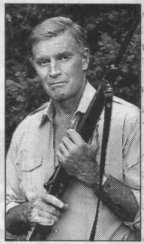
The Festive Charlton Heston

In a letter, the N.R.A. president, actor Charlton Heston, said the group was canceling a gun show along with all other “festive ceremonies normally associated with our annual gathering.” The group was nevertheless going to hold its annual members meeting at the city’s convention center. From the New York Times, April 21, 1999

heston.jpg (55519 bytes)

“Festive ceremonies normally associated with our annual gathering”?????

This is Moses speaking. Moses also asserted that the massacre at Littleton, Colorado shows that every school should have armed guards. Governor of Minnesota and Wrestler Jesse Ventura agreed: “Had there been someone who was armed, in this particular situation, in my opinion, it may have stabilized.” But what does “stabilized” mean to a man who used to run around in tight underpants and throw chairs at people in masks?

Well, why stop at permitting concealed handguns? I think they should be obligatory. Just imagine: you’re at school. A couple of kids come in wearing black trench-coats with furtive expressions on their faces. You gonna wait to see what happens? Hell, no. Case closed. Incident ended. No more anxiety for all those parents sending their kids off to school in the morning– they can trust that everyone is well protected!

Wouldn’t you feel better knowing that your teenage daughter was at school, surrounded by a bunch of illiterate metal morons carrying concealed handguns?

sniper.jpg (6151 bytes)

Think of how convenient that concealed hand-gun might be as well, next time you meet up with those hooligans from that rival football team across town, or that dorky teacher that failed you in Consumer Ed!

Charlton Moses Heston, interrupting his prayer breakfast (I kid you not) also said this: “If there had been even one armed guard in the school, he could have saved a lot of lives and perhaps ended the whole thing instantly.”

Errr…. according to the New York Times, Neil Gardner, of the Jefferson County Sheriff’s department, was in the school at the time, and was quite armed. In fact, sounds like he took a few shots and then cleared out as quickly as possible.

And I’m ashamed about the prayer breakfast bit. Deeply ashamed. Deeply, deeply, deeply. Everyone reading this should know that many, many Christians abhor violence and guns, and don’t consider a gun show to be a “festive” occasion, regardless of whether or not it opens with a prayer breakfast.