Bush League

In a speech at a conference at McGill University recently, former U.S. President George Bush responded to charges that former Prime Minister Brian Mulroney had been too cozy to the U.S. President, selling out Canada’s needs and aspirations in order to cozy up to those big American mega-corporations. “However close our relationship was, the prime minister always had Canada’s best interests at heart.” Spoken like a true tart. He sounds like Dracula praising a woman for her lovely, long neck.

Brian Mulroney himself later proclaimed that where-ever he travels in Canada, “I am just about received in triumph”. It’s a very telling phrase: just about. I picture two old ladies with pom-poms asking if it’s true that Joe Clark is making an appearance. Just about.

Somehow this doesn’t jive with the reports of Conservative campaign workers who found, in the election following Mulroney’s resignation, that doors were slammed in their faces as soon as they identified themselves as representatives of Mulroney’s party. Doesn’t jive, either, with the election results: the Progressive Conservatives under hapless successor Kim Campbell were pretty well wiped right off the map. No one seriously believed this was a vote on Kim Campbell. The Conservatives still haven’t recovered. Mulroney claims that the media made him look bad. The media and about 10 million voters.

Well, when Bush wasn’t busy singing Mulroney’s praises, he lavished a few compliments on former Mexican President Carlos Salinas. Mexico certainly hasn’t lost it’s desire to see Mr. Salinas– he is hiding out in Ireland right now avoiding extradition on charges of pilfering the state treasury. Mr. Mulroney must have blushed with delight at having risen to such lofty heights– to be praised in the same breath with a corrupt former Mexican dictator!

What is so offensive about Mr. Mulroney’s attempts to rehabilitate his “image” is his cold conviction that he really was a great as he thinks he was, and it is only a matter of sufficient determination and persistence on his part for the rest of us to be so enlightened. One gets the impression that he thinks that the people of Canada were tricked into believing he was a creep, and they can be tricked back into believing he was a genius.

The problem with that is that if Canadian public opinion was really so wishy-washy, who would want the blessings of its favour?

Bush has the same problem in the U.S. He is generally regarded as a light-weight president, a man who led his country into the most one-sided and hollow military victory of this century, and, for all that, couldn’t manage to get himself re-elected while running against a shifty womanizing chameleon from Arkansas.

Cutting Taxes

I just read that there is an election in Texas, and all the
candidates are promising to reduce the size of government
and cut taxes.

Here in Ontario, Mike Harris, of the Progressive Conservatives (wouldn’t that name sit nicely on some of those Neanderthal Texans!), is also promising to cut taxes.

This puzzles me. It seems to me that we’ve been cutting
taxes and reducing the size of government since the Lyndon Johnson Administration. The Viet Nam War was the most expensive undertaking by the U.S. government at that time. I can’t remember the last time I heard a candidate promise to “increase taxes and make the government bigger”. But if everybody has been cutting taxes and reducing the size of government, it seems to me that there shouldn’t be very much of either left by now. Just two guys in a rented office in Washington, and a driver’s license bureau in Peoria.

Ronald Reagan ran against Jimmy Carter in 1979, promising to cut taxes. He criticized the Democrats as irresponsible “tax and spend” liberals. In 1979, the U.S. had a national budget deficit of about $45 Billion. Reagan won and cut taxes. He cut spending on a few things but increased spending on the military. When he left office in 1988, the U.S. national deficit was $500 Billion.

That’s the trouble with conservatives. When the deficits in most western countries were really high, they argued that governments could no longer afford to spend a lot of money on social programs and education and health care. People would have to make sacrifices for the good of the country. Workers would have to settle for smaller wages and less benefits. But then they went right out and squandered an unbelievable fortune on idiotic, ill-conceived, outrageously over-priced military hardware like the B-2 Stealth Bomber. (Remember– these are the companies that charged the Pentagon almost $1000 for a common pair of pliers, and $700 for a hammer). And the richest business and corporate leaders continued to give themselves mammoth increases in pay and benefits, while demanding that the government dump single mothers off welfare.

Is it really so surprising that “liberals” like Bill Clinton and Jean Chretien are finally eliminating those horrendous deficits? But even Clinton tends to give in to the military, which, in spite of the fact that America doesn’t have a single powerful enemy in the world, continues to spend money in the most wasteful way imaginable: on military technologies that are obsolete before they even hit production.

Think about this– the U.S. military budget reached a size that could truly be termed “colossal” at a time when most Americans believed that the Soviet Bloc was ten times as large and powerful as it is now. As it turns out, the Soviet Bloc was never anything near the military threat the Pentagon said it was. Yet the U.S. continues to spend even more today on the military than it did in the 60’s, 70’s, or 80’s. A lot of thoughtful people think that this whole Yugoslavian adventure is primarily a desperate attempt by the military to justify sustained expenditures on new toys.

One last thing about tax cuts. Conservatives like Mike Harris love to rave about how they are giving the same tax cut to everybody, rich or poor, white or black, male or female, gay or heterosexual. That’s right. Let’s see. Let’s say it’s a 4% tax reduction.

If you make $50,000 a year and pay $8,000 in taxes, Mike Harris is going to give you a hefty $320 back! Whoooeee! Don’t spend it all at once! You may want to save it for appointments with your acupuncturist!

Now, if you make $500,000 a year, and pay $100,000 in taxes, then your tax break amounts to…. hold on to your hat! $4000! That’s right. Even though you make way more money than the poor schmuck making $50,000, the province of Ontario is going to give you ten times as much money back! Sort of Robin Hood in reverse. Especially when you consider that to get that $4000, Mike Harris had to borrow $24 billion, which is now added to the province’s dept. Actually, he also got some of the money by reducing services at hospitals and schools, that benefit everybody regardless of income.

Lest you think I’m just another of those “tax and spend” liberals, let me assure you that I hate paying taxes as much as the next guy. It just peeves me off when the government borrows money from all of us to give a big tax break to a few. Let’s at least eliminate the deficit before giving out any big fat tax breaks, and lets make sure we have adequate housing, medical care, and social services too.

Do you like walking past the panhandlers in downtown Toronto? Me neither. Harris’ solution is to truck them out of down. My solution is to rearrange priorities. Second BMW for a wealthy Ontario family? Second. Affordable housing for poor people in Toronto? First. Done.

I’ve said this before and I’ll say it to my dying day: even the rich benefit from a stable, safe society, and you can only have a stable, safe society if you ensure that wealth is distributed fairly among as many people as possible.

Ketchuppy

Heinz recently held a bit of a pageant. They were looking for a new advertising agency. They already hold about 46% of the ketchup market, but they wanted more.

Maybe they saw the khaki ads for The Gap on TV and thought, “Hey! They’re cool! They’re hip! We want to be cool and hip. Are we cool and hip? I don’t think so. Let’s find someone to help us be cool and hip.”

The two finalists were Leo Burnett Co. and TBWA Chiat/Day. Chiat/Day is famous for some weird new office concept they introduced a couple of years ago: nobody would have a desk or a computer or an office. Everyone would just wander around until he or she found a nice place to work. You could borrow a computer from the front desk. You could sit in a portable cubicle if you had a private meeting. You could haul your files around in a little red wagon. It didn’t work.

The Burnett Co. created the famous “Anticipation” ads for Heinz many years ago– you know– showing ketchup slowly dripping from the bottle while playing the Carly Simon song.

Anyway, the Leo Burnett Co. must have been watching those khaki ads too. They won the contract. How did they do it?

They met with teenagers at restaurants and tried to figure out what the “essence” of ketchup was to these kids. They asked, “if ketchup was a TV character, who would it be?” The answer: the Fonz.

Ah! Oh! Now we understand! Unfortunately, when asked if ketchup was important to them, most teenagers said, “nah”.

What! Ketchup is not important to you! Egad! Outrageous! How can we remedy this state of misguided culinary atrophy?

A Beavis and Butthead spoof? Passé.

The solution was to give ketchup “a personality”. To give it a hip, iconic personae, that can withstand the rigors of adolescent ironic detachment. “Even ketchup advertising can be edgy” chirps Newsweek.

Heinz wasn’t sure. They called in a consultant named Gary Stibel. “Yes, ketchup advertising can be edgy. Here’s my bill.”

Burnett won the contract. Their ads will “focus on teens’ desire for control by showing ketchup smothering fries ‘until they can’t breath’ and highlighting its ability to make food taste ‘ketchuppy’ “. The ads “avoid traditional product-touting or slogans, which might turn off media-savvy teens”.

Ketchup is a good product. I like it on my fries and hamburger. And Heinz makes the best ketchup– check out the number of restaurants that buy a cheaper brand and then pour it into Heinz bottles. Heinz thinks I should put ketchup on my pizza and grilled-cheese sandwiches. Right.

And they think they are pretty smart. They think they can manipulate teenagers by being iconic. They think they can fool us by deconstructing their own motivations: we are not here to sell you a product. We are here to sell you an image. You’re sitting there at a table in a restaurant with your friends. You’re worried about whether or not your friends like you. Do they find you sophisticated enough? Do they find you sufficiently ironic and detached? Are they convinced that you cannot be manipulated or deceived by adults?

You reach for the ketchup. You’re cool.

The Cost of Books

Why does a book cost about $25 nowadays? Why do even paperbacks cost $15? How much do you think the author gets?

Well, the author gets about a buck. That’s right: $1.00. The rest of that “reasonable” price is the cost of printing, formatting, shipping, and handling. It includes the cost of display shelves, store clerks, cash registers, and agents. It includes the cost of advertising, promotion, travel, office furniture, telephones, and postage.

What if you didn’t have any of those costs? What if you could buy the book directly from the publisher? What if the book could be shipped to you over a phone line, in about 10 seconds? What if the publisher didn’t have to pay for paper? How much should the book cost? About $2.00, right? All right– let’s be generous: $3.50.

Wrong. It would cost $15-20.00. It would cost more than the same book on sale, in paper, on a shelf, in a store, in front of a counter with a cash register and a clerk.

This makes no sense. But it’s true. Meet the “electronic book”. Meet greed.

This reminds me of when the CD first came out. It was priced about $10 more than a vinyl LP. Why? The record companies said it cost more to produce. Well, today the CD cost way less to produce than a vinyl record. When do the discounts start? When do they start to pay their artists?

Yes, the first “virtual” books are on the market: The Software Book and The Rocket. They cost about $500 – 600. They are about the size and weight of real books and consist mostly of computer components and monochrome screen. Yes, you can read in the toilet again.

And how about that: you can buy Shakespeare for your virtual book. I couldn’t find out the price, but I’m sure you won’t mind paying a royalty on it.

Should you buy one? If you’re the kind of person who buys lottery tickets for birthday presents, then yes, by all means.

For the rest of us— forget it.

Some Numbers

Americans killed in the…

Civil War: 600,000

World War I: 114,000

World War II: 292,000

Viet Nam: 56,000

Germans killed, WWI: 2,000,000

French killed, WWI: 1,700,000

British casualties, battle of Passchendaele, July 1917: 70,000 dead, 170,000 wounded.

So Happy Together

So Happy Together

Come all you fair and tender maidens
Take care with how you court young men
They’re like a star on a cloudy morning
First they’ll appear, and then they’re gone

Have you ever watched those late-night dating shows, with the sleazy host who dances and leers at all these dancing women and urges you to call this number to meet them? The girls take turns preening in front of the camera and saying stuff like, “Hi, I’m Carmen, and I like hang-gliding and scuba, and I’m looking for a guy who can be sensitive but also has a great sense of humor.” And makes a lot of money.

Crass and demeaning, and depressing, isn’t it? They say that 17% of all newlyweds had sex on their first date. Well, here they all are, the 17%, giggling and wiggling and flexing their abs, just begging you to call. They want to meet people. They want to have fun. They are all employed.

They’ll tell to you some loving story
They’ll tell to you that they love you best
Straight away they’ll go, and they’ll court another
That’s the love they have for you.

I don’t mean to be sarcastic with that last remark. These women hold jobs. Good jobs. They get paid well. They can afford nice clothes and makeup. They work hard all day, and they want to party all night. One day, they probably want to settle down and have 1.2 children. They want that child to grow up quickly, with privilege and ambition, so they can get right back to hang-gliding. As soon as the baby can walk, their mothers are back on the run, taking part-time work, exercising, taking classes. Before you know it, the child’s in day-care and mom is back on the daily commute, along with dad. Whoever gets home first makes dinner.

Presuming it works out…. if the guy they’re doing this with turns out to be annoying or stupid or unfaithful, they won’t hesitate to divorce him.

How far we are from “fair and tender maidens”, a mournful, nostalgic song if I ever heard one. Fair and tender: pretty and sensitive. The tragic tone of this song could only be due to the fact that the rejected girl’s entire life was doomed because of the infidelity of her boyfriend. He’s off courting another—she gets to grow old in dire poverty, or move to London and become a prostitute. He doesn’t care if it’s her or some other girl: they’re all alike to him. He doesn’t need her. He’ll go join the army, get a new job, or run off and fend for himself.

Update that song to the 1940’s and you get the girl who gets pregnant out of wedlock. Update it to the 1950’s and you get the devoted secretary who finally realizes that her boss is never going to leave his wife. But update it to the 1960’s or 70’s and the song no longer makes sense. Though it will be a long time before she can make as much money as he does, she can move around, find a job, enroll in a different university, whatever. She won’t be pregnant because, maybe, she was smart enough to get on the pill before she started having sex with him. Maybe she’s experimented a little, with drugs, or alternative lifestyles.

And the 1990’s? Girrrrls. Tattoos. Attitude. Self-defense training. Articles in Harper’s called “Who Needs Men?”.

Some people find it tempting to think that those “fair and tender maidens” had it a lot better than our “girrrls”. In our own nostalgic fantasies, she did get married, and her husband provided for her and never strayed, and they grew old and happy together and went to church twice every Sunday and never questioned authority because God appointed governments and magistrates to restrain the evil-doers.

On the other hand, it’s hard to overlook the fact that the adult female population of London in the late 19th century consisted largely of prostitutes—women who, for various reasons, didn’t fit into our nostalgic fantasy, and had to go fend for themselves, and because they were denied access to any meaningful employment, fell into the only vocation left available to them. And as for all those “faithful” husbands and fathers… there has to be a big population of customers to sustain that many prostitutes.

Some progressive social thinkers nowadays question whether men even have a role in our society anymore. Women don’t really need them. They can go to university, get jobs, buy homes and cars, and raise children by themselves. They can decide not to have children at all. In Japan and Europe this process is already accelerating with bewildering speed—more than 50% of adults live alone in some communities. In Iceland, 65% of all children are born out of wedlock. In Japan, more and more women are refusing to marry. Many industrialized western nations have a negative birth rate.

Tonight the light of love is in your eyes
But will you love me tomorrow?

If these thinkers are right, and the social and economic forces in our culture are driving men and women into greater and greater independence, it seems likely that more and more people are going to be spending more and more time alone in the future. I think of that guy in “2001: A Space Odyssey”, living in some weird all-white apartment, eating his breakfast, watching the time warp, growing old, and dying, and being reborn as a cosmic fetus. You should see it if you get a chance. It may well be our destiny.

The Ends of the Earth

Once upon a time the top of the world was a small, undefiled place, where, if anywhere on the planet, a man could go to be alone with himself for a moment or two.

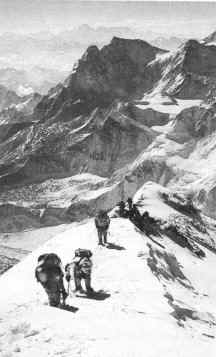
Below, 39 climbers make their way to the top, on May 10, 1996.

everest2.jpg (23473 bytes)

Star Whores

Some guy in New York, who was interviewed on TV recently, paid $2000.00 to see the new Star Wars movie, the Phantom Menace, three days before its general release.

Some people act as if this is some kind of gesture of true fanaticism. Now, I can imagine someone being “fanatic” about Leonard Cohen, or “Rocky Horror Picture Show” or Isabelle Adjani. But Star Wars?

Some critics are saying that “The Phantom Menace” isn’t nearly as good as the original “Star Wars”. As if the original “Star Wars” was any good.

George Lucas honed his cinematic chops on Hollywood “B” pictures of the 1950’s. These were second-rate adventure stories about gangsters and hoodlums and men in masks and space ships that were regarded with condescension by serious movie critics because they were unbelievable, unimaginative, and repetitive. It was a bit of a shtick for some critics in the early 1980’s to regard some of these movies as “found” classics, as if they were really quite good in some strange way, though we hadn’t noticed it the first time.

This was just some kind of reconstructionist oneupsmanship that critics indulge in periodically to prove that they really are more thoughtful or clever than other critics. The truth is, as it always was, that most Hollywood “B” pictures really were as dumb as they looked.

And so is “Star Wars”, and all of its sequels or prequels or whathaveyou. The only difference between “Star Wars” and the Hollywood western is that Lucas was able to lavish expensive special effects on “Star Wars”. The story is still dumb. The script is mind-bogglingly inane. There are no interesting characters. There is no interesting story.  The penultimate scene of the victory of the virtuous heroes is copied from Leni Riefenstahl’s “Triumph of the Will” (I kid you not).  And don’t forget: this is about restoring a princess to the throne.  A damn princess.

Some movie fans think that’s just great. That’s what movies are for. Escapist entertainment. I might concede the point except that “Star Wars” isn’t even all that entertaining. It’s not as much fun as, say, “Robocop”, nor as playful as “PeeWee’s Great Adventure”, nor as witty as “The Princess Bride”. It’s just tedious and boring.

Finally, aren’t we all a little tired of having all the merchandise shoved down our throat? “The Phantom Menace” is nothing more than pure business, and tries to make a virtue out of overweening greed and ruthless acquisitiveness. The toys, the lunch pails, the action figures— it’s a little sickening, especially since it is all aimed at youngsters.

“Into Thin Air”: on Climbing Your Ego

For a while, Edmund Hillary and Tenzing Norgay were the only two persons to have set foot on the top of the world’s tallest peak. They did it on June 2, 1953, just before coronation of Queen Elizabeth II. The news electrified the world in a way we can hardly imagine today. The North Pole had been found, and the South Pole, and almost every other remote location in the world had been explored and conquered and claimed. British climbers had been trying to ascend Everest for at least 25 years before Hillary and Norgay, using bottled oxygen, finally succeeded.

Since then, there have been more than 615 successful ascents of Mount Everest– and 142 deaths. In 1996 alone, there were 30 expeditions, all up there during the same two-week period in May, the only safe– if you could call it that– time to climb Everest, between the winter snows and the spring typhoons.

So it’s not a very exclusive club any more. Nor is this club confined to extraordinary athletes: in 1985, climber David Breashears escorted a wealthy but fit 55-year-old Texan to the top, proving, so it seemed, that almost any reasonably healthy person could do it. Everest lost some of its lustre and soon serious mountain climbers were going after more exotic records, like “first person to climb the highest mountain on all seven continents” and “first person to climb a mountain on a bicycle” and “first person to actually camp on the summit”, and so on.

Every year now, dozens of climbers make the attempt, and a good number of them make it. It’s become big business, for the guides, for the Sherpas (12 or more required for each expedition), for the climbers (witness the glut of books and films), and for the governments of Nepal and Tibet, the two nations bordering on Everest. These governments charge up to $70,000 for permits for each expedition. Legitimate expenses? Right.  Because the government has to cover some costs involved in these expeditions.  Do they?  So how come volunteers from around the world have to clean up the cast-off oxygen bottles and torn tents? Cash grab? Probably.

Still, it would be a mistake to underestimate the resolve, discipline, courage, and determination required to plant your foot on the highest spot on the planet. One out of five never come back.

It’s not as if you can just take a bus to the base of the mountain and then give it your best shot. The journey to “Base Camp” itself (at 17,500 feet, the starting point for all expeditions to the top) requires a flight to Katmandu, a ride in a battered, aging Soviet helicopter to the town of Lukla, 9,200 feet up, and then a long trek, usually about 3 or 4 days, through mountainous passes and wobbly foot-bridges over winding rivers. There are no Holiday Inns on this journey: you stay overnight in rambling, leaky stone lodges. You may pick up a dangerous parasite if you are not careful about what you eat and drink. And if you do get the runs, you’ll have to relieve yourself in an outhouse– if they’re not overflowing.

All of the supplies necessary for a summit attempt– food, water, oxygen bottles, medical equipment, and radios, and so on, must be laboriously hauled up narrow, winding mountain paths by yaks.

There is only about 1/2 as much oxygen in the air at base camp as there is at sea level. Above 25,000 feet, there is only 1/3 as much. Climbers must slowly acclimatize themselves to the thin air, a process than can take up to eight weeks, of grueling excursions up and down the lower ranges of the mountain.

The ascent begins with a harrowing trip through the Khumbu Icefall, a unstable white maze of fractured glacier and towering seracs that has taken more lives than any other part of the mountain, including the summit. In some places, climbers must walk across three or more rickety aluminum ladders strapped together over a crevasse hundreds of feet deep. The glacier itself moves 3 to 4 feet every day, and is covered with a thin layer of snow and ice that can conceal treacherous gaps.

After a few trial runs, you camp above the glacier in temperatures that can descend to -20 C. Then climbers ascend the Lhotse Face, a sheer icy wall of 3000 feet, and camp about halfway to the top of it, at 24,000 feet.

When someone says “mountain climber” to us, we tend to picture a blonde yodeling alpinist ascending a steep rock face with ropes and pick axe. Most of Everest, however, including the Lhotse Face, is more like a very steep walk. Most climbers attach themselves to ropes strung along the face for safety, but they basically walk up a very steep, hard, icy incline of about 30 degrees. It is the incredible cold, the wind, the snow and ice, and that thin oxygen that makes it so fearsome.

The tents are nestled into little ledges carved out of the ice by the Sherpas. The Sherpas don’t carve out ledges for themselves, though: they prefer to go on up to the South Col at the top of the Lhotse Face and camp where it’s safer.

The film version of “Into Thin Air” (a dramatization– not a documentary) shows Chen Yu-Nan, a Taiwanese climber, coming out of his tent on the Lhotse face clad only in his boot liners. He slips and falls down a hundred feet or so and then drops into a crevasse. In the film, he died then and there, but in real life, he died a few days later, while trying to make his way back to base camp. The Taiwanese team proceeded without him.

Above 20,000 feet, the adventurers travel very slowly, resting every few steps. Many climbers develop a hacking cough, dizziness, and insomnia. If you ascend too fast, you can develop altitude sickness– your body fails to produce enough red blood cells to keep your brain fed. This can also lead to High Altitude Cerebral Edema (HACE) or High Altitude Pulmonary Edema (HAPE). Blood vessels in the brain, starved for oxygen, swell up, causing disorientation, loss of motor functions, and even coma. Climbers lose weight quickly, making them more vulnerable to the cold.

As if that isn’t enough to deal with, the sun and snow combine to create unbearable heat and light during the day, giving climbers splitting headaches and dehydration. Once the sun has gone down, the temperature can drop to 20 or 30 below zero or worse. If you were to spend the night near the summit itself, you might encounter a wind-chill of well below -50. Few of the climbers who have been stranded near the top overnight in a blizzard live to tell the tale or make the talk show circuit.

Keep in mind that, even in this day and age of phenomenal technological breakthroughs, Everest remains one of the most remote places on earth. Helicopters cannot ascend higher than 20,000 feet (the air is too thin to provide thrust to the rotors), so there is no rescue possible for climbers trapped near the summit in a raging blizzard, other than the assistance of your depleted and exhausted fellow climbers.

Much of the current fascination with Everest can be traced to the media coverage of the disaster in 1996, when 12 climbers died over a three-day period. Writer Jon Krakauer was on one of those expeditions and wrote a searing, compelling book on it called “Into Thin Air”. This unusually honest and self-examining account of the many lapses in judgment that led to the disaster unleashed a storm of controversy that continues to simmer today.

Krakauer claims that some of the guides behaved irresponsibly, rushing ahead of their clients to the summit and then descending before their clients were safe. One of the key Sherpas wore himself out carrying 80 pounds of useless communications gear for writer Sandy Pittman so she could send “live” dispatches from the summit. Lines were not strung over the difficult Hillary Step until climbers had been waiting in the freezing cold for 90 minutes– a delay that may have cost several lives. It is clear that all of these problems were aggravated by the fact that there were 39 people trying to summit on the same morning. Bottlenecks formed. Climbers in difficulty were lost in the crowd. Guides lost track of who was where.

When a storm struck late in the day, two of the expedition leaders, Rob Hall from New Zeeland, and Scott Fisher from the U.S., were trapped on the mountain, along with several exhausted clients. Doug Hansen, a client with the Hall group and a postal worker from Washington State, disappeared and was never found. Andy Harris, a guide with Rob Hall’s group, probably slipped over one of the sheer cliff’s that surround the peak while trying to assist Hall. A group of climbers barely made it back to the South Col, the location of their advanced base camp, but couldn’t locate the tents in the howling wind and snow. They huddled in the cold growing weaker and weaker until ace climber Anatoli Boukreev (who had descended early, ahead of his charges) found them. Beck Weathers and Yasuko Namba (the oldest woman to ever summit Everest) were left for dead. The others were almost carried back to the camp.

The next day, to the utter astonishment of Krakauer and the others, Beck Weathers walked into camp under his own power. He was put into a tent and made as comfortable as possible, but it was expected that he would not last the night. The next day, he was found lying in the open– his tent had collapsed and torn away in the night and his sleeping bag was half off. He had been shouting for help for hours but nobody had been able to hear him. He ultimately lost his hand and nose to frostbite.

Ed Viesturs and David Breashears, who were waiting at the base camp to make their own summit bid, helped rescue Weathers, an action that became a bit of a sub-plot of the IMAX film. Viesturs and Breashears did a good thing, but the film plays coy with the facts. You are left with the impression that Beck Weathers got into trouble and Viesturs and Breashears heroically rescued him, and that was that. The IMAX film glosses over the rest of the disaster, partly because real disasters don’t sell very well, are complicated to explain, and raise questions about the whole idea of celebrating a summit of Everest.

A few days after Weathers was helicoptered to Katmandu from base camp, Viesturs, Breashears, a Spanish woman named Aracelli Segarra, and Jamling Norgay, the son of Tenseng Norgay, the first Sherpa to summit Everest, made their own successful summit.

The Viesturs team made a film of the trip for IMAX. It’s a big disappointment. For one thing, Viesturs got ahead of the team and reached the summit without benefit of cameraman. So what was supposed to be the climax of the film ends up being a verbal footnote. And when Segarra and Norgay make the top with the camera-man, you are left with the absurd impression that they filmed themselves. They celebrate, embrace, look out over the world, while the narrator trills their accomplishment… and you wonder who the heck is filming this, and why haven’t they said anything about him? How did he get there? Wasn’t that remarkable? Why are you pretending he isn’t there?

* * *

Many people don’t think much of the idea of climbing Everest. Why risk your life for an achievement that is completely symbolic, and of no scientific or humanitarian value whatsoever? Why should we feel sorry for climbers who die on Everest, when it is plain that their goals are entirely ego-centric?

The Viesturs expedition tried to patch a gloss of scientific necessity to the risk they took, much the way Robert Ballard tried to make his efforts to find the Titanic look useful and valuable, and NASA tried to make manned space missions seem necessary. But it is clear that there are really only two reasons people climb Everest. Firstly, to gratify one’s ego: I climbed Everest. Wow. Secondly, (and less dubiously), for the sense of personal accomplishment.

I have some respect for those who climb for the sense of personal accomplishment. It is still a remarkable achievement, of endurance, determination, and mental stamina. As I read through Krakauer’s book, I found myself experiencing an odd sense of longing for that bleak, windswept, arctic landscape near the top of Everest.

But I found that sense diminished when I considered that there would probably be another two dozen climbers up there at the same time.

Krakauer’s book is a powerful antidote to any illusions you might have about mountain climbing. It is a very rare little gem: an honest, intelligent book about sports– for that is what mountain-climbing really is– competition. Who got there first? Who did it the fastest? Who did it the most? Krakauer’s book has soul.

George Leigh Mallory

George Mallory was the mountain climber who, when asked why he wanted to climb Mount Everest, replied, “Because it is there.” This has generally been taken to mean– “because it exists, because it is a challenge, because it has been put before us as something we must conquer!” In fact, he may have simply been expressing his exasperation at hearing the same question over and over again. “Because it’s there…  Stupid.”

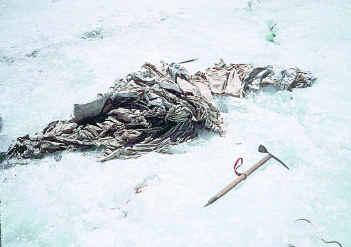
Mallory was lost somewhere high on the North side of Everest on June 8, 1924. A few weeks ago, his body was found by an expedition filming a tv special for PBS’s NOVA. It is remarkably well-preserved. The exposed skin is ivory white, smooth, and hard. He appears to have fallen: one leg is broken, and there is a shoulder injury, and he is facing down, his arms spread out as if he was trying to stop himself from sliding down the mountain. It looks like he fell, injured himself, and then just lay there for some time, waiting for the inevitable end. It was a sad, lonely way to die.

There was no sign of Irvine. Another intriguing mystery: did his climbing partner Sandy Irvine, see the fall? Did they both fall (they were likely tethered) and end up in different locations? Did Irvine survive the fall and set off on his own to descend only to become lost?

Mallory, as noted, was lost on the North side. Most expeditions to Everest nowadays (and the first successful expedition in 1953) follow a route up the South side, considered more accessible, but back in 1924, foreigners were generally not permitted into Nepal.

The location of the body raises the intriguing question of whether Mallory and his partner Andrew Irvine may have summitted before disaster struck on the way down. Nobody knows. The last person to see them alive, Noel Odell, reported that they were within a few hours of the summit at about 1:00 p.m. When his body was found, his sun-goggles were stuffed into his shirt pocket. That suggests that it was past daylight at the time he fell. And the location of the body, well below where he was last seen, suggests that he was on his way down, not up, at the time of the accident.

There is a very difficult notch in the summit ridge just below the peak, an almost vertical climb of 80 feet or so. The problem with the theory that Mallory summitted is the question of how he got over that notch. In the early 1960’s, the Chinese finally got over the notch by pushing a man up through a crevice, but he had to use his bare hands to make it and suffered some frostbite. Once they got a man up there, they tied a ladder in place, and almost all climbers since have used the ladder. (How does that play with your perception of just how athletic mountain climbers are?)  However, the team that found Mallory’s body is incorrect in saying that nobody else has ever climbed the North Ridge without the ladder: last year, another expedition, finding the ladder damaged, did manage to climb it, as did a member of the expedition sent to find Mallory’s body. So he could have done it.

If he had not been able to climb the step, then he would probably have turned around well before daylight expired, and thus would not have tucked his goggles away into his pocket before reaching the slope where his body was found. It’s an intriguing mystery. History may yet be rewritten.

On the other hand, as some, including his son, have pointed out, it’s getting back down alive that counts.

The answer may be contained in Mallory’s camera, if they can find it. Kodak says they can probably develop the film, even after 75 years.

Mallory’s body was left on Everest. That is a tradition among climbers that is the product of necessity: it is very difficult to recover bodies from the unforgiving mountain. He is among the first of 142 bodies currently residing on the majestic mountain.

2013-06-21

Let’s dust a bit of the blather about nobility and honor and class off this story, shall we? At least one excellent climber (Richard B. Graham) was excluded from the team because he was a Quaker and hadn’t participated in the slaughter of World War I. Another was excluded because he was Australian (George Ingle Finch) and, ho ho, pip pip, I say, we can’t have a bloody Australian on the summit along with an Englishman! It’s just not British!

Wikipedia describes how Mallory and Irvine, after failing to climb Everest or to return, were acclaimed as “national heroes”. That’s really quite fascinating. It certainly isn’t the result of a great achievement, because many other men ascended as far as they did without conquering the summit and none of them have been acknowledged as heroes. I think it is a rationalization. They died. Their lives must not have been wasted in a frivolous attempt at personal or national glory. Therefore, they are “heroes”. To say otherwise makes you disloyal and disrespectful.