Software Police

All over the civilized world, the software police– at taxpayer’s expense– are invading homes and the offices of Internet Service Providers, warrants in hand, to shut down those evil, pernicious, dangerous, malevolent software pirates.

That’s the way the world works. The lawyers for a big company like Microsoft or Lotus calls the police. They say, “arrest that man– he’s stealing our software!” The police say, “yes sir!” and throw on their flak jackets, arm themselves to the teeth, hop into their paddy wagons, and go racing out to courageously fight for justice and truth and all that.

It should tell you something about the nature of our economy and our politics that if you called the police and asked them to arrest Microsoft or Lotus or Compaq, for the same crime, they would laugh in your face. You just know, don’t you, that the police would assume that a lawyer for Microsoft represents the forces of justice and truth, while a mere consumer represents… well… the average person. And the law, my friend, has become a tool of the rich, by which they exploit you and me.

Case in point. Do you own a computer? What does it mean to own? If you own your couch, that means that no one can sit on it without your permission. If you own a house, in the U.S., that means you can pretty well kill anybody who tries to enter it without your permission.

You own this computer. So why is your hard drive loaded with parasite programs that suck the breath out of your CPU? Why is your e-mail flooded with SPAM? Why can’t you delete certain directories like “My Documents”? Why does Office 97 exterminate your copy of Office 95, without giving you a choice? And when Windows crashes for the umpteenth time, costing you hours and hours of precious work, why is nobody accountable for it? Why is Compaq allowed to sell laptops with fake modems? Why can a software company sell a check-writing program that doesn’t work and refuse to give the purchaser his money back?

This is theft, of your time and your property.  It is robbery.


Tail-Gunner Bill Buckley Jr.

William F. Buckley, the famous American conservative with a fake, snotty British accent, has recently published a novel. With an audaciousness rarely seen in the literary community, he has decided to undertake the rehabilitation of Senator Joseph McCarthy. Sure, the rest of the world has come to see McCarthyism as a synonym for bigotry, intolerance, and fanaticism, but Mr. Buckley has decided that he alone can correct that erroneous impression. McCarthy was a hero. He was right. He may well have saved America!

I always feel reassured when conservatives show their true colors. You see, many conservatives seem to have turned their backs on McCarthyism and appear to agree with most people that McCarthyism was a bad thing. In a roundabout way, I think this causes many people to get the warm fuzzies when they see George Bush Jr. on television, talking about compassion, even if they know that the U.S. Treasury can’t print dollars fast enough to keep up with the orgasmic flush being directed to Bush, and the Republican Party, by big corporations.

In case anyone needs a refresher, Senator McCarthy chaired a committee which investigated the penetration of U.S. government agencies, including the army, by communist agents. You really need to see one of the good dramatizations of McCarthy’s tactics (“Fear on Trial” is a good start) to appreciate the man. Not a man to waste his time with obtuse diversions like evidence or due process, he merely smeared people with innuendo or suspicion and bullied corporations, the government, the army, and Hollywood, into destroying the lives of anyone who would not appear before his committee, bow before him, and rat on his or her buddies. He was finally disgraced when even Eisenhower couldn’t stomach him anymore. He died a lonely, broken man, an alcoholic, and left, as his greatest legacy, his name as an adjective.

But Mr. Buckley wants to rehabilitate his image. Did we all miss something? Was Senator McCarthy misunderstood? Did he really save America? Can you believe Billy Buckley Jr.’s version of events?

Buckley describes, in his novel, an old black man who asks if it is true that the International Communist Conspiracy is seeking to undermine the U.S. government. Yes, of course. Then why, he asks, don’t we just run them out of town, like we used to? Buckley thinks this is the right attitude. Why don’t we just run them out of town? And that is Buckley’s real vision of “democracy”. If we don’t like someone, we just run him out of town. And why apply that solution only to communists?

If you like that philosophy, then save a soft spot in your heart for “Tail-gunner” Joe McCarthy. And keep your bags packed. There is always a witch hunt somewhere


Letter to Compaq Computers

Thursday, June 03, 1999

Dear Mr. Ciceri,

I’m a busy person, and I’m sure you’re very busy– so I will be very brief.

About two months ago, we were shopping for a laptop computer. I had not purchased a Compaq in some time, because I had been “burned” about seven or eight years ago by Compaq’s proprietary memory modules– we had to pay three times as much as other computer owners did for a simple memory upgrade. However, I thought it was time to give Compaq an opportunity to win more of our business. We bought three Compaq Armadas, and then I bought a Presario Notebook, model 1920, for myself—because I needed a large hard drive and lots of power.

I discovered, within a couple of weeks, that Compaq now installs “Winmodems” on its notebooks. I was shocked and extremely disappointed. I called your staff and asked to exchange this model for a Compaq that had a real modem. No dice—you don’t make any models with a real modem anymore. Fine, I will take a refund—it’s been less than 30 days. Then I’ll get a Sony or some other model that does have a real modem. Surely you don’t want a dissatisfied customer.

I won’t bore you with the details. I was on the phone for hours arguing with your staff. The bottom line was quite clear. Once Compaq has your money— they will never, ever give it back, no matter how dissatisfied you, the customer, may be..

I was a little stunned. Usually large companies that wish to do well over the long term realize that customer satisfaction is far more important than the profit margin on the sale of a single item. We are not a small company. I play an important—probably decisive – role in almost all computer purchases for this agency. You don’t even want to give me the benefit of the doubt?

Your staff argued vehemently with me that winmodems are great. I won’t repeat the discussion—ask any reputable, independent computer expert what he thinks of “winmodems”. They are the “mopeds” of the computer world. They only function with Windows. They create a larger profit margin for the modem vendors because, even though they cost less to the consumer, they also cost way less to manufacture. And they can sell you an “upgrade” without providing any new product at all. Just send the user a “patch” that shoves more of the work onto the CPU. And Winmodems increase Microsoft’s proprietary stranglehold on the desktop.

That’s not my only complaint about your notebook. I discovered that my 6.5 GIG hard drive is only a 5.0 Gig hard drive. Again, semantics aside, the Presario has stolen 1.6 GIG of MY disk space for something called “System Save”. I am warned that if I delete this, I will be in danger of losing data or worse.

Look, you had a reasonable customer who didn’t expect the world—only a decent, well-made notebook computer, with 6.5 GIG hard drive space, and a modem. Because this notebook has a “winmodem”, I cannot use it to run Linux, my favourite OS. Nothing in your advertising or webpages indicates that you can’t run Linux on the Presario 1920. And, well, you can run it, if you don’t need a modem. As if…

Anyway, the bottom line is this: Compaq had (has) a choice. Compaq could have said: we have an unhappy customer. We did fudge a bit about the modem. Maybe he’s got a point. Maybe not. But let’s make sure we don’t cost ourselves future sales: give him his money back.

Or… like any carnival huckster, Compaq can keep my money in their tight little fists and refuse to ever give it back, knowing full well that it would cost me more in legal fees to fight them than it would to swallow that unpleasant taste in my mouth and take my cruddy little notebook computer home and let it sit in a little corner somewhere.

Sir, you refused to make good on your promises. You made me feel ripped off. Your salesmen, beyond all comprehension, said, yes, we will write off any possible future sales to Christian Horizons for years and years and years, just so we can desperately hang on to the profit margin from a single laptop computer. I was amazed. If I had any money invested in Compaq stock and if I thought this was representative of how Compaq deals with its customers, I would sell my stock immediately.

Unless Compaq has a change of policy, you might as well send your brochures elsewhere.

Bill Van Dyk

Butch, Sundance, and Etta: the Lonely Dislocations of History

Robert Leroy Parker, alias Butch Cassidy, was born in Beaver, Utah, on April 13, 1866. He was the first of 13 children. His mother and father were Mormons, trying to eke out a living on a small homestead that was eventually taken away from them by the Mormon Church. At 16, Butch met a drifter and cattle rustler named Mike Cassidy. Cassidy taught Butch how to shoot, and, possibly, why he would want to know how to shoot. At 18, Butch left home and began his long career as an itinerant outlaw. Eventually, he adopted Cassidy’s last name. He was called “Butch” after one of his infrequent attempts to earn an honest living, as a butcher.

Harry Longabaugh, alias The Sundance Kid, was born in Pennsylvania in the Spring of 1867. At the age of 15, he left home and traveled to Durango with a cousin. He drifted around taking jobs here and there, until the harsh winter of 1884, when disastrous winter storms in the west wiped out most large herds of cattle, and the jobs tending them. In 1886, he stole his first horse. He was caught. He escaped. He was caught again, and escaped again. A newspaper published a headline story about his adventures. He wrote a fairly literate letter to the editor, disputing some of the points, but disarmingly conceding that he was, indeed, a thief.
butch.jpg (8813 bytes)

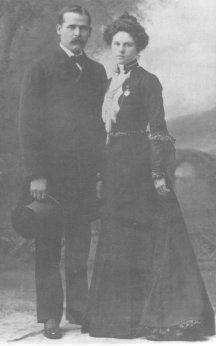
It was around this time that the Sundance Kid met a woman named Etta and took her with him to the famous outlaw refuge, the Hole-in-the-Wall, in Wyoming. Who was she? Where did she come from? Why was she traveling around the wild west in the company of a known outlaw? She registered in hotels as Etta “Place”, but Place was Sundance’s mother’s last name. All that was known about her for certain was that she was young, she appeared to be refined and educated, yet she could ride a horse and shoot a Winchester rifle, and she spent about ten years in the company of two of the most wanted bank robbers and criminals in the history of the American West. There were many rumors—that she was a prostitute, or a teacher, or both–but almost nothing could be confirmed. Even the Pinkerton’s Detective Agency was mystified by her.

On June 2, 1899, the Sundance Kid and Butch Cassidy, and about five others, robbed their first train together—the Union Pacific—between Wilcox and Medicine Bow, Wyoming. They politely informed passengers and crew that no one’s lives were in danger as long as they cooperated. Then they blew up the mail car—using too much dynamite– and recovered $30,000 from the debris. On August 29, 1900, they took another Union Pacific train for $55,000. On September 19, $33,000, from a bank in Winnemucca, Nevada. The banks and railroads posted rewards of $10,000 a head for any member of the gang. In today’s terms, that would be over $100,000. Their $30,000 haul from the Union Pacific was probably worth about $400,000 today. Pocket change, by Michael Jordan standards.

Keep in mind that some conjecture is involved here. While it is known with some certainty that Butch Cassidy and the Sundance Kid were associated with the gang known as the Wild Bunch during this period and that members of this gang committed a series of train and bank robberies during the late 1890’s and early 1900’s, everything else is somewhat conjectural. Naturally, the outlaws did not exactly keep detailed logs of their larcenies. Different combinations of men robbed different banks. In some cases, Butch or Sundance may have masterminded robberies that they did not directly take part in. In other cases, it is now known, robberies attributed to them were committed by others.

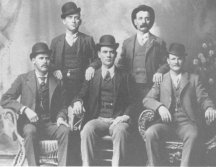
That fall, one of the gang members married a former prostitute, Lillie Davis, in Forth Worth, Texas. Lillie had worked in a well-known bordello named “Fanny Porter’s” in the rowdy Hells Half Acre—a sort of red-light district to which the authorities turned a blind eye, usually. After the reception, Butch Cassidy and the Sundance Kid, and Harvey Logan, Ben Kilpatrick, and the groom, Will Carver, had a group portrait taken. This turned out to be a serious mistake, an act of hubris, by men who were otherwise regarded as very clever. A Well’s Fargo detective, recognizing Will Carver, obtained a copy of the picture and it was widely posted. Ironically, it may have been this picture, more than anything else, that sealed the image of glamour and sophistication attached to these men, in the public mind. The outlaws look dapper, bemused, and well-bred. They look like well-to-do bankers. They looked successful.

Study the photograph carefully for a minute. Will Carver was killed by a sheriff in Texas in April the next year. Logan, reputed to be the only genuine psychopath in the group, was killed (or committed suicide) in June 1904. Kilpatrick was captured and sentenced to 15 years in November, 1901. He was released in 1911, and killed while attempting to rob a train less than a year later.

Anyway, back in 1900, Cassidy and Sundance found their lives becoming difficult. The wild open plains of the west became dotted with towns and villages, new railroads and telegraph lines, marshals and posses, private detectives and bounty hunters. The legendary Pinkerton Detective Agency, hired by the railroads, was also hot on their trail. With their photos posted everywhere and large rewards for their capture, dead or alive, they faced long, lonely, restless lives as fugitives, never able to drop their guards for even a minute.

Oddly enough, they felt safe traveling to New York City with Etta in February, 1901. I would suppose they figured that would be one of the last places Pinkerton’s would expect to find them, but who knows?
etta.jpg (9875 bytes)

After three weeks of rest and relaxation, they departed for South America, where they planned to go straight, buy themselves a ranch, and blend into the general population. Sundance, in particular, seemed to crave a “normal” life, perhaps hoping to settle down with Etta and raise children.

In South America, the threesome established a ranch near the remote town of Cholila, in southern Argentina, where they built a log cabin and acquired horses and cattle and entertained their neighbors and were regarded as good citizens. Argentine officials had no idea of who they really were. It is said that Etta even danced with the governor at a ball.

For unknown reasons, Sundance and Etta traveled to Manhattan on April 3, 1902 and remained there for three months. Butch accompanied them as far as Buenos Aires. He stayed in a comfortable hotel there, the Europa, for three weeks. Sundance may have sought medical treatment for a wound in the leg in Chicago, and Etta may have seen the doctor as well: about this time, the Pinkerton’s obtained a description of her. She was 5’ 5″, 110 pounds, medium dark hair, blue or grey eyes, no blemishes on her skin.

Butch allegedly said of her once, “She was a great housekeeper with the heart of a whore.”

Cholila was a remote village in Southern Argentina, inaccessible from the more settled north during the rainy season, and 15 days strenuous travel by horseback from Rawson, on the coast. Nevertheless, the Pinkertons were able to trace their movements through informants. They offered to arrest them and bring them back to the United States for trial, but the American Bankers Association was content to leave them alone in South America, where they wouldn’t be able to rob American banks.

The Pinkerton’s were not content. A spiteful agent, Frank Dimaio– it had to be spite, didn’t it?– circulated wanted posters in the area around Cholila. He tried to persuade the Argentine police that Butch and Sundance were involved with local bank robberies. By the end of 1904, the trio had disappeared from Cholila. They had been tipped off that the authorities were on their way to arrest them.

Without a source of honest income, Sundance and Butch fell back upon tried and true methods of survival. They robbed a bank in Rio Gallegos, near the Magellan Strait, and then they robbed one in Villa Mercedes, about 800 miles north of Cholila. It is generally believed that Etta took part in both robberies. According to friends, Butch and Sundance had wanted to go straight, but nobody would let them.

The details of the Rio Gallegos robbery provide an interesting glimpse of how they operated. The three arrived in town two weeks before the robbery and checked into the best hotel under assumed names. They deposited $12,000 in the Banco de la Nacion, the largest, most prestigious financial institution in town, and made the acquaintance of the manager and several tellers. They made it known that they were looking to buy some land and were invited to parties given by the elite of the town. Either Butch or Sundance dropped by at the bank every day, pretending to have business to discuss with the manager, while actually scrutinizing the layout, the schedules of major deposits, and the best escape routes. On the day before the robbery, they withdrew all their money, and threw a lavish party that lasted well into the night for all their new friends. The next day, at 11:00 a.m., one of them asked to see the manager while the other waited in the lobby. Then they pulled out their weapons, forced the manager to turn over the money, and raced off on fresh horses waiting for them outside, probably with Etta. They made off with $70,000. Several posses and police forces followed them for up to three weeks. All they found were tired, discarded horses.

In January 1906, the trio were seen crossing the Salado river on a raft, probably headed over the Andes into Chile. This may well have been the last reported sighting of Etta Place. She was never seen again in the company of Butch or Sundance, or, indeed, anyone else.

Percy Siebert, an engineer for the Concordia Mine, where Butch and Sundance worked for a time as payroll guards (!) claimed that Butch told him that Sundance had taken Etta back to Colorado for an appendectomy. While waiting for her to recover, Sundance got drunk one night, shot up his room, and had to leave town in a hurry. “He didn’t know what became of her after that,” said Percy. Nor did anyone else. Etta’s pretty, fine-featured face faded away into one of the great mysteries of the old west.

If she had needed an appendectomy, it would have made no sense to travel all the way to Colorado to have it done: she would have died well before she got there.

He didn’t know what became of her after that. I don’t want to just glibly pass over that line. If, as reported, Sundance fled the scene and never came back for her, it’s one of the saddest lines ever written. How does the “heart of a whore” break? Did Sundance grow tired of her company, or did she grow tired of their primitive, dangerous lives in Argentina?

In the following years, Butch and Sundance tried again to go straight, working for mines and ranchers, but inevitably their real identities were discovered and they were forced to flee. Again and again, they resorted to larceny to get by. After holding up the payroll for a mining company in Bolivia, in early November 1908, they stopped in a small, godforsaken little town called San Vicente. A citizen noticed the mining company brand on one of their mules and notified the local constabulary. When the soldiers arrived to question them, gunfire broke out. Butch and Sundance were trapped in a small, unprotected villa. After an intense gun-battle, both were seriously wounded. The police waited all night before confirming that the two were dead. Both of them had died from bullet wounds to the head. It was believed that Sundance shot the wounded Butch to put him out of his misery, and then himself.

There were persistent rumors that Butch survived the shootout—or wasn’t even there when it happened– and traveled back to the U.S. where he lived in anonymity for another thirty years. Unfortunately, there is very little convincing proof of this story. A Spokane machine shop owner named William T. Phillips famously claimed to be the former outlaw, but his claims have been demonstrated to be false.

What is clear is that no one ever heard from them again. All letters and contacts ceased as of November 6, 1908. And almost immediately, the process of transforming outlaws into icons set in. Western novels celebrated their skills with a gun, their rugged individuality, and “honor” code (the myth of the shootout at high noon, with it’s almost mystical adherence to protocol). One of the very first films ever made, Porter’s “The Great Train Robbery”, was inspired by their exploits.

* * *

Now most Americans nowadays seem to be possessed of this great notion that men and women who break the law should be punished very severely. If you commit a felony three times in California, the judge is obliged to sentence you to something like 50 years, under the “Three Strikes and You’re Out” laws passed by its enlightened state legislature.

You would think that a society that is so determined to punish crime that it would send pick-pockets, soft drug users, and shoplifters to prison for 50 years would regard a pair of bank robbers with at least a little ironic detachment. But a quick browse through the dozens of web sites devoted (and I mean devoted) to Butch Cassidy and the Sundance Kid tells you a different story: Americans love these guys. They adore them. They admire them beyond all reason and common sense. They want to know everything about them, what they wore, what they ate, how many bullets they had in their gun belts at the moment they died. They want to believe that they were the fastest, the smartest, the best-looking criminals on the face of the earth. They are our heroes.

You could make an argument for it. Butch and Sundance planned their robberies with meticulous attention to timing and detail. Like Bonnie and Clyde, they seemed to rob institutions, not people. They tried to live up to a standard of professionalism. They preferred to get in and out quickly, with a minimum of confrontation. They studiously avoided shooting anybody if they could. This might strike the modern reader as chivalric, but there’s a lot of common sense to it too—murder is a far more serious crime than robbery, and would certainly draw more lawmen, detectives, and bounty hunters into the chase.

But when pursued and confronted, they would shoot to kill. I didn’t see many web sites devoted to the lawmen who died in their wake.

So you could argue that Butch and Sundance are heroes today because they were smart and witty and good-looking and didn’t really do any harm to people, other than to the banks and the corporations. On the other hand, you could probably say the same about a lot of those young men serving long prison terms in California right now. In 1993, 50% of the prison population consisted of people convicted of drug possession. Surely these men and women were no more intent on harming anyone—other than themselves– than Butch or Sundance were. I’ll bet a lot of them are witty. Some of them probably know how to dress well.

And you could say the same about a lot of young professional athletes, who get caught using drugs, or driving while drunk, or assaulting their coaches, or raping cheerleaders, or cheating on their college grades. Those poor boys. We should help them.

There is a further irony in the fact that one of the reasons Butch traveled out west in the first place was his thirst for adventure, slaked by cheap dime-store novels about the west. Blame the media.

It is important to remember that the line between right and wrong in the western frontier in the late 19th century was not clearly delineated. Ranchers frequently “employed” lawmen, to drive out homesteaders and “undesirables”. Sometimes the homesteaders would hire their own “lawman”, to fight the rancher’s lawman. State politics were exceedingly corrupt. Perhaps, like Bonnie and Clyde, the Sundance Kid and Butch Cassidy represented the underdog, fighting the corrupt powers that be. Perhaps they were just good businessmen, like Monsieur Verdoux, doing what they had to to make a living. Kill someone during a robbery and you are a criminal. Kill thousands during an invasion and you get a medal.

But in the same sense, young black athletes, like Allen Iverson, Lattrell Sprewell, and others, emerged from poverty and economic oppression in the dark inner cities of America, to represent vicarious triumph over the corrupt, rich, white racist establishment.

There’s not much out there that reads well in black and white. Most of the world is as grey as Etta’s peerless face in that wonderful black and white photograph. We don’t know what became of her after that.

Henry Cisneros

America the Pure

Henry Cisneros was the Mayor of San Antonio in 1988. He was married with children. Then he had an affair with his campaign manager, Linda Jones. It was not a very secret affair: almost everybody involved in civic politics in San Antonio knew about it. Cisneros decided to come clean about the affair: he called a press conference and admitted the truth. Then he left his wife, and moved in with Linda Jones.

Nobody admires an adulterer, of course, but it isn’t against any law in the United States or Canada. Cisneros left politics and tried to make a new life for himself with his new partner. Big deal.

About a year after he left his wife, Cisneros changed his mind and moved back in with his wife. Good. He did the right thing. But Linda Jones, in the meantime, had left her own husband. She graciously asked for a divorce without alimony. Gracious indeed, since she was the one who broke her marriage vows. After Cisneros left her to go back to his wife, Jones was not as gracious. She demanded some kind of support payments. She wanted $4,000 a month. Cisneros agreed. Everything, at this point, looks a little tawdry, don’t you think? Still, nothing illegal about it all.

In 1992, Bill Clinton made Cisneros head of the Housing and Urban Development Agency (HUD). Before he could take up his new position, he had to pass an FBI “background check”. The FBI asked about financial issues and Cisneros did something a little strange. He informed the FBI that he had given money to Jones but he said that he gave a lot less than he really did. This is strange because there is nothing illegal– quite the contrary– about paying support to a former partner. Nevertheless, when Cisneros’ financial obligations increased– he has a child with a heart defect and two daughters in college– he stopped making payments to Jones. Jones sold her stories to the tabloids and launched a lawsuit. The FBI found out that the amounts he had previously paid her were far in excess of what he had said he paid her– more like $40,000 instead of $10,000 a year.

Janet Reno appointed an independent prosecutor to investigate the charges. Why? Who knows? It cost the FBI and the Independent Counsel $9 million to investigate Cisneros’ consensual relationship.

Cisneros now faces 90 years in jail. I’m not kidding. For what? For “conspiracy”, “lying to a law enforcement officer”, “obstruction of justice” (which sometimes appears to be the major crime of not telling the police when you are committing a minor crime or something that could be construed as a crime). Whatever.

What kind of a lunatic asylum is this? What kind of an idiot is running the Justice Department and the FBI? What kind of a nation tolerates this kind of hysterical persecution?

A nation that executes children. A nation that subsidizes millionaire athletes. A nation that rewards graduating high school seniors with breast implants. A nation that enters a war with the expectation that it will withdraw with the first casualty.

Update, February 2003:

I just discovered that Bill Clinton pardoned Cisneros in January 1999. One of the few pardons that makes sense..

Update January 2006: The Republicans want to reanimate the Cisneros scandal after a disclosure that– apparently– someone came to their senses and decided that $9 million was quite enough to spend on investigating a well-known divorce. Cover-up, Cover up!

Are most Republican supporters so whacko that they will be sufficiently aroused by Robert Novak to simply buy this story without actually checking into any of the details? Write me if you are a Republican and you actually did some independent research on the Cisneros stories before buying the “cover-up” spin. Please.

Your Hard Drive is Your Property

Did you ever consider that your computer is private property? You bought it. You paid for it. It’s yours. The hard drive, the motherboard, the CD, the RAM— it’s all your property, just like your couch, your stereo, and your house. If someone came into your house and tried to remove your computer without your permission, you could have that person arrested. If the same person tried to steal your computer three times, in California, he could go to jail for 25 years! Think about that. Our government is so concerned about your private property that is willing to spend millions of dollars to punish anybody who tries to take it without your permission.

The hard drive is your property too. That’s where the programs and data go. The hard drive is like a gigantic cathedral with thousands and thousands of rooms. And you own it! All of it! And like any owner, you can put stuff in your rooms.

Wait a minute! Somebody’s living in your cathedral! Some complete stranger just walked right in and made himself at home without asking for your permission. Not only that, but he’s brought hundreds of his friends. By golly, they are taking up a whole wing of your cathedral!

Why, it’s Bill Gates. He’s living in your house! How about that!

How did he get there? Well, first of all, on the day you bought your computer, Bill Gates and a large number of his friends moved right in. And guess what? Not only does he get to live in your hard drive without paying you any rent, but he gets to make YOU pay rent, even though you might never have invited him in. Yes, you pay the Microsoft Tax every time you buy a computer, whether you want Bill Gates to live on your hard drive or not. If you don’t believe me, go to a computer store and tell the guy that you want to buy a computer but you don’t want Windows on it.

Ever look through your Windows directory? There’s about a hundred subdirectories! That’s where all of Bill Gates’ parasitical friends live. You’ll find his best friend, MSN there, along with IE, and AOL, and Genie, and lots of other weirdos that you didn’t invite in. These guys are taking up space in your house! And they didn’t ask to come in!

Look, maybe you asked Bill Gates in, because you needed to use his Windows software. And maybe you don’t mind that he added a few freebies to your Windows, like CD Player and DeFragger. But after winning your good will with those freebies that don’t really annoy you, he has suddenly pulled up at your front door with two eighteen-wheelers. “Hi there? You don’t mind if I bring all this stuff in, do you?” And there he is loading up your hard drive with all kinds of bizarre little applications.

But this is like inviting an electrician in to come and fix your main electrical panel, and then finding out that he brought about a hundred of his buddies with and they’re all setting up hot-tubs and pool tables and beer kegs and partying down on your hard drive and smoking and blowing your fuses and leaving blood stains on your drapes and so on. Think about this next time your Windows 98 crashes. Why did it crash? Because it’s so hard to write a good computer program nowadays? Or because of all the other crap that got loaded onto your system along with Windows 98?

So you go– what’s wrong with that? Okay. You like hot tubs? So you decide to get into your hot tub. The hot tub manager says, hold it: you have to pay me $300 to use the hot tub. You say, that’s too much. I won’t use the hot tub. Do you think the hot tub is going to go away? No, it’s not. It’s going to stay there, steaming away, corroding your pipes, leaking into tour basement for ever. Every time you walk by, the guy goes, “hey, wanna use a hot tub?”

It’s not only Microsoft that is guilty of this invasion of your private property. Most computer vendors dump all kinds of technotrash all over your computer before delivering it.

I recently bought a Compaq notebook. I needed a lot of disk space, so I paid extra for a 6.3 gig hard drive. Well, Bill Gates had already taken up about half the house there, and then I found out that Compaq had stolen an additional 1.6 GIG of space on another drive. This is called “system-save”. Compaq sets it aside as a backup of the system so that when Windows goes bad, as it inevitably does, you can simply delete all your work and start over again with a fresh install. Great solution, eh? Compaq assumes you are a total idiot who wouldn’t actually decide to customize your software. Well, my attitude is: get the hell off my property! If I want to pay twice as much for a house so I can have a whole wing devoted to backup toilets and appliances, I’ll buy it from somebody else who gives me a choice, thank you.

Even worse– most of that 1.6 gig is not taken up with essential files for running your computer– it’s taken up with all the crap that you didn’t want in the first place and won’t buy! Compaq insists you keep that crap right in front of you because sooner or later…

Bill Gates is getting pushier and pushier too now. You get your new computer—it’s already got a directory called “My Documents”. What kind of idiot is going to create a directory called “My Documents”? An idiot who is going to create all of about five documents in his entire life and wants to keep them all in one folder so he never loses them, maybe. And then there is “program files”. You can’t get to the program files directory by typing “CD \PROGRAM FILES” like you should be able to. You have to type “CD\PROGRA~1” for some bizarre reason! You can’t get rid of these folders either. Why not? If that electrician who fixed your electrical panel decided to leave a bathtub in the middle of your living room, you could get rid of it. But Windows says you can’t delete certain folders, including the idiotic “My Documents”. And when you browse to the Windows directory with Windows Explorer, you don’t see the files that are in there. Instead, you are warned not to tamper with anything.

Microsoft’s mission in life, of course, is to sell as much software as possible. Because there are a lot more dingbats in the world than power users, Microsoft keeps aiming Windows at the idiot-user. Don’t know how to organize your files? No problem—Windows will put them all in one directory. Don’t plan to ever customize your applications or edit their configuration files? You’ll never even know where they are. Can’t figure out how to configure dial-up networking so you can go on the Internet? Hey—Microsoft will do it all for you, and log you into their web servers, and demand your credit card number, of course.

In other words, most people are going: “Hey—I hired a plumber to fix the toilet and you know what he did? He put in a hot tub and a Jacuzzi and a sauna too! And I didn’t even ask him!” Oh, but how much did it cost? “It was free. It came with the computer.” Free, of course, except for the Microsoft tax on every new computer sold by mainstream vendors. Free, at the price of freedom and individuality and choice. Free, except for the fact that the primary objective of Microsoft is to turn the Internet into television: 67 channels and nothing on.

The software companies never tire of trumpeting their rights all over the place. It’s about time the computer user started standing up for his own rights. You own your hard drive. You have a right to demand that software companies and internet servers stop dumping their advertising on your hard drive. It’s time to demand that Microsoft install only the application that you asked for on your hard disk.

I Went to See the Doctor

I went to see my doctor today. She has an office downtown in one of those little medical buildings, which she shares with several other doctors and a pharmacy. That tells you something about medicine right away. Not feeling well? Here—take a controlled substance.

The waiting rooms in doctor’s offices always seem to be full of women and children. You don’t see many men there. If you do, they are usually old. This is a well-known fact: women go to see the doctor way more often than men do. Why? Are they sick more often? Maybe it’s because the parts of the human body that are responsible for giving birth are unnecessarily complicated and need a lot of maintenance. The corresponding male organ seems highly resilient and durable. Or maybe men just never bother to get it fixed. Which is the truth? I don’t know.

My doctor is a female. This made me nervous when I made my first visit. But she put me at ease almost immediately by inviting me to undress and lay on the table while she strapped on a disposable glove. Then she invited the nurse in to watch, just to be sure I was feeling safe and comfortable. Hell, invite everybody in.

I found it a little strange. Equality gone amok? The nurse was in there to make sure that nothing “inappropriate” happened, or, at least, nothing inappropriate without a witness. This puzzled me. There were three possible inappropriate things that could happen. Firstly, the doctor might have assaulted me. Secondly, I might have assaulted the doctor. Thirdly, we might have had an argument—maybe about my high cholesterol—and assaulted each other.

We don’t usually worry about a female doctor assaulting a male patient. But we do worry about male doctors assaulting female patients. But it would be unfair to require a nurse to be present whenever a male doctor examines a female patient and not require a nurse to come in when a female doctor examines a male patient– everybody has to be equal– so the nurse comes in for everybody.

On the other hand, the nurse was also a female. Would it be considered appropriate for a male doctor to summon a male nurse to make sure nothing inappropriate happened while he examined a female patient? I don’t think so. What we have here is a conflict between two cultural ideals: equality and protection.

I wondered whether the nurse was in the room to protect me or the doctor. I wanted to tell my doctor that if it was for my sake, I’d just as soon take my chances and not have a spectator. But I couldn’t think of a diplomatic way to say so. So the nurse sat there on a chair. She couldn’t actually read or anything like that. She had to watch. But everybody in the room knew that it would be embarrassing for her to watch too closely, so she just kind of looked in our general direction without actually seeming to see anything.

I think every doctor should be required to be a “patient” for one hour a week. They don’t always seem very sensitive to the patient. I’m always nervous as a patient. When I was a child, the only time we saw a doctor was to get a needle. If doctors are smart, they will change this. They will invite children to come in and play with some toys and watch the doctor do surgery or something. Make it festive and fun. Nowadays I’m not worried about needles, but I get nervous when the doctor tells me to undress and lie on a table and then she goes out of the room for fifteen minutes and comes back in with a nurse, “to watch”.

Back to my visit– after sitting in the waiting room for five minutes, a nurse came and fetched me and led me to one of the examination rooms. There was not much in this room. A few chairs, a desk, and a counter with a sink. There was a box of rubber gloves and a tube of petroleum jelly on the counter. And the examining table, a rather mechanical piece of furniture with a black vinyl cushion on it. The room was painted pink. The nurse left the door open and I was able to hear a woman in another room explaining her symptoms to the doctor. I think she must have just started talking about it without waiting for an official examination to begin, because the first thing the doctor did when she came into my examining room was close the door. Maybe the patient didn’t think anybody else could hear. I often act that way myself at work, talking on the phone in my cubicle. You get a false sense of security because you can’t see anybody else nearby, and you can’t hear them, of course, unless they are talking on the phone.

My doctor must have gone to some kind of conference on patient-doctor relationships. At my first visit, she was very “traditional”. I want you to do this and that and then I’ll have a look here and tell you what we’re going to do. At my more recent visits, it was more like “what would you like me to do? I recommend this, but it’s up to you. You tell me when if you want this or that checked.” She has a poster on the wall stating that she does not casually prescribe antibiotics, because over-prescribing antibiotics has led to some strains of viruses becoming resistant.

Generally, I enjoy visiting the doctor. I used to think that anybody being paid to care for you didn’t really care for you. Now I think that just because someone is being paid doesn’t mean they don’t want to do a good job. It’s all where you draw the line.

Alternative Medicine

How many have you tried? I’ll bet you’ve tried a few. Almost everyone gets sick or injured on a semi-regular basis. Almost everyone feels lousy now and then. Almost everyone wants to feel better than they do. How many people ever say, “boy, I feel great” almost every day? Not as many as we wish.

There are almost as many alternative therapies around today as there were theories of psychology in the 1960’s. But what is unusual about the state of health care today is the way it has become a kind of smorgasbord, from which people pick and choose as they please, without regard for the theoretical, religious, or cultural foundations of each therapy.

Most of these therapies have links to the far East. Acupuncture drew some attention back in 1971 when American journalist, James Reston, had his appendix removed while traveling with President Nixon’s entourage on a visit to China. The Chinese surgeons claimed to use acupuncture instead of general anesthesia during the surgery to remove the damaged appendix. Reston wrote favourably about the experience in the New York Times.

The trouble with most of these remedies, in the view of many members of the Medical establishment, is that, by normal standards of scientific investigation, they don’t really work, and they are based on utterly fantastical theories about how the human body works. Acupuncture, for example, identifies “meridians” that extend along the body from head to toe, and are somehow related to certain medical conditions. By inserting very thin needles into points along these meridians, various ailments can be cured or pain alleviated. Western science has never found empirical proof of the existence of these meridians or any relationship they might have with, say, back pain, or hemorrhoids, or allergies. The acupuncturist argues, well, they must exist because acupuncture works.

There is, in fact, a good deal of anecdotal evidence that acupuncture can be effective in treating certain conditions. On the other hand, you can find anecdotal evidence to prove just about anything, and “scientific” experiments have been inconclusive, at best. It is unclear whether it has a placebo effect—it works because people think it works—or really works in some way unknown to medical science.

Some alternative remedies offer maddeningly mystical explanations of how they work. Therapeutic touch claims to modulate the patient’s energy field, detect imbalances, and then redirect the energy to locations in the body requiring healing. Oddly enough, practitioners claim that there is “scientific” evidence that it works. Reiki claims to draw the body’s own healing power back into itself, through the channeling of the reiki therapist. Massage Therapists claim that stern manipulation of muscles and skin releases toxins (presumably into the bloodstream where they are safely disposed of by the liver and kidneys). Chiropractors claim that manipulating the spine to eliminate points of “subluxation” frees up blockages in the nervous system, though scientists insist that nerves are not like water hoses, that can be “pinched” and choked off—they are more like electrical circuits, which can only be “on” or “off”. Iridologists claim to detect symptoms in the patterns of the iris. A bit like reading your palm, and about as convincing, to the scientific establishment.

Most people don’t care about the theoretical underpinnings of alternative medicines. They might not buy the explanation entirely, but it isn’t hard to believe that western science doesn’t completely understand the human body. Customers of alternative therapists are typically dissatisfied with traditional medicine. It hasn’t worked for them. They are willing to try anything in the hope that it will work. For cases of back pain or depression, acupuncture or massage can be a harmless diversion. For cancer or more serious problems, alternative medicine offers hope where none existed before. Chronic Fatigue Syndrome is so ill-defined and nebulous that almost any remedy can be advertised as a sure-fire cure.

It seems to me that there are three possible conclusions to be drawn. 1) all alternative remedies are, by and large, a sham, and the success stories are not representative of the actual experiences of most users. 2) at least some alternative remedies work, even if we don’t understand how or why just yet, and 3) alternative remedies work because they are based on a holistic view of life that takes into account spiritual and psychological dimensions that western science ignores.

After experimenting with a number of different alternative therapies, and reading as much as I could about the others, I’m not really very convinced about the effectiveness of the remedies themselves. However, some of the therapists are very nice people. They pay attention when you tell them your problems. They express concern and compassion to you, and they might even touch you with their hands. Most people respond to a kindly word or touch. Most people feel better after a session with a masseuse or reiki practitioner because, hey, it might be the only kindness they’ve experienced that week in their lives.

But the truth is that most traditional medical remedies are tested fairly thoroughly by the scientific community and most of the methods they use are sound. Does a new drug cure certain types of cancer? Get a group of 500 patients and give it to half of them and give a placebo to the other half. After five years, is there a difference? Sure drug companies try to cheat, and sure doctors over-prescribe and do too much surgery. The difference is that the medical community, by and large, believes in open, systematic testing and authentication of therapeutic drugs and practices. Any two-bit medical student can get approval to challenge any long-held scientific assumption, as long as he can marshal some evidence in support of his position.

There have been very few of these types of rigorous studies performed on alternative remedies. For one thing, most practitioners seems to instinctively shy away from any kind of systematic testing of their remedies. Chiropractors in particular seem shifty and evasive about what the term “subluxation” means, and how it is detected on an x-ray. Investigative news programs love going “undercover” to expose inconsistencies in the way they diagnose ailments. While it is true that some of these investigative programs—20/20 comes to mind—are sensationalistic and manipulative, the chiropractors don’t make much of a case for themselves.

Just how many alternative remedies are there?

Aromatherapy
Reiki
Cranial Sacral Therapy
Touch Therapy
Energy Balancing
Acupuncture
Needle-less acupuncture (acupuncture lite?)
Reflexology
Homeopathy
Chiropractic
Ear candling
Massage
Tai Chen
Shiatsu Massage
Iridology
Colon Therapy

Unreported Crime

The chairman of the police services Board in Toronto doesn’t believe her own eyes.

New reports show that the crime rate in Toronto has declined by a hefty 8% in the past year. Some types of crime have decreased by 15% or more.

Every single time the statistics show that crime has gone up, the Chairman of the Police Services Board has climbed onto her gold-plated pedestal and proclaimed that the taxpayers better fork over some more money for police services.

The Chairman never says: Oh oh. We’re doing a lousy job. Instead of reducing crime, we’re making it go up! Nor does she ever say, “Oh, those statistics are due to changing demographics—we’re doing just fine, really. Put that money into shelters for the homeless instead.” And she never says, “Those statistics are not true. I don’t believe them.” Not when the statistics say that crime is on the increase.

But when these statistics come out and show that the amount of crime in the city of Toronto has gone down, she says, “I don’t believe those numbers. All of my friends say crime is going up. They are all more afraid of crime now than they used to be.”

This is about as stupid a thing as a responsible person in an official position can say. She is saying, I don’t care about proof or facts or truth. I don’t care about the fact that my personal experience is a completely meaningless measure of how widespread crime in a city of 2 million people is. She is saying, it doesn’t matter what the reality is: we are going to ask for more and more money every single time the budget comes up for negotiation.

I think we should give her the increase. Give her another 10, 20, 30 million dollars. Why not? And the next time the statistics come out and show that crime is going up, we’ll tell her: We don’t believe those statistics. We feel that the crime rate is going down. No soup for you.


Capitalism

According to the Utne Reader, the 500 richest people in the world control more wealth than the 3 billion poorest. Think about that. We’re all born with nothing. We live on this big blue ball. We have to find some way of living our lives out with whatever resources we have available. This goes on for about 10 million years. We end up with 500 people owning half the planet. If you believe the ideological priests of capitalism, this is great. Those 500 people worked so hard and were so smart that they deserve half of all the wealth on the planet.

Capitalism isn’t a bad system. Communism sounds great in the abstract, but nobody’s succeeded in making it work in practice. There are two big things wrong with it. First of all, it requires a high degree of government control over everybody’s lives. Secondly, it reduces the incentives for people to work hard and produce things of value. It’s unfortunate, but human beings don’t have a great deal of self-discipline. Without a good reason to work hard, we won’t.

Now, all government control is not bad, and people shouldn’t live their lives just to work hard, but I like life in the wealthy west, and I wish more people in the world would have access to good health care, adequate food and shelter, and decent clothing like we do. But it is a myth to believe that capitalism provided these things. Capitalism provided an engine of economic growth, but the widespread distribution of wealth among large numbers of peoples was caused by political and social action, not by economic forces. Governments created minimum wages, social security, unemployment insurance, and pension plans. If it had been up to the fathers of capitalism, most of us would be making 50 cents a day, living in dirty hovels in dark, unlit streets, and working twelve hours a day. The funny thing is, the fathers of capitalism wouldn’t have been so rich either.

Why did governments interfere with the economy? Because socialists and communists convinced many people that workers were also entitled to some of the benefits of economic growth. Because workers joined unions to fight for a share of the pie. Because social activists created organizations and movements determined to make improvements in the lives of the working poor.

Ironically, these improvements in the living conditions of the average worker benefited the very rich as well: without a large market of affluent middle class citizens, where would corporations that sell expensive cars, gadgets, clothing, and furniture, get their customers?

For a short period of time—about the end of the Depression to the 1980’s—the life of the average worker improved steadily. He got better wages, better health care, better social benefits. Then, with the triumph of Reaganomics and the conservative backlash against the sixties, the rich started to take it all back. It started with tax cuts—which primarily benefit the rich—and with the deficits that seemed to justify massive cuts in social spending (but never, of course, in military spending). Since then, there has been a steady erosion of government programs that benefit the poor and the middle class, and a steady increase in the proportion of wealth in this country that is held by a small percentage of the very rich. Maybe you used to make $34 thousand a year. Now you make $36 and a half. A top executive at a large corporation used to make $250,000.00. Now he makes $100 million. I am not exaggerating. Lawyers win huge settlements and take in millions for themselves. Athletes have steadily increased their income by 10% or more every year since 1972. It seems very odd that the president of the United States still makes a paltry $250,000. Why? Because voters believe it would be outrageous to pay the leader of the most powerful nation on the planet more than Albert Belle?

It’s time for the pendulum to swing back towards the middle. Increase the minimum wage, strengthen the unions, cut military spending, put more money into the schools, reduce tuition costs for colleges and universities, and put some money into redevelopment of inner city cores, state and provincial high ways, and urban greenbelts.