Billy Graham’s Recovered Memory

The Rev. Billy Graham apologized Friday for a 1972
conversation with former President Nixon in which he
said the Jewish “stranglehold” of the media was ruining
the country and must be broken.

Billy Graham, who must occasionally take a little pride in the fact that while Swaggert and Baker and others have fallen, he remains pure and unsullied by scandal, says:

Although I have no memory of the occasion, I deeply regret comments I apparently made in an Oval Office
conversation with President Nixon … some 30 years ago.

This statement was released by Mr. Graham’s Texas public relations firm.

It’s disgraceful. He has no memory? He has no memory of a conversation he had with President Nixon, in the Oval Office? He has no memory of the fact that he was an anti-Semite?

The thing is, the comments didn’t materialize out of thin air. They don’t sound like a man making conversation while waiting for a bus. They sound like a man deep in serious discussion with another powerful man for whom the issues being discussed are not academic or abstract. Mr. Graham, presumably, said what he believed. Why would it be something he didn’t believe? It’s not enough for him to say now that he doesn’t remember saying it, and doesn’t believe what he said. It is not enough.

You have to think of other things. You have to think about the civil rights movements and the antiwar movements and the media reporting on it all and the perception widely held among redneck Americans at the time of some kind of global Jewish conspiracy to undermine core American values. Mr. Graham was condemning the media for holding liberal values which he thought were alien to Mr. Nixon’s constituency, the so-called silent majority.

“This stranglehold has got to be broken or this country’s
going down the drain,” Graham said.

“You believe that?” Nixon says in response.

“Yes, sir,” says Graham.

“Oh boy. So do I,” Nixon agrees, then says: “I can’t ever
say that but I believe it.”

“No, but if you get elected a second time, then we might
be able to do something,”

Now, what I am disturbed about is this: Billy Graham has a public relations firm?


Added March 2007:

President Nixon wasn’t able to break the “stranglehold” of the liberal, Jewish Media. So was God’s man in America, Billy Graham, being prophetic when he said America would go “down the drain”.

Are we down the drain yet?

I know some people think we are They think the pervasiveness of sex, sexual references, sexual topics, sexy bodies, sexy jokes, and sexy clothes are proof of that. The sex itself is not what leads us down the drain: it is the drain. We are here.

But by any objective standard, we actually live in a kind of neo-Victorianism where in Stewy’s little animated butt on “Family Guy” is now censored. I am not making this up.

JAGged Little Pill

According to the New York Times (March 31, 2002), the television program “JAG” (I’ve never watched it) has become a mouthpiece for the Pentagon, lovingly rendering noble soldiers and officers wisely and bravely enacting foreign policy on behalf of an adoring citizenry.

Star David Elliot says, “we send our scripts to our liaison and they weigh in on it,” he said, referring to Paul Strub, the Pentagon’s liaison with the entertainment industry. Mr. Elliott said the show hesitated to anger its Pentagon contacts, “because they certainly lend a great deal of production value that we couldn’t buy.” That “production value” is government funded military installations and equipment that are used in the series.

“JAG” reflects the pro-military sensibility of Mr. Bellisario, 66, a former staff sergeant in the Marines. He said that he believed military tribunals, not an international court, were the best way to mete out justice to terrorists, and that he wanted to show that such tribunals would not be kangaroo courts.

“I want to show people that the tribunals are not what many people feared they would be, which is that they would be nothing more than a necktie party, that they would have no foundation in law, that this was a way of taking these people and killing them,” Mr. Bellisario said. “I wanted to show that we still have a system of justice.” Personally, though, he said he believed “they should all be taken out and blown up.”

The JAG episode thrills viewers with a tribunal lynching party of a real Qaeda implicated in the WTC bombing. In real life, we haven’t caught a single suspect yet. Not one. Most of them, apparently, escaped into Pakistan where General Musharraf (98% approval rating in the latest “poll”) pretends to be trying to round them up, while testing nuclear missiles to use on India.

At $62 billion, the most expensive fruitless prosecution in history.

But what really concerns me is this. Bush is the Republican President, a member of the party that believes that welfare is a corrosive handout that increases lassitude and dependency, and that the government should stay out of business let the free enterprise system work it’s magic unencumbered.

So why are they subsidizing Hollywood movies and television programs like JAG? It’s a bailout. It’s propaganda. It’s a government handout. It’s created dependencies and laziness and lassitude. Make those entertainment moguls get off their fat butts and build their own sets and special effects! Stop these massive government hand-outs and subsidies immediately, so that the taxpayer’s money can be used for legitimate purposes. Like building more prisons.

War With Iraq: Quagmire Awaits

Do you think George Bush is smart? No, you don’t. Even his conservative, Republican, oil executive supporters don’t think he is smart. But that’s okay. He is surrounded by smart people and he relies on their judgment.

That is logically ridiculous of course. Americans are suspicious of intellect– we know. They somehow think that a down-home country guy with a little cunning surrounded by competent managers is the ideal leader. He won’t get confused by details or messed up by the subtleties or ambiguities of complex realities. He’ll just go with his instincts. Instincts are always better than closely reasoned judgments. Aren’t they? They are in the movies.

Well, actually, less than 50% of the voters seemed to think that Bush was smart enough to be President. And, of course, a decisive majority of all the conservative Republicans on the Supreme Court, including the acute Clarence Thomas.

The trouble is, if you aren’t very smart yourself, how do you know your managers and advisors are smart? And when they give you conflicting advice, as surely Colin Powell and Donald Rumsveld and John Ashcroft have been doing, how do you sort out who is right? You kind of feel for it, right?

Is that good enough in 2002? Is that good enough for the world’s only remaining superpower, other than Europe, China, or India?

So you have this fixation on Iraq. Iraq is a crisis point for America right now because, well, George Bush Jr. decided Iraq is a dangerous threat. He seems to have made up his mind that he must invade Iraq and kill Saddam Hussein and set up a new government, so that oil can be extracted and sold by large American corporations, or democracy can be restored, or Americans can feel safe once again from all those Iraqi Scud missile attacks we’ve been experiencing lately.

Dick Cheney was so prescient about Iraq that while he was in charge of Halliburton, as recently as 1998-99, he did more than $23 million of business with Iraq. Didn’t he know that Saddam was a monster? Not until George Bush Jr. announced the “axis of evil”, apparently.

Do you think these men in charge of the White House have given thoughtful, intelligent consideration to these issues:

  • what if the Kurds, who are already itching to join the attack, decide, as they are likely to, to set up their own little country in Northern Iraq, right on the Turkish border? How would Turkey like that? Or Iran, which also has a substantial Kurd population that it is struggling to keep in check. Neither Turkey nor Iran would tolerate a breakaway Kurd republic on their borders.

Bush has extracted promises from the Kurds not to seek an independent state. And these guys are smart enough to believe them….

  • what if the hardline Moslems react to the war by tossing President Pervez Musharraf and setting up a hardline Islamic republic? With a bomb. And with an incendiary situation in Kashmir?
  • what if the same thing happens in Saudi Arabia or Yemen? What if hard-liners in Iran come to believe that the U.S. won’t be satisfied with deposing just one pole of the “axis of evil”?
  • what if the Shiite Moslems in the South of Iraq decide they would be happier united with their brethren in Iran than with Baghdad’s Sunni minority, whatever form that leadership might take in a post-Saddam Iraq?
  • what if the overthrow of Saddam doesn’t stop terrorism? (It won’t– it will probably increase it.) Who’s next?
  • can the officials of this administration name a single instance in which concerted military action (as opposed to negotiation and compromise) put an end to terrorist activities, anywhere in the world?

After Iraq, terrorists hiding out in Yemen, Pakistan, Egypt, Saudi Arabia, and elsewhere will continue to target U.S. military installations, diplomatic buildings, and the U.S. itself.

Since the U.S. seems incapable of actually tracking down and capturing real terrorists, it will have to find someone else readily available for a good bashing. Iran? North Korea? Somalia?

The Golden SUV Medal for Conspicuous Valor and Consumption

Since the impending war on Iraq is really about one thing only, I propose that the U.S. armed services create a whole new series of medals to be awarded to soldiers who display conspicuous courage, determination, and consumption while battling the forces of Armageddon in Baghdad.

But first of all, why should the tax-payer get stuck with paying for these priceless trinkets? Let’s allow the people we’re really fighting for to put up the incentives: Exxon, Texaco, Mobil, and Amoco.

The Copper Gas Can – replica of a gas can in brass, for meritorious service above and beyond the call of duty.

The Victoria Pump – a little gas pump, to the soldier who displays resourcefulness and integrity under pressure.

The Silver Carburetor: for extreme diligence under threat of reduced consumption of material goods and trinkets.

The Golden SUV – the highest possible award, for extreme courage under fire and extensive media coverage while battling the forces of global conservation and oil supply.


Why is Britain, which has ratified the Kyoto protocol, along with the rest of the EU, and which is lobbying Canada to ratify it, not doing the same in the U.S.? Considering Blair’s support for the war on whoever it is out there that hates us because we’re free and not because we support Israel or overthrow unfriendly governments and install toadies, you would think he would bring it up a time or two in those intimate phone conversations with George Bush Jr., while they’re going over the latest intelligence reports showing that Osama and Saddam were spotted drinking together at a trendy Baghdad hot spot earlier this year. Enquiring minds want to know.


`I think the free world must realize that no one is safe — that if you embrace freedom, you’re not free from terrorism,” Bush said October 14, 2002.

So that’s what the terrorists hate about America — freedom.

If this were true, I rather think the citizens of Denmark might start feeling threatened about now too.

Dick Cheney’s Monkey Business

`This is the highlight of my trip, and I can’t think of a better way to spend this day,” Cheney told sailors Friday after watching jets roar off on bombing runs to Afghanistan.

The vice president was spotted Sunday carrying a Vietnam War novel, “Once an Eagle,” which an aide said was a favorite he was rereading. The book’s cover bore a blurb from U.S. Gulf war commander General Norman Schwarzkopf calling it “a classic novel of war and warriors.”

I keep thinking of Lon Chaney, playing the Wolfman. Why do Republicans always pick such ridiculous vice-presidents? From Nixon to Agnew to Ford to Quayle to Bush to Cheney– they are a regular gaggle of cold war gumshoes or bumbling functionaries.

What’s scary is that three of the four previous Republican vice-presidents (Ford, Bush, Nixon) went on to become president.


Mel Lastman and the Bikers

Toronto Police Chief Julian Fantino nearly had a fit when he heard that Mayor Mel Lastman went down to a local hotel that was hosting a biker’s convention and shook hands with a member of a motorcycle gang.

Didn’t he know, by golly, that these bikers are criminals? What the hell was he doing shaking hands and smiling with a gang of known felons?

My question is, what was Julian Fantino doing sitting on his duff while known criminals were frequenting a Toronto bar? Why didn’t he get into his new police helicopter, race down to the hotel, and arrest them? Quick– before they hurt the mayor!

Possibly because the police didn’t happen to have any evidence that any one of these particular persons shaking the hands of the mayor had actually committed a crime.

In other words, these were merely unsavory characters, with whom respectable men– like Julian Fantino– would never associate.

Fantino knows that some members of biker gangs commit crimes. He also knows very well that some do not, just as we know that not all business executives cheat and lie and then sell off their stocks and retire with millions in ill-gotten gains. But I’ll bet Mayor Lastman doesn’t get any flack for shaking hands with Enron executives.

Mel Lastman should never have apologized. He should have said, look Fantino, if you have evidence that these people committed crimes, go ahead and arrest them. If you don’t, then respect the fact that like any other citizen they are entitled to the assumption of innocence, and to visit our fair city and spend their tourist dollars here like any other tourist.

The image of a supposedly respectable public person shaking hands with a felon, though, calls to mind an image from last year: Margaret Thatcher embracing Augusto Pinochet, Chile’s dictator and torturer-general.

I don’t care if you call it “stereo-typing” or “profiling” or any other euphemism for prejudice. It’s wrong. Fantino is the one who should apologize. His statement is the one that should be garnering loads of disapproval from the so-called liberal media.

Give Peace a Chance

There was a moment a few years ago when some Republican leaders in Florida came to a startling realization.

As Republicans they held two cardinal values. Well, “cardinal” to Republicans. Firstly, they were in favor of small government, efficient, and free of wasteful extravagance. Secondly, they were strongly in favor of an effective, strict criminal justice system that promoted law and order and reduced crime.

The realization that they came to was that the same strict law-and-order platform they espoused was at odds with their first goal– small and efficient government. They realized that throwing hundreds and thousands of teenaged hoodlums into jail for long sentences without possibility of early parole or rehabilitation was actually costing the government a lot more money than… gasp… prevention programs.

What they realized was that a relatively small amount of money invested in youth programs in the inner city would actually have the effect of reducing the number of youths that would proceed into a life of crime and violence. It would also thereby reduce the costs of policing, criminal prosecution, and incarceration, by a very substantial amount. They came to this conclusion on the basis of solid research conducted by– gasp– intellectuals with college degrees.

So these Republicans found themselves in the odd position of advocating greater spending on social programs and prevention– Democrat icons– in order to further their goal of smaller, more efficient government.

They were far-sighted and wise. They foresaw a win-win situation: less crime, and more opportunity for the poor in their community. They were willing to re-examine dogmatic belief in the light of scientific evidence.

National governments today spend over $800 billion on defense. They spend about $10 billion on the primary tool of averting wars, the United Nations.

The Republicans have worked very hard to demonize the United Nations over the past few years. They claim that it is a bloated bureaucracy–which it is–and that it is inefficient and works against the interests of the United States.

What they really see is that the United Nations tries to work in the interests of all peoples of the planet, and that sometimes means that the U.S. is called upon to share, and Republicans don’t want to share. They don’t want to share the fish in the sea, or the profits of pharmaceutical corporations or the responsibility of reducing global warming. They do want to share in the profits to be made by selling weapons to antagonists in local conflicts. They don’t even hesitate to sell land-mines which, more often than not, end up harming civilians rather than soldiers. Thousands and thousands of children. Children with missing limbs. Bill Clinton wanted to sign the International Land Mine Treaty. The Republicans, with a majority in Congress, blocked him.

But these Republicans in Miami realized that their long-range goals are best served with foresight and planning, and with consideration of the causes of the problems they mean to address.

Why is this lesson so hard to absorb on a national level? These terrorists are global thugs and our immediate reaction is to demand death, or long prison sentences. We launch a military attack which, in substance if not formal organization, is similar to the action that provoked it. We bomb the hell out of them.

If we keep waiting for more terrorist attacks and then simply retaliate and punish, not only will we have the very thing we are trying to stamp out– as every retaliation provides righteous fodder for the next generation of suicide bombers– but we will increase it, and it will cost us more and more to deal with.

The United Nations is the world’s inner-city program. It should be funded. It’s not perfect, but it does better than most people think it does. We don’t keep statistics on wars prevented but the truth is that the world is a far more peaceful place today than it used to be. The United Nations should be empowered. It should be employed to resolve the issues that give rise to terrorism. The U.S. will have to change it’s tack from “how can we directly benefit” to “how can we reduce the global tensions and economic disparities that give rise to insurgencies and terrorist acts”.

Redneck America scoffs: what we need to do is kill them all. If you want Ireland or the Middle East, you shall have it. But if the real goal is to reduce terrorism, to reduce death and destruction and violence, we have to follow the path of the British, who decided 20 years ago that the only way to bring an end to violence in Northern Ireland was to end the cycle of attack and retaliation and bring the interested parties to the negotiating table.

And every cop knows that the first step to preventing trouble is to win the trust and respect of the people who might or might not eventually go on to make trouble. The U.S. has to show Pakistan and Saudi Arabia and Egypt that it can develop new policies in the region that are principled and fair, and that don’t always only benefit themselves. Step #1 is that Israel must be dragged kicking and screaming to the negotiating table, not because they are wrong or because they are at fault or because they are bullies– they might or might not be all of these– but because it is the only way to begin to resolve the Palestinian issue, and the Palestinian issue is at the heart of most conflicts between Islamic fundamentalists and the west.

The U.S. must also review it’s relationships with Egypt, Pakistan, and Saudi Arabia. Those nations need to gradually incorporate more democratic elements into their governments or they will eventually be over-thrown by militant Islamic fundamentalists, as Iran was. Most of the September 11 hijackers came from Saudi Arabia. There is serious resentment in the Moslem world over the conspicuous U.S. presence in this nation that is custodian to the holiest sites in Islam, Mecca and Medina.

The sanctions against Iraq should end. Saddam Hussein, though vilified by the U.S. media, is really no better or worse than most of the other leaders of nations in the region, including Saudi Arabia, Jordan, and Syria.

Bush – WTC II

So what exactly is George Bush Jr. going to do?

He’s already made a couple of major mistakes here. He declared that an act of criminal terrorism was actually an act of war. He has vowed to eradicate terrorism from the face of the earth. He has promised the American people that he will destroy evil in the world.

We’re all getting carried away here. It sounds ridiculous, considering the scale of the disaster, the World Trade Centre attack, but we are getting carried away.

First of all, it was not an act of war. You have to have two parties for an act of war and both parties have to be nations in some form or another. So far, what we have, is a tightly bound group of conspirators. We have about 20 men against the entire military and industrial might of the United States of America. If this was a war, it would have been over before it started.

Bush has yet to show the world any evidence of complicity of any sovereign nation.

By calling it an “act of war”, Bush actually diminishes the horror of what the fanatics did. If it’s an act of war, it falls into the category of Dresden and London during World War II, or Hiroshima, or My Lai, or any of dozens of other wartime atrocities that history tends to excuse because it regards them as examples of excess, not criminality.

On this issue, I consider myself harsher than Bush: it was an act of criminal terror. It was mass murder.

By calling it an “act of war”, Bush probably hoped to justify a vigorous and powerful U.S. response. The next question, of course, is what is that response going to be?

It seems to me that there are three major options.

  1. He can blame a particular nation and launch a full-scale attack and invasion of that nation.
  2. He can blame a particular person or group and launch a limited attack with the aim of killing or apprehending that person or group. Or…
  3. He can blame a network of organizations and political entities and launch numerous limited attacks on their bases and hideouts.

Is there some other viable option I missed? I can’t think of it. I tried to think of it because these three options aren’t really very good.

With his grandiose rhetoric, Bush has created high expectations. Americans are waiting to see a big development. Can he deliver?

Option 1 is hopeless. There are good reasons why the U.S. would not want to invade or occupy Afghanistan or Iraq or Yemen or whoever. It would take a long time, and there would be an enormous cost in lives. It would likely introduce instability into a potentially volatile region. It would create a large pool of new, future terrorists. It would create alarm and concern in China and Russia and Pakistan. If the U.S. occupied the nation, it would have to constantly contend with terrorists and insurrectionists.

It would result in disaster.  [2022-04-27: Looks like I was right about that.]

The Soviets couldn’t take Afghanistan. It is a nation of mountains and deserts, with no infrastructure left, after the Soviet Occupation, to destroy. An invasion would unite the fractious forces that are currently at each other’s throats, as well as recruit tens of thousands of Islamic volunteers from other nations, some of whom will try to bring the war home to America. Most importantly, it would destabilize Pakistan.

Pakistan has a bomb.

I can’t believe the U.S. will adopt this insane strategy.  [They did.]

Option 2 is a more attractive, viable option, but won’t be effective. It’s too easy for the targets to move and hide and avoid interdiction. If it is the option Bush chooses, expect a ton of spin on the results. We got them. We got most of them. We got a lot of them. But nobody is going to be able to pretend we got all of them, and the ones we miss will strike back with a vengeance. Two, three years down the road, someone is going to ask an embarrassing question: do you feel safer today than you did in 2000?

Option 3 will look the most impressive with a new CNN logo and theme music. Lots of maps and diagrams, showing a combination of missiles, bombs, and paratroops, taking out numerous targets, and making a mighty impression on the global reach of the all-powerful U.S. military.

Once again, I doubt it will be particularly effective, but it will look effective, and when terrorists continue to strike back, it can be made to look more like the results of having intractable enemies than foolish foreign policy. American allies in the region– Pakistan, Saudi Arabia, Egypt– can breathe a big sigh of relief as the Americans pack up their carriers and rush home.

What should they do?

They should launch a new era of activism abroad with a concerted effort to broker peace in Israel, and to promote economic development in democratic third world nations. The U.S. should sign the Kyoto accord and law of the sea treaties, and ease up on it’s demands in the areas of trade and intellectual property rights.

It should forgive huge amounts of global debt.

That last item would cost it a lot less than most of the military options.

JFK WTC I

I keep thinking about the Kennedy assassination. It’s the only other event I can remember that parallels, in my mind, the impact of this catastrophe. At the time, people compared Kennedy’s violent death to Pearl Harbor, and the death of Roosevelt, so I guess that makes the lineage clear: Pearl Harbor, Roosevelt’s death, Kennedy’s Assassination, the World Trade Centre. In a league of their own.

Only four men died, initially, in the Kennedy Assassination– if you don’t count all those “mysterious” deaths of witnesses– but one was the youngest, brightest, and most forward-looking President in the history of the U.S. The others included one of the most baffling figures in American history: Lee Harvey Oswald. Oswald allegedly also killed Officer J.D. Tippit (one of the most puzzling peripheral characters in this drama) and was killed, in turn, by Jack Ruby, who, in turn, died of cancer in prison.

It is to the eternal shame of the Warren Commission that it did not create a sensation with a detailed biography of Lee Harvey Oswald, who joined the Marines, helped service U-2 spy planes in Japan, spoke fluent Russian, defected to the Soviet Union, married a Russian, defected back to the U.S., wandered around Dallas and Irving, Texas, and New Orleans, in the company of CIA agents and provocateurs, anti-Castro Cubans, and gay gun-runners and erstwhile assassins, and whose best friend in Dallas was a strange ex-Nazi CIA informant George De Mohrenschildt. Lone nut? Are you kidding? He had the craziest social life in Texas.

I just played back a speech Kennedy made in Houston on November 22, 1963. Someone converted it to an MP3 and put it up for file-sharing. (I love the internet.) He talks about 1990– I’m not kidding. In 1990, we will need three times as many spaces at our colleges and universities. In 1990, we will have long since landed on the moon and will have embarked on a new phase of the space program (the shuttle?). He talked about big government programs that would benefit all citizens. He talked about human progress and development.

Shameless, wasn’t it? One of the hallmarks of this age is that most of us would heap scorn and ridicule on big government programs even though those programs included civil rights, our highways, the internet, our defense systems, NASA, and the near destruction of organized crime.

There was a lot of innocence and optimism. The government of the United States can set it’s mind to a seemingly impossible task– landing a man on the moon — Johnson followed with a war on poverty– and accomplish miracles. It is amazing to me that Kennedy succeeded is his most grandiose project– though he never lived to see a man on the moon. He even succeeded within his schedule, before the end of the decade.

Kennedy’s charisma and wit were extraordinary. He describes a new booster rocket used in the space program and mispronounces “payload” into “payroll”. He pauses a second and then says, “it will be the largest payroll too… who should know that better than Houston?” and the audience roars with laughter. It’s not just the wittiness of the remark, but his timing, his utter confidence and charm, and total command of the facts and detailed information– correct names, numbers, statistics, (which, like it or not, was also a remarkable ability of Bill Clinton.) You had the extraordinary sense that he was probably smarter than his advisers.

This was a man so confident in his own abilities that he allowed film-makers to follow him around the White House recording every moment of the day. Nothing was staged or phony– these were real meetings and phone-calls. There was an extremely circumspect, tense phone call to a segregationist governor. There were discussions about how to deal with the crowds of segregationists blocking school entrances. It was extraordinary. I have not seen footage like this of any president since.

Kennedy wasn’t remotely perfect, of course, and it’s hard to tell where he was going since his administration was cut short. But he made a number of “helluva” good decisions and judgments under enormous pressure (the Cuban missile crisis, dispatching the National Guard to Mississippi), and he was arguably moving towards withdrawal from Viet Nam because he believed that the government of South Viet Nam did not have the support of it’s own people (it didn’t). And while Hoover’s FBI, terrified or indifferent, had made no progress against organized crime in 20 years, Bobby Kennedy turned the crime families upside down. By the way– the wonders of the Internet age– you can download a lot of Kennedy’s speeches through Morpheus or other file-sharing programs (along with the Zapruder film)– quite amazing. Listen for yourself. Has anyone sounded that articulate, and that visionary, in a million years?

By 1972, Nixon was talking about how best to withdraw, and that was probably the greatest difference between Kennedy and those who followed him: he thought ahead. He didn’t want to allow himself to be put into the position of having to “withdraw”. He wanted the nation to be somewhere farther along in science and education and culture 20 years down the road. He knew that new technologies would remake industrial America if the education system provided the talent and skills needed.

He was talking about 1990. He was thinking about quagmire. He reluctantly accepted the Bay of Pigs invasion, planned during the Eisenhower Administration, but when it failed he fired the people who planned it and had assured him it would succeed (one of these was the brother of Earle Cabell, the mayor of Dallas in 1963). He initially did not think America was ready to step ahead on civil rights but when Martin Luther King forced the issue, he realized there was only one path to follow, because there was a future and you had to think about that.

I think most people intuitively understood that the Warren Commission was a sham. The Zapruder film was withheld from the public for ten years because it was bought by Time-Life which was managed by C.D. Jackson who was a friend to the CIA and who kept it away from the public, possibly because it didn’t show what the Warren Commission claimed it showed. Dan Rather, the fatuous old ass, did see the film and publicly claimed that it showed Kennedy’s head jerking “forward” with the last shattering bullet. Then he assured America that all was well and that the constitution had worked and the peaceful transition of power had occurred. I have a feeling that a Chilean Dan Rather spoke similar words in 1973 in Santiago, with kind words for Pinochet.

In spite of this tacit complicity with the coup, media coverage of the assassination was genuine and stunningly compelling, probably because they didn’t know how to do it yet. There was no “The JFK Assassination” logo, no theme music, no pimped-up collagen-faced newsreaders with their best-rehearsed tragic faces, as there was in September 2001. Reporters didn’t habitually encourage people to cry on camera. News organizations routinely waited for confirmation before releasing new details.

There was Cronkite with a catch in his voice as he announced the death, sitting at a makeshift studio, reading the news on paper as it was handed to him, removing his glasses. The difference was that Cronkite was a newsman, a real reporter, who understood the significance of the story. And those men behind him at the teletype: real people, not props. And there was the incredible KBOX radio broadcast, live from the route ” something has gone terribly wrong with the motorcade…”. It was a reporter who was not yet trained on how to “package” a tragedy.

Anyone who is old enough probably remembers that the impact of the Kennedy assassination on the world was as great, if not greater, than this WTC attack. People stood on street corners in stunned disbelief. They crowded around stores watching television. Complete strangers began talking intimately. Men bit their lips and wept and young girls wailed in grief.

And it was a similar loss of innocence. This young, vibrant, popular president who was almost certainly headed for a second term, was suddenly replaced with the master of the back-room deal (not that Kennedy wasn’t), the sly old Lyndon Johnson. Nothing against Johnson– I think he was a better president than people give him credit for though his decision to escalate the American commitment in Viet Nam was was his undoing– but he didn’t have nearly the vision of Kennedy, or acute sense of what could or could not be accomplished, and at what cost. Johnson was old-style party politics, with cigar-chomping brokers, party favors, and big campaign contributions from vested interests.

[2022-04-27: I amend this: Johnson actually passed several visionary, milestone pieces of legislation.  But he was absolutely underestimated on domestic policy, and disastrously wrong about Viet Nam.]

Most people probably felt they didn’t fully understand what had happened or who was responsible. But the idea that they would choose a man to be their leader and that their sacred right to do this was unabridged and incorruptible was skewered.

Johnson was defeated by Viet Nam, and Nixon by Watergate, and Carter by the “debacle in the desert” (anyone remember Ken Taylor). What is it with the U.S. and the Middle East?

I don’t know if it was Oswald alone or if Oswald even fired a shot. The paraffin test failed to pick up gunpowder on his fingers, and it seems a stretch to believe he was able to fire three shots, hide the rifle and remove his fingerprints, descend to the second floor and buy a coke before building manager Roy Truly and police officer Marion Baker ran into him in the lunch room.

I know the Warren Commission was totally concerned with convincing America that all was well and didn’t have the slightest interest in actually analyzing the crime. I know the autopsy was performed by a forensic pathologist named Humes who had no experience with gunshot wounds and couldn’t draw the correct conclusion until he was told what it was. But there are so many crack-pot conspiracy theorists out there that it’s hard to sort out the truth anymore. Most Americans seem to have come to the conclusion that there probably was a conspiracy. Someone changed the direction of history. Someone led us to Johnson and Nixon and Ford (who was on the Warren Commission) and Carter.

It wasn’t until Reagan came along that I think America realized it had finally emerged from it’s own quagmire, the nightmare of assassinations and wars and hijackings and oil crises, that seemed to have enveloped the 60’s and 70’s. They turned to Reagan after four smart presidents (Kennedy, Johnson, Nixon, Carter) and the world, by coincidence, changed dramatically at the same time. The cold war was over. The internet age had begun. A new era of unparalleled peace and prosperity emerged.

The Kennedy assassination followed a decade of relative peace and prosperity, as did the WTC. Kennedy won the narrowest of victories over Nixon. We all know about George Bush Jr.’s margin. Kennedy seemed to be entrusted with a new decade of progress and technological marvels. Bush inherited the first surplus since… Kennedy.

Kennedy’s assassination, like the WTC, was captured on video (film) and live on radio. The world watched in stunned disbelief. America was relatively isolationist under Eisenhower, but Kennedy launched the Peace Corps and a new era of activism abroad (Ich bin Ein Berliner). Bush seems to have started his administration with a return to isolationism, rejecting international treaties and choosing to “go it alone” on several international issues.

And now, the U.S. embarks on a declared war on terrorism, which, for me, bears an awful echo of Viet Nam. I don’t know if the results will be the same or not. There is an impressive tone of optimism out there about America’s ability to defeat terrorism, and just because America was equally optimistic, in 1965, about it’s ability to save Viet Nam doesn’t mean the results will be the same this time. But I think any thoughtful person would consider the question.

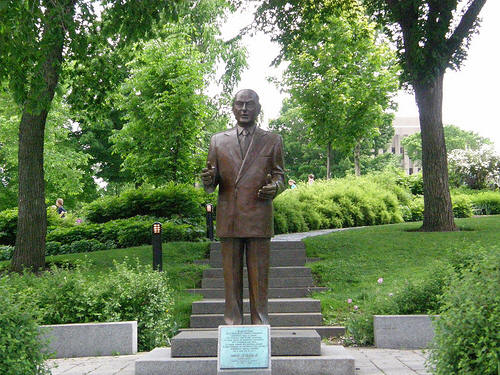
The Stature of Rene Leveque’s Statue

I have always liked Rene Levesque, and I think I like him even more in death than I did in life.

In life, of course, Levesque was a Quebec Nationalist, a separatist who dreamed of creating a Francophone state from the remains of Canadian Confederation. I didn’t agree with his politics– I’ve always believed that Nationalism is just a tarted up version of tribalism– but he was an honest man, and a straight-shooting politician. He wasn’t a hypocrite either. That’s quite an achievement for a Canadian politician.

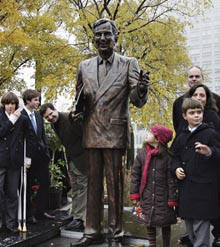
Levesque was 5′ 3″ tall. When the Quebec legislature decided to erect a statue of the former premiere, his family made it clear that they wanted none of that bombastic iconography that living hypocrites employ in honor of the dead. The statue would be 5′ 3″ tall.

Now you may think that it is only natural that a statue would be the same height as its subject. This is what the guy looked like. You can stand beside the statue and feel like this is a guy you could tell your problems to.

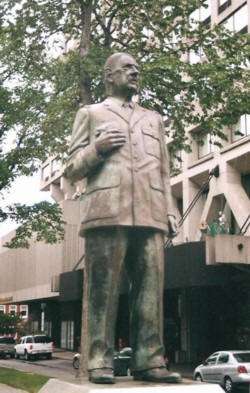
But most statues are not life-sized. Most statues, you see, are about 40% bigger than lifelike. Premiere Lesage stands about eight foot tall. When people walk by, they look up at this awesome man and think, what a hero!

Bourassa’s Statue.

Why is he a hero? Because his statue is so big.

Rene Levesque was also a heavy smoker. The statue makes it look like he should be holding a cigarette in his left hand, but the party leaders had to draw the line somewhere. The good citizens of Quebec generously stick real cigarettes into the bronze fingers: here, Rene, have one on me.

What goes through the minds of the functionaries, bureaucrats, and politicians when they decide on the size of a statue? Why would they make the statue eight feet tall? It seems to me that human nature is rather impure in this area. Monuments are rarely truly meant to honor the subject of the monument. They are made to honor the people who made the monument. France, for example, has innumerable monuments to wars and generals and battles. France, of course, has never won a single decisive battle in it’s history. These monuments are testaments to the spirit of denial and hypocrisy. These monuments say, “we are heroic, because we have monuments to heroes! Disregard the evidence of history: our leaders are giants!”

The monument to Levesque is unusual because it says, this was a guy who didn’t pretend to be any bigger or better than you or me. He was honest and real. He’d rather show you the unpleasant truth than a varnished lie. He knew what it was like to stand in a crowd of powerful, well-dressed men, and not be noticed. Quebec made him their first and best separatist leader.

But the leaders of the Party Quebecois want to put his monument on a pedestal so it will tower over the citizens of Quebec. They want the monument to reflect how they see themselves: Look at us and tremble! We are mighty giants!

I think they go to sleep in fear and trembling every night because they are afraid that after they die, someone will put up a monument to them, and it will be exactly the size it should be.