Godspell

Apparently, Godspell is being revived on Broadway this year. The title “Godspell”, by the way, is not meant to suggest some kind of spiritual magic: “Godspell” comes from the old English words for “good word”, which also evolved into the more familiar “gospel”.

There was “Jesus Christ Superstar” and there was “Godspell”. Superstar was incredibly polished, elaborate, and ambitious. It was sophisticated and complex. It was an opera. Godspell was like the country bumpkin cousin, all jocularity and clowning, but, underneath it all, as conventional and conformist as the church in the wild dell. Astonishingly, Christians still objected to it, because the cast looked like hippies, and because, after all, Jesus was portrayed as a clown.

Here’s an oddity. John-Michael Tebelak, a student at Carnegie Mellon University, wrote the musical while he was still in college, as a masters thesis. He died of a heart attack April 2, 1985 (age 35).

Jeffrey Mylett, cast member, died May 7th, 1986 (AIDS).

Lamar Alford, died April 4, 1991, age 47, cause of death not disclosed.

David Haskell, died of brain cancer, age 52, August 30th, 2000.

Lynne Thigpen, cast member: cerebral hemorrhage, age 54, March 12th, 2003.

Merrell Jackson (one of the apostles), February 23, 1991, age 39. His cause of death is conspicuously unmentioned anywhere on the web. He could sing, he could act, he could dance: let me guess.

[Sonia Manzano, another cast member, clearly implies it was AIDS.]

Two members of the celebrated Toronto production (May 1972-August 1973),  also died young:  Gerry Salsberg, June 22, 2010, in a car accident, and Nancy Dolman, natural causes, August 21, 2010.  She was married to Martin Short.

Victor Garber, who played Jesus in Toronto, performed the same role in the movie.

Tebelak was both a believer and a hippie, and Godspell shows it. I’d always regarded it as charming at some level, but sloppy and unfocussed, which is another way of saying it shows its roots as an improvised piece that was taken in different directions at different stages of development. The deciding factor of its success seems to have been the involvement of Stephen Schwartz, though some seem to think the original score by Duane Bolick was more authentic, more rock’n’roll. We’ll never know– I’ve never heard of it being available anywhere. On the internet? Duane Bolick doesn’t seem to exist. He’s probably dead.

Here’s another oddity. The original, with the music by Duane Bolick, was a smash success among the small crowds that saw it at Carnegie Mellon, and when it first went to New York. So, if you have a smash success, you want to throw out the music, right, and rewrite it? I don’t know what to make of that. The template for this kind of makeover is Hollywood, which almost always cuts the heart and soul out of a story before castrating it into innocuous vehicle for Leonardo Di Caprio. But there was a more immediate template: James Rado and Gerome Ragni’s Hair. Hair (1968), like Godspell, seems to be about the rock’n’roll generation, and outwardly acknowledges rock music, but it is structurally, heart and soul, a Broadway musical. It should be: the composer, Canadian Galt MacDermot, had never encountered hippies before being contacted by Rado and Ragni to write the musical.

Many people, including cast members who played in both versions, concede that Stephen Schwartz is a genius, and that he made it sound more clever and polished and sophisticated. Like Barry Manilow and Bette Midler?

And here’s another oddity: Stephen Schwartz also came from Carnegie Mellon University. And yet another oddity: many of the original cast members, and the director, who happened to be John Michael Tebelak, made it all the way to the Broadway version. Tebelak was even involved in the movie script. Surely someone has written a Hollywood movie about this plot: sincere, visionary hippie writes a musical that rocks the world, transport him and his cast to Broadway, and wins a Tony.

Of course they didn’t really win a Tony, but Hollywood doesn’t care if it really happened or not.  It understands perfectly that movie audiences want to be spoon fed harmless illusions.

The movie version of Godspell is set on the streets of New York, including an extraordinary sequence with cast members dancing and singing on window washer platforms and on the roof of the unfinished World Trade Center. It’s all a bit precious in some ways, but it’s also a courageous attempt to take the gospel out of the sterile Mayberry of Andy vintage, and it’s own quiet irrelevance, into a vital, crackling, youthful urban setting: God speaks to the twin towers! It remains startling in concept, which is outrageous considering that it is 2012, but it’s even more outrageous that Rick Perry and Michelle Bachmann campaign for president as if it were the 1950’s, devout and puritanical, and ragingly hypocritical. God rules everything when it comes to prayer in schools and abstinence training, but his authority is severely limited when it comes to stewardship of the environment: drill baby, drill.

Tebelak’s Jesus, by the way, is a bit sanctimonious. When John the Baptist/Judas almost uses his name in vain, he slaps him, and the rest of the troupe are aghast when Judas almost slaps him back. It’s a weird scene. This is not a new age Jesus, sheep-like, tolerant, inclusive. It’s a strong moment in the play and I am amazed that the considerable forces of homogenization and pleasant superficial conformity didn’t filter it out.


At one point in Godspell, in the movie version, the cast is dancing on top of the roof of the unfinished World Trade Center.  The shot was taken from a helicopter.  It is remarkable.

Anything like that (along with other scenes on roofs and windows washer platforms) shot today would have been green screened, so enjoy it while you can. It’s pretty amazing.

The Original Cast album, the first recorded version of Godspell, was recorded in one day, and sounds like it.

There are copies of the original theatrical trailer for Godspell online. You will be shocked. The trailer seems to illuminate aspects of the movie. The cuts are several seconds long. There are no helicopters, explosions, or naked women. The purpose actually seems to be to give you some kind of idea of what kind of movie Godspell is.

More on Godspell.

More not on Godspell:

At the 1969 Tony Awards, “Hair” lost out to “1776” for best musical. You remember “1776”, don’t you?

One of the reasons Eugene Levy says he lost out on the role of Christ in the Toronto production was that he looked too Jewish. And also too hairy.
Peter Pumpkinhead

“Peter Pumpkinhead” was recorded in 1992 by British group XTC, and was a #1 hit in Britain. In 1995, the Crash Test Dummies recorded a new version for the movie “Dumb and Dumber”. These lyrics were excised:

Peter Pumpkinhead pulled them all
Emptied churches and shopping malls
Where he spoke it would raise the roof
Peter Pumpkinhead told the truth

The song uncannily predates “Take Back Wall Street” by 20 years.  But America is not ready, apparently, to empty churches and shopping malls.  Especially, those places where the devout truly worship the things they crave more badly and urgently than anything else in the universe: shopping malls.

But he made too many enemies…

Governments would slur his name
Plots and sex scandals failed outright
Peter merely said
Any kind of love is alright
But he made too many enemies
Of the people who would keep us on our knees
Hooray for Peter Pumpkin…

Do you believe that was written before the Clinton sex scandal?

The writer of the song, Andy Partridge, has stated that he didn’t have any particular individual in mind when he wrote the song.

So there.

Deportees

On January 29, 1948, the New York Times ran a story about a plane crash in California in which 32 people died, 28 Mexicans, and four Americans. The four Americans were identified by names and professions. The Mexicans were merely identified as “deportees”.

Woody Guthrie read the article and thought about those Mexicans. He thought about their wives and children and girlfriends, and about the way they risked their lives at times to cross over into the U.S. illegally to try to make some money to send home to their families. He thought about how they were often exploited and cheated by their “coyotes” (guides), and sometimes abandoned to die in the dessert. He thought that they deserved to have names.

He wrote the lyrics for “Deportee (Plane Crash at Los Gatos Canyon)” and recited the piece at some performances. Ten years later, a school teacher named Martin Hoffman took Guthrie’s poem and wrote a melody for it. Pete Seeger covered it and it became a hit.

It’s a beautiful song. It’s flawed (that last didactic verse isn’t necessary)– like the faces of many great beauties– but it has a zen-like clarity to it that entrances. It builds slowly, laying out the scene, literally and metaphorically, and then hammering home it’s point with

We died in your hills, we died in your deserts,
We died in your valleys and died on your plains.
We died ‘neath your trees and we died in your bushes,
Both sides of the river, we died just the same.

“Both sides of the river, we died just the same” may the most eloquent summation of a liberal, progressive attitude that I have ever seen. This is not about war between illegals and native sons, or Mexicans and Americans, or the owners and the dispossessed. It’s about how we treat each other as human beings. It’s about the dignity of the laborer, and the hypocrisy of a culture that openly hates illegal immigrants but depends on them to harvest their crops, look after their children, and wash their cars.

One measure of the greatness of a song is its enduring appeal. Is there another song that has retained such a high degree of relevance? Up to 500 Mexicans die every year trying to cross the border illegally to do work that Americans won’t do, for willing employers. In return, they are treated like “outlaws, like rustlers, like thieves”.


How do I acknowledge 9/11? With this tribute to “Deportees”.

In 2005, more than 500 Mexicans died trying to cross over into the U.S. illegally.

Deportee on Wiki

Best version? I have an ensemble version that I adore that is attributed to “Woody Guthrie”– obviously, the song-writer– with no further information about the performers. Sounds like early Weavers, but it’s not them. Lists of songs performed and recorded by the Weavers do not list “Deportee”.

Dolly Parton did a version, on her album “9 to 5”. I will remind you that she was quite a good singer before the industry got their fangs into her style.


The only “tribute” to 9/11 I could really stomach to watch was the curious performance of Paul Simon, at Ground Zero, of “The Sounds of Silence”. As he sang,

And the people bowed and prayed
To the neon god they made.

the camera cut to a shot of the American flag draped on a nearby office tower. Very curious. Simon didn’t change a word– good man!– so we were left with an image of the “words of the prophets” written on the subway walls and tenement halls.

We know from another Paul Simon’s songs (“A Poem on the Underground Wall”) what one of those words was.

Harry Chapin Takes a Taxi

The best lines of Harry Chapin’s epic “Taxi”, one of his most successful and popular projects, are these:

And she handed me twenty dollars for a two-fifty fare
She said, Harry, keep the change
Well another man might have been angry
And another man might have been hurt
But another man never would have let her go
I put the bill in my shirt.
And another man would have had Harry throw the bill in her face in the song and ruminate on how at least he didn’t sell his soul.

I’ve always liked Chapin, but his flaws as a performer and writer are a bit too pronounced to rank him anywhere near the greats of his era.

And there are some extraordinarily awful songs: “Circles” and “Flowers are Red”, and “Mr. Tanner” which is worse than awful: it’s disingenuous. It’s when you consider alternatives like Neil Diamond that Chapin’s honesty and seriousness are appealing. He belongs to a sub-genre of serious, unpretentious, and sometimes visionary but inadequately gifted artists like Don Maclean, Murray McLachlan, Tom Paxton, and Tim Hardin.

And I wonder sometimes about Kristofferson.

Well, you wonder about all of them. I loved “Sniper”, and “Taxi” has it’s moments, but I could hardly ever bear to listen to a Chapin album all the way through more than once. In fact, I don’t think he has a single song that doesn’t have a dud line or two in it (what the heck does “little boy blue and the man in the moon” mean?) And couldn’t he have found a better phrase than “you know we’ll have a good time then”? Even “Taxi” ends with a rather diminished: “I go flying so high/when I’m stoned.” And now that I mention it, “through the too many miles and the too little smiles”.  Does he mean too few smiles?  Or that the smiles were little?

But at least he was too honest to not admit that, in “Taxi”, Harry keeps the money. Of course he keeps the money. It is the moment in the story when it seems most clearly connected to real life.


By the way, Chapin doesn’t have a great voice, but he puts passion into it, and he takes risks, and he had Big John Wallace with the fabulous five-octave tenor and his cello to give life to his arrangements.

Trivia: Chapin’s widow, Sandy, won a $12 million lawsuit against the owners of the truck that rear-ended Chapin’s 1975 Volkswagen Rabbit in 1981 resulting in his death. According to the authorities, he may well have suffered a heart attack before the accident and the police investigation showed that he had slowed to 15 mph and was wandering the lanes at the time of the collision.

Chapin’s license had been suspended at the time for traffic violations.

But she still got $12 million? I guess if you rear-end someone, you’re going to be at fault no matter what the guy ahead you is doing.

What’s wrong with “Mr. Tanner”?

“Mr. Tanner” tells us about a man with a good voice who works in a laundry and sings to himself. His friends discover his talent and encourage him to move to New York and go for the big time. He does so. He takes every penny he has and rents a hall and gives a performance but he gets raked by the critics. He returns to his home town shattered and disillusioned. As in “Flowers are Red”, Chapin’s villains are made of straw and, as Susan Boyle showed, critics are far more likely nowadays to shower praise on mediocre talents than they are to savage good ones.

The other flaw with “Mr. Tanner” is that the circumstances of his disappointment are ridiculous: critics don’t attend vanity concerts put on by somebody who has never performed publicly anywhere before, and if they did, they would never have reviewed him in the same way they would review professionals. He wouldn’t have been “fair game”.

It’s not likely professional critics would even attend a concert presented by an unknown singer without any previous professional credits. And Chapin conspicuously omits a critical component of this scenario: the audience. Either they would have loved him because, in Chapin’s scenario, he really is very good, in which case he would have been validated regardless of critical opinion, or they would have booed, thus validating the critics.

But that would have eviscerated Chapin’s goal of eviscerating the straw-critics.  And it would have been problematic: there are so many mediocre singers who are very popular and successful.  “Mr. Tanner” might very well have been a hit.

It tells me that this song is not based on any real experience or first-hand knowledge. If it was, Chapin would have dealt with the problem of the audience.

[2022-05-01]

A far more interesting take on this issue is the wonderful film, “Florence Foster Jenkins” staring Meryl Streep as someone who really did have a terrible voice and was still able to throw a concert, in Carnegie Hall, of all places.

Unfortunately, Chapin wrote a sequel to the song which, if nothing else, proves that sequels are almost always a bad idea. Especially since, in this one, (role reversal) she refuses the money.

So Chapin re-visions the song… and reverses the most endearing — and believable– detail of the original.

Sarah Slean’s Diva Moment

Sarah Slean is a terrific singing talent. Maybe a good songwriter too. But.

On the CBC, late at night, May 20th 2011, Sarah was being interviewed as part of a songwriter series on CBC, on Apropos. She told a story about a song she had written. She was living in Paris for whatever reason. Every day, she walked past a little café. And every day she saw a middle aged man sitting there drinking by himself. She said the man looked like he had given up on life. “He pierced me,” she said. She was so moved by his plight that one day she just decided out of the blue to write him a letter. She wrote in the letter that he should “start again”. No matter what you have done in the past, let it go, and start again: the universe loves you.

The next day, when she brought the letter to the café, he was gone. The next day as well. And the next. She gave up on the idea, though she left the letter in her bag. She wondered if he was lying dead in an apartment somewhere, un-noticed and unremembered.

Up until this point, I thought it was a fairly interesting, compelling story. I was all ears, as I drove back from a wedding in St. Catharine’s. I wondered if she would end up buying a beer and sitting down and joining him, to show that there was hope, at least, of friendship in the world. That she would show a little interest in him, ask about his life, his family.

She continued her story. A little later, she walked by again, and there he was! Her heart beating wildly, she walked right up to him and handed him the letter and then walked on. She did not stay to talk.

She was very pleased with herself.

Then I realized that she was less interested in this man who “pierced” her than she was in herself being pierced. And then she wrote a song which she freely admits is really about her. The song is not about him, or whatever interesting thing happened to him, or whatever interesting things he would do in the future, or why he was unable to connect with anyone, or why he had given up. It was all about this courageous young girl who summoned the audaciousness to actually have an amazing insight into her own insight.

And the very definition, to me, of a diva.


The CBC has a soft spot for divas. Many afternoons, on my way home from work, they will play the latest recording by someone who seems endlessly fascinated with her own voice. It’s a kind of showiness that is all about theatricality and ostentation and effects for the sake of calling attention to one’s self, and really quite boring.

Visitation

1960’s Princesses

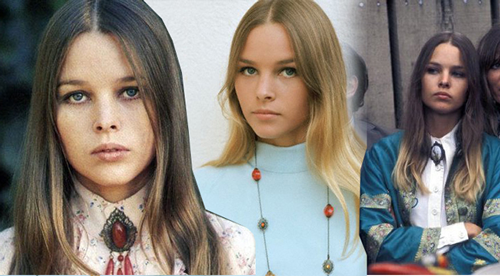
Among all the princesses and all the mermaids and all the goddesses of late 60’s popular culture, she may well have been the most entrancing: Michelle Phillips, fine-featured, blonde, green eyes.

She married John Phillips at 18. Aesthetic member of the Mamas and the Papas. Inspiration for “California Dreaming”. Sang backup for Leonard Cohen on one of his tours, 1970. Married, briefly, to Dennis Hopper, one of the few genuine psychos of all the Hollywood psychos.

And married again and again: five times.


“Go Where You Want to Go” is a slight song, typical of the John Phillips’ Mamas and Papas: melodic, cleverly-arranged, and ephemeral. And pretty and alluring like Michelle’s face– you wonder and hope there’s something rich and satisfying beneath that pouty face.

The haunting parts of the song are the voices of the girls, Michelle and Cass:

You’ve been gone a week, And I tried so hard
Not to be the crying kind
Not to be the girl you left behind

Actually, the really haunting part is the “with whomever”:

You gotta go where you want to go
Do what you want to do
With whomever you want to do it with…

Listen carefully– I hear something authentic in the yearning voices on that line.

Cass was in love with Denny Doherty but he did not reciprocate, and Denny and Michelle had an affair a year or so after this song was recorded and she was kicked out of the band in June 1966 for a few months (that’s how you fire your wife. Note that Denny was not kicked out of the band.)

Is that what we also hear in Fleetwood Mac’s “Rumours”, the insinuations of real desire, real longing into the voices? She returned to the group at the end of August in the same year and dubbed over her replacement’s vocals. To this day, no one is quite sure which vocals on “The Mamas and the Papas” are hers and which are Jill Gibson’s.

Barry McGuire called Cass Elliot a “stallion”. She must have rued the cruelty of fate putting such a monumental voice and hunger into a package that was not Michelle Phillips– oh, life is unfair!

Or just real sadness, as you, as Neil Young put it, “try to make arrangements with yourself”. That’s a pretty good description of 20-somethings trying to manage their lives– the components of happiness are often there, circulating, waiting, not-waiting, hesitating. Sometimes holding out to see if something better might come along. The movie “St. Elmo’s Fire”, frustratingly, took the raw material of poignancy and ambivalence and turned it into melodrama and sentimentality and mush and I almost feel haunted by the potential for something interesting in the elements they placed before us and failed to deliver on. “Once”, on a smaller scale, delivers more, because there are no fireworks but real unresolved urges, missed opportunities, and uncertainties.

Hollywood loves to blueprint relationships for us. In real life, as in “Once”, it may not be clear to us where a relationship might or should end.

Michelle is the last surviving member of the band. Cass Elliot– she of the voice as beautiful in sound as Michelle’s face in light– died of a heart attack in London at age 33 after three “stand-out” performances at the Palladium in July 1974. John Phillips burned himself out, deep into drugs and alcohol and waste, and died of heart failure in 2001. Denny Doherty died in Toronto of an illness January 19, 2007.

The TV record, now strung out on Youtube, is cruel: most of their performances seem to be lip-synched. Their opportunity to shine at Monterrey with their signature song, “California Dreamin'”, was fatally marred by a lack of preparation and massive drug abuse: it’s one of the most disappointing live performances of an important song by a successful pop group ever. You can’t hide the embarrassment. Most of the video archives simply dub the studio recording over it.

But it wasn’t their most preposterous live performance ever– that came on “Hullabaloo”, with go-go girls popping out of bathtubs, and the band visibly ridiculing the dance moves.

John woke Michelle up in the middle of the night in New York City in 1963, I think it was, because he had a great idea for a song and needed her help to finish it. She has admitted that she basically just wrote down the words for him, and chords, and maybe helped with a few phrases, for which she, nevertheless, still receives a healthy income: the song was “California Dreamin'” of course. The first two lines– and the hook– “California dreamin'” made the song what it is:

All the leaves are brown, and the sky is grey
I’ve been for a walk on winter’s day

The distilled moment of 20-something ennui and disconsolate self-absorption. Think of those lines when you’re young and maybe in love and maybe not and maybe you could do better and maybe not and the evening didn’t go all that well and you’re not sure if maybe you shouldn’t move on and try some other future and all the leaves are brown and the sky is grey… and the wind is blowing your hair and the leaves and you feel such delicious desolation that it’s almost tragic, and it’s definitely deep, and you feel alive.


In the early 1960’s– nobody seems to have a definite date– The Mamas and the Papas went to the Bahamas to work on their music and ran out of money. Desperate, they went to a casino and Michelle threw 17 straight winners at craps to get them enough money to fly back to New York.

It is remarkable that they resisted the temptation to continue betting.

The essential dynamic of gambling is this: when you are losing, you will keep trying to win back what you lost, believing that your luck is likely to change for the better. When you are winning, you will feel lucky, and human nature will drive you to want to win more and more and more.

The inviolable statistical fact about gambling is that the longer you gamble while winning, the more inevitable it is that you will eventually lose everything you won, and more.

That’s why it is so astonishing that John Phillips decided to quit while they were ahead and use their winnings to fly back to New York.

Want to get rich? Own a casino.


In 1967, Cass Elliot had a child– out of wedlock — , a daughter. She refused to identify the father.


Me.

Five Perfect Songs

There are five perfect songs. Here they are:

  • Sam Stone (John Prine)
  • All Along the Watchtower (Bob Dylan)
  • Anchorage (Michelle Shocked)
  • I Fought the Law (Bobby Fuller Four)
  • You Don’t Own Me (Leslie Gore)

That’s it.

About Sam Stone:
But life had lost its fun
And there was nothing to be done
But trade his house that he bought on the GI bill
For a flag-draped casket on a local heroe’s hill

“Suspicion” (Elvis Presley) comes close, but no cigar.

Other Honorable Mentions:

“Reelin’ in the Years” (Steely Dan) A truly awesome recording but I can’t overlook the pettiness of “the things that pass for knowledge I can’t understand…”

“Homeward Bound” (Simon and Garfunkel) a fine, fine song, but “all my words come back to me in shades of mediocrity” is a little precious.

“Four Strong Winds” (Ian & Sylvia) is a bit slight, so you have to repeat the chorus and that gives it a bit of a sense of aimlessness and repetition and violates the rule of economy.

The Beatles’ best song is “Girl”:

Was she told when she was young that pain would lead to pleasure?
Did she understand it when they said,
That a man must break his back to earn his day of leisure
Will she still believe it when he’s dead?

But “Eleanor Rigby” is also very nearly perfect.

“Go Your Own Way” (Fleetwood Mac) is too slight.

“Sultans of Swing” by Dire Straits is very, very good.

“Echo Beach” (Martha & the Muffins) Actually, this song is darn near perfect as well. Darn near.

“The Night They Drove Old Dixie Down” (The Band) Great, great song, but a bit murky, and the Band’s own recording of it is not as perfect as the song. As is “This Wheel’s on Fire” and “Tears of Rage”. I do actually like the cover version of “Dixie” by Joan Baez, featuring crack Nashville session musicians. It’s from an album that appeared to be an effort by Baez to reach out to the alienated silent majority of Americans who seemed to despise her.

Levon Helm (who wrote “The Night They Drove Old Dixie Down”) despised her version, but one suspects that that is because Levon Helm despised Joan Baez.

“Satisfaction” (Rolling Stones) Okay. So this one is perfect too. Six perfect songs. But it has to share with “Light My Fire” (Doors).

“Like a Rolling Stone” (Bob Dylan) Violates rule of economy, but also a great, great song. “Tangled up in Blue” might actually be a better song.

“Thunder Road” (Bruce Springsteen) Can’t sustain that great take-off, “you can hide ‘neath your covers and study your pain” though he tries, brilliantly. In the end, it’s just a trifle indulgent, a trifle too self-consciously monumental. A trifle. On some days I prefer “Jungleland”.

“Don’t Think Twice, It’s Alright” (Bob Dylan) is as good or better than any other song on the list. All right, seven.

“One of These Days” (Emmy Lou Harris) Lovely, enchanting piece, reminds me of “As I Went Out One Morning” (Bob Dylan): both are elegantly economical, tight, balanced.

“Someday Soon” (Judy Collins) Okay– another one. Eight.

All right: 9– “The Hammond Song”, by the Roches. Actually, this song is obviously flawed, but there are moments when it does sound just perfect to me. So 8. Wait — 9. I forgot about one of the most perfect, crystalline, renditions ever: “Wayfarin’ Stranger” by Emmy-Lou Harris with that absolutely wonderful lead by Tony Rice and mandolin by Albert Lee.

Bill’s Top 50 Canadian Singles of All Time

Bill’s Personal Choices: Canada’s top 50 singles.

On the CBC’s list:

There are some great songs on the list, but “Four Strong Winds” as number 1??!! “Snowbird”, that bland, vacuous, treacly, schmaltz at #19? “Life is a Highway”? Tell me, do you think anyone else ever thought of the highway as a metaphor for life? Or flogged “all night long” as a chorus? “Summer of ’69”? An embarrassing rehash of Bob Seger’s most obvious lyrics.

There was an obvious, alarming tendency to prostrate us all before the gods of international popular acceptance. So Sarah McLachlan had to be on the list, even though it’s hard to think of a single song by her that was so outstanding that it deserved to finish ahead of, say, “Lovers in a Dangerous Time” written by Bruce Cockburn and performed by the Bare Naked Ladies. Or even fluff like Joni Mitchell’s “Big Yellow Taxi”, which I can’t believe even she herself took seriously…. (“Court and Spark” would have been a far more interesting choice.) And where, in heaven’s name, are the Northern Pikes and Crash Test Dummies? Oh– I get it. Didn’t have any U.S. hits.

If you think “Canadian Railroad Trilogy” is so great (#6), tell me, when was the last time you actually listened to it?

And all those factories and businesses that the railroad brought to Canada– “for the good of us all”?

It could have been worse. Celine Dionne and Walter Ostenak did not make the list, though Paul Anka did.

My number one is Neil Young’s “Helpless”, because it captures that resigned Canadian acceptance of over-arching doom, and its shadings of hopes and dreams– so Un-American in it’s denial of personal control. And it has one of the greatest lines ever, in Canadian music: “In my mind, I still need a place to go; all my changes were there”.

“If I had a Million Dollars”– is it a novelty tune like “Hockey Song”? Maybe. But it’s also wittier and funnier and quintessentially Canadian– who else would buy Kraft Dinner with their million dollars?

Bill’s Highly Disputable List of Top Canadian Popular Songs.   Not quite 50 yet…

No, “Snowbird” does not make the list.

Rank Song Artist
1 Suzanne [1966] Leonard Cohen
1.1 Helpless Neil Young
2 Famous Blue Raincoat Leonard Cohen
4 Early Morning Rain Gordon Lightfoot
4.1 That’s What you Get for Lovin’ Me Gordon Lightfoot.
5 Cowgirl in the Sand Neil Young
6 Echo Beach Martha & the Muffins
7 Lovers in a Dangerous Time Bruce Cockburn.
8 Venice is Sinking Spirit of the West
9 Old Man Neil Young
9.5 The Weight the Band
10 Both Sides Now Joni Mitchell
11 Heart of Gold Neil Young
12 Barrett’s Privateers Stan Rogers
12.5 Superman’s Song Crash Test Dummies
12.75 Dream Away Northern Pikes
13 Court and Spark Joni Mitchell
14 Tears of Rage the Band
14.1 Where Evil Grows Poppy Family
14.2 American Woman The Guess Who
15 You Were on my Mind Ian & Sylvia
15.5 Mmm Mmm Mmm Mmm Crash Test Dummies
16 Montreal Blue Rodeo
17 Stage Fright The Band
19 Born to be Wild Steppenwolf
20 First We Take Manhattan Leonard Cohen
21 Down by the River Neil Young
22 Hallelujah Leonard Cohen
23 Wake Up Arcade Fire
24 Scared Tragically Hip
25 Old Man Neil Young
26 Hey Hey, My My Neil Young
27 Home for a Rest Spirit of the West
28 Carrie Joni Mitchell
29 If I Had a Million Dollars Bare Naked Ladies
30 What a Good Boy Bare Naked Ladies
31 Tokyo Bruce Cockburn
32 Universal Soldier Buffy Ste. Marie
33 Tell Me Why Neil Young
34 Raised on Robbery Joni Mitchell
35 1234 Leslie Feist
36 Take This Longing Leonard Cohen
37 Which Way You Goin’ Billy Poppy Family
40 Sh-Boom [1955] the Crew Cuts
41 Superman’s Song Crash Test Dummies
42 Woodstock Joni Mitchell
43 So Long Marianne Leonard Cohen
44 For Free Joni Mitchell
45 A Man Needs a Maid Neil Young
46 Heart Like a Wheel Kate and Anna McGarrigle
47 Complainte Pour Ste-Catherine McGarrigle Sisters
48 Black Day in July Gordon Lightfoot
49 Come Calling Cowboy Junkies
50 Come all Ye Fair and Precious Ladies Rankin Family

Absolutely positively never ever going to make my list: K. D. Lang’s awful, overwrought delivery of Leonard Cohen’s “Hallelujah”, the pinnacle of self-serving, claustrophobic, look-at-me-sing-oh-god-I’m-so-humble-I-can’t- believe-it-narcissism.  Her rendition robs the lyrics of every ounce of meaning and context and it’s a performance calibrated for people with a shallow understanding of “she tied you to her kitchen chair/she broke your throne and she cut your hair”, a vague sense of titillation, and a conviction that the louder, more ostentatious voice, the deeper the meaning.

And that goes double for Rufus Wainwright’s whiney, weaselly cover.  And shame on “Shrek” for trivializing the whole thing by putting into a cartoon about a troll that farts.

Check John Cale’s version for a corrective.


The Music From “Shark vs Eagle”

I made this list because all of the music selected for this movie, “Shark vs. Eagle”, an odd, quirky little film by Taika Waititi, is unfamiliar to me, but interesting on some level.

That’s all: here it is.

“80’s Celebration”
Performed by The Reduction Agents

“I Love You, Awesome”
Written by Samuel Flynn Scott & Conrad Wedde
Performed by The Phoenix Foundation

“Lily’s Theme (Apples & Tangerines)”
Written by Samuel Flynn Scott
Performed by The Phoenix Foundation

“Cosmic Danse”
Written by Luke Buda
Performed by Luke Buda

“Seaworld”
Written by Luke Buda & The Phoenix Foundation
Performed by The Phoenix Foundation

“The Pool”
Written by J. Milne
Performed by The Reduction Agents

“I Don’t Want”
Written by Age Pryor
Performed by Age Pryor & The Marvelous Medicine

“Blue Summer”
Written by Luke Buda
Performed by Luke Buda

“I Don’t Want (Reprise)”
Written by Age Pryor
Performed by Age Pryor & The Marvelous Medicine

“Seaside”
Written by Luke Buda
Performed by Luke Buda

“Funny Shadow”
Written by Tessa Rain
Performed by Tessa Rain and Age Pryor

“The Body Breaks”
Written by Devendra Banhart
Performed by Devendra Bernhardt

“Brain”
Written by Samuel Flynn Scott/The Phoenix Foundation
Performed by The Phoenix Foundation

“Let’s Dance”
Written by David Bowie
Performed by M. Ward

“Wholly Molly”
Written by Samuel Flynn Scott
Performed by The Phoenix Foundation

“This is the One”
Written by Ian Brown / John Squire
Performed by The The Stone Roses (as Stone Roses)

“Idillio Italiano”
Written by The Doro Kraus String Quartet
Performed by The The Stone Roses (as Stone Roses)

“Hitchcock”
Written by William Ricketts/Luke Buda/The Phoenix Foundation
Performed by The Phoenix Foundation

Soundtrack List

01 – Lily – The Happiest Man – 0:50
02 – The Phoenix Foundation – I Love You, Awesome – 2:49
03 – The Phoenix Foundation – Blue Summer – 3:37
04 – Luke Buda – Cosmic Danse – 1:28
05 – The Reduction Agents – The Pool – 2:29
06 – Lily – Apples and Tangerines – 1:51
07 – Jarrod & Lily – Mum and the Cow – 0:19
08 – The Phoenix Foundation – Hitchcock – 3:27
09 – Age Pryor and the Marvelous Medicine – I Don’t Want – 4:32
10 – The Phoenix Foundation – The Hill 1 – 0:49
11 – The Phoenix Foundation – Sea World – 3:39
12 – Luke Buda – Seaside – 3:08
13 – Jarrod, Mason & Lily – Tomorrow – 0:40
14 – The Phoenix Foundation – The Breakup/The Hill 2 – 3:26
15 – Tessa Rain and Age Pryor – Funny Shadow – 2:49
16 – The Reduction Agents – 80’s Celebration – 2:21
17 – Jarrod – Justice is Waiting – 0:41
18 – The Phoenix Foundation – The Hill 3 – 0:53
19 – The Phoenix Foundation – Brain (Live at Helens) – 3:52
20 – The Phoenix Foundation – Wholly Molly – 2:09
21 – The Phoenix Foundation – Apples and Tangerines – 4:11
22 – Lily & Jarrod – Do the Blues – 0:43
23 – M. Ward – Let’s Dance – 5:06
24 – The Stone Roses – This is the One – 5:01
25 – The Phoenix Foundation – Going Fishing – 4:57
26 – Taika Waititi – Not So Hidden Track – 2:53

The Wonder Years Without the Music

Here’s my second brilliant idea of the month!

As you may or may not have heard, a well-regarded TV series, “The Wonder Years”, has never been released on DVD. Why not? Lots and lots of people want it. Well, the problem is that “The Wonder Years” used a lot of popular music in the background of many episodes. At the time, the cost of using pop music in a tv show or movie was negligible. Now it is not. Everyone got greedy. Of course, the owners of “The Wonder Years” are also greedy– they are dissatisfied with the amount of money they will make if they have to pay all those royalties.

The funny thing is, you could probably acquire most of the songs used in the show for a very reasonable cost, if you just bought them on iTunes. Maybe you already have copies of those songs. In fact, if you are fan of the “The Wonder Years”, chances are pretty good that you already have a fully licensed, fully paid for copy of the songs used in the show.

So what we need is software.

What we need is for the owners of “The Wonder Years” to release the series on special DVD’s without the expensive already paid-for music. You put the DVD in your computer and this special software scans your hard drive, finds the missing music, and synchronizes it. Then it burns the entire DVD to a new blank. Problem solved.

The only problem is that this would make naked a little-understood fact about copyright: you are paying twice, three, four times for the right to listen to the same song, whether you have the album, the CD, the iTunes version, or a movie or TV show with that song on it, your wedding video (if your videographer paid for and charged you for the rights– not likely.)

And by the way, it’s not the artists who are greedy, of course. It’s people who usually swindled the artists out of their rights in the first place. They’ll be damned if you get to watch “The Wonder Years” or the great documentary on the civil rights movement, “Eye on the Prize” with the music.


Fred Savage, who played “Kevin” on “The Wonder Years” grew up surrounded by some of the most beautiful and, in the case of his co-star Danica McKellar, smart, women in Hollywood.

Who did he end up marrying? Someone he met in kindergarten.

I had stopped watching “The Wonder Years” after a year or so because I thought it was getting too precious, and I began to find the narration annoying. I just read a TV critic who feels that the narration “made the show”. Hey, maybe I was wrong. I don’t know. I won’t be able to re-examine the idea until it does finally get released on DVD. Or not.