Hard Boyled

Over 30 million people have now been duped into watching the video of the frumpy middle-aged woman who can sing. Everyone is astonished. Who would have thought a frumpy middle-aged woman could sing?!

Who would have thought anyone would be surprised that a frumpy middle-aged woman can sing?

Either the average person is far more dull-witted than ever previously imagined, or we are all fooling ourselves. You’re at a talent show. You watch various attractive young people march across the stage, with varying levels of talent. Then you see a frumpy middle-aged woman. You think– obviously she has no talent.  Right.

In fact, any reasonably astute person would have likely thought, she’s certainly not here for her looks. Obviously, she must be able to sing.

Now, this is a program which introduces emerging talents and then processes them like hamburgers through the obscene rituals of fashion makeovers, stylists, image consultants, deportment experts, etc., with the goal of rendering them into mental frumps– celebrities. Why the real frumpy woman? To convince the viewers that they are not like those shallow, crass people who only appreciate art if it is packaged in sexy, youthful flesh. No no no– I don’t judge people by their appearance– only by their abilities.

And after Susan Boyle has had her meaningless moment on the stage, these same people will go back to choosing the singer with the biggest bosom, and only watching movies that star sexy young Hollywood starlets. Except for Meryl Streep movies– because she is the Susan Boyle of Hollywood films: the exception that proves we are decent, intelligent people after all. We like serious actors. My enjoyment of their films is a badge of culture and good taste. I’m glad you know that. Besides, Meryl Streep may be flat-chested but she is sort of pretty. She’s prettier than Mrs. Doubtfire.

Now, it has occurred to me that my enjoyment of obscure films by Japanese directors like Ozu might be taken for the same thing. I’ve had that reaction before: you can’t seriously like “Late Spring”– it’s excruciatingly slow moving and, it’s black and white. Or, more likely, “I watched that film you were so hot about– I couldn’t believe how boring it was!”

It’s probably true. Though I must admit, it’s not that much fun at work to casually mention, at lunch, that I watched an obscure Japanese film last night.

You just do that to make us think you’re smarter than we are.

Yeah, that’s what you get.

What I liked about my college experience is that it was one of the few times in my life when most of the people I hung out with respected elite artistry, drama, and music.

Nowadays, the elite is there to be mocked, even by the elite.


The Inevitable “Make-Over”

The latest: Susan Boyle has undergone a modest “make-over”, using a local hair stylist instead of a fancy one from the big city. The idea is to make it more digestible for the average viewer to maintain the illusion that they appreciate her for her voice and don’t care at all about the fact that she looks like a real person.


The Un-Boyle

Diana Krall seems like a perfectly fine lady. She looks very nice. She gets a lot of airplay on the CBC.
She is the opposite of Susan Boyle. Diana Krall looks absolutely ravishing– if your taste runs to big-boned blonde Visigoths– but, truthfully, is a rather average singer.

Norah Jones is in the same category: really, a mediocre singer with a pleasant voice, and, most importantly, a pretty body.

Just think– if you could combine Susan Boyle’s voice with Diana Krall’s looks, you would have the perfect entertainer. Right? Wrong. Nobody really cares about the voice part. Diana Krall has the only advantage that matters already in hand.

And actually, Susan Boyle’s singing talents really are quite over-rated as well.
Lost and Lost: Marianne Faithful

Has any performer ever looked as uncomfortable and confused on stage as Marianne Faithful in 1965? Here she is awkwardly lip-synching on some television show or another. “What am I doing here?”

What you are doing is helping Mick and Keith promote a song (they wrote “As Tears Go By”).

There’s a hell of a movie in her life, much of it not pretty. Partly descended from Austro-Hungarian nobility, her parents divorced when she was six and she spent time in a convent school. She was “discovered” at 18 by Andrew Loog Oldham– what a great name!– and propelled to stardom. By “propelled” I mean, it was all arranged. I mean, she was hot looking, and connected, so it all could be arranged. You will be on TV. You will be on the cover of magazines. You will learn to sing.

She married, had a baby, left her husband to live with one of the Rolling Stones– she tried three before settling on Mick– was arrested wearing only a fur rug at a scandalous party at Keith Richard’s house, lost custody of her son, declined into cocaine addiction, broke up with Mick…. Some time during those lost years, her mother attempted suicide, and Marianne Faithful disappeared off the radar screen, except for one eerie appearance with David Bowie, singing, of all things, “I got You Babe”.

But it is that first video I’m mainly interested in. This was an era in which powerful men who controlled the music industry made and broke stars. Marianne Faithful was never a particularly good singer, but she was strikingly beautiful. In the first video, you can see that she doesn’t have much of a stage presence either. It feels painful just to watch her sitting there, looking like she was petrified of losing her timing. The audience was not expected to notice or care that she wasn’t actually singing or performing– she was lip-synching.

Brian Epstein mismanaged the Beatles around the same time. He steered them into signing horribly disadvantageous contracts, but wasn’t shy about paying himself extremely generously. It was part of the music industry culture of the time. The artists had one thing in common. They were young and they knew nothing about how the music industry worked.

The music companies lavished cash and luxury on them– the cost of doing business, which was the business of ripping off the talent– and the law did not protect their interests then and it doesn’t protect them today.

In fact, it’s far worse.


Sometimes, as in the movie “The Wrestler”, real personal history and artistic expression intersect in surprising and intriguing ways.

Marianne Faithful started out her career with a breathy little alto, singing delicate little folky love songs and mournful ballads. Then came the years of drug use, the scandals, and the disappearance. Ten years later she reappears… and sounds like Tom Waits:

Could have come
through anytime,
Cold lonely, puritan
What are you fighting for ?
Its not my security.

Broken English is an amazing enema of an album, a purging of all the demons of the 1960’s and 70’s, and a profound statement that this woman was no longer the doe-eyed naïf of those painful appearances on Hullabaloo– it features the most caustic and bitter break-up song ever: “Why D’ya Do What Ya Did”.


One of the better album titles of the last fifty years: Marianne Faithful’s “Broken English”, 1979.

Songs allegedly written about or influenced by Marianne Faithful:

Wild Horses, You Can’t Always Get What You Want (Rolling Stones)


[2020-05-09]

Just for fun:  In the Year 2525

The video is great, of course: it’s from the movie “Metropolis”.  It’s genuinely horrifying.

The Inauguration and the Fake String Quartet

I just read that the lovely little quartet that performed “Air and Simple Gifts” at Barack Obama’s inauguration faked it. You watched the lovely musicians, elegant, focused, rising to the occasion– you thought. But the music you heard came from a recording that had been made a few days earlier. They finger-synched. They had ear-pieces so they could hear the recording, and then they put on a performance, but the performance was not musical: it was acting.

I am always amazed at the rationales given for cheating. The Chinese said that the little singer was not pretty enough to dance and the Olympics were too important to allow ugliness into the stadium. The people in charge of the inauguration said it was too cold to play, and too important an event to take a chance something going wrong, and allow any musical ugliness’s into the mall.

Even Pavarotti, at a performance in Italy a few years ago, cheated because he had a cold and didn’t want to disappoint his fans. Never mind the people who were disappointed to find out that even Pavarotti is a fake.

I hope most people immediately see through these lies. When we watch a brilliant musician perform, we are impressed precisely because it is difficult to do, and because of the dynamic connection between performer and audience responding to each other in the moment. So someone who successfully performs, live, deserves our respect. Others only want you to believe that they performed live. They want the same applause and respect. They bow and bow and bow– what’s the matter with you? What do you mean “cheating”? I just didn’t want to disappoint my fans.  I say, fuck you.

If it wasn’t fakery of the highest order, why were they trying to make it look like they were performing live? Why not just stand there and bow?

And why on earth, if they were so concerned about the cold, didn’t they just perform live in the White House — in the Oval Office– and then broadcast it to the huge screens on the mall? At a moment of crisis and change, demanding the highest level of inspiration for the American people, Obama’s people cheated. They pretended they could do something they didn’t believe they could really do.

They put on a show loaded with symbolism meaning nothing.

Well, I refuse to give in to this bullshit that someone it is reasonable and good and fair to cheat in public performances.  It is absolutely possible to perform live or to simply do something else if you don’t want to be honest.

[2022-05-09: they did for music what Obama did for progressive politics — faked it.]


The faked musical performance music wasn’t the only thing about the inauguration I didn’t like. The rows of guards dressed in grey overcoats lining the streets called to mind nothing so much as a police state. Rick Warren was boring. Obama’s speech was disappointing– merely “very good” instead of great. The poet played it entirely, decisively, antiseptically safe.

Diane Feinstein was good. She looked like she was having fun up there. I have never liked patriotic hymns of any sort, so Aretha Franklin’s song didn’t move me. The only other part of the inauguration I really liked was the benediction by Rev. Joseph Lawry, who at least put on a little funk and passion and sounded cheerfully unceremonious.

More Fakes: 2011-04

Did you like the tap-dancing in “Riverdance”? The sound was faked. The producers triumphantly chortled: nobody cares.

Turns out that Greg Mortenson (Three Cups of Tea) is also a fake, according to “60 Minutes”. The stories he tells in his books and repeats in person, about getting lost on K2, and being kidnapped by the Taliban. False.


Bitter Dobsonites

If you check the James Dobson website, you’ll find that there are at least a few patriotic bible-believing Americans who are so bitter and self-serving that they are unwilling to acknowledge, even on inauguration day, the historic importance of America’s first black president.

Dobson’s proxies, instead, attacked Obama for employing several Clinton-era appointees.

Why on earth choose John Williams, most famous for the theme of “Star Wars”, to compose a piece for this historic inauguration? In his favor, he is American, living, and successful. But were the best parts of the composition the pieces he lifted from Aaron Copland? I would have preferred Tom Waits myself, but that’s just me.

$250 a Seat: Neil Young at the Air Canada Centre, December 2008

What’s with Neil Young charging $250 for the best seats at his concert at the ACC in December? And for this, you get to see his wife sing back-up.

Now it is quite possible that his wife, Pegi, can actually sing. It is also quite possible that she has no particularly remarkable skill in this area, but she is married to the boss. It is possible that it doesn’t really matter to anyone except me.

I recall watching the Neil Young video “Heart of Gold”, shot by Jonathan Demme in 2006. Young had his wife Pegi singing backup alongside Emmy Lou Harris, one of the finest backup singers ever, and a terrific solo artist. Was it just me, or did Emmy Lou seem a bit put out? I think that if I had been Emmy Lou Harris, I would have politely reminded Neil that I had paid more than a few dues in my career and, oh, is that my phone? Oh darn, I guess I can’t make the tour after all.

But then again, Young– who I think is an absolutely terrific song-writer, by the way– has been known to tour and record (in his barn!) with probably the worst back-up band of any front-line rock star of the era: Crazy Horse. I’m sorry– they were just awful.  They really were.  Listen to their recordings: they sound like a below-average bar band.

Sometimes I listen to Bob Dylan’s “John Wesley Harding” and wonder what Neil Young would have sounded like with crack accompaniment. Well, all right– we have “Deja Vu” and “Harvest” and “Comes a Time”. There you go: fabulous.

“Smothered” on PBS

PBS recently showed a documentary (“Smothered”) on the struggle between Tommy Smothers and CBS brass over content of the “The Smothers Brothers Comedy Hour” shown on CBS from  1967 to 1969.

You might have expected a fairly ideological blast at the network heavies for crassly suppressing the free-spirited higher consciousness of the rebellious 60’s but the film is actually fairly nuanced and even-handed. For example, it shows us that CBS actually permitted Pete Seeger– who had been blacklisted during the McCarthy era– to appear on the show. And then it excised “Waist Deep in the Big Muddy” for it’s allusion to Johnson in Viet Nam: “and the old fool said ‘to push on'”. And then, after the Smothers Brothers protested to the print media, allowed them to show it after all. Clearly, CBS brass was concerned about getting flack from someone– the White House, most likely– about a song that slyly and cleverly attacked the Viet Nam War and Lyndon Johnson himself. Yet, in the end, they let it go on.

The contract Tommy Smothers signed with CBS gave him “creative control” over the show, so CBS was clearly not within the spirit of the agreement to continue, through the life of the show, demanding cuts and excisions based on it’s own programming and practices code. On balance, however, the documentary is not shy about pointing out Tommy Smothers’ own ornery contrariness over the issue. Certainly, he wanted cutting edge writers and comedians, and he wanted the show to be daring and relevant. But he also seemed to actively court controversy and at times he was clearly arrogant about his own perceived power– “The Smothers Brothers” shockingly ousted long-time champion “Bonanza” from the No.1 spot in the television ratings.

You come away with the impression that CBS wasn’t all that bad. They allowed Joan Baez to appear, but cut out her comments about her draft-dodger husband. They nitpicked a lot. Maybe they expected Smothers to eventually just give in and self-censor: “oh, they’ll never let us do that anyway, so let’s take it out”, which is what most television people did. Tommy Smothers astutely observed at one point that America liked to have some dissidents on TV to show that they were a broad-minded, tolerant country… but not in prime-time.

“The Smothers Brothers Comedy Hour” never used canned laughter or applause, and treated their guests with respect. Tommy Smothers recruited some the best young comedic talent in the business, including Rob Reiner, Mason Williams, and Steve Martin, and clearly influenced the development of Saturday Night Live a few years later.

And it was one of those young talents– David Steinberg– that finally drove CBS over the edge, with a “sermon” on Jonah and the Whale. Knowing that CBS would never allow the sketch (after a torrent of angry letters about an earlier, similar sketch about Moses), Tommy Smothers refused to turn in the tape of the show early enough to allow CBS censors and the affiliates to preview it. CBS used the technicality to cancel the show. The Smothers Brothers sued CBS for breach of contract and eventually won.

By the way, the documentary left out the funniest line of the Moses sketch. Moses stands before the burning bush and God asks him to remove his sandals. But the ground was hot and burned Moses’ feet. And for the first time in the Bible the words “Jesus Christ” were uttered.

How about that– more than 30 years later, I still remember that line.


Don’t forget– Bill Maher’s show “Politically Incorrect” was cancelled when he said something that really was politically incorrect (that the hi-jackers of the planes on 9/11 were, whatever else you say about them, courageous). And in spite of the fact that conservatives would love you to believe that it is the liberals, the feminists, and so on, who promote political correctness, it is almost always, in fact, the conservatives who ban and censor and harass those who disagree with them. (After all, one of the liberal values that conservatives dislike is the attitude of tolerance of diversity.)

Do you think James Dobson would ever have Naomi Klein on his show? Would Liberty University ever invite Hillary Clinton to speak?  Would John Hagee offer a spokesman for the Palestinians to discuss his views on Israel?

Anne Coulter might like you to believe that the liberals in control at some universities won’t invite her to speak because she is so, so… controversial. No, it’s because you’re a feather.

The Real Sally Bowles

Someone named Hilary Baily– I’ve never heard of her– has written a novel about a search for the “real” Sally Bowles. It sounds like a rather thin premise for a book.

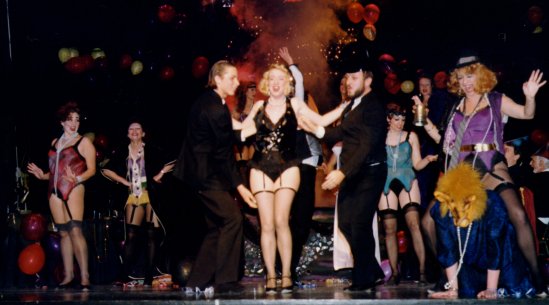
cabaret078.jpg (24688 bytes)

During the production, Scott Roose and I wandered around the backstage area with a video camera interviewing various participants. Mike Broad, I believe, also shot some of this video. I have edited some of the interviews together with clips from the production and posted it to Youtube. [added November 26, 2008]

posted it to Youtube.  [added November 26, 2008]

I had heard once– I can’t remember where– that the “real” Sally Bowles died in a concentration camp. Very poignant. I remember being puzzled by that at first– she wasn’t Jewish– but, in the account I read somewhere, she got into trouble for speaking out against the Nazis.

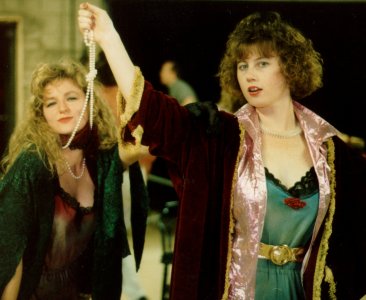
cabaret108.jpg (38360 bytes)

The truth is that “Sally Bowles” subsequently left Germany and moved back to England where she died in 1973, of natural causes. Her real name was Jean Ross. And she really was a lousy singer and actress. Apparently Ross was not very pleased with the transformation into Sally Bowles. And why would she be? It’s not a flattering portrait. At the same time, a certain constituency seems to regard her as a passionate, mischievous, spirited lass, whose only fault was that she loved too well, and often. By most accounts, Jean Ross’ life after Berlin was not very eventful.


cabaret094.jpg (25554 bytes)

Meryl Streep Can’t Sing

There have been shameful moments in Hollywood history this past decade– events and appearances and speeches that made a rational person cringe with revulsion and consider changing the channel to a preacher of faith healer or Fox News or anything… Hugh Grant. Halle Berry’s Oscar speech. Michael Moore chasing an elderly Charlton Heston down the walkway of his home. Chris Rock’s mockery of Jude Law…

And my nomination for the lowest of the low: Meryl Streep “singing” “Winner Takes it All” in Mama Mia. Performed in one take, according to the bedazzled talents behind the camera. And in interview after interview, the actors in the film admit that they never respected Abba back in the 70’s but now that they have been paid, they can see that they really were musical giants– and did you see Meryl nail it in one take? Suddenly, Bjorn Ulvaeus is the Swedish Bob Dylan.

This self-aggrandizing, cloying, critics-be-damned attitude is supposed to be lovable on some deeper level than I can ever imagine, like Sarah Palin’s leadership qualities or the expressions on the faces of Secret Service agents. But what if it is just as it appears to be: a massive, slobbering wet kiss of desperation: no, I don’t have any real talent, but because I am a celebrity, you may stand back astounded at my generosity of spirit, that I would be so silly on purpose. Because it’s just fun.

No it’s not. Real fun is the Beatles’ “Help”, “The Pink Panther”, and Abbie Hoffman threatening to surround the Pentagon with meditating hippies and levitate it (the generals announced that they would stop him). Abbie, not ABBA.

As Dr. Seuss once observed: this “fun” proclaimed by Meryl Streep is the wrong kind of fun. She has confused her own singing with the careful talent that Richard Lester applied to his films, and Peter Sellers to his, … when it is actually the kind of fun you do in your bedroom with your girlfriends during a sleepover.

The first lesson is the hardest: it’s not nearly as amusing for those watching as you think it is.


Abba Babble

Ruby’s Lips and Tinted Hair

“You painted up your lips and rolled and curled your tinted hair”

Ruby, are you contemplating going out somewhere? If you know Kenny Rogers from his pathetic later career as a panderer of faux earnest country cliché– the kind of middling pap that has always given country music a bad name– you might be surprised by a song from his early repertoire, “Ruby, Don’t Take Your Love to Town”. The song was written around 1967 by country singer Mel Tillis who had a serious stutter when he spoke but not when he sang. It was covered by– do you believe this?– Leonard Nimoy, among others, but not successfully until Kenny Rogers and the First Edition took a shot at it in 1969.

I always admire economy in writing– that first line is a marvel. In one stroke, he has set the scene and imputed her motives and honesty– her “tinted” hair. Ruby never speaks in the entire song, never answers the narrator, never even seems to respond to him. Ah the poignant “but it won’t be long, I’ve heard them say, until I’m not around”. Don’t go cheat on me now– wait ’til I’m dead. It will be soon.

But the real marvel of the song is how unselfconscious it is. The narrator is crippled and paralyzed from “that crazy Asian war”. But he is proud to have done his “patriotic” chore. Boy, there is one born every minute, isn’t there? He is no longer “the man I used to be” and acknowledges Ruby’s needs as a woman. Then he says:

And if I could move,
I’d get my gun and put her in the ground

which is about as economical as you can get when describing how you’d like to murder your faithless wife, even if it’s not her fault that you are incapable of giving her love.

In the video I found on Youtube, Kenny Rogers appears to be posturing, making a fetish of restraint there, but the girl with the tambourines is fun to watch. And yes, this is an honest-to-god live performance.

Rogers actually put out a couple of interesting songs late in the 60’s, including the weird “I Just Dropped in to See What Condition my Condition was in”, but he was bit too old for psychedelia, and his instincts were not with rock’n’roll. He shortly split from “The First Edition” and went country. He discovered it was more profitable to produce inane, predictable ballads like “You Picked a Fine Time to Leave me Lucille” and “The Gambler”.

The question about Kenny Rogers moves from, “why did he go bad” to “why was he ever any good?” The answer: he was more influenced by the counter-culture in his early career. And he had a cool chick with tambourines in the band.

What does that last line mean? “For God’s sake, turn around.” A last desperate plea for Ruby to come back. Or does it really mean, “don’t look at me”?


Kenny Rogers is the evil twin of Kris Kristofferson.

Music

Wikipedia on This Song

When Kenny Rogers performed the song in the 1990’s and later, audiences joined in, clapping and laughing, and wailing along-“Rubeeeeeee….. don’t take your love to town!” and you knew that the women in their bulging pastel pant suits were all thinking of waiting for their broken hubbies to go to bed so they see if there was any action in the lounge… Are we all killers? This is a song about a man who was paralyzed in a war wanting to kill his unfaithful wife. A little jarring then, isn’t it, to learn that Tillis was inspired to write this song by a real-life couple known to his family back in the 1950’s, a paralyzed World War II vet, whose wife did indeed take her love to town.

And he did indeed get his gun and “put her in the ground”. Hilarious.


Kenny Rogers can also be glimpsed at the beginning of the Poppy Family’s “Where Evil Grows”, on Youtube. He briefly hosted a syndicated TV variety show in the early 1970’s. It’s a weird video. Watch Susan Jacks’ face– it looks a lot to me like the dancing bit was someone else’s idea. She seems to periodically remember to move her hips. And that is quite an outfit. More on Susan Jacks.

In 1986, the combined readership of USA Today and People magazine– get this– picked Kenny Rogers as the favorite singer of all time. I repeat: the favorite singer of all time. And that poll, my friends, should go down in history as the greatest collective act of aesthetic absurdity of all time.

Does this surprise you: his fifth wife gave birth to twins when he was 65.

In 1994, Rogers couldn’t resist the temptation to insult every jazz singer in the country by trying to pass himself off as one with an album of jazz standards called “Timepiece”.  God help us.

Nick Cave’s Towering Tower of Song

Unfortunately, I can’t trace the origin of this story, but here it is: Nick Cave was asked to do a cut for the 1991 Cohen Tribute album “I’m Your Fan”. But he didn’t want to. But he loved Leonard Cohen, so he had to.

This is not the same as the more mainstream tribute 1995 album “Tower of Song”, which featured some regrettable and embarrassing choices (Don Henley singing “Everybody Knows”, Elton John butchering “I’m Your Man”, Billy Joel singing “Light as a Breeze”. Now that I mention it– how can any album with a Don Henley cut on it be a tribute to anything?)

Where was I? Oh yes– Nick Cave did not like tribute albums. He thought they were tacky and tasteless and, you know, Don Henleyesque. But he loved Leonard Cohen. So he showed up at the studio and then took his band to a bar across the street and got everybody totally smashed and then came back into the studio and worked up “Tower of Song”. Apparently, he did several versions and the engineers later patched them altogether.

I was not impressed, the first time I heard it. Or the second or third. It was there in the middle of an album that I enjoyed very much, otherwise. And then a funny thing happened. The first I remember of it was this: I began listening for the belch. Yes, about 2/3’s of the way through Nick Cave’s cover of “Tower Song”, he lets go one very loud, ornery, rude belch. Then I began to listen more carefully to this whacked out pastiche of bizarre interpretations– one minute he’s Elvis, the next he’s Hank Williams, then Heavy Metal, then Lou Reed…

It’s really quite charming. It’s simultaneously off-putting and embracing, passionate and excoriating. It’s a throw-back to Cohen himself, in his old “Dress Rehearsal Rag” days. It’s a paean to pure unbridled passion and spirit and despair, and a great party song.


“I’m Your Fan” also features the definitive cover of “Hallelujah”, for my money, but if you liked Rufus Wainwright’s or K.D. Lang’s versions, you might not like this one.

It’s a quiet, humble little performance by John Cale accompanying himself on the piano. Why oh why oh why do so many so-called artists approach this song with the attitude of, “well, let’s see how many people I can blow away with my soaring rendition of this esteemed song!”

It’s not that kind of song. It’s a song that is demeaned and embarrassed by a soaring, virtuoso performance. “It’s not a cry you can hear at night/ it’s not somebody who’s seen the light/ it’s a cold and it’s a broken Hallelujah”.

Please, have some respect for the integrity of the song and stuff your fucking ego into the toilet.


Nick Cave and his band “The Bad Seeds” appeared in “Wings of Desire”, an exquisitely beautiful German film by Wim Wenders.

Nick Cave also created and performed one of the most revved up and demented– and hilarious– criminal mind songs ever called “The Curse of Millhaven”, about a young girl that goes on a murder spree, which features these fabulous lines:

Now I got shrinks that will not rest
with their endless Rorschach tests
I keep telling them
I think they’re out to get me
They ask me if I feel remorse
and I answer, “Why of course!
There is so much more
I could have done
if they’d let me!”
So it’s Rorschach and Prozac
and everything is groovy

Leonard Cohen Live in Kitchener

I remember fondly an era in which I was the only person I knew who was a fan of Leonard Cohen. When I was in college, I personally introduced many of my friends to the dark, brooding pleasures of “Suzanne”, “The Stranger Song”, “Famous Blue Raincoat”, and “Take This Longing”.

Most, quite sensibly, rejected him: “music to slit your wrists by”.

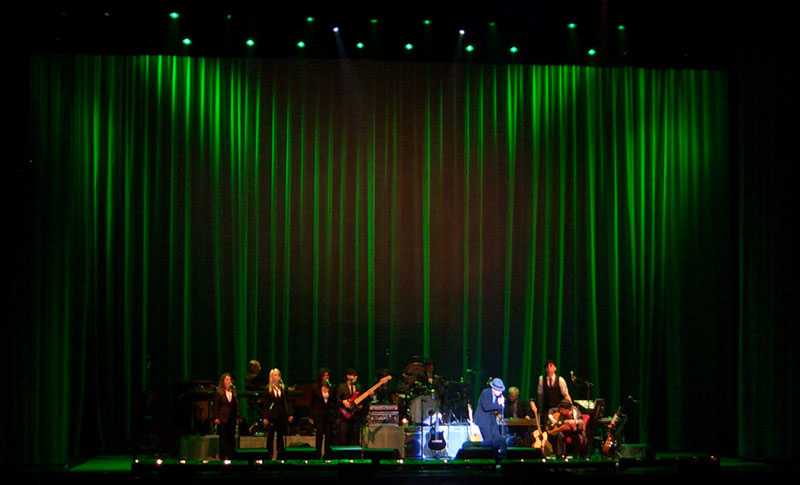
On June 2, 2008, I joined more than 2000 people paying over $100 a seat in Centre in the Square in Kitchener to see “the grocer of despair” on his latest (and last, perhaps) tour. With the exception of “Suzanne”, he didn’t do any of my six or seven favorite songs, which are, without exception, products of his early career, before he became the bard of rueful despair, rather than the bard of exquisite, flaming rage and desire… and despair.

Nothing in this concert suggested the searing heat and mystical vulgarity of his brilliant novel “Beautiful Losers” or the searing heat and mystical vulgarity of “Songs of Love and Hate”.

I have a couple of favorites from his later albums– “First We Take Manhattan” and “Hallelujah” of course. His backup singers, the Webb Sisters, performed a marvelous version of “If it be Your Will”. The band was smoking on “Who By Fire”, the best performance of the night. “I’m Your Man” was fine. But I longed to hear the Cohen I first came to love, and his explorations of the dark links between sensuality and mysticism and despair and grace.

Well, what kind of a sick person “enjoys” listening to this:

There is no comfort in the covens of the witch
Some very clever doctor went and sterilized the bitch
And the only man of energy, yes the revolution’s pride
He trained a hundred women just to kill an unborn child

(Leonard Cohen, “Diamonds in the Mine” from “Songs of Love and Hate”)

Or

And when we fell together all our flesh was like a veil
that I had to draw aside to see
the serpent eat its tail.

And the answer is:  me.

(Leonard Cohen, “Last Year’s Man” from “Songs of Love and Hate”)

Would Mr. Cohen be embarrassed to sing those lines today?

He now sings “give crack and careless sex” instead of “give me crack and anal sex”, so, yes, I think he is.  And to sing them with passion?

It is more embarrassing to hear him wail, unconvincingly, “there is a crack in everything/ that’s how the light gets in”.


Songs I wish he had skipped:

  • Democracy
  • I Tried to Leave You (the joke, of performing this as an encore, is worn out)
  • Anthem (Cohen’s Hallmark Card song; yes, there is a crack in everything, but sometimes there is a light in everything and a crack gets in.)
  • A Thousand Kisses Deep
  • Bird on the Wire (I know this is a fan favorite but even Joe Cocker can’t make it interesting musically).

Songs I wish he had performed

Famous Blue Raincoat
Take This Longing
Chelsea Hotel
Last Year’s Man
Stranger Song
Memories